
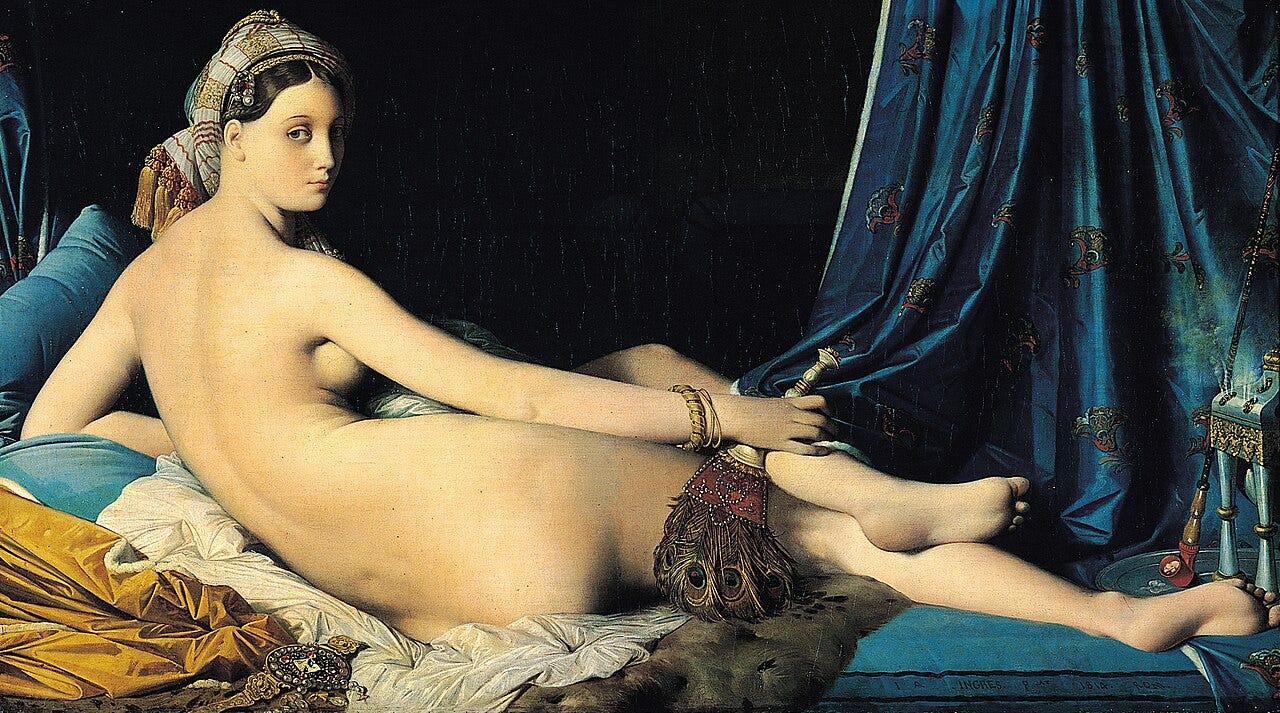
Jean Auguste Dominique Ingres was the great defender of line in French painting, the pupil of David who worshipped drawing and gave his Grande Odalisque a back with a few too many vertebrae.
He won every prize, yet slowly lost the century to Delacroix. Born in Montauban in 1780 and trained by David, he spent eighteen years in Italy, ran the French Academy in Rome, and was still finishing nudes in his eighties.
For Ingres a perfect line was close to a moral law. That faith made him the most polished painter of his century and, to his rivals, the most stubborn.
More incredible painter stories
If Ingres pulled you in, you will love these too:


Ingres at a glance
1780. Born in Montauban, handed a pencil by his artisan father.
1801. Won the Prix de Rome, then waited five years for the state to pay for the trip.
1814. The Grande Odalisque, mocked for its extra vertebrae.
1834. Named director of the French Academy in Rome.
1867. Died in Paris at 86. His bequest built the Musée Ingres in Montauban.
Line above all
Trained under Jacques Louis David, Ingres carried Neoclassicism into a new century. He believed drawing mattered more than color, that contour was everything.
His surfaces are cool and enamel smooth, his outlines pure, his finish so perfect the brushwork seems to vanish.
The Grande Odalisque
His most famous nude is the Grande Odalisque, a reclining woman in an imagined harem, an exercise in cool Orientalism Critics counted the vertebrae and complained her back was too long.
It was no mistake. Ingres stretched her body for the sake of the line, choosing beauty over anatomy on purpose.
Ingres against Delacroix
The art world of the day split into two camps. Ingres led the party of line and the past; Delacroix led the party of color and feeling.
They sniped at each other for decades. Ingres collected the official honors, yet it was the Romantic side that opened the road to modern art.
To me that is the quiet irony of Ingres: he won every prize in the room and still lost the century to the man he could not stand, Delacroix.
The violin of Ingres
Ingres was a serious amateur violinist who loved music almost as much as paint. His habit gave the French language a phrase that survives today: a violon d'Ingres means a passion or talent you pursue alongside your real work, a second calling.
Few painters have ever lent their name to an everyday expression.
Portraits and a bath at eighty
Ingres was also one of the finest portrait painters who ever lived, catching silk, jewels and sharp personalities with the same exact line.
Even in his eighties he kept working, finishing the crowded, sensual Turkish Bath, a circular canvas packed with nudes, proof that the cold master ran hotter than he let on.
From Montauban to Rome
Ingres was born in Montauban in 1780 and trained in the Paris studio of Jacques Louis David. He won the Prix de Rome in 1801 and left for Italy in 1806, where he stayed eighteen years, first in Rome, then Florence.
He returned to Paris in 1824 as a celebrated history painter, later ran the French Academy in Rome, and worked almost to the end. He died in Paris in 1867, at 86.
The Louvre keeps his odalisques
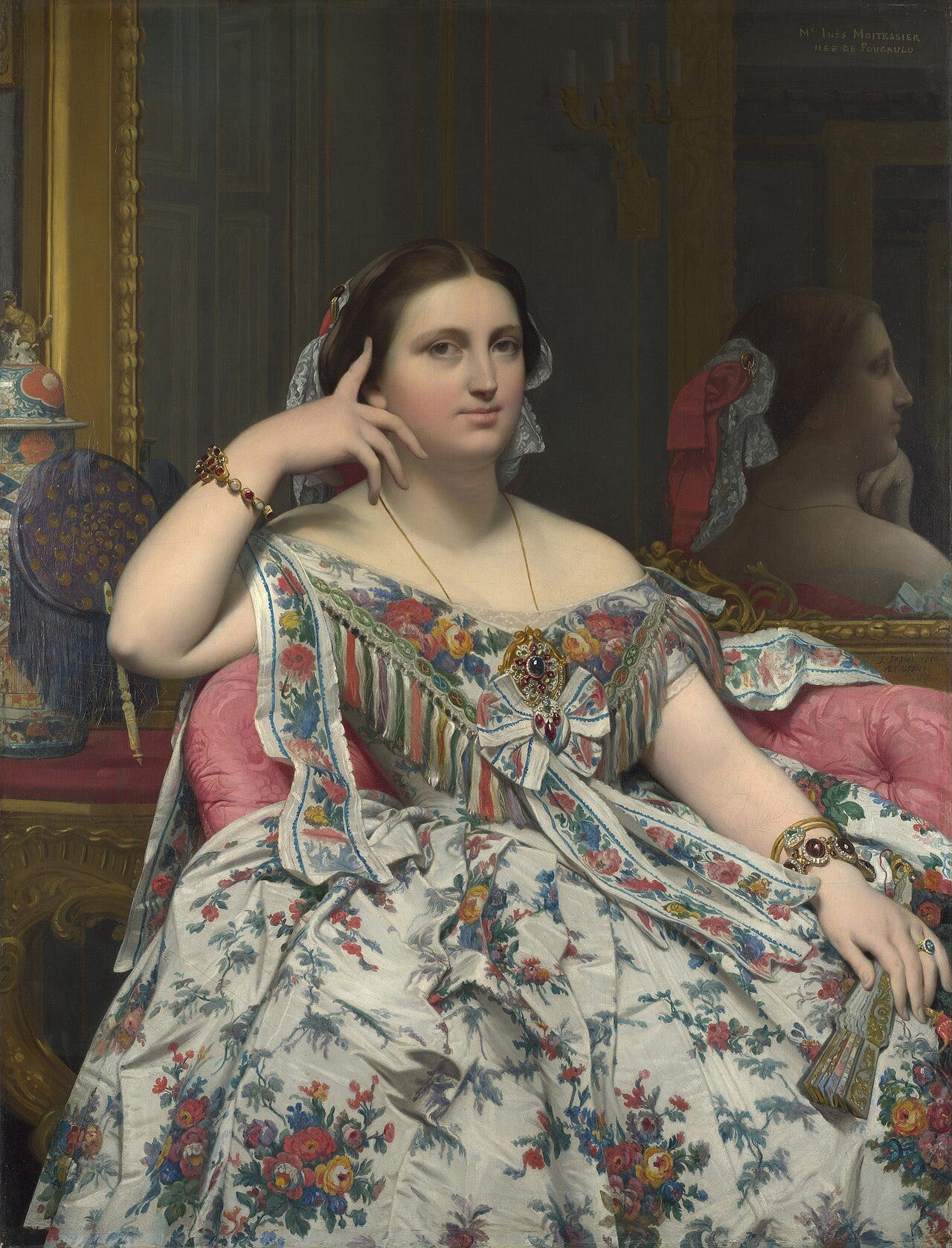
The Louvre in Paris holds the Grande Odalisque and the late Turkish Bath. In London, the National Gallery has Madame Moitessier, the portrait he labored over for twelve years before signing it in 1856.
A father who handed him a pencil
Jean Auguste Dominique Ingres was born in Montauban, in southern France, on 29 August 1780. His father, Joseph Ingres, was a decorative painter and sculptor who also worked as a musician.
Joseph spotted the boy's gift early and trained him himself, in drawing and in music. That double schooling stuck for life. Around the age of eleven Ingres was sent to the academy in Toulouse to study drawing and painting properly.
He was a provincial boy with a steady hand and a father who believed in him. Everything that followed, the outline, the discipline, the ambition, started at that first table in Montauban.
From David's studio to a stalled prize
In 1797 Ingres moved to Paris and entered the studio of Jacques Louis David, the most powerful painter in France and the champion of Neoclassical art.
There he learned the creed of clear outline and noble subjects drawn from antiquity. He absorbed the rules, then began quietly bending them toward the pure contour that became his own.
In 1801 he won the Prix de Rome, the top prize for a young French painter. The award promised a funded stay in Rome and should have sent him at once.
It did not. Napoleon's France was at war and the treasury was empty, so the trip kept slipping. Ingres waited five years and finally reached Rome in 1806, at twenty five.
Booed before he was admired
Rome set Ingres free, but Paris was slow to follow. From Italy he sent back canvases to prove his progress. The Valpincon Bather, a nude seen from behind, arrived in 1808. Jupiter and Thetis, a large mythological scene, followed in 1811.
Today both are studied as high points of his early work. At the time, French critics were cool or openly hostile. They found his figures strange, his proportions off, his style oddly archaic, closer to early Renaissance painting than to fashionable taste.
Ingres took the rejection hard and remembered it for years. His most personal choices, the long backs, the smooth surfaces, the flattened space, tended to be mocked first and praised much later.
Eighteen years in Italy on tourists' portraits
Ingres stayed in Italy for eighteen years, far longer than the scholarship intended. He lived in Rome from 1806 to 1820, then moved to Florence, where he remained until 1824.
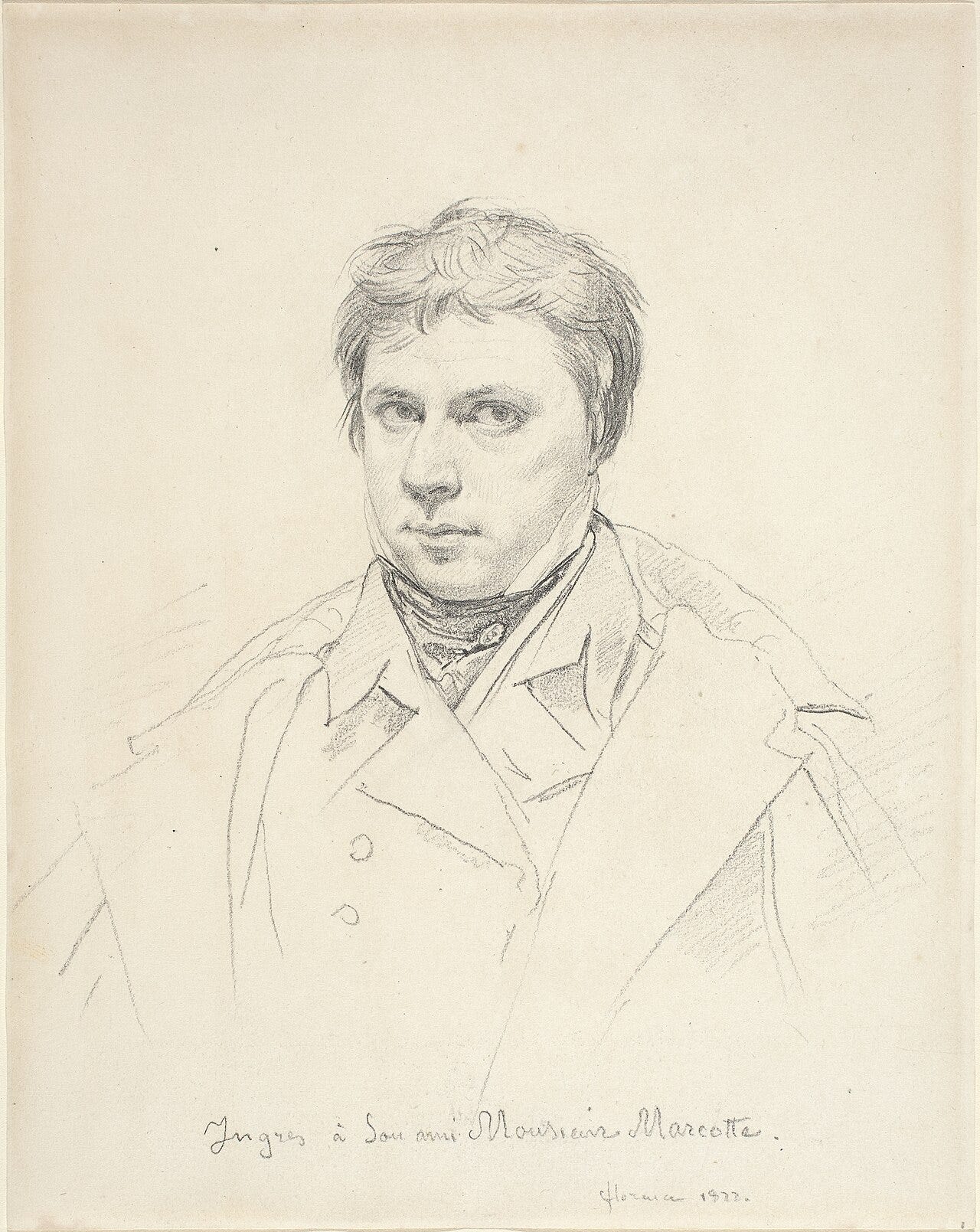
Grand history commissions, the work he wanted most, came only rarely. To pay the rent he drew people. Ingres produced small, exact pencil portraits of travelers, officials and English visitors passing through Italy.
Each is a marvel of clean line and likeness, often finished in a single sitting.
He treated them as a chore, a way to earn bread while he waited for something loftier. History reversed his judgment. Those drawings now rank among the finest portrait work of the nineteenth century, and they carried him through his leanest years abroad.
The canvas that turned the tide
The turning point came in 1824. Ingres sent a large religious painting, The Vow of Louis XIII, to the Paris Salon. It had been commissioned for the cathedral of his home town, Montauban.
This time the crowd and the critics were on his side. The picture, with its calm nod to Raphael, was a clear success. After nearly a quarter century of struggle, Ingres was suddenly the man of the hour.
He returned to settle in Paris and opened a busy teaching studio.
Soon afterward he was elected to the Academie des Beaux Arts and honored by the state. From that Salon on, he was no longer the odd provincial. He was the standard bearer of French Neoclassical painting, the safe choice the establishment trusted.
Director in Rome, keeper of the classical line
By the late 1820s Ingres was an institution. In 1827 he unveiled The Apotheosis of Homer, a large ceiling painting for the Louvre.
It gathered the great artists and writers of history around the poet Homer, a public statement of his faith in classical order.
In 1834 he was named director of the French Academy in Rome. He ran the Villa Medici, the Academy's home, from 1835 to 1841. There he shaped a generation of French students in the classical creed.
By now Ingres led the Neoclassical camp, the party of line and restraint. For his followers he was the guardian of drawing itself, the man who kept the old standards alive against every new fashion.
The vertebrae and the boneless arm
Ingres cared more about a beautiful line than about correct anatomy, and he proved it again and again. His Grande Odalisque of 1814 has a back so long that viewers have joked she carries extra vertebrae.
Her spine curves well past what a real body allows.
When the painting was shown at the Salon of 1819, critics ridiculed exactly these distortions. He did the same in portraits. In Madame Moitessier, the sitter's right hand and arm look almost boneless, bent into a soft, impossible curve against her face.
Ingres knew the anatomy. He broke it on purpose, stretching and smoothing bodies to serve the flow of his outline. For him the elegant curve won every argument with the skeleton.
The women he claimed not to want to paint
Ingres said he despised portrait commissions. He called history painting the only serious art and treated sitters as a distraction from it.
The record tells a different story. Portraits paid his bills for decades, and they are now among his most admired works. Look at the women he painted.
Madame Devaucay, in 1807, sits poised and watchful. The Comtesse d'Haussonville, finished in 1845 and now in the Frick Collection in New York, leans on a mantel with quiet self possession.
Madame Moitessier, completed in 1856 after twelve years of work, is pure Second Empire luxury.
He resented the job and was better at it than almost anyone alive. The pictures he thought beneath him became the reason many people love him today.
Two wives, and a last gift to Montauban

Ingres married twice. In 1813, in Rome, he wed Madeleine Chapelle, a match arranged through friends and sealed by letters before the couple had even met.
The marriage was happy, and her death in 1849 left him devastated. In 1852 he married again, to Delphine Ramel.
He kept working into extreme old age; his last great canvas is signed with an inscription proudly noting his age, eighty two.
Ingres died in Paris on 14 January 1867, at eighty six. He left the contents of his studio to Montauban, the town where he was born.
The gift included about four thousand drawings, several of his own paintings, works from his private collection and his reference library.
Montauban built its Ingres museum around it.
More secrets to unlock


The Ingres questions that keep coming up
Who was Ingres? A French Neoclassical painter, the great champion of line.
When was he born? In Montauban, France, in 1780.
When did he die? In Paris, in 1867.
What is he famous for? The Grande Odalisque and his portraits.
What does violon d'Ingres mean? A hobby or second talent, named after his love of the violin.
Where can I see his work? The Louvre in Paris and the Musee Ingres in Montauban.
Did Ingres win the Prix de Rome but wait years to reach Rome? Yes. He won the Prix de Rome in 1801, but the French state, drained by Napoleon's wars, could not fund the scholarship. He waited five years, living on portrait commissions, and only reached Rome in 1806.
Did Ingres hate painting portraits? He said he did. Ingres called history painting the highest art and treated portrait commissions as a lesser chore. Yet portraits paid his bills for decades and rank today among his finest and best loved works, from Madame Devaucay to the Comtesse d'Haussonville.
The phrase violon d'Ingres outlived most of his paintings in everyday speech, and the artist Man Ray even borrowed it for a famous photograph.
The Grande Odalisque, with her impossible spine, still draws crowds at the Louvre, proof that one beautiful line can beat anatomy every time.