


170 000+ readers. Learn art the fun way.
This is a preview. Paid subscribers get the full story.
You’ll also get:
10 new stories every month
The full archive (130+ Art stories)
Your personal art guide. Comment, ask questions, DM me anytime
iPhone user? Subscribe at coolstoriesabout.art, not via the app. Apple adds 30% to the price.
Paris, spring 1868. A gallery on the first floor of the Louvre.
Two sisters paint side by side, standing before a large Rubens. For weeks they have been copying one of the huge red and gold canvases of the Marie de Medici cycle. Edma, the elder, is 28. Berthe, the younger, is 27.
For young women of their world, copying at the Louvre is the only school allowed. They are not permitted to study the nude in a men’s studio. So they come here, with a chaperone, set up their easel beneath the old masters, and learn by copying them, stroke after stroke.
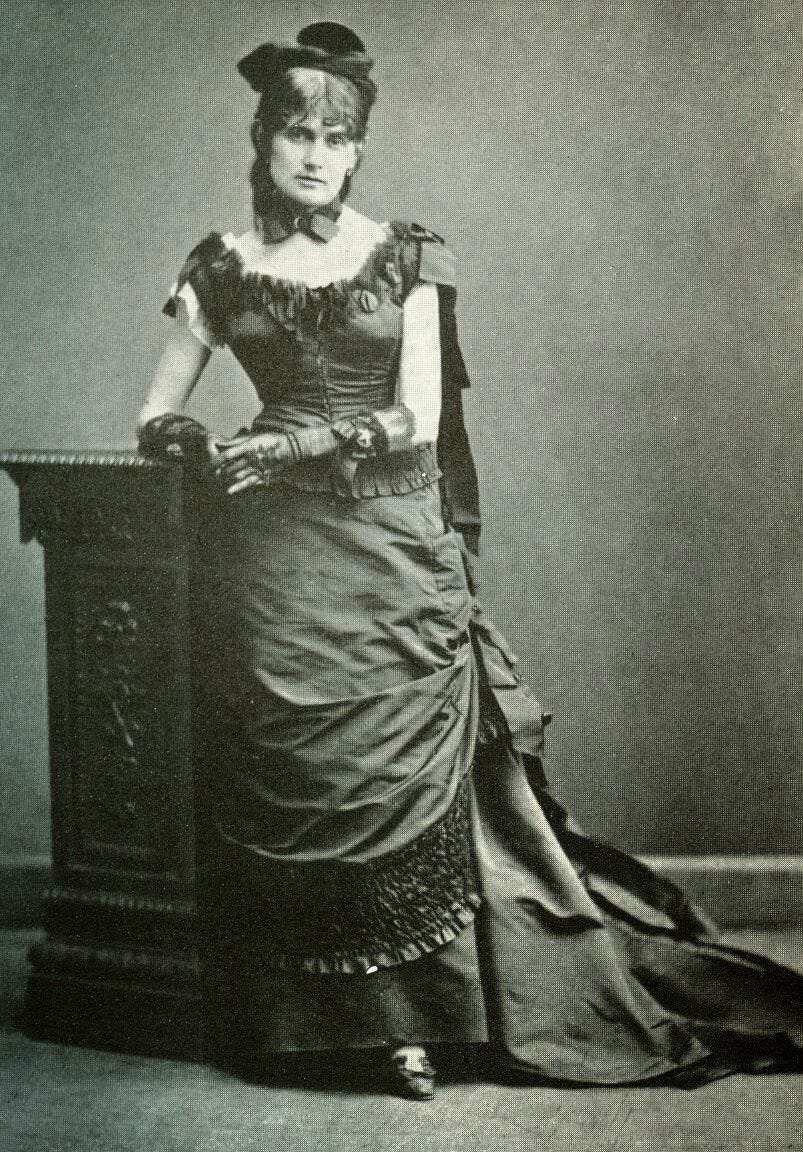
Their father was a prefect, a senior state official. The family keeps a salon in Passy. People come to call, play the piano, talk painting as a polite accomplishment for a well bred young lady. A girl is allowed to paint. She is not allowed to make a profession of it.
That day, a man crosses the gallery. Henri Fantin Latour, a painter, a copyist like them, a friend of the family for years. Someone is with him.
The man is 36. Fair beard, light gloves, the look of a boulevard dandy.
All of Paris knows his name, and half of Paris despises him. Five years earlier, his Luncheon on the Grass caused a scandal. Two years after that, his Olympia set off an uproar at the Salon, the official state exhibition, the one that makes and breaks painters.
His name is Édouard Manet.
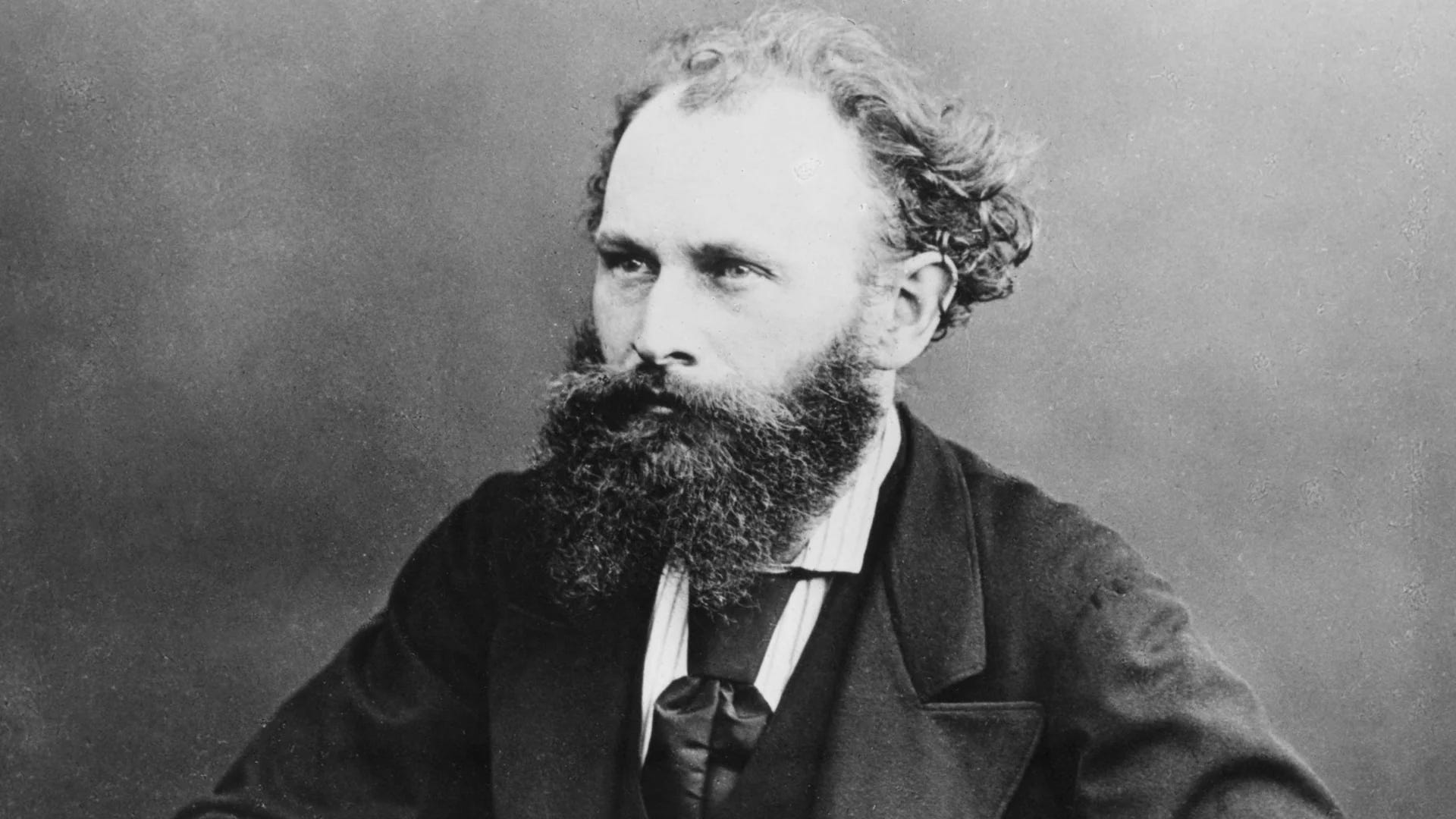
Fantin Latour makes the introductions. Berthe looks up from her copy.
Manet is married. Since 1863 he has lived with Suzanne Leenhoff, a Dutch pianist who once gave the family piano lessons. Nothing in his life leaves room for another woman.
And yet, from that afternoon on, he will never stop painting her.
The First Face
The two families grow close quickly. Each has its day for receiving guests, as good society requires: Marie Cornélie, Berthe’s mother, receives on Tuesdays, Manet’s mother on Thursdays. They dine together, pay visits, talk about the paintings in progress.
Berthe begins to sit for him. Never alone. Her mother sits in a corner of the studio, or a sister, or a friend. A young woman of her standing is never left alone with a man. That is the rule, and no one breaks it.
Marie Cornélie watches her daughter. She sees her face change when Manet walks into a room. She confides it to her letters, with the worry of a mother watching her child grow attached to a married man, unable to do a thing about it.
Manet, for his part, speaks of Berthe lightly. A month after they meet, on 26 August 1868, he writes to Fantin Latour.
“The Morisot sisters are charming. A pity they are not men. As women, though, they could serve the cause of painting by each marrying an academician and sowing discord in the camp of those old dotards.”
An academician is one of those official painters who rule the Salon, the very men the young, like Manet, hold in contempt.
In the spring of 1869, Paris finally sees her face.
Manet shows her at the Salon. The painting is called The Balcony.
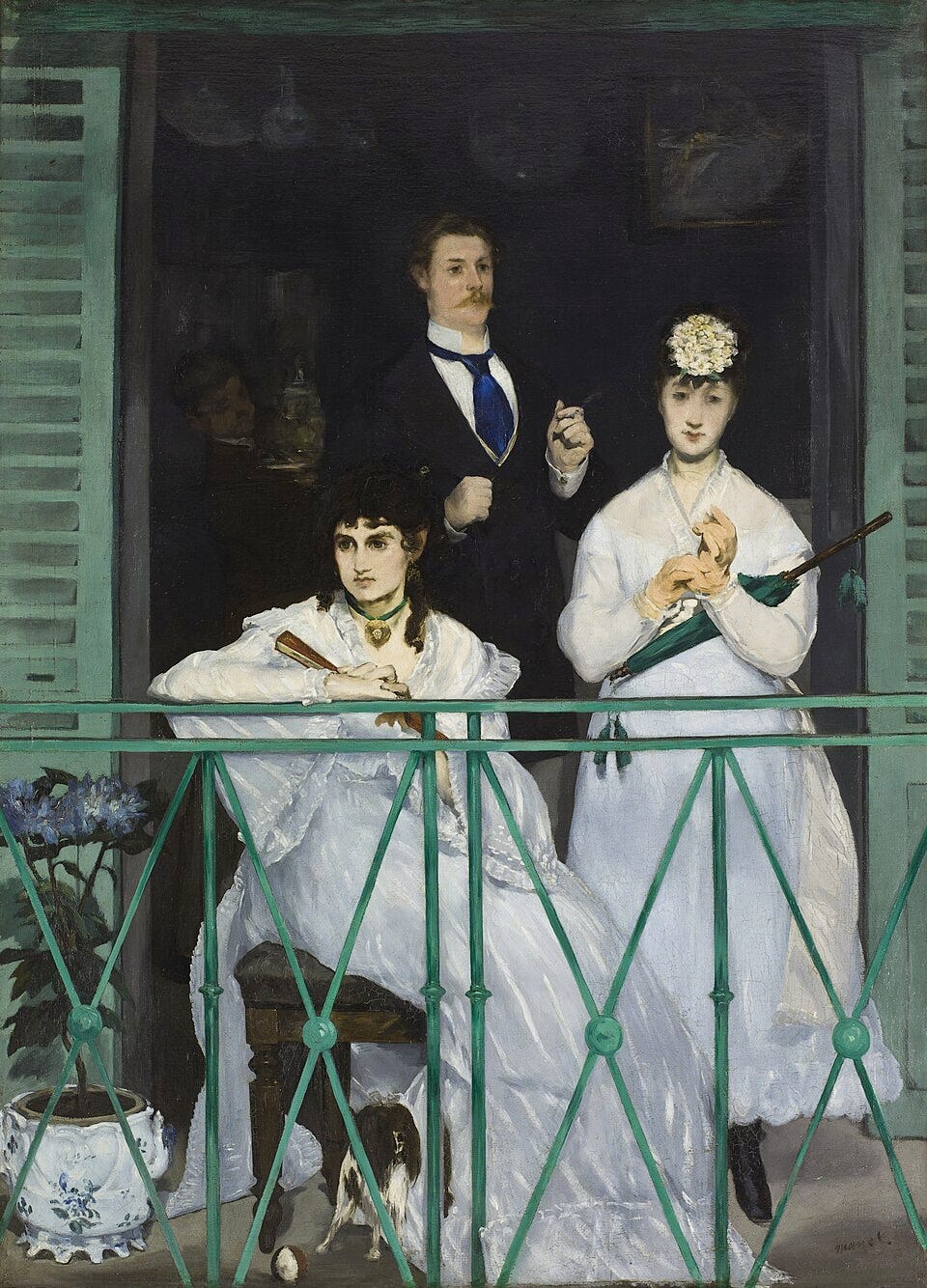
Three figures behind a bright green railing. At the back, standing, a violinist and a painter. In front, seated, a woman in a white dress, a fan in her hand. She looks straight ahead, her eyes very dark, her face closed.
It is Berthe. The crowd sees her for the first time.
They find her strange, magnetic, almost unsettling. The words femme fatale go around the room. Berthe herself thinks she looks “more strange than ugly.”
What no one knows is the risk she is taking. Three years earlier, the woman Manet had painted the same way was named Victorine Meurent, the nude model for Olympia, the courtesan who stared Paris in the face.
To give the features of a young woman of the upper middle class to that kind of painting is to throw her reputation to the whole city.
Berthe comes back to sit for him. Again, and again.
The Studio
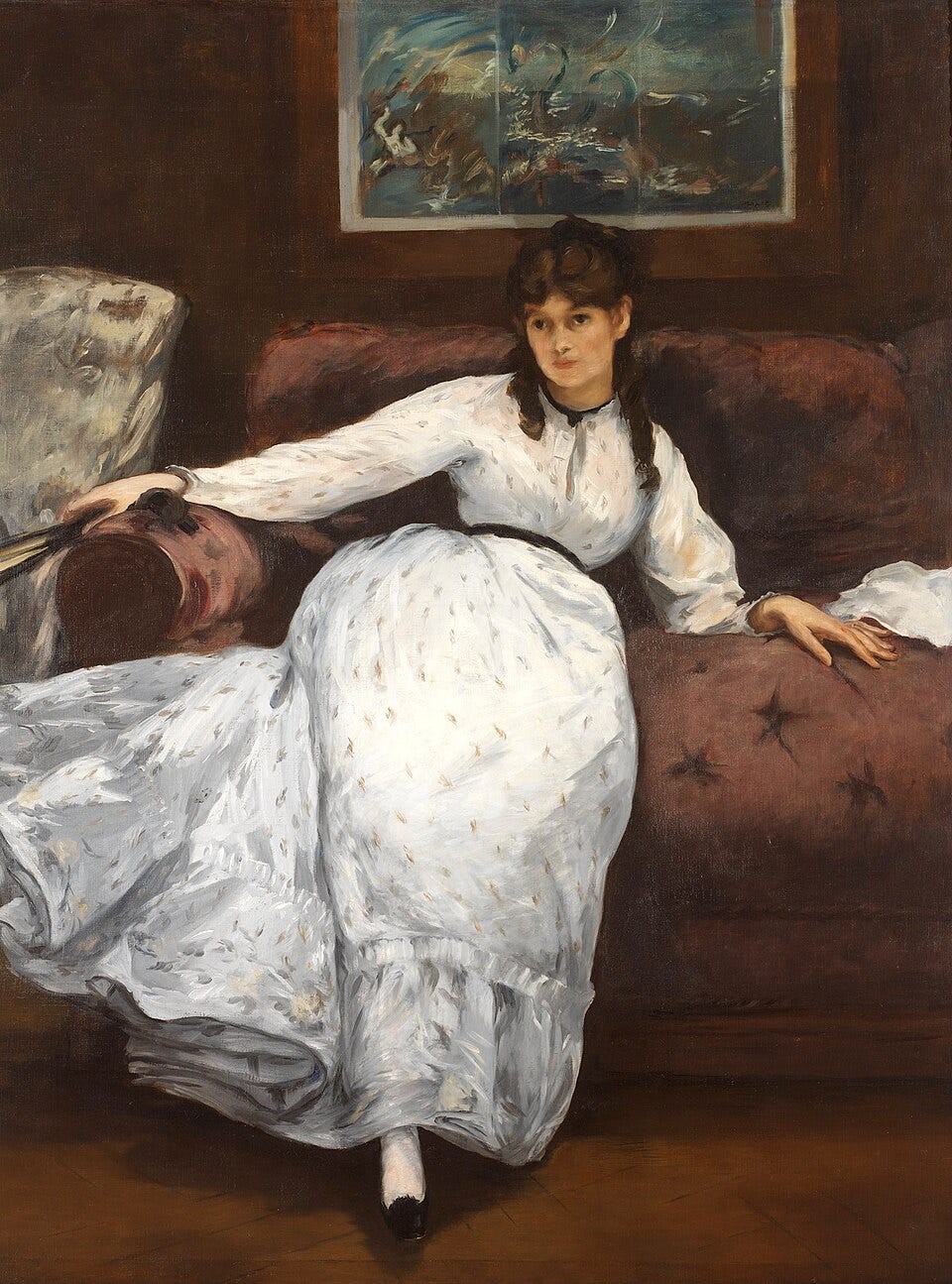
The visits become a habit. Berthe goes up to the studio, sits, leaves. Manet paints her in every pose.
Repose. She lies on a sofa, in a long white dress, abandoned in a way no woman of her standing shows herself before a man who is not her own. Above her head, Manet has hung a Japanese print: a raging sea, a wave rearing up. Below, the calm of a body at rest. Above, the storm.
He paints her with a fan, with a muff, in profile, her face half hidden by a black veil. Always under the eye of the chaperone.
And always the same thing: he never paints her as a painter. Never a brush in her hand, never an easel. He paints her as a woman, never as an artist.
The influence, though, does not run one way. It is Berthe who pushes him to lighten his palette and to go out and paint in the open air. The master learns from his model.
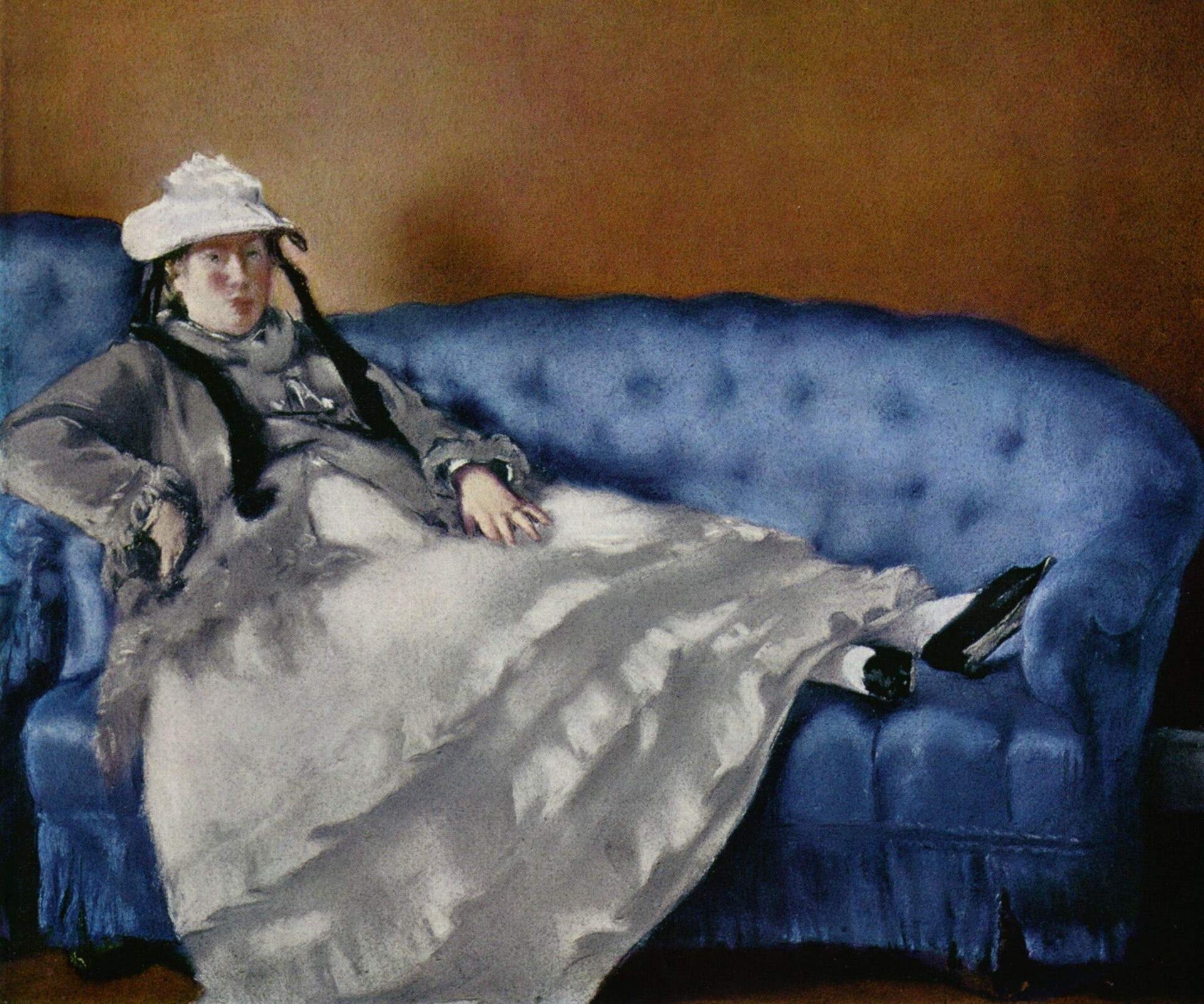
At the same time, he paints his wife too. Suzanne, seated at the piano or in an armchair, her face calm, her hands folded. Quiet, well behaved portraits, with none of the charge he brings to Berthe. What he saves for his model, he does not give to his wife.
He also takes on a pupil.
She is 20, her name is Eva Gonzalès, she is the daughter of a fashionable novelist. Manet sets her up in his studio and paints her, standing at her canvas, brush raised, hard at work. Exactly what he never grants Berthe.
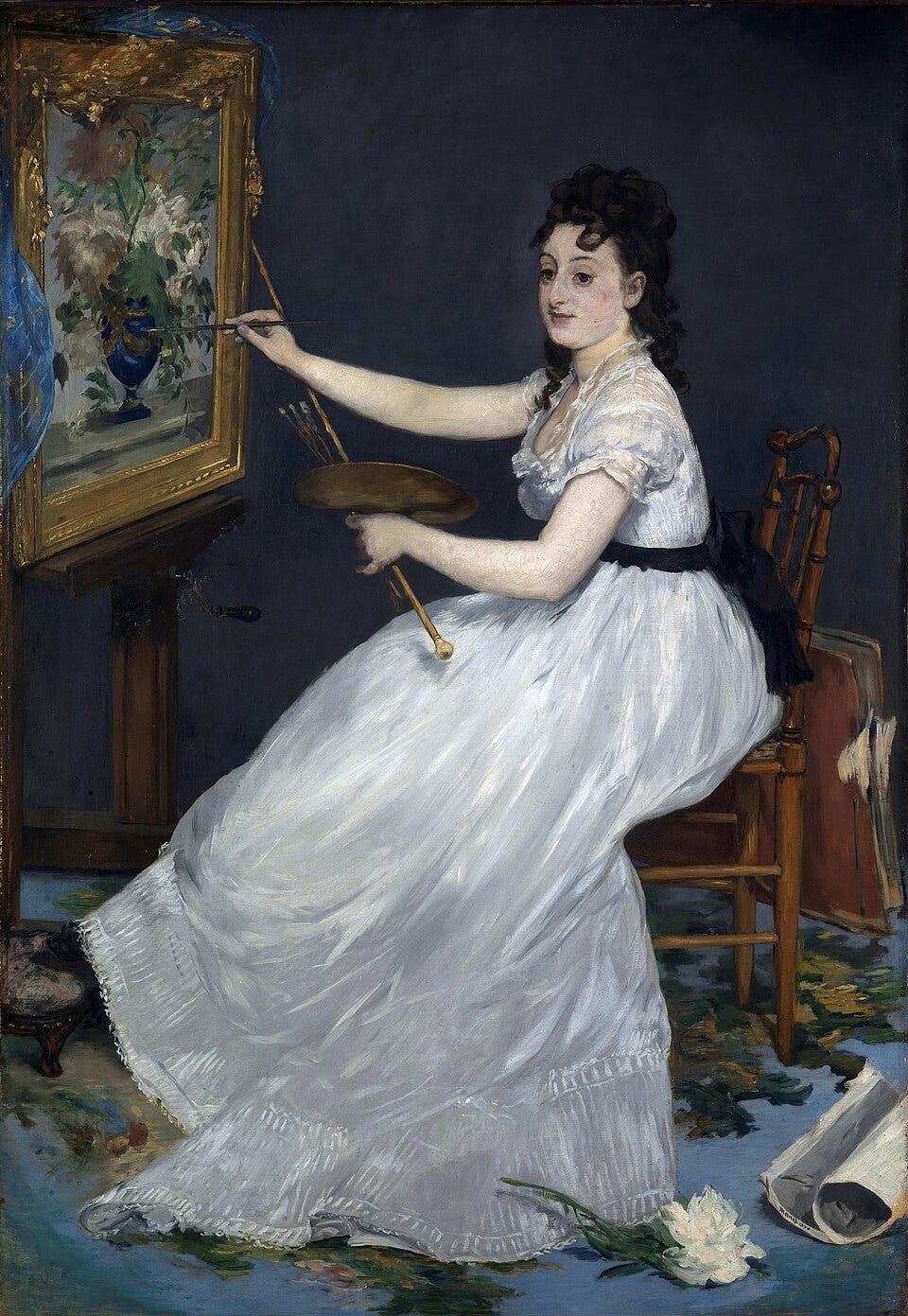
Berthe cannot bear it.
She writes everything to her sister Edma, married not long before, gone to live in the provinces, and who has put away her brushes for good. From a distance, Edma has become her confidante, the one to whom she admits what she would tell no one else.
In these letters, Berthe watches Eva like a rival. She relishes the days when Manet gets nowhere with her, when he scrapes off each evening the portrait he keeps starting over. She fumes that he throws “that eternal Mademoiselle Gonzalès” in her face as a model of seriousness.
No one gets that jealous over a mere colleague.
One spring day in 1870, a scene says it all.
Berthe has just finished a large painting for the Salon, a portrait of her mother and her sister Edma, then pregnant. The evening before the works go in, unsure of herself, she asks Manet to come and take a look.
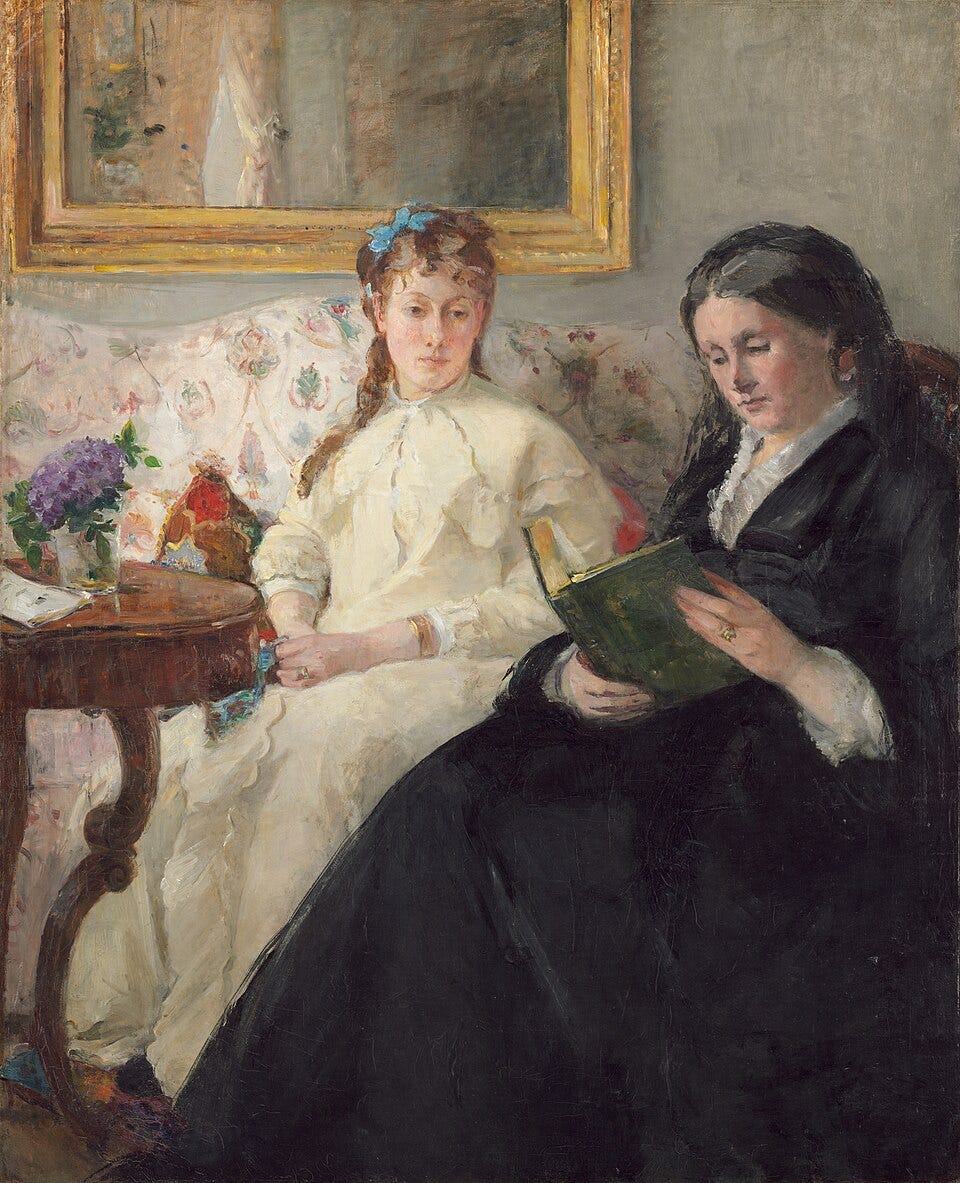
He looks. Then he takes Berthe’s brush, and her palette.
He retouches the skirt. Then the bodice. Then the head. Then the background. For four hours, in front of a frozen Berthe, he repaints the figure of the mother entirely, unable to stop.
She writes to Edma that there is no holding him back, that he moves from the petticoat to the bodice, from the bodice to the head, and that she watches without daring a word.
The painting leaves for the Salon the next day, half painted by him. Berthe says she would rather be at the bottom of the Seine than see it on the wall.
Two years later, in 1872, Manet paints the most intense portrait of them all.
Berthe in black, dress and hat, her face turned to the front. Her eyes are green. He paints them deep black. And at the neckline of her bodice, almost invisible, he sets a small bunch of violets.
No one, then, gives those flowers a second look.
Keep learning art the fun way


1874
The year 1874 opens with a death. In January, Berthe’s father dies.
She is 33, and still no husband. In her world, at that age, it is almost a failing. A woman who paints, who turns down matches, who will not settle down, becomes the worry at every dinner table. Her mother presses her, harder and harder.
In the spring, Berthe does the opposite of what is expected of her.
She hangs her paintings at the first Impressionist exhibition, in the former studios of the photographer Nadar, on the Boulevard des Capucines.
The only woman in the group to show under her own name. An act of independence all the sharper because Édouard Manet refuses to take part, and even tries to talk her out of it. Berthe’s old teacher, Joseph Guichard, writes to her mother, alarmed: she must break with this school that will be the ruin of her.
Everything pushes her toward a marriage that would settle her for good.
And it is that very year that Manet paints his last portrait of her.
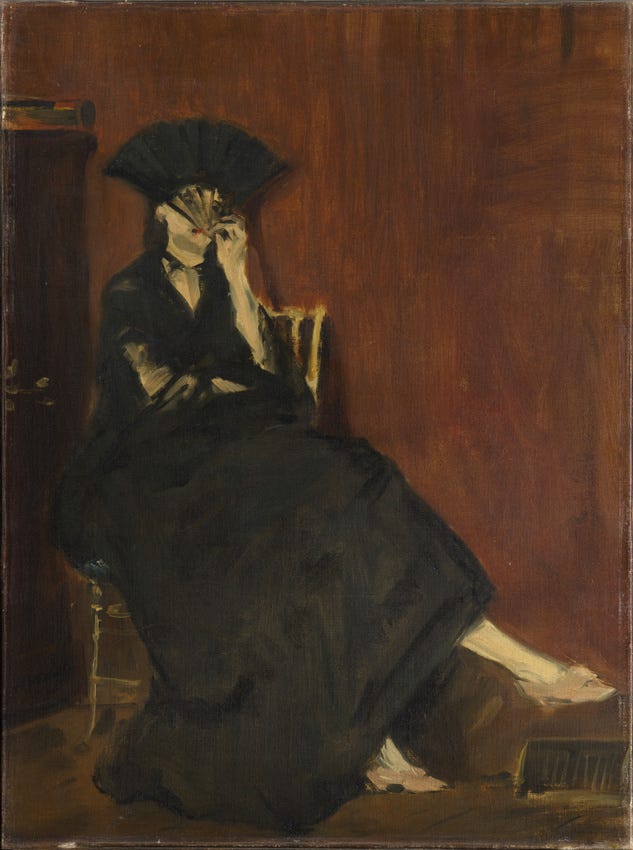
Berthe with a Fan. She is in mourning for her father, all in black, a velvet ribbon at her throat, a fan in her hand. On that hand, an engagement ring, clearly visible.
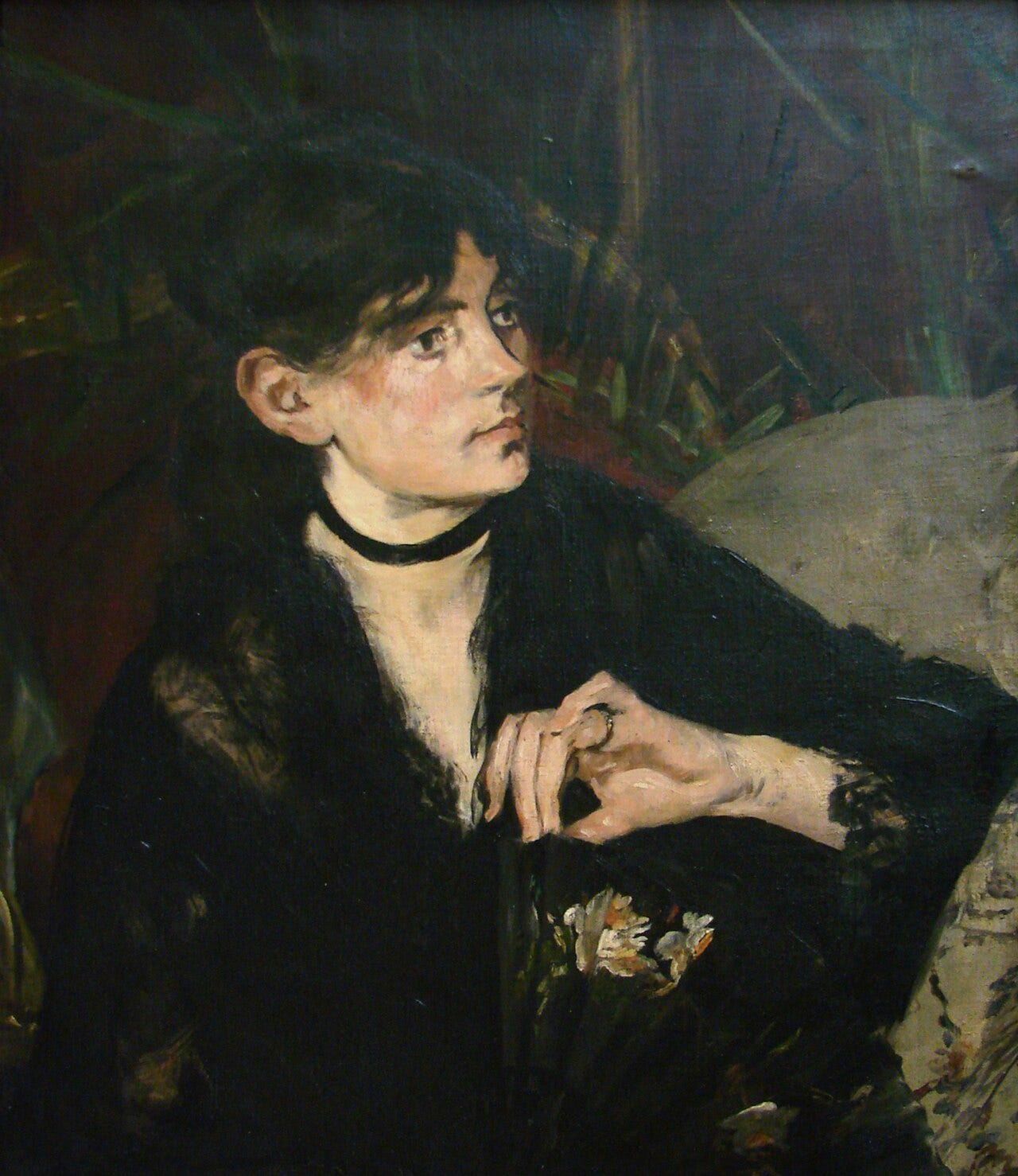
For six years, almost every time, Berthe’s eyes had sought the painter. This time, they slide to the side. She no longer looks at him.
After this canvas, he will never paint her again.
A few weeks later, on 22 December 1874, Berthe Morisot marries.
And the name of the man she marries casts the previous six years in a sudden new light.