
Hans Memling was the calm master of Bruges, the most successful Northern painter of the late 1400s. His serene Madonnas, jewel like religious panels and quiet portraits glow with the patience of the early Netherlandish tradition.
He made stillness feel like grace, and grew rich doing it.
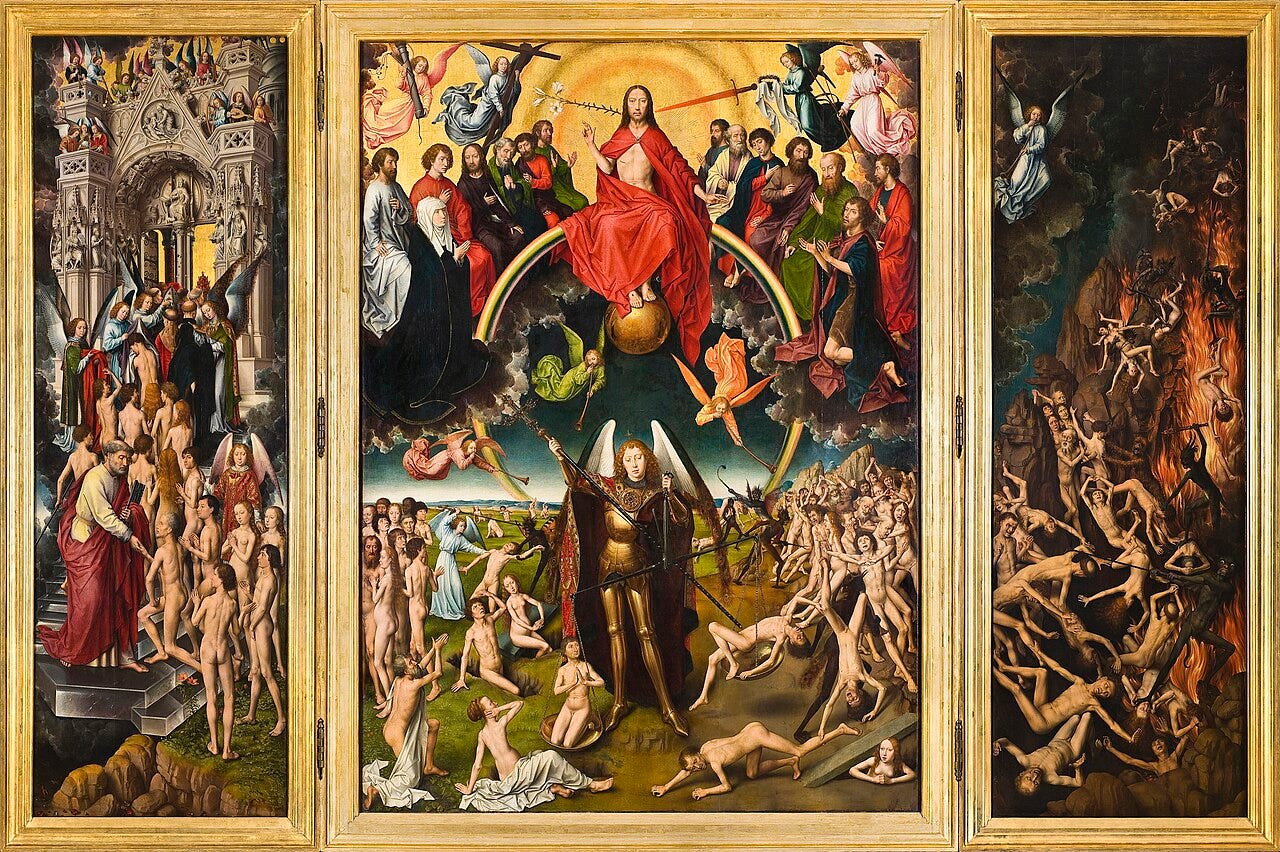
One of his great panels was captured at sea by a privateer and never reached the people who ordered it.
Born: Seligenstadt, Germany, around 1430
Known for: serene Madonnas, the Last Judgement, early Northern portraits
Died: Bruges, 1494
More incredible painter stories
If Hans Memling pulled you in, you will love these too:


Hans Memling at a glance
1430. Born around this year in Seligenstadt, near Mainz.
1465. Became a citizen of Bruges, the start of three decades at the top of the city’s painting.
1473. His Last Judgement, bound for Florence, was seized at sea by a Danzig privateer. It has been in Poland ever since.
1489. The Shrine of Saint Ursula was consecrated at the Bruges hospital.
1494. Died in Bruges, listed among the city’s wealthiest taxpayers.
The painting the pirates took
Memling's great Last Judgement triptych was commissioned by an Italian banker and shipped toward Italy. At sea a privateer seized the vessel and its cargo and carried the altarpiece off to Gdansk.
It never reached its owners. The triptych is still in Poland today, one of the strangest journeys any panel has taken. See what is a triptych.
Stillness as a style
Where Rogier van der Weyden, whose tradition he came from, painted grief, Memling painted peace. His Virgins sit composed and tender, his saints calm, his colour deep and clear. See what is oil painting.
Rogier van der Weyden ran the Brussels workshop where Memling trained, until the elder painter's death in 1464.
He worked in the German born, Bruges based manner of glowing oil and minute detail, building quiet devotional worlds you can fall into.
The portrait with a view
Memling helped invent the modern portrait. He was among the first in the North to set a sitter against an open landscape rather than a blank wall, opening a window behind the face. See what is portrait painting.
His tiny Shrine of Saint Ursula, a wooden reliquary painted like a little Gothic church, packs a whole legend onto a box you could carry in two hands.
The bankers who carried him to Italy
Bruges was the banking capital of the North, and its Italian merchants became Memling's best clients. Tommaso Portinari, the Medici bank's man in Bruges, sat for him with his wife Maria.
Through patrons like these, Memling's calm Flemish style traveled south into Italy, quietly shaping how Italians thought about oil paint and portraiture. The quiet master of Bruges had a long reach.
From Mainz to the Brussels workshop
Memling was not Flemish by birth. He was born in Germany, at Seligenstadt near Frankfurt, most likely between 1430 and 1440, and he seems to have spent his early years around Mainz on the Rhine, the same Rhineland region where Matthias Grunewald would later paint his altarpieces.
At some point he crossed into the Netherlands to learn the trade. Scholars think he trained in the Brussels workshop of Rogier van der Weyden, the most sought after painter in the region, and stayed until Rogier died in 1464.
Everything calm and tender in his later work traces back to that apprenticeship. He took Rogier's grave religious figures and quietly drained the pain out of them.
How a German became the leading painter of Bruges
By 1465 Memling was recorded as a citizen of Bruges, then one of the richest trading cities in Europe. He would stay for the rest of his life.
Business was good. By 1480 he had bought a large stone house, was taking on pupils, and had joined a local confraternity, the sort of civic and religious club that anchored a successful craftsman in the town.
He ran a busy workshop with assistants, which is why so many panels survive in his manner. He was the painter foreign visitors came looking for.
The devotion machine that merchants could carry home
Bruges was full of foreign merchants, bankers and agents passing through on business, and many of them wanted portable objects of private prayer. Memling gave them exactly that.
His serene Virgins and quiet saints came in formats a traveller could pack and ship: small panels, folding wings, faces you could kneel in front of anywhere. The calm was the selling point.
He repeated his best ideas without letting them go stale, which made him dependable to a client hundreds of miles away who could never come back to complain.
The praying half of a picture
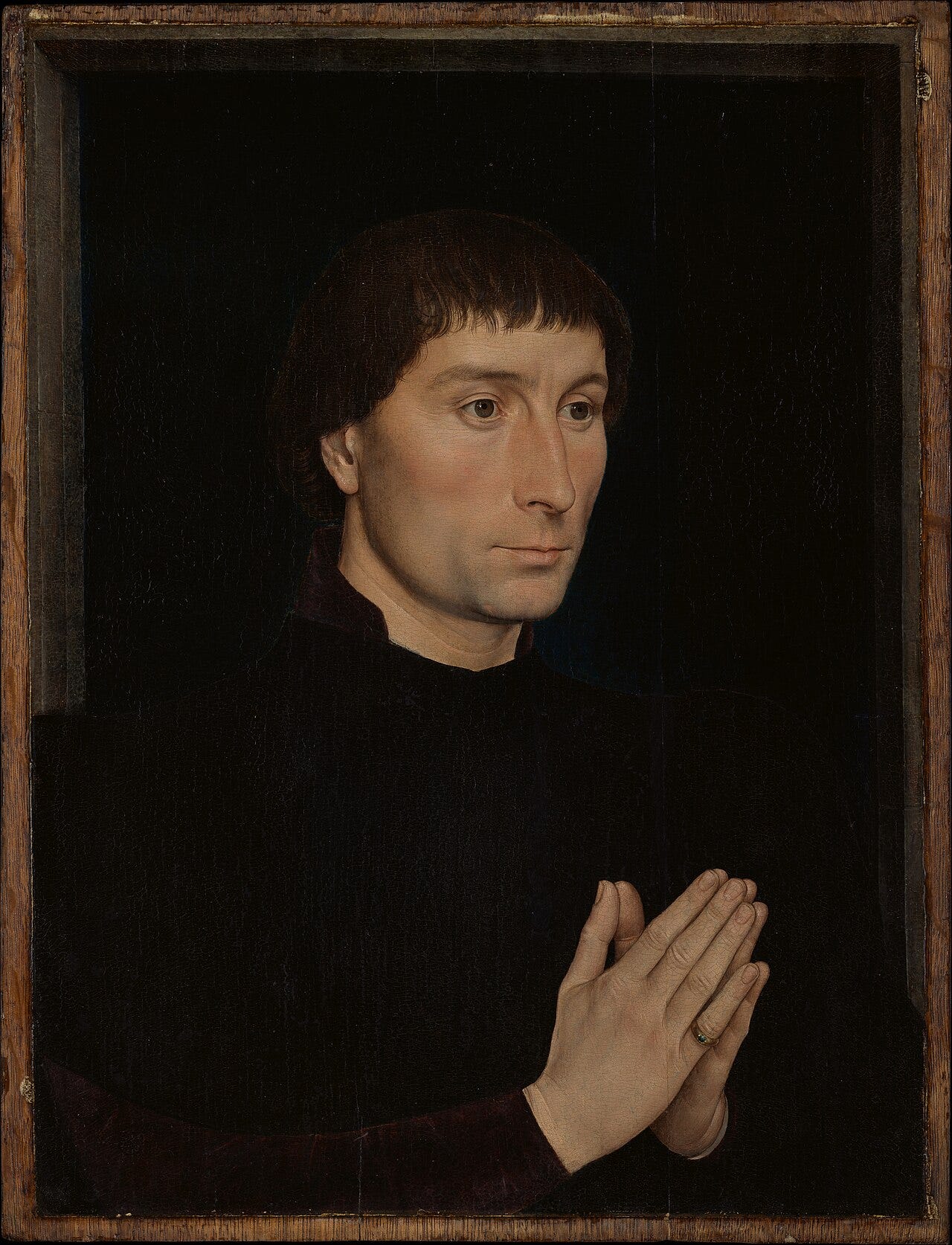
One of Memling's specialities was the donor diptych, a picture in two hinged panels. On one wing the person who paid kneels in prayer. On the facing wing sits the Virgin and Child they are praying to.
Open the diptych and the two halves meet: a real Bruges citizen brought face to face with heaven in the same painted room.
In 1487 he pushed the idea further for Martin van Nieuwenhove, adding a convex mirror on the Virgin's wall that reflects both figures, so donor and Madonna share one continuous space.
The order book that spanned Europe
The Italians of Bruges were not his only clients. Memling painted a large triptych for Sir John Donne, a Welsh courtier and diplomat, and small altarpieces for Florentine bankers.
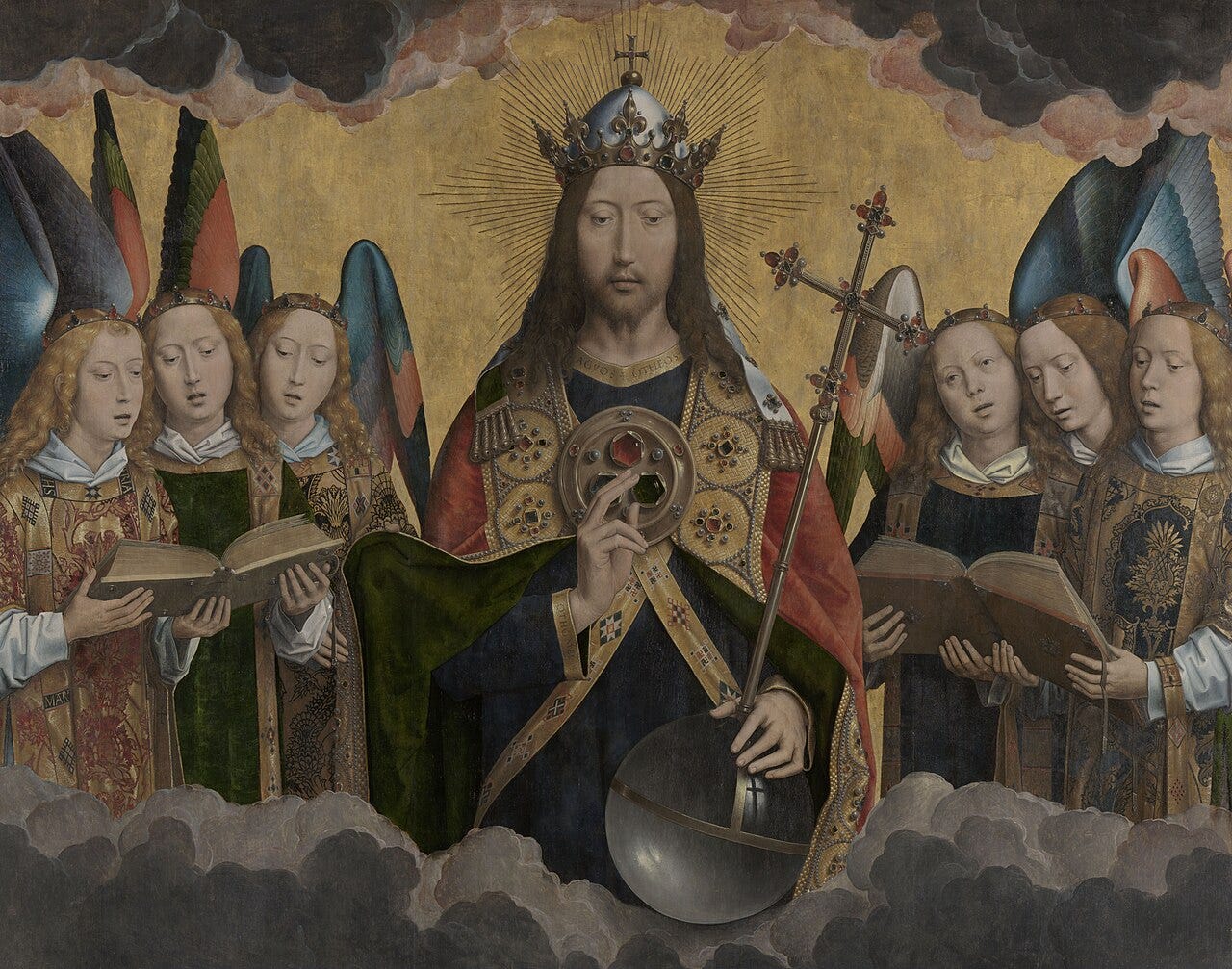
His reach ran as far as Spain. Around 1489 he supplied a huge altarpiece for the abbey church of Najera, and the surviving panels of music making angels now hang in Antwerp.
A German painter in a Flemish town was quietly filling orders for England, Italy and Spain at once.
A reliquary shaped like a church
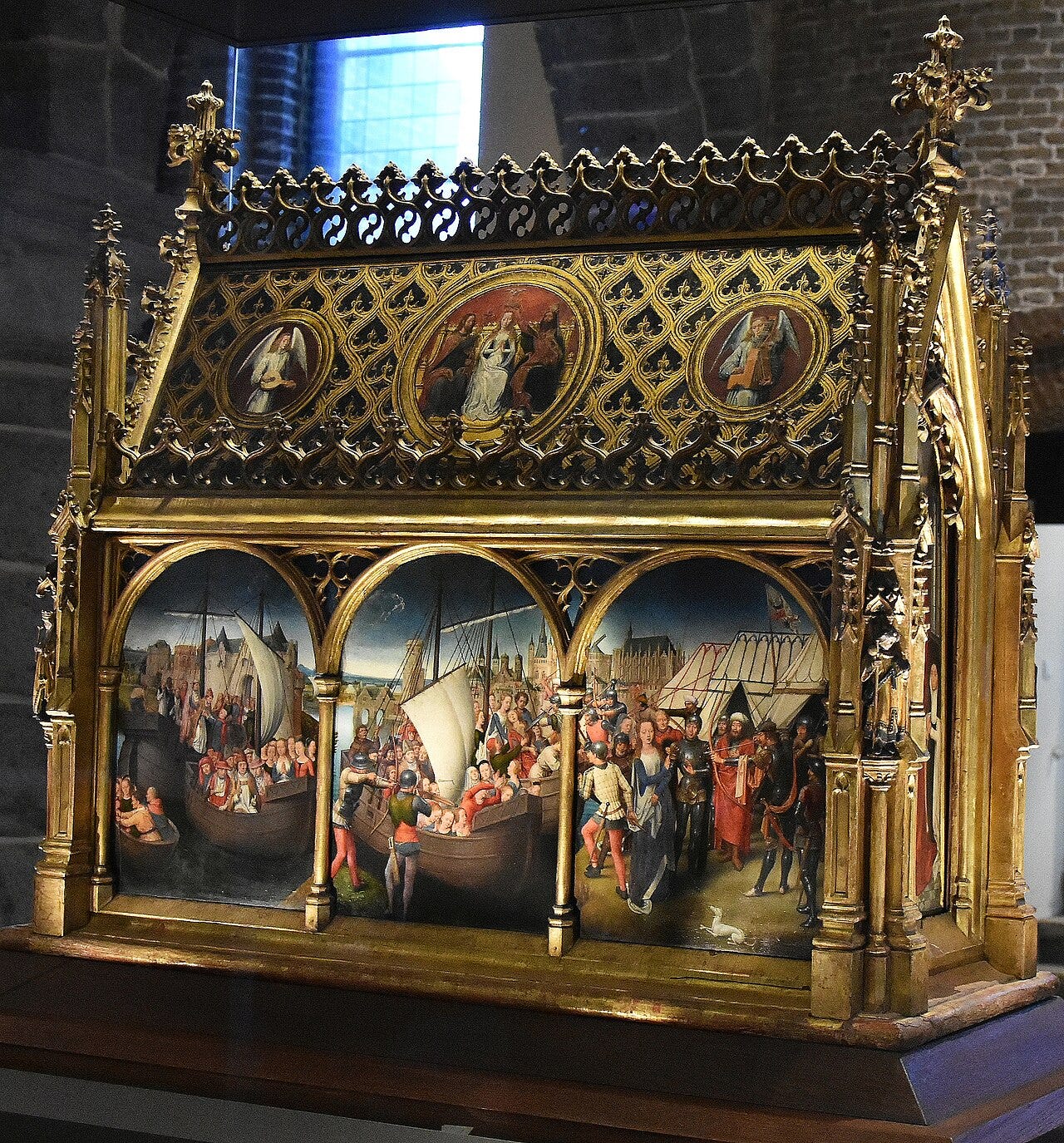
In the Old Saint John's Hospital in Bruges, the nuns kept the bones of Saint Ursula. Memling built them a home for the relics that looks like a tiny Gothic chapel in painted wood.
Along its sides, under little arches, run six scenes of Ursula's pilgrimage and killing, with the half built towers of Cologne cathedral rising in the background of one of them. He turned a whole legend into a box you could lift in two hands.
The relics were placed inside on 21 November 1489. The shrine has never left the hospital, which is now the Memling museum.
The great triptych in the hospital
Memling's largest surviving work is the Saint John Altarpiece, finished in 1479 for the very hospital that still holds it. At its centre sits the Virgin and Child, flanked by Saint John the Baptist and Saint John the Evangelist, with the mystic marriage of Saint Catherine unfolding in the foreground.
The side wings show the beheading of the Baptist and the visions of the Evangelist on Patmos, complete with a many headed beast and a rain of fire, all painted with the same unhurried calm as the peaceful centre.
It was made for the nuns and brothers who nursed the sick of Bruges, and it has hung in their building for more than five hundred years.
Tommaso and Maria Portinari
Among his clients were the Portinari, the Florentine family who ran the Medici bank in Bruges. Memling painted paired portraits of Tommaso Portinari and his young wife Maria, now hanging together at the Metropolitan Museum in New York.
The couple are shown in prayer, hands joined, turned slightly toward a religious scene that once sat between them. Maria wears the tall headdress and heavy necklace of a rich merchant's wife.
These are among the first Netherlandish portraits to feel like real, particular people rather than types, and Italian visitors carried the taste for them home.
Praised in his day, then quietly forgotten
In his lifetime Memling was celebrated, and foreign buyers, Italian bankers and English merchants among them, sought out his Bruges workshop.
Then the Zwin channel silted up, Bruges lost its harbour, and the city's fortunes sank. The painter's name sank quietly with them, admired locally but little known abroad for centuries.
The revival came in the 1800s, when travellers rediscovered old Bruges and its quiet altarpieces. Today he is counted among the finest of the Early Netherlandish masters, the calm one who outlasted the noise.
Where to stand in front of a Memling today
The richest place is Bruges itself. The Sint Janshospitaal holds the Saint Ursula shrine and the Nieuwenhove diptych, and the nearby Groeningemuseum keeps more of his panels.
Beyond Belgium, the National Gallery in London owns the Donne Triptych and several small devotional pictures, and New York and Antwerp hold others.
The town that made him rich slid into decline soon after his death, and his calm world stayed behind, intact, on its walls.
One of the richest men in Bruges
Memling did not just paint for wealthy merchants. He became one himself. By 1480 his name appears on a Bruges tax list drawn up to fund the city's share of a war, and he sits among the wealthiest citizens of the town.
Records show he owned several stone houses, a mark of real standing in a rich trading city. The quiet, prayerful painter ran what amounted to a thriving business.
His steady stream of commissions from Italian bankers, local guilds and foreign visitors made him prosperous in a way few artists of his century managed. Piety on the panel and profit in the ledger sat comfortably together.
The workshop and the quiet end of 1494
Behind the calm surfaces stood a busy workshop. Memling took in assistants and turned out altarpieces, portraits and small devotional panels at a pace that fed demand across Europe.
That scale is part of why so many Memlings survive today, and why his manner spread so widely. Patrons knew what they would get: order, sweetness and a serene light that never raised its voice.
Memling died in Bruges on 11 August 1494, a rich and respected man. Within a couple of generations taste had moved on and his name faded, until the nineteenth century rediscovered him as one of the great painters of the early Netherlands.
The Hans Memling questions that keep coming up
What is Hans Memling famous for?
Serene Madonnas and portraits, and the Last Judgement triptych now in Gdansk.
Why is his Last Judgement in Poland?
A privateer seized the ship carrying it to Italy and took it to Gdansk, where it remains.
Where did he work?
Bruges, then a wealthy trading city, where he became one of its richest residents.
When did he die?
In 1494, in Bruges.
What is the Shrine of Saint Ursula? The gilded reliquary he painted for the Bruges hospital in 1489, a Gothic chapel in miniature with six scenes of Ursula's legend, still in the building it was made for.
How much is a Memling worth? Almost nothing ever reaches the market; a small Madonna made 4.4 million pounds in 2014, and the great works are permanently in museums.
More secrets to unlock


Why the calm one lasts
Memling never shocked anyone, which is exactly why he was so loved. In an age of grief and drama he offered serenity, and the wealthy of Europe paid handsomely for it. The Memling Museum in Bruges still keeps his quiet world intact.
One last detail. When Bruges marked the five hundredth anniversary of his death with a great exhibition in 1994, it took loans from half the museums of Europe to bring the quiet townsman's work home.