
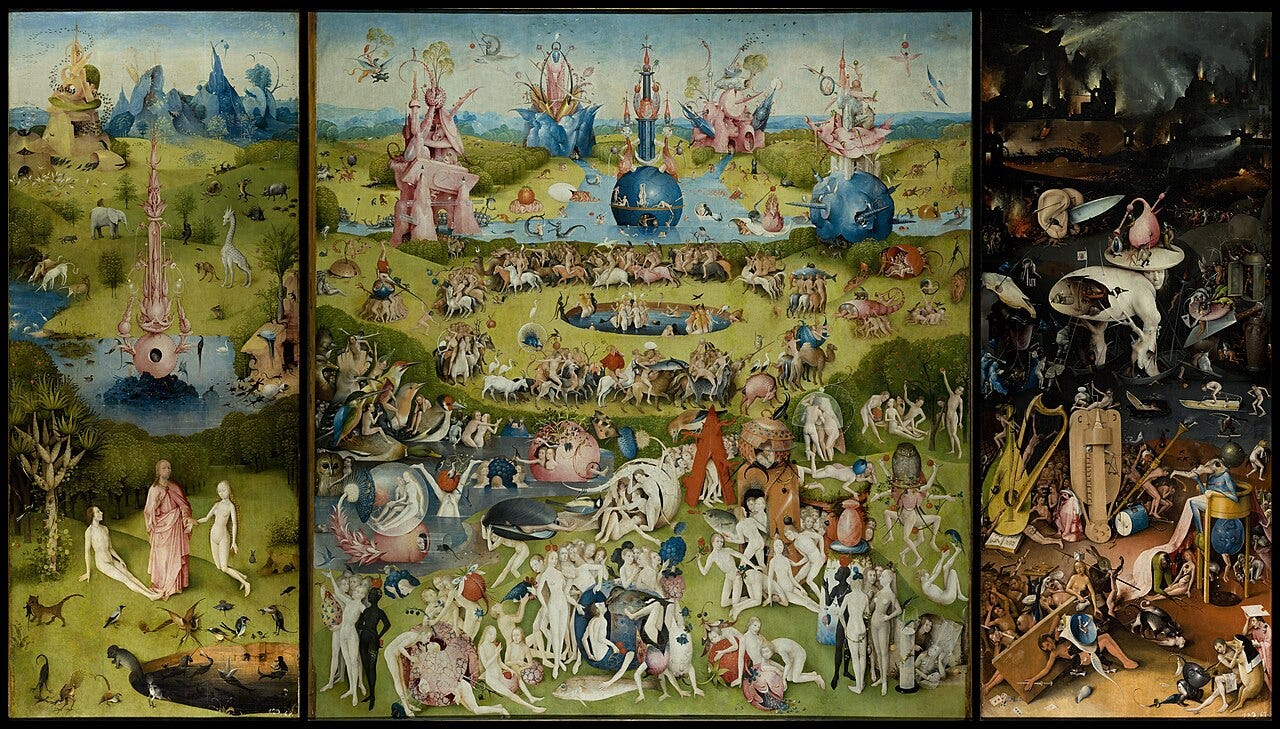
A triptych is a work made of three panels, usually a wide central scene with two narrower wings hinged to fold over it. For centuries it was the standard form of the altarpiece, a painting built to open and close.
Bosch packed his Garden of Earthly Delights into one, paradise on the left wing and hell on the right. What that crowded middle panel actually shows is unpacked in a full reading of the painting.
The triptych is the classic shape of the altarpiece, made to be thrown open on feast days and folded shut the rest of the year. A narrow strip of small painted scenes often ran along its base, what is called a predella.
Triptych, the basics
What it is: an artwork in three panels, a center with two wings.
The word: from the Greek triptychos, three folded.
The use: the classic Christian altarpiece.
The trick: the wings fold shut, often painted on the outside too.
The family: two panels is a diptych, three a triptych, many a polyptych.
Keep learning art the fun way


Three panels that open and close
To me, a triptych is not just a painting in three parts. It is a hinged object with moving parts.
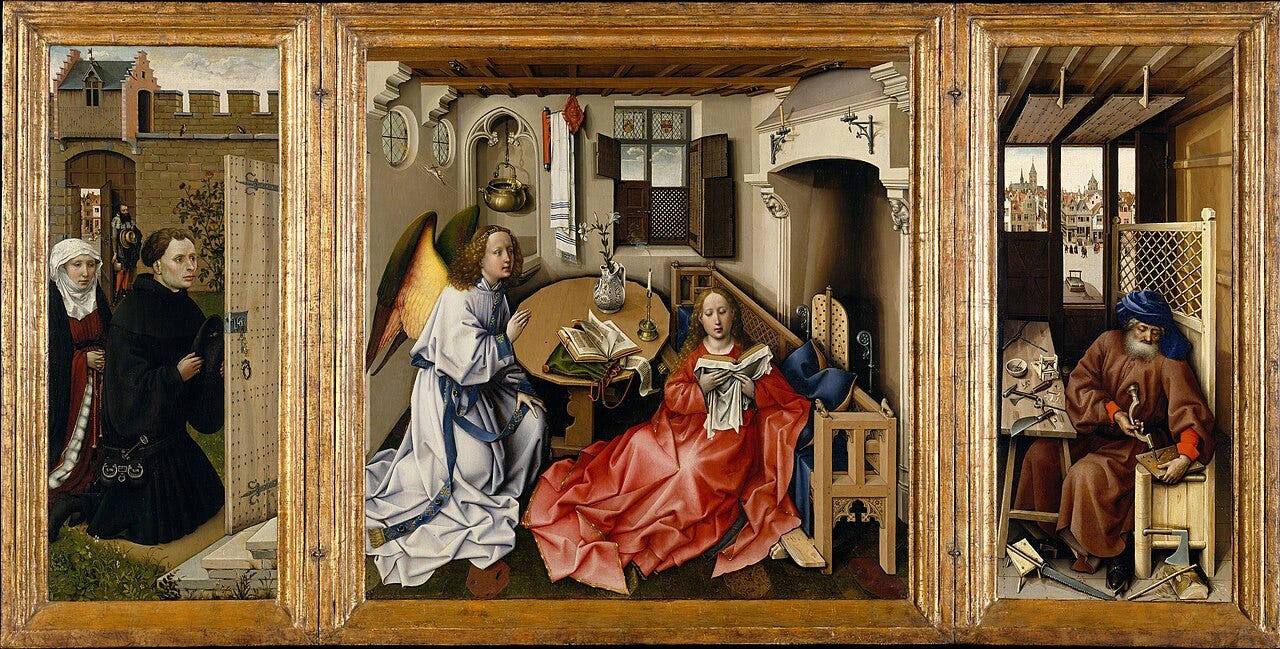
The two wings swing in to cover the central panel. So the work has two completely different states: closed, when only the outer faces of the wings are visible, and open, when the full scene blazes out across all three panels.
It is less a picture than a small theatre with doors.
A painting with two faces
This is the part I wish more museums showed, because they usually display triptychs open.
On ordinary days the altarpiece stayed shut, its plain outer wings facing the congregation, often painted in muted grey grisaille to imitate stone. On feast days it was opened, and the dull stone exterior gave way to a burst of color and gold inside.
The triptych was designed for that reveal. Closed for the everyday, opened for the holy.
Bosch's Garden of Earthly Delights
The most famous triptych of all turns the form into a wild story in three acts.
Hieronymus Bosch painted the Garden of Earthly Delights around 1500.
Opened, it runs left to right from the Garden of Eden, through a teeming landscape of naked pleasure, into a nightmarish hell.
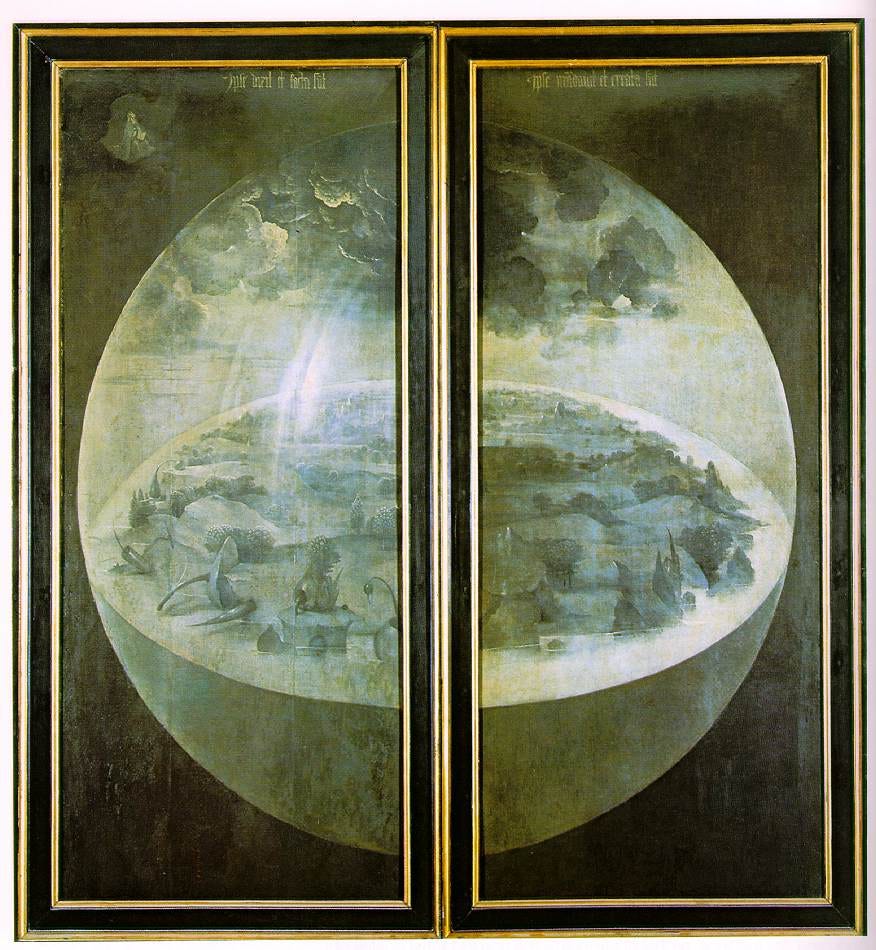
Closed, the outer wings show the whole earth as a flat globe inside a glass sphere, grey and quiet, on the third day of Creation.
You shut it and hold the entire world in your hands. You open it and fall through paradise into damnation.
The giant: the Ghent Altarpiece
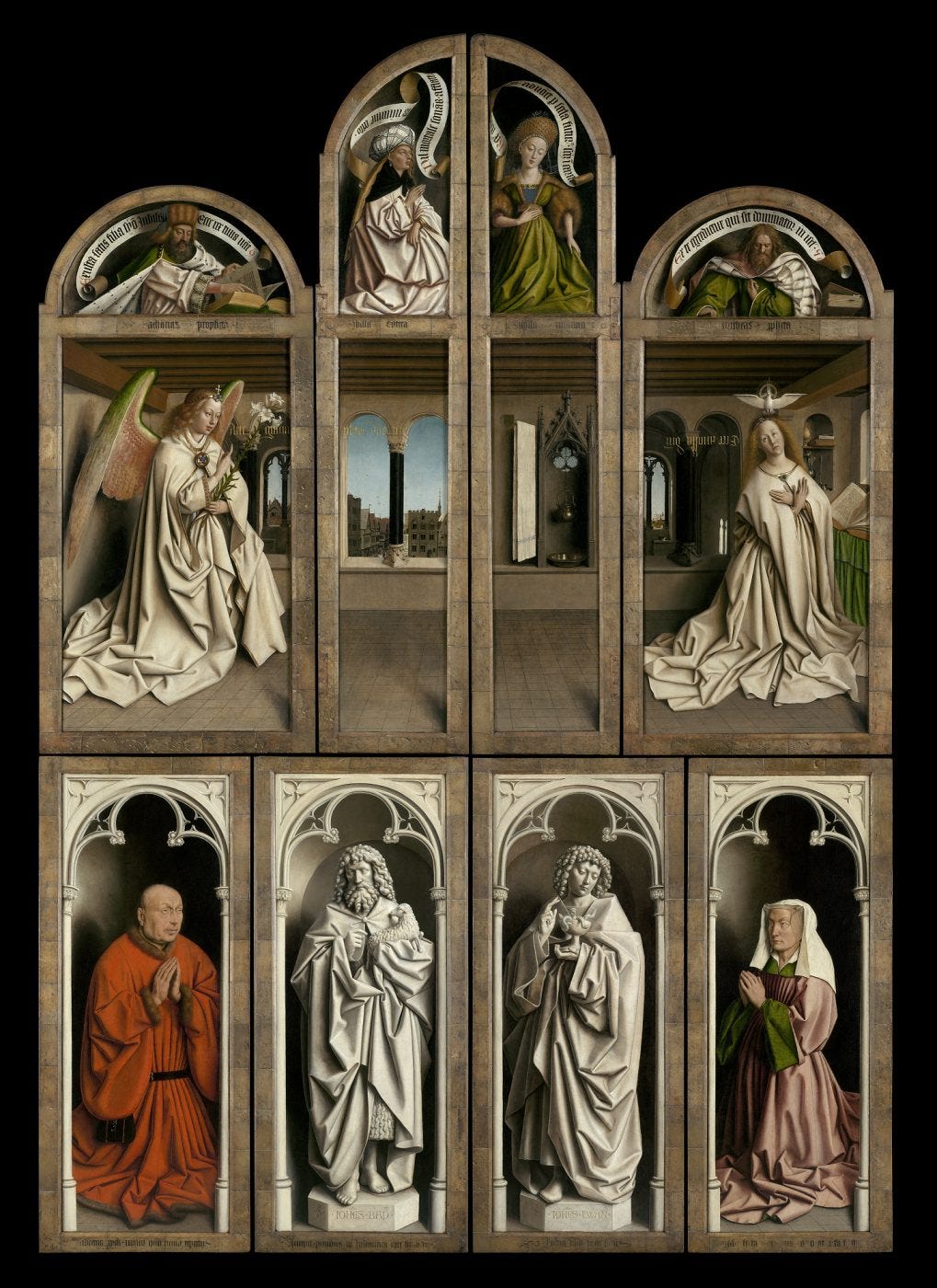
Add more panels and a triptych becomes a polyptych, and the greatest of all is the Ghent Altarpiece.
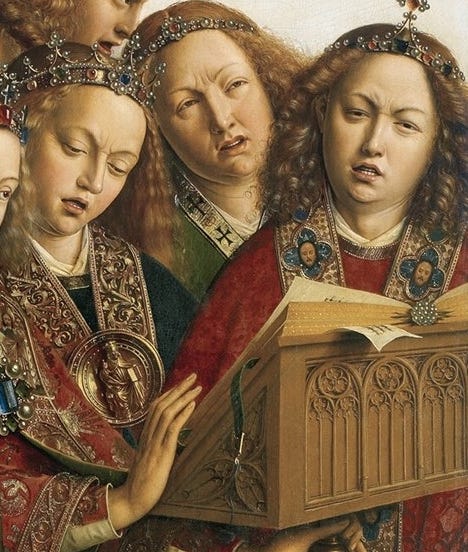
Finished in 1432 by Jan van Eyck and his brother Hubert, it opens into twelve glowing panels, a landmark of the new oil painting. Reading its dozens of figures and symbols is a lesson in iconography.
It is also the most stolen artwork in history, looted and dismantled again and again across six centuries. One lower panel, taken in 1934, has never been found.
Why three panels
The number is not random, and to me that is the elegant part. Three suited both theology and the eye.
A central panel held the main event, the Virgin and Child or the Crucifixion, while the two wings carried saints, donors or related scenes that pointed inward to the middle.
The shape itself focused all attention on the center, like a sentence with its key word in the middle.
It is the same family as the smaller, more private diptych, only grander, and often built in glowing tempera or the new oil on big oak panels.
The triptych, folded and answered
What is a triptych? An artwork in three panels, usually a central scene with two hinged wings.
Where does the word come from? From the Greek triptychos, meaning three folded.
Why do the wings close? To protect the painting and to stage a reveal, shut on ordinary days, open on feast days.
What is the most famous triptych? Bosch's Garden of Earthly Delights, around 1500.
What is the difference between a triptych and a polyptych? A triptych has three panels, a polyptych has many.
More secrets to unlock


Shut for the everyday, open for the holy
The shape outlived the altar.
Five centuries after Bosch, Francis Bacon was still painting in threes, and that lineage is what I find most telling: his screaming figures spread across triptychs that borrowed the form once built to stage paradise and hell.
