
Hieronymus Bosch was the Netherlandish painter of heaven, hell and every nightmare in between, filling altarpieces with demons and mutant creatures five hundred years before Surrealism had a name.
We know almost nothing about his life, yet his Garden of Earthly Delights is still one of the strangest paintings ever made. Working in one small Dutch town, he left barely two dozen paintings and not one reliable word about himself, which is why the most inventive imagination in early European art belongs to a near total stranger.
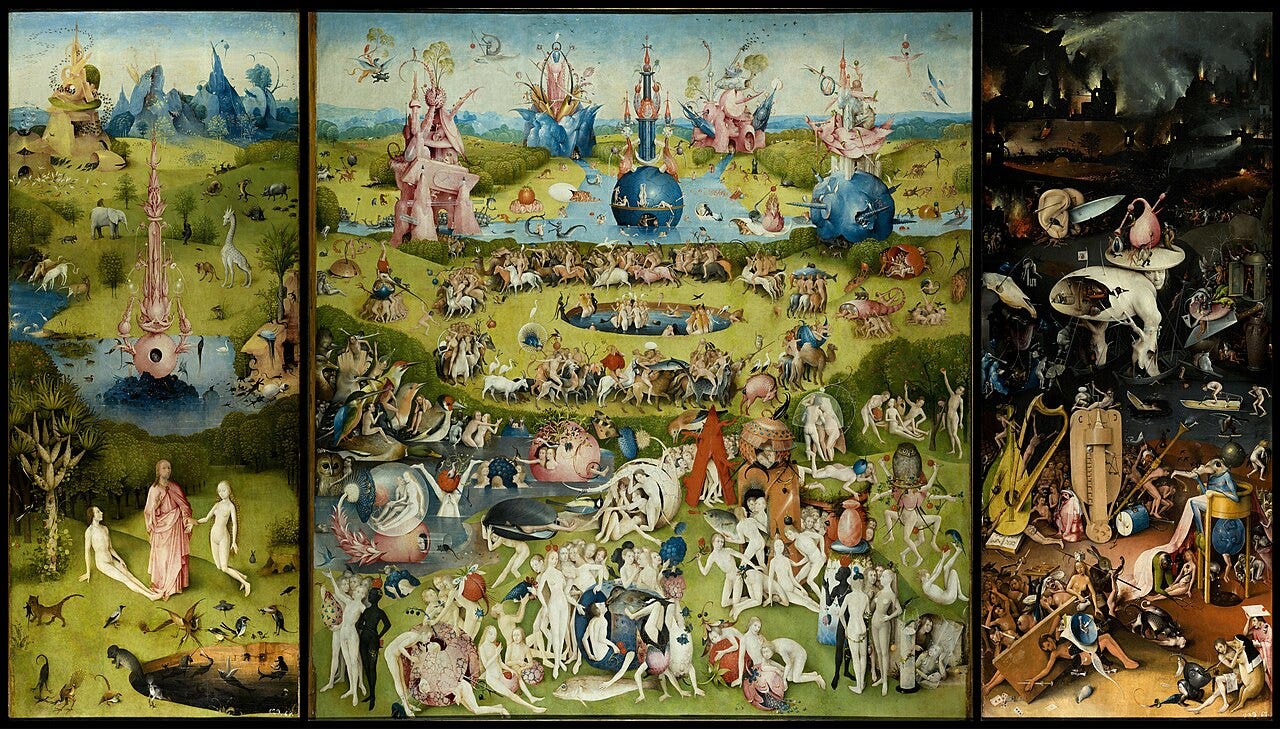
Stand in front of a Bosch and you keep finding things: a man inside an egg, a knife between two ears, a bird headed monster eating the damned. Nobody has ever painted quite like him.
More incredible painter stories
If Hieronymus Bosch pulled you in, you will love these too:


Hieronymus Bosch at a glance
1450. Born Jheronimus van Aken around this year in ’s-Hertogenbosch, into a family of painters.
1481. Married the wealthy Aleid van de Meervenne and joined the town’s elite around this time.
1488. Sworn into the Brotherhood of Our Lady, the town’s religious inner circle.
1500. The Garden of Earthly Delights, painted around this time, for a palace rather than a church.
1516. Died in ’s-Hertogenbosch. His funeral mass was held in the cathedral he had painted for.
A life almost entirely missing
Bosch was born around 1450 in the Dutch town of Den Bosch, which gave him the name we use. Beyond a handful of records, his life is a blank: no letters, no diary, no certain self portrait.
Only about twenty five paintings survive that scholars feel sure are his. The wildest imagination in early European art belongs to a near total stranger.
The Garden of Earthly Delights
His best known work is a triptych On the left, Eden. In the centre, a huge garden of naked figures lost in pleasure. On the right, a dark, burning hell full of punishment.
Open and shut, paradise turns to damnation, and five centuries of viewers have argued about what it means. A full walk through what is actually happening on each of the three panels, hollow bodied Tree Man included makes it easier to follow.
Hell like no one before him
Bosch built an entire visual language of damnation: hybrid beasts, the haunting Tree Man with a hollow body, ears skewered on a blade, instruments of music turned into instruments of torture.
His iconography of sin is so original that we still borrow from it whenever we picture hell.
Moralist, not madman
It is tempting to call him a lone weirdo or a secret heretic. Most scholars now read him the other way: a deeply orthodox, moralizing painter who used shock to preach.
The horrors are warnings. Bosch wanted to scare his viewers straight, and his clients were respectable churchmen and nobles who knew exactly what he was doing. That same instinct to scare a churchgoer straight runs through eleven other landmark religious paintings, from Fra Angelico's calm Annunciation to Caravaggio's own restaging of scripture.
The song from hell
One detail shows how alive his work still is. In the hell panel of the Garden, a tiny piece of musical notation is painted across the backside of a damned soul.
In 2014 a curious student transcribed it and played it, and the so called butt song from hell went viral online. A six hundred year old joke, finally heard.
Bosch's long shadow
For centuries he was a curiosity. Then the Surrealists found him and claimed him as a grandfather: Dali, Ernst and Miro all studied his impossible creatures.
Modern eyes, raised on strange dreams and stranger films, finally caught up with what Bosch was doing in 1500.
The van Aken workshop he was born into
His real family name was van Aken. Both his grandfather and his father were painters, and Bosch almost certainly learned the trade in the family workshop.
He rarely left the town. He joined its devout Brotherhood of Our Lady, and worked for wealthy patrons across Europe who wanted his strange visions of sin and judgment.
Why most of Bosch hangs in Madrid
The Prado in Madrid holds the greatest group of his paintings, including The Garden of Earthly Delights, which King Philip II of Spain hung in his own palace.
The man was really named Jheronimus van Aken
Hieronymus Bosch was a working name, not a birth name. He was born Jheronimus van Aken, in Dutch Jeroen van Aken. Hieronymus is simply the Latin form his contemporaries used.
The surname van Aken points to Aachen in Germany, where the National Gallery in London says his family probably came from. Van Aken literally means from Aachen.
So where did Bosch come from? From his home town of s Hertogenbosch, known locally as Den Bosch. He borrowed the town onto the end of his name, and signed some paintings Jheronimus Bosch.
It worked like a brand. By the time collectors across Europe wanted a Bosch, the town and the painter had become one word.
Den Bosch today, and the year the whole town became a museum
s Hertogenbosch is still a real place. It is the capital of the province of North Brabant in the southern Netherlands, and locals still call it Den Bosch.
In 2016 the town marked 500 years since Bosch died. Het Noordbrabants Museum in Den Bosch mounted an exhibition called Visions of Genius, open from February to May 2016.
It was a coup. The small museum borrowed about seventeen of the roughly two dozen surviving Bosch paintings, works that normally hang in Madrid, Lisbon, Vienna and Washington.
The show grew out of years of study by the Bosch Research and Conservation Project, which used infrared imaging to look under the paint.
How little of Bosch actually survives
For an artist this famous, the real catalogue is tiny. Only about two dozen paintings are now widely accepted as his own hand, and modern research has trimmed that number rather than grown it.
Two facts make dating him almost impossible. Only about seven paintings carry his signature. Not a single one carries a date he wrote himself.
That is why you will see careful labels like about 1490 on his work. Scholars build the timeline from style, from the wood panels, and from the underdrawings, not from anything Bosch left behind.
The Bosch Research and Conservation Project even demoted two paintings once given to him out of the accepted list.
A rich marriage and a seat among the town elite
Here is the myth worth killing. Bosch was not a hermit or an outsider muttering at the edge of town.
He married well. Around 1479 to 1481 he wed Aleyt Goyaerts van den Meervenne, a woman a few years older from a wealthy local family. She brought property, and the marriage lifted him into the comfortable class.
He also joined the Brotherhood of Our Lady, an elite religious confraternity based in Den Bosch. Its records name him from the 1480s and note his death in 1516.
The picture that emerges is of a respected, well connected citizen who painted nightmares. The man behind the demons paid his dues and sat with the town's leading families.
The Haywain, a whole world grabbing at a wagon of hay
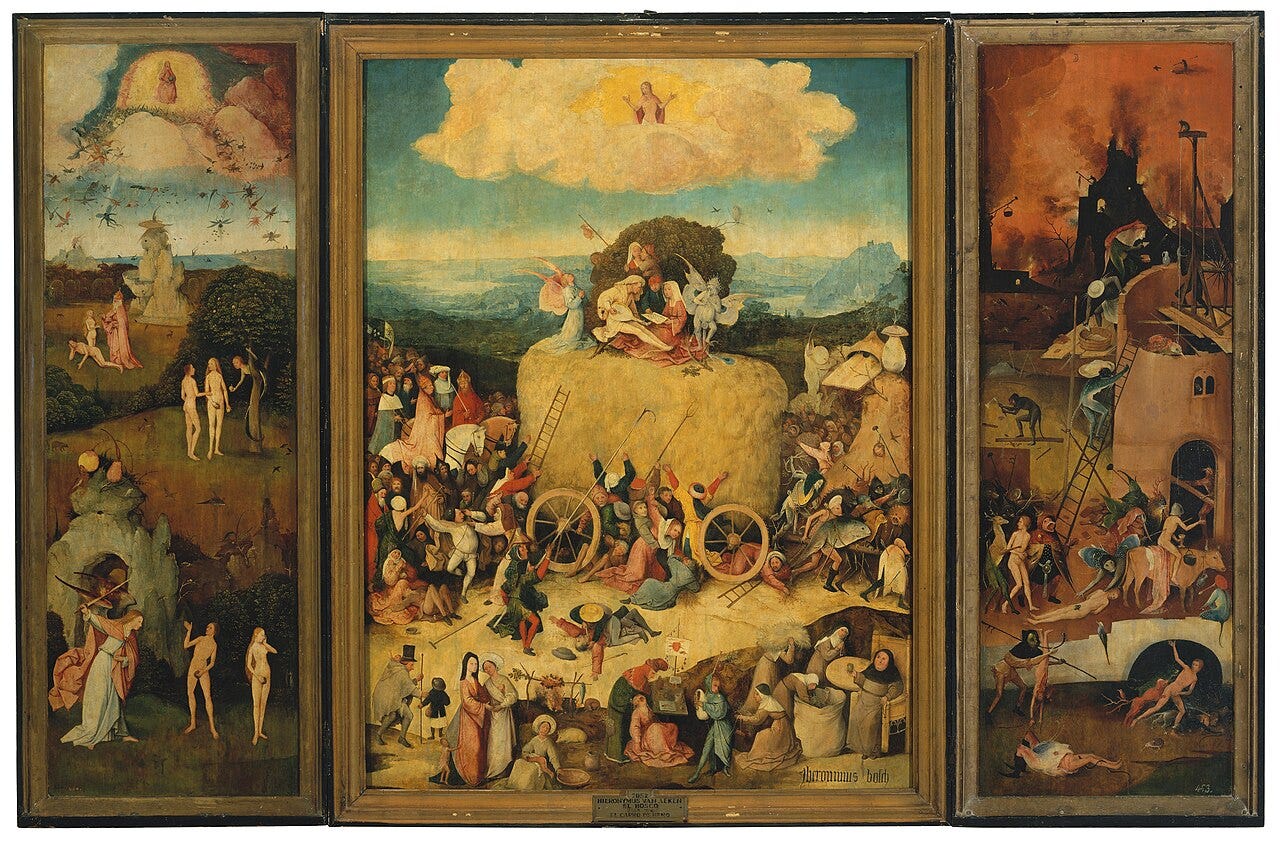
One triptych in the Prado turns a Flemish proverb into a moving picture. The Haywain is built on the old saying that the world is a haystack, and every person grabs what he can from it. Bosch paints exactly that.
A giant wagon of hay rolls across the central panel. Around it people claw, trample and even kill each other for a fistful of straw that is worth nothing.
Demons pull the wagon toward hell on the right wing. On the left wing, the story starts with paradise and the fall. The message is blunt. Chase worthless things and you drag yourself, cheerfully, all the way to the fire.
The Temptation of Saint Anthony, his signed showpiece in Lisbon
Some of Bosch hangs far from Madrid. His fullest treatment of temptation is a triptych in the Museu Nacional de Arte Antiga in Lisbon.
The subject is Saint Anthony, a hermit of the Egyptian desert who, by legend, was tormented by the devil. Bosch surrounds him with a swarm of demons stitched together from human, animal, plant and machine parts.
Britannica calls this work one of the best keys to Bosch's private world of symbols, and a condemnation of false belief and quack healers.
It matters for another reason. It is one of the few paintings Bosch actually signed, which makes it an anchor for judging everything else.
The Ship of Fools, a boat going nowhere in the Louvre
In the Louvre hangs a small panel of a boat that never reaches shore. A group of revelers crowd a tiny vessel. A monk and a nun sing with their mouths open, a lute is played, and a roast bird is nailed to the mast while a man tries to slice it down.
The boat drifts. No one steers. That is the point, a picture of humanity too busy feasting to notice it has lost its way.
The theme echoes a 1494 bestseller, Sebastian Brant's Ship of Fools. Bosch's panel is only a fragment. It was cut from a larger dismantled altarpiece, and its lost lower half survives as a separate piece.
Death and the Miser, a bedside standoff in Washington
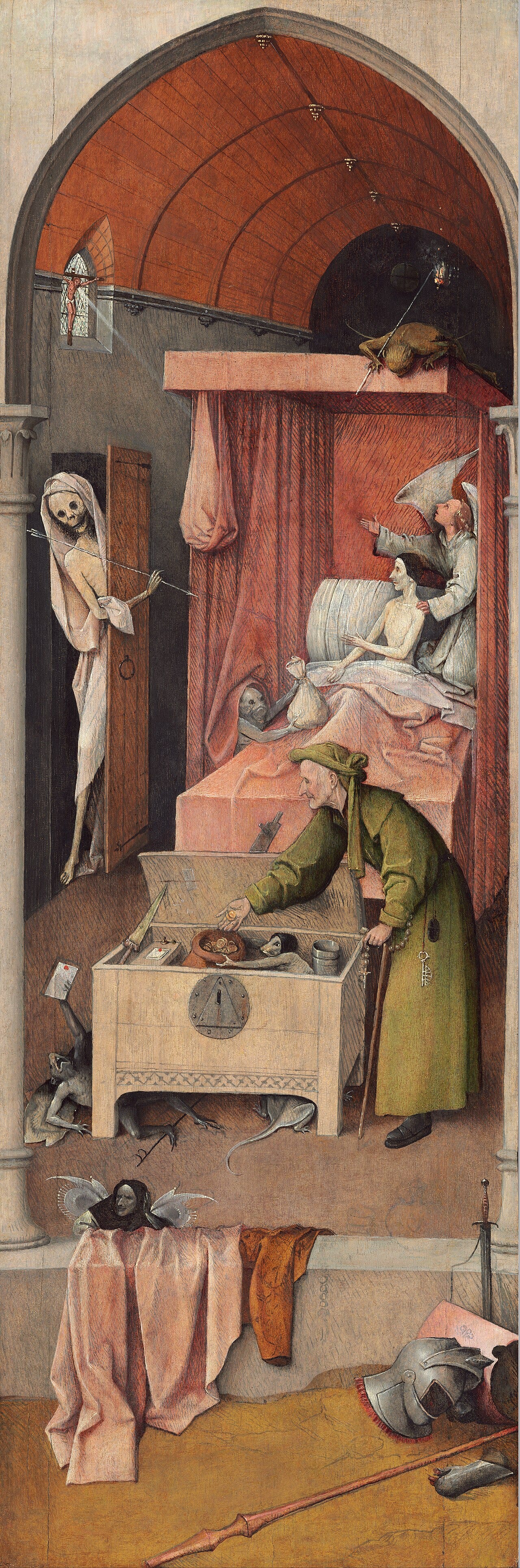
The National Gallery of Art in Washington owns one of Bosch's most human scenes. A dying miser lies propped in bed. Death slips through the door with an arrow, so the last second of the man's life is here.
Two forces pull at him. A small monster under the bed curtains offers a fat bag of gold. An angel at his shoulder points to the crucifix glowing in the window.
The man's hand hovers between them, and we never learn which he chooses. The panel, painted around 1485 to 1490, once belonged to the same dismantled altarpiece as the Louvre's Ship of Fools. The two paintings were parts of one lost whole.
The tabletop where the eye of God stares back
Not everything by Bosch is a triptych. In the Prado there is a painted tabletop, meant to be seen looking down. At its center is a huge circle painted as an eye, and in the pupil stands the risen Christ, with a Latin warning around him: beware, beware, God sees.
Around that eye Bosch paints the seven deadly sins as everyday scenes. Greed, anger, pride, lust and the rest are shown not as monsters but as ordinary people misbehaving in ordinary rooms.
The four corners show the four last things, death, judgment, heaven and hell.
Some scholars now doubt the panel is fully by Bosch himself. The Prado still defends it, and the debate is unresolved.
Heretic, strict Catholic, alchemist, or folklorist
For a century, scholars have fought over what Bosch really believed. One camp read the paintings as coded heresy, arguing he belonged to a secret sect. Early critics, unable to decode him, assumed he practiced the occult.
A second camp says the opposite. He was a strict, orthodox Catholic painting stern sermons on sin for a devout audience.
Others hunt for alchemy in his flasks and furnaces, or trace his monsters back to Dutch proverbs and folk sayings, where a visual joke stands in for a spoken one.
Modern scholarship leans toward the moralist reading over the occult one. The honest answer is that we still cannot fully translate him, and that unsolved quality is part of why he still pulls crowds.
More secrets to unlock


The Hieronymus Bosch questions that keep coming up
Who was Hieronymus Bosch? A Netherlandish painter famous for fantastical religious scenes.
When was he born? Around 1450, in Den Bosch in the Netherlands.
When did he die? In 1516.
What is he famous for? The Garden of Earthly Delights.
What style is he? Early Netherlandish, and a forefather of Surrealism.
Where can I see his work? The Prado in Madrid holds the greatest group, including the Garden.
What was Hieronymus Bosch's real name? He was baptised Jheronimus van Aken, Dutch for Jeroen van Aken. He took the name Bosch from his home town of s Hertogenbosch and used it to sign his work.
Where is 's-Hertogenbosch? It is a city in the southern Netherlands, the capital of North Brabant province, often shortened to Den Bosch. Bosch spent nearly his whole life there, and in 2016 it hosted a landmark exhibition of his work.
For me the eeriest thing about Bosch is how modern he still feels.
In 2016, five hundred years after his death, the Prado gathered his surviving panels into one show that drew some of the biggest crowds in the museum's history. We are still lining up to decode him.