
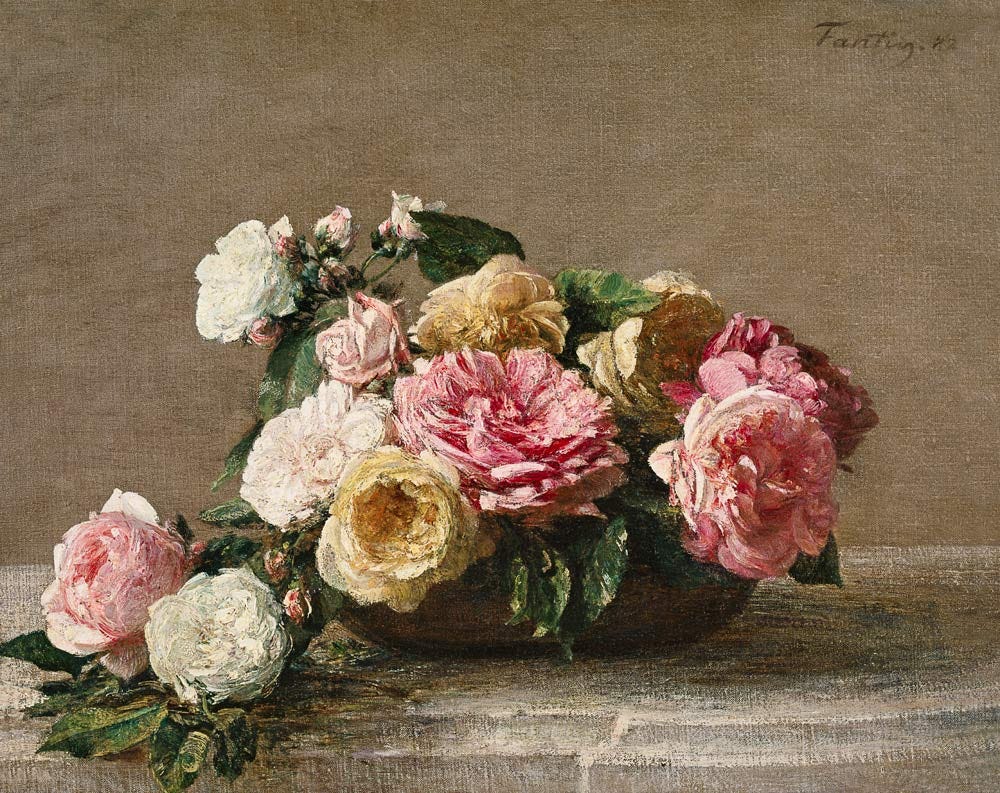
Henri Fantin-Latour was a French painter, born in Grenoble on 14 January 1836, who died in Buré on 25 August 1904. He left two bodies of work that seem to belong to different men: flower pieces that English collectors bought for years, and group portraits in which Manet, Monet, Renoir, Zola, Baudelaire, Verlaine and Rimbaud sit for posterity. He painted the avant garde of his day and, in 1874, refused to exhibit with it.
In 1874 the Impressionists held their first exhibition, and Fantin, who had painted several of them, declined to exhibit with them.
Cool Stories About Art is a newsletter to learn art the fun way.
Join 200,000+ readers and get:
10 new art stories / month
The entire archive of content (1,000+ articles)
Comment, ask questions, and chat with other readers
Four years earlier, in 1870, he had painted the picture that made him the portraitist of that circle. A Studio at Les Batignolles shows Manet at his easel with Renoir, Zola, Bazille and Monet around him, all of them grave and still, each seeming to pose for posterity. The State talked of buying it, but the war ended the talks, and Bazille, one of the young men in the picture, was killed that year at twenty eight.
So the picture went to a collector instead. In 1871 it belonged to Edwin Edwards, a wealthy amateur engraver whom Whistler and Millais had put in touch with Fantin, and who had it from the painter himself. Edwards also bought Fantin's still lifes for years and helped support him. Mrs Edwards sold the canvas to the State in 1892, for the Luxembourg museum, so for two decades the portrait of Paris's new painters stayed with the family of the man who paid for Fantin's roses.
One patron, in other words, held both halves of Fantin's work: the portrait of the avant garde and the flowers that kept him working. Fantin had recorded a revolution in French painting from close range, and when its painters held their own exhibition he stayed away.
What You'll Discover
Who he met copying in the Louvre.
What the dead master's face was copied from.
Who crowds around Manet's easel.
Who is missing from the table.
Where he stood among the Impressionists.
What a flower painter heard in Wagner.