Ivan Aivazovsky: The Complete Story
Ivan Aivazovsky painted around 6,000 canvases, almost all of them the sea, and nearly all of them from memory. Turner wrote him a poem, the Russian Navy made him its official painter, and he died at 82 with an unfinished ship explosion on the easel.
No painter ever produced more water. The method behind the spectacle is stranger than the spectacle.
Ivan Aivazovsky at a glance:
1817: born Hovhannes Aivazian in Feodosia, Crimea, to a poor Armenian family; a local architect spots the boy drawing on walls.
1844: appointed painter to the Russian Navy's General Staff, with fleets and admirals as a research department.
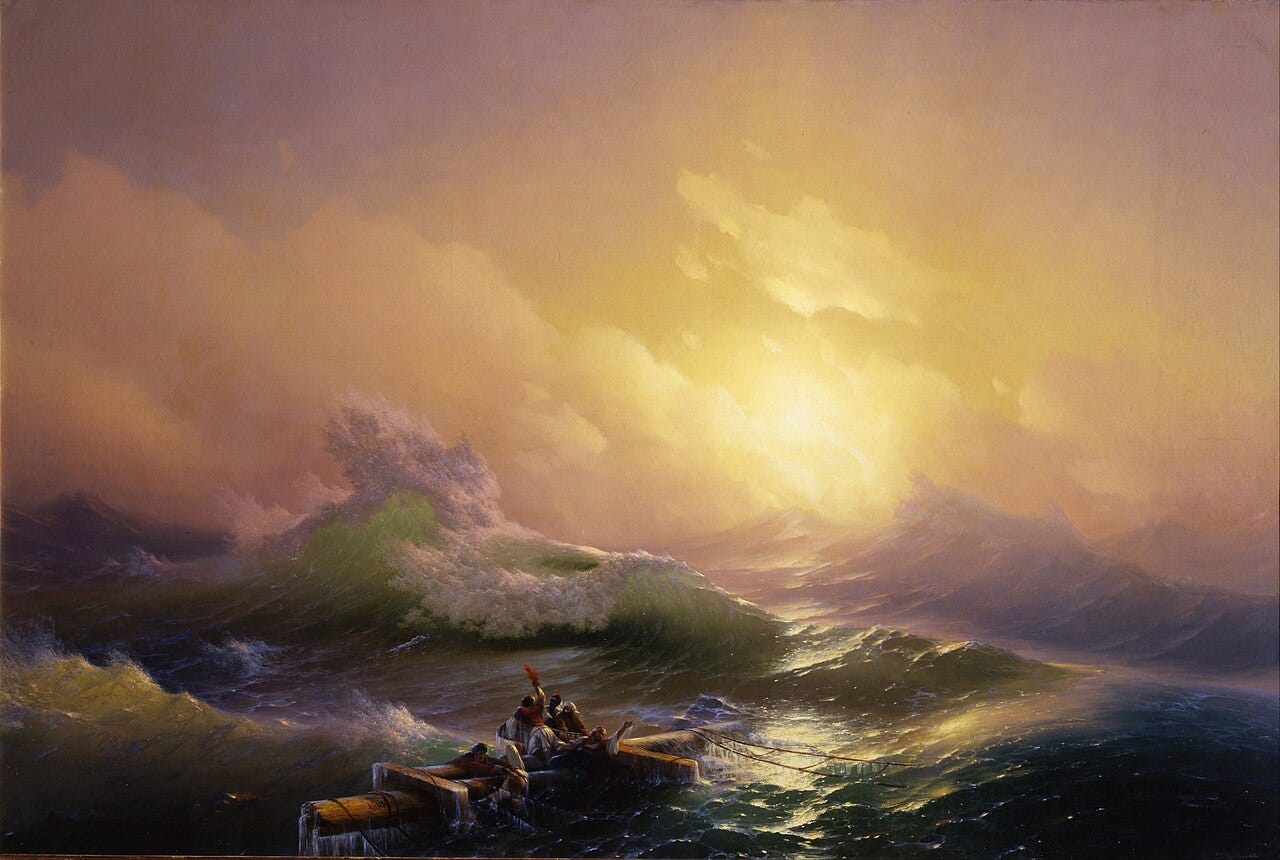
1850: The Ninth Wave, dawn survivors on a broken mast, becomes the most beloved painting in Russia.
1888: pipes drinking water from his own estate's spring into a Feodosia gone dry, free of charge.
1900: dies at 82 with a battle scene unfinished on the easel, roughly 6,000 paintings behind him.
An Armenian boy in Feodosia
Hovhannes Aivazian was born on July 29, 1817, in Feodosia, Crimea, to a poor Armenian family, and drew ships in charcoal on the town's walls before a governor noticed.
The St Petersburg Academy gave him its gold medal, and a European tour in the early 1840s made him famous young: in Rome in 1842 his seascapes so struck the aging Turner that he wrote verses in their honor.
By 1844, at 27, he was official painter to the Russian Navy.
6,000 paintings, zero painted at sea
Aivazovsky insisted that waves cannot be copied from life because they never hold still, so he watched, memorized, and painted in a studio whose windows faced away from the water.
The system produced roughly 6,000 works and about 55 solo exhibitions in his lifetime, numbers no marine painter has approached.
The Ninth Wave of 1850, survivors clinging to a mast under a green mountain of water lit from behind, remains the most famous Russian seascape ever painted.
More incredible painter stories
If Ivan Aivazovsky pulled you in, you will love these too:
The patriot of two nations
He never left Feodosia for the capitals.
He opened one of the Russian Empire's first provincial public art galleries there in 1880, piped water from his estate to the town's fountains in 1888, and backed the port and railway campaigns.
When the massacres of Armenians began in the Ottoman Empire in the 1890s, Aivazovsky, then almost eighty, painted the atrocities and renounced the decorations the Ottoman court had given him.
The myth of the kitsch wave machine
Six thousand canvases invite the sneer of a production line, and plenty are routine.
The correction is in the method and the best hundred: painting the sea from memory is a feat of visual retention closer to a musician's ear than to souvenir work, and at his peak, moonlight through storm spray, the transparency inside a cresting wave, no one has matched him since.
The market agrees, with his top canvases selling in the millions.
Death at the easel, and where to see him
Aivazovsky died in Feodosia on May 2, 1900, at 82, leaving Explosion of a Turkish Ship unfinished on the easel, a career that began and ended mid-wave. The Aivazovsky National Art Gallery in Feodosia, the Russian Museum in St Petersburg with The Ninth Wave, and the Tretyakov hold the core, and the National Gallery of Armenia in Yerevan keeps his other allegiance.
The navy's painter
From 1844 he held an official post: painter to the Russian Navy's General Staff, with access to maneuvers, logbooks and captains who checked his rigging.
Battle pictures were state commissions. He painted Sinop within weeks of the battle, from survivor accounts and his knowledge of every ship involved.
That access resolves the paradox of the studio sailor: he did not need the deck; he had the entire navy as a fact-checking department.
The water trick
The transparent wave was a repeatable method and he never hid it: thin glazes over a light ground, the crest scraped back so the ground glows through the water.
He painted at demonstration speed, sometimes finishing a canvas before an audience in a couple of hours, a century before performance painting had a name.
Six thousand paintings is not a scandal of mass production; it is a perfected method multiplied by a long life and an ocean of demand.
Feodosia's benefactor
The money went home. Besides the water, he founded the town's art school and gallery, dug for antiquities, and lobbied the railway into existence.
The gallery went to the city outright at his death, paintings included.
Visitors have entered the Aivazovsky Gallery on his terms for over a century: the sea, handed back to the town that raised him.
The Ivan Aivazovsky questions that keep coming up
How many paintings did Aivazovsky make? Around 6,000, one of the largest bodies of work of any painter in history, almost all marine subjects.
What is The Ninth Wave? His 1850 canvas of shipwreck survivors facing a huge backlit wave at dawn, named for the sailors' belief that the ninth wave is the deadliest. It hangs in the Russian Museum.
Did Aivazovsky paint from life? No. He held that moving water cannot be posed, so he painted entirely from memory, often finishing large canvases in days.
Where can I see Aivazovsky? The gallery he founded in Feodosia, the Russian Museum in St Petersburg, the Tretyakov in Moscow, and the National Gallery of Armenia in Yerevan.
How much does an Aivazovsky cost? View of Constantinople and the Bosphorus brought 5.2 million dollars in 2012, his record; good marines trade constantly in the hundreds of thousands.
Did he only paint the sea? Mostly, not only: Armenian subjects, Ukrainian steppes, portraits and biblical scenes exist. The sea outsold everything, and he obliged.
More secrets to unlock
A poem from Turner, a death at the easel
Turner, the greatest sea painter of the West, met the 25-year-old Aivazovsky's work in Rome and answered it with a poem. Sixty years later the old man of Feodosia died painting the sea he had never once painted from.