Jackson Pollock: The Complete Story

In August 1949 Life magazine asked if Jackson Pollock was the greatest living painter in the United States. Seven years later he was dead on a country road, and sixty years later a single drip painting changed hands for about 200 million dollars.

Between the cowboy myth and the tragedy sits the actual work: three years of controlled pouring that changed what a painting could be.

Pollock at a glance:

  • Born in Cody, Wyoming, in 1912, youngest of five brothers.

  • Studied under Thomas Hart Benton, whose rhythms survive under every pour.

  • The drip period lasted barely three years, 1947 to 1950.

  • Life magazine asked in 1949 if he was the greatest living American painter.

  • Number 17A reportedly sold for about 200 million dollars in 2015.

Portrait photograph of the painter Jackson Pollock
Jackson Pollock.

Cody, Benton, and the long apprenticeship

Pollock was born in Cody, Wyoming, on January 28, 1912, the youngest of five brothers, and grew up in Arizona and California.

At the Art Students League in New York from 1930 he studied under Thomas Hart Benton, whose muscular rhythms survive under every later pour.

Through the Depression he worked for the WPA mural program, wrestled with alcoholism, and filled notebooks during Jungian analysis begun in 1939.

Peggy Guggenheim and the Mural legend

In 1943 Peggy Guggenheim commissioned Mural, roughly six meters of canvas for her townhouse hallway, and legend says Pollock painted it in one frenzied night.

Conservation study has quietly retired that story, finding layers that dried over weeks, which is the useful correction in miniature: the wildness was staged over time, with craft.

In 1945 he married Lee Krasner and moved to a farmhouse in Springs, Long Island, where the barn became the most famous studio floor in art.


Hooked on Pollock? Get more art secrets and stories in your inbox, free.


More incredible painter stories

If Jackson Pollock pulled you in, you will love these too:


1947-1950: the drip years

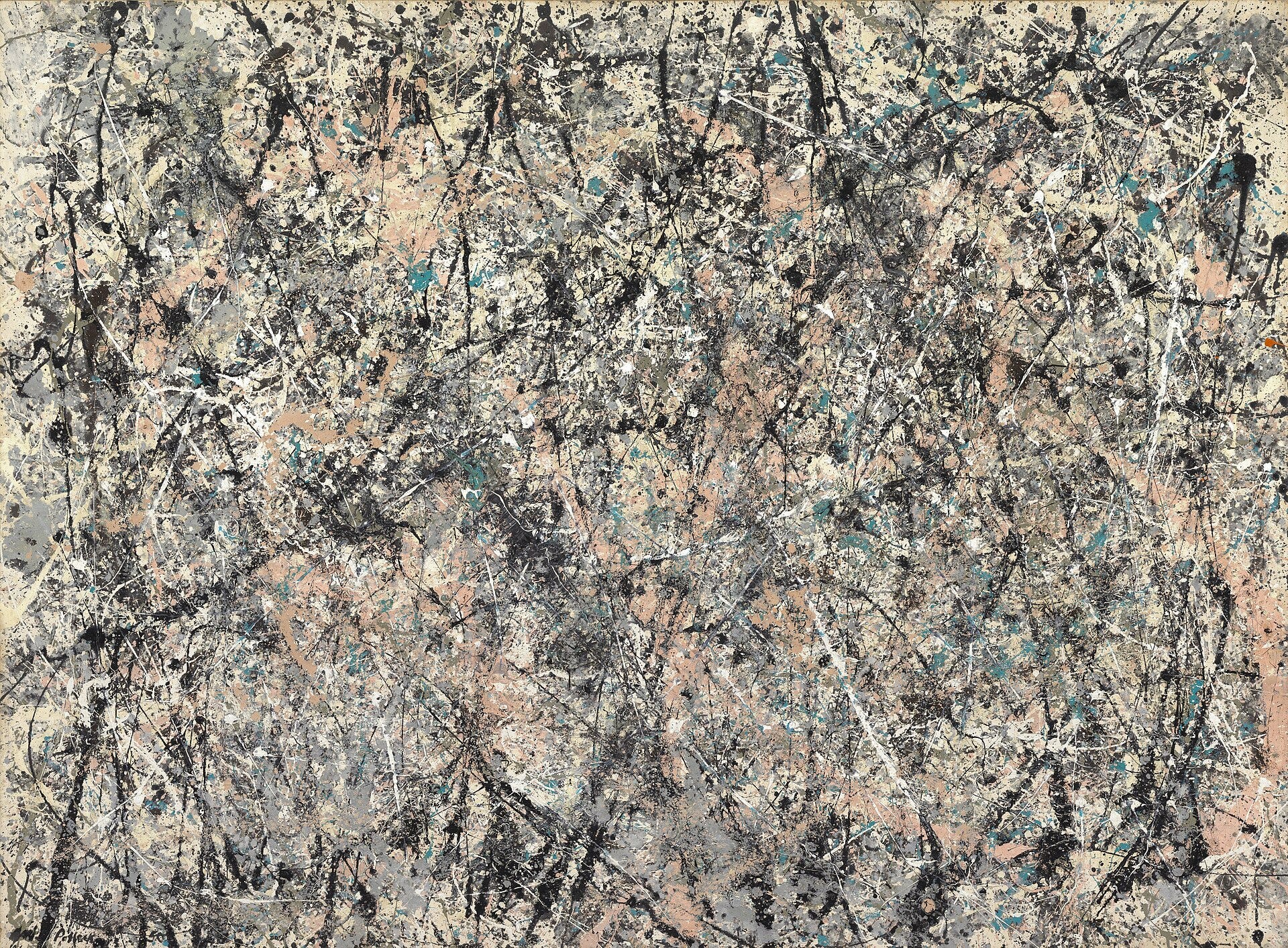
For three years Pollock laid canvas flat and moved around it, flinging and pouring house paint from sticks and hardened brushes, working from all four sides.

Autumn Rhythm, Lavender Mist, and One: Number 31 came out of that barn in barely more than thirty months.

The Life article of August 1949 made him the first American painter to be famous the way actors were famous, and Hans Namuth's 1950 photographs and film fixed the image of the painter as dancer.

The myth: anyone could splatter that

Pollock answered the charge himself, insisting he denied the accident: the skeins were placed by a body that had drawn for twenty years, and he discarded canvases that escaped control.

Later analyses of the drip paintings found fractal structure consistent across scales, and forgers keep failing to fake them convincingly.

The filming ended badly anyway: the day shooting stopped in November 1950, he began drinking again after two dry years, and the drip period was effectively over.


130,000 readers learn art the fun way here. Join them, free.


The crash, and where to see him

Pollock painted the darker black pourings of 1951, then almost nothing. On August 11, 1956, drunk at the wheel near Springs, he crashed his Oldsmobile, killing himself at 44 and a passenger, Edith Metzger.

Krasner spent three decades stewarding the estate.

One: Number 31 is at MoMA, Autumn Rhythm at the Met, Lavender Mist at the National Gallery in Washington, and Mural at the University of Iowa, while reported private sales of Number 17A and No.

5, 1948 sit around 200 and 140 million dollars.

How a drip painting is actually made

Pollock stood over canvas laid flat, moving around all four sides with sticks, basting syringes, and brushes hardened into wands.

The paint was commercial enamel, chosen for how it flows. He controlled density by speed of gesture and distance of fall, and stopped when the web balanced.

Watch Namuth's 1950 film and the word splatter dies: it is closer to choreography with gravity as a partner.

The physics inside the web

Researchers who analyzed the drip paintings found fractal patterns, self-similar at different scales, consistent across his mature work.

The finding is debated as an authentication tool, but it matches what forgers report: the hand is unfakeable at speed. Copies read as noise; Pollocks read as weather.

What Springs preserves

The Pollock-Krasner House at Springs keeps the barn floor exactly as he left it, overshoot arcs and all, and visitors walk it in soft slippers.

Look down and you are inside the paintings' negative: every arc on that floor missed a canvas that now hangs in a museum.

The Jackson Pollock questions that keep coming up

  • Did Pollock just splatter paint randomly? No. He worked from the wrist, arm, and whole body with practiced control, said he denied the accident, and destroyed pours that failed. Analyses find consistent structure forgers cannot reproduce.

  • How much is a Pollock worth? Reported private sales reach about 200 million dollars for Number 17A in 2015, with No. 5, 1948 at around 140 million in 2006.

  • How did Pollock die? In a drunk-driving crash near his Springs home on August 11, 1956, at 44, which also killed Edith Metzger, a passenger.

  • Where can I see Pollock? MoMA and the Met in New York, the National Gallery in Washington, the University of Iowa for Mural, and the Pollock-Krasner House in Springs, paint-spattered floor intact.

  • Did Pollock use house paint? Yes, commercial enamels like Duco, partly for cost, mostly for flow. Conservation science now studies those unstable paints intensively.

  • What is the Pollock-Krasner House? Their farmhouse and barn studio at Springs, Long Island, preserved with the painted floor intact and open for visits.


More secrets to unlock


One last fact

The barn floor in Springs still carries the overshoot of every drip painting Pollock made there, and visitors walk it in felt slippers: the most valuable square meters of paint in America are the ones that missed.


Learn art the fun way. Get the next story in your inbox, free.