Parmigianino: The Complete Story

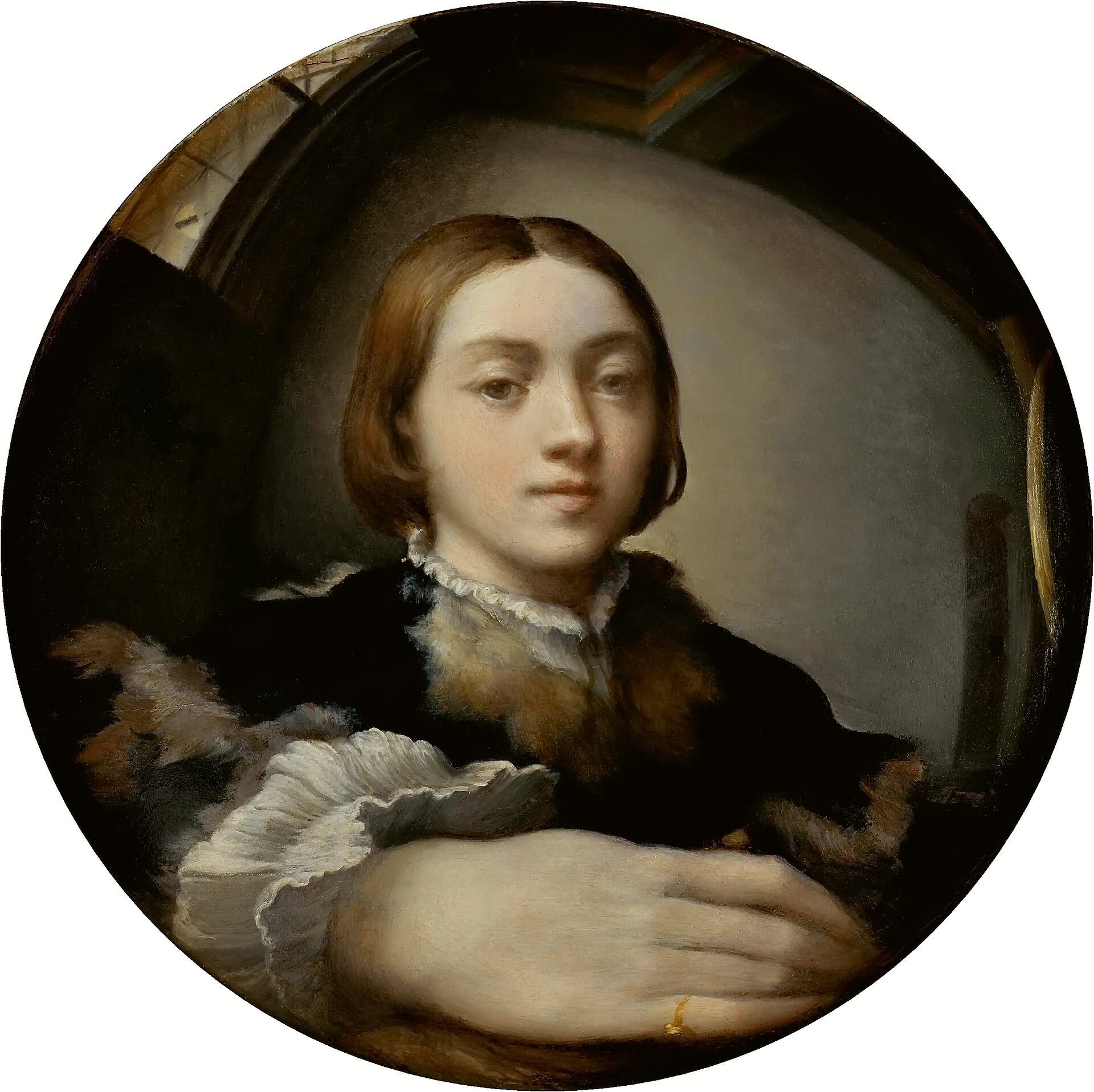
At twenty one, a young painter stared into a barber convex mirror and painted exactly what he saw: his own calm face at the centre, and in the foreground a hand swollen huge and curved by the bulging glass. The self portrait stunned Rome, and announced Parmigianino, the prodigy who would push grace to the very edge of strangeness.

Madonna with the Long Neck by Parmigianino
Parmigianino, Madonna with the Long Neck, c 1535

He became a founder of the elegant, artificial style we call Mannerism, painting figures of impossible, stretched beauty, before his life took a stranger turn into alchemy and ruin.


The strangest talents in art, free in your inbox.


Elegance pushed past nature

Parmigianino is a master of Mannerism, the style that took the balance of the High Renaissance and deliberately bent it: longer limbs, smaller heads, sinuous poses held with cool, artificial grace.

His most famous painting, the Madonna with the Long Neck, stretches its figures into something unreal and gorgeous, pure Mannerism.

The self portrait in a curved mirror

Self portrait in a convex mirror by Parmigianino
Parmigianino, Self Portrait in a Convex Mirror, 1524

His breakthrough was that self portrait in a convex mirror, painted on a specially curved panel to match the distortion, with the swollen hand reaching out at the viewer.

It is one of the most daring images in the whole history of self portraiture, a young artist showing off and questioning vision itself in one move.

Pioneer of the print

Cupid Making His Bow by Parmigianino
Parmigianino, Cupid Making His Bow

Parmigianino was also one of the first Italian artists to make his own prints, taking up etching and helping develop the chiaroscuro woodcut, which used several blocks to print tone like a wash.

By turning his elegant designs into prints, he spread his style across Europe without leaving his studio, an early grasp that an image could live as a reproducible object.

The escape and the obsession

Vision of Saint Jerome by Parmigianino
Parmigianino, Vision of Saint Jerome, 1527

His life grew turbulent. When the imperial army sacked Rome in 1527, Parmigianino reportedly kept working as soldiers burst into his room, so struck by the painting that they spared him.

Later he became consumed by alchemy, neglecting commissions, including a chapel he left unfinished, and he died at just thirty seven, his promise half spent on the search to make gold.

Parmigianino, briefly answered

What is he known for?

Mannerist paintings of stretched, elegant grace, above all the Madonna with the Long Neck.

What is the convex mirror self portrait?

A panel painted to match a curved mirror, with his hand swollen huge in front.

Why did his career falter?

He became obsessed with alchemy and left work unfinished.

When did he die?

In 1540, aged thirty seven.

Why the long neck still fascinates

Parmigianino took beauty and tilted it just past the natural into something cool, strange and unforgettable. He died young with his gifts half wasted on alchemy, yet that one stretched Madonna and that swollen hand in a mirror keep him among the most original artists of his century.


110,000 people read Cool Stories About Art every week. Join free.


He chased the dream of turning base metal into gold and let his real gold, his painting, slip through his fingers. The greatest alchemy he ever performed was on the human figure, which he stretched into pure, strange elegance. His Madonna with the Long Neck was itself left unfinished at his death, the elongated grace above and the bare, incomplete base below telling the whole story of a genius who reached too far in too many directions at once. He remains one of the most beautiful warnings in art about a gift half spent.


Get the secrets behind the paintings. Free, every week.