Peter Paul Rubens: The Complete Story

Rubens self portrait in a black hat
Self Portrait, Peter Paul Rubens, around 1623.

Peter Paul Rubens was a Flemish Baroque painter who became the richest and most powerful artist in Europe, ran a workshop that produced more than a thousand paintings, and doubled as a diplomat who helped broker peace between Spain and England.

He painted gods, kings and full figured nudes with the same restless energy. Four centuries later, his name still describes a body type.


Hooked on Rubens? Get more art secrets and stories in your inbox, free.


The painter who ran a factory

Rubens did not work alone. From his grand house in Antwerp he ran a studio of assistants and specialists, one painting flowers, another animals, another drapery. The young Anthony van Dyck, who became a master in his own right, trained there. Clients could even pay by the level of finish: more money meant more of the master's own hand. Around fourteen hundred works carry his name.

An artist with a diplomatic passport

Rubens tiger and lion hunt scene
Tiger and Lion Hunt, Peter Paul Rubens.

Rubens was knighted by both Philip the Fourth of Spain and Charles the First of England. He spoke several languages, carried letters between courts, and used his fame as a painter as cover for real political missions. Few artists in history held that kind of power at a royal table.

The eight years that made him

Before any of this, Rubens spent eight years in Italy, from 1600 to 1608. He copied Titian for the color, studied Michelangelo and the ancient statues for the muscle, and absorbed the raw light of Caravaggio. He came home to Antwerp with all of it fused into one style, and a reputation that made him the painter every court in Europe wanted.

The Marie de Medici cycle, propaganda in twenty four canvases

Rubens Feast of Venus mythological scene
The Feast of Venus, Peter Paul Rubens.

The queen mother of France handed him one of the largest commissions in art history: twenty four enormous canvases that turned her troubled life into glorious myth, gods and all. The series now fills a room of its own at the Louvre.


150,000 readers get one art story a week. No jargon, just the good parts.


Where the word Rubenesque comes from

Rubens Fall of the Damned tumbling figures
The Fall of the Damned, Peter Paul Rubens.

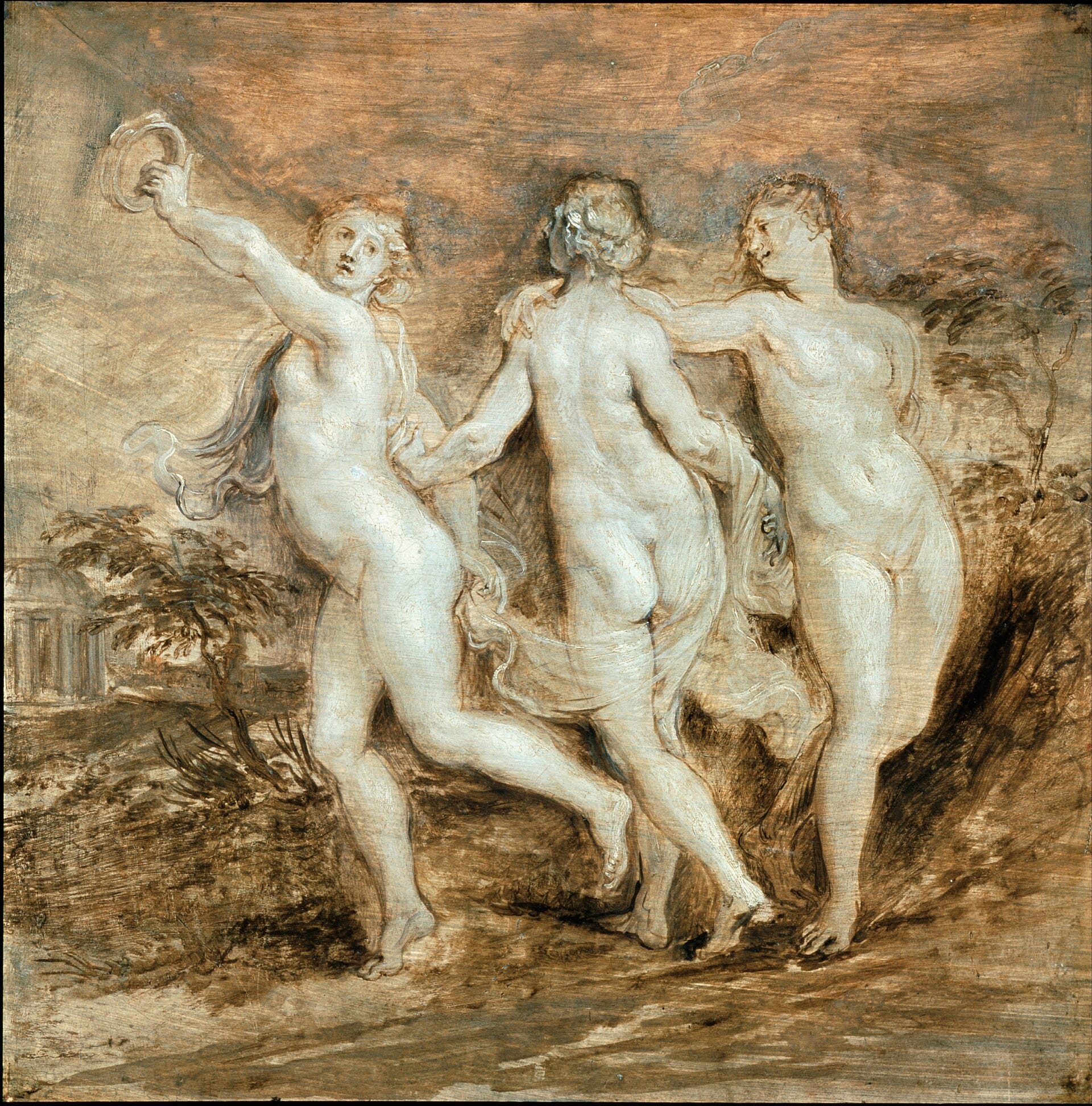
His women are soft, ample and full figured, from the dancing trio of the Three Graces to the portrait of his young second wife wrapped in fur. The body ideal he painted was so distinct that we still call it Rubenesque. There is a real reason behind it, explained here: what does Rubenesque mean.

Inside the Baroque engine room

Rubens altarpiece triptych in Antwerp
A monumental altarpiece by Rubens, Antwerp.

Rubens is the engine of the Baroque: swirling diagonals, bodies in motion, drama in every corner. He took the hard light of Caravaggio and the warm color of the Venetians and fused them into oil paint that almost breathes. Where Rembrandt turned inward and quiet, Rubens went outward and loud.

The works to know

Rubens countryside landscape
A late landscape by Rubens.

A handful of paintings sit at the center of his fame: Samson and Delilah, The Descent from the Cross, the brutal Massacre of the Innocents, the grim Saturn, and the tender Garden of Love. Each one is a story in itself, and each rewards a slow, close look.

Quick answers about Rubens

  • Who was Peter Paul Rubens? The leading painter of the Flemish Baroque and a working diplomat.

  • When was he born? In 1577, in Siegen, and raised in Antwerp.

  • How did he die? In 1640, in Antwerp, from heart failure linked to gout.

  • Why is he famous? For his energy, his color, his huge workshop, and the body type named after him.

  • Is he the same as Paul Reubens? No. Paul Reubens was a modern American actor. This is the Flemish painter, born 1577.

  • What art movement did Rubens belong to? The Baroque, which he drove forward across northern Europe.

One number says it all about his pull today. In 2002 his Massacre of the Innocents sold for around forty nine million pounds, a record for an Old Master at the time, after spending years mislabeled as the work of an assistant.


Learn art the fun way. One email, every week, free.