
Caravaggio was the most dangerous man in European painting, a street fighter with a sword and a death sentence who also reinvented how light falls on a canvas.
In barely fifteen years he turned saints into ordinary people, killed a man, ran for his life, and died at 38. He was one name among twelve painters who built the Baroque on exactly that kind of drama, gathered in the movement's greatest painters.
The thug and the genius lived in one body. That is the whole story.
And almost everything the museum label leaves out is the good part. He painted holy figures using prostitutes and beggars as models, dirt still on their feet. He worked with no drawings, straight onto the canvas.
He left a trail of police reports across Rome. For almost 300 years after his death the art world treated him as an embarrassment.
Five things to know first:
He was born in 1571 near Milan and died in 1610, aged 38, on the Tuscan coast.
His signature move is tenebrism: deep black, one hard light, no escape for the eye.
He used real, poor people as models for saints, and refused to clean them up.
He killed Ranuccio Tomassoni in 1606 and spent his last four years a wanted man.
He was nearly forgotten for centuries, and only rediscovered around 1951.
More incredible painter stories
If Caravaggio pulled you in, you will love these too:


His whole life pivots on one night in 1606, so that is where we begin.
Caravaggio at a glance
1571. Born Michelangelo Merisi in Milan. Plague soon drove the family to the town of Caravaggio.
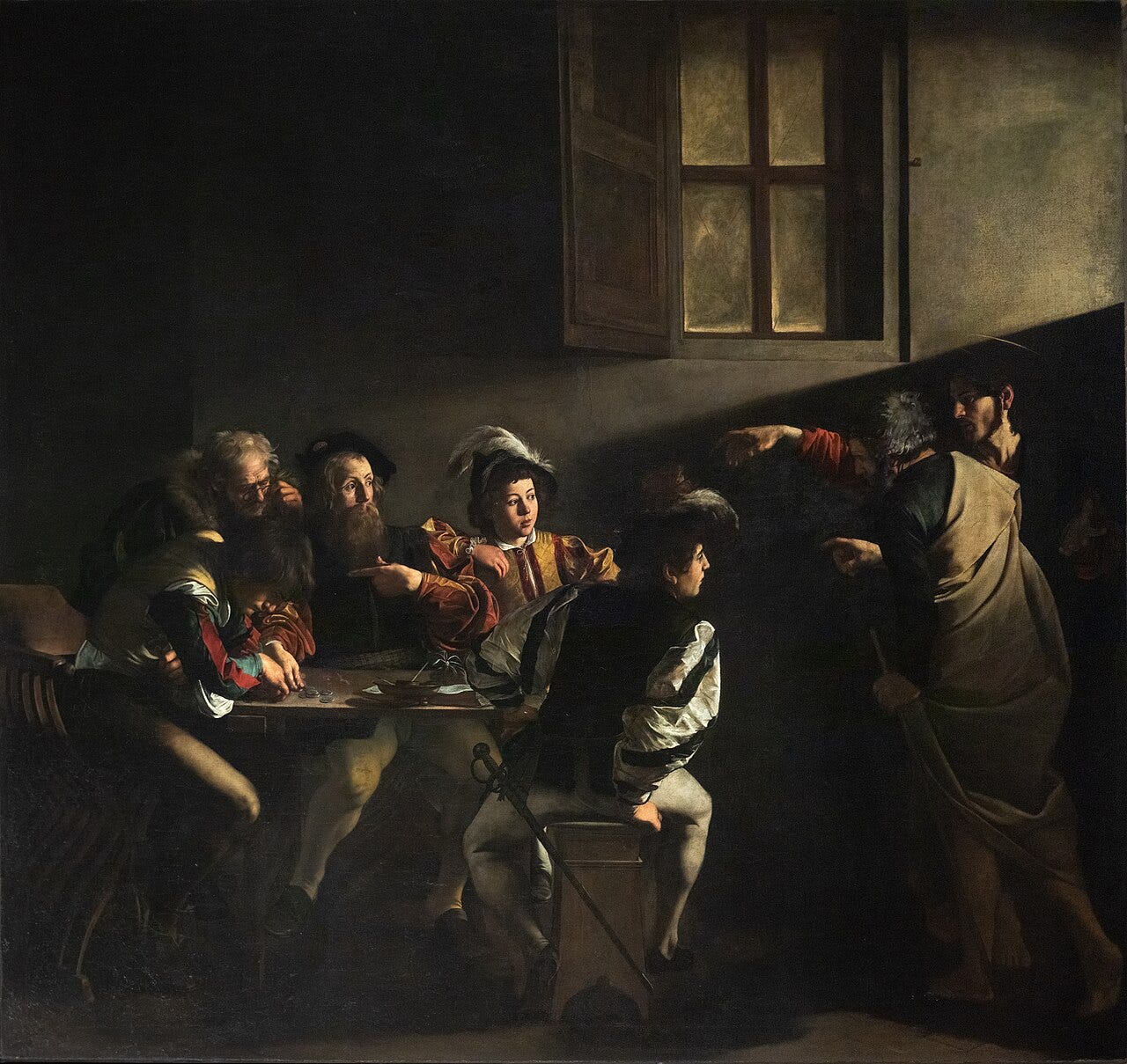
1600. The Calling of Saint Matthew made him the most talked about painter in Rome.
1606. Killed Ranuccio Tomassoni in a duel and fled Rome under a death sentence.
1608. Knighted in Malta, then jailed and expelled after another brawl.
1610. Died at Porto Ercole at 38, waiting for a papal pardon that arrived too late.
The night that broke his life
On 28 May 1606, in a planned, armed fight near a Roman tennis court, Caravaggio killed a young man named Ranuccio Tomassoni.
It was not a drunken accident. Both sides came with blades and companions, in the manner of a duel over honor. Caravaggio struck Ranuccio in the thigh, cut the artery, and the man bled to death.
A papal court sentenced him to death in his absence. The order, a bando capitale, meant anyone in the Papal States could kill him on sight and collect a reward.
The most celebrated painter in Rome became a fugitive overnight, and stayed one until he died.
I tell the full story of that night in Did Caravaggio Kill Someone.
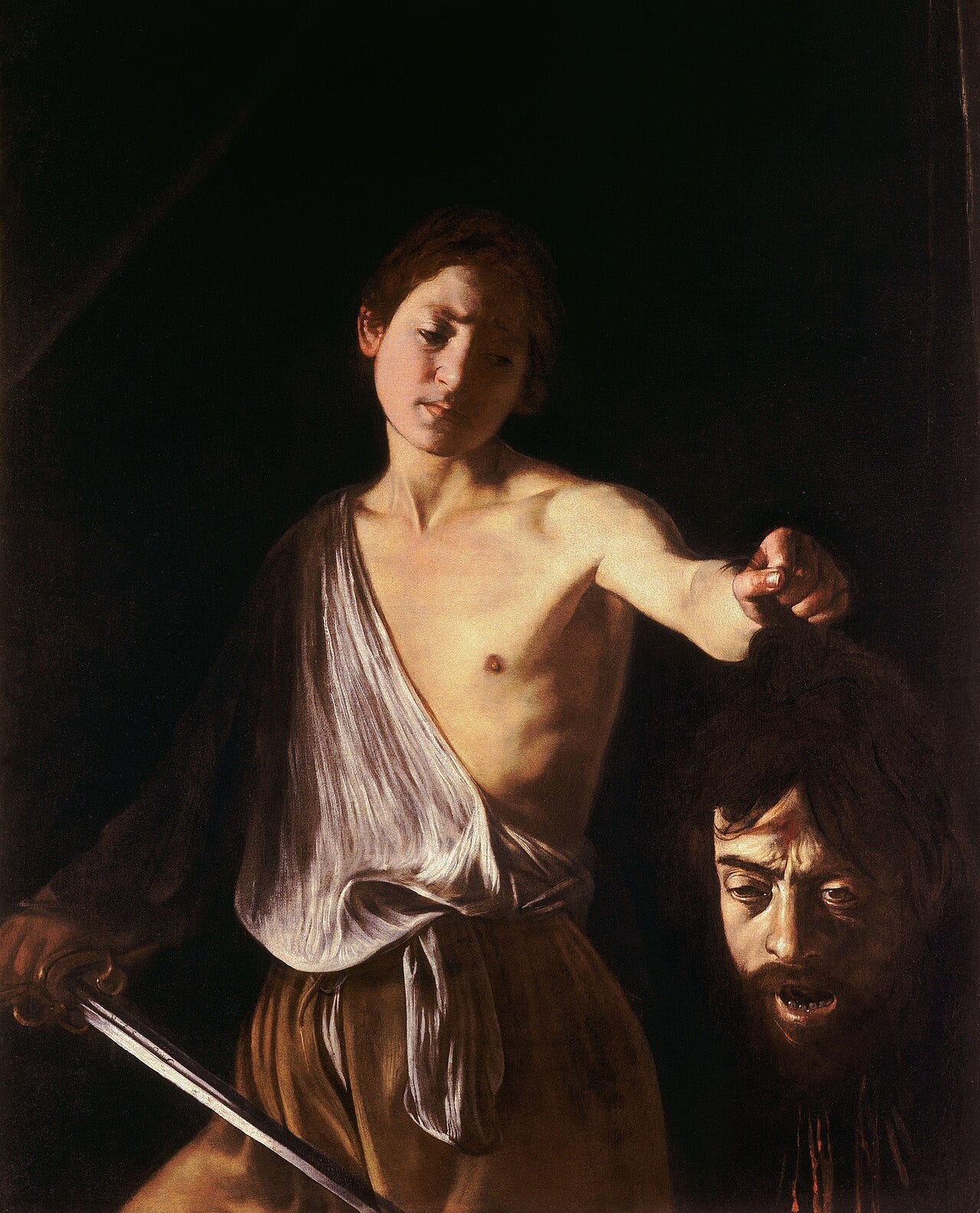
After the killing, severed heads fill his work. He painted David holding the dripping head of Goliath and gave the dead giant his own face, a self portrait as the executed criminal, almost certainly sent to the cardinal who could grant his pardon.
He kept painting his way out of the noose.
How a plague orphan conquered Rome
To understand the violence, rewind to the death that opened his life.
He was born Michelangelo Merisi in 1571, near the town of Caravaggio. When he was six, the plague killed his father, grandfather and uncle in a single day.
He trained as a teenager in Milan under Simone Peterzano, who had learned in the orbit of Titian, and came out with a hard Lombard taste for plain truth.
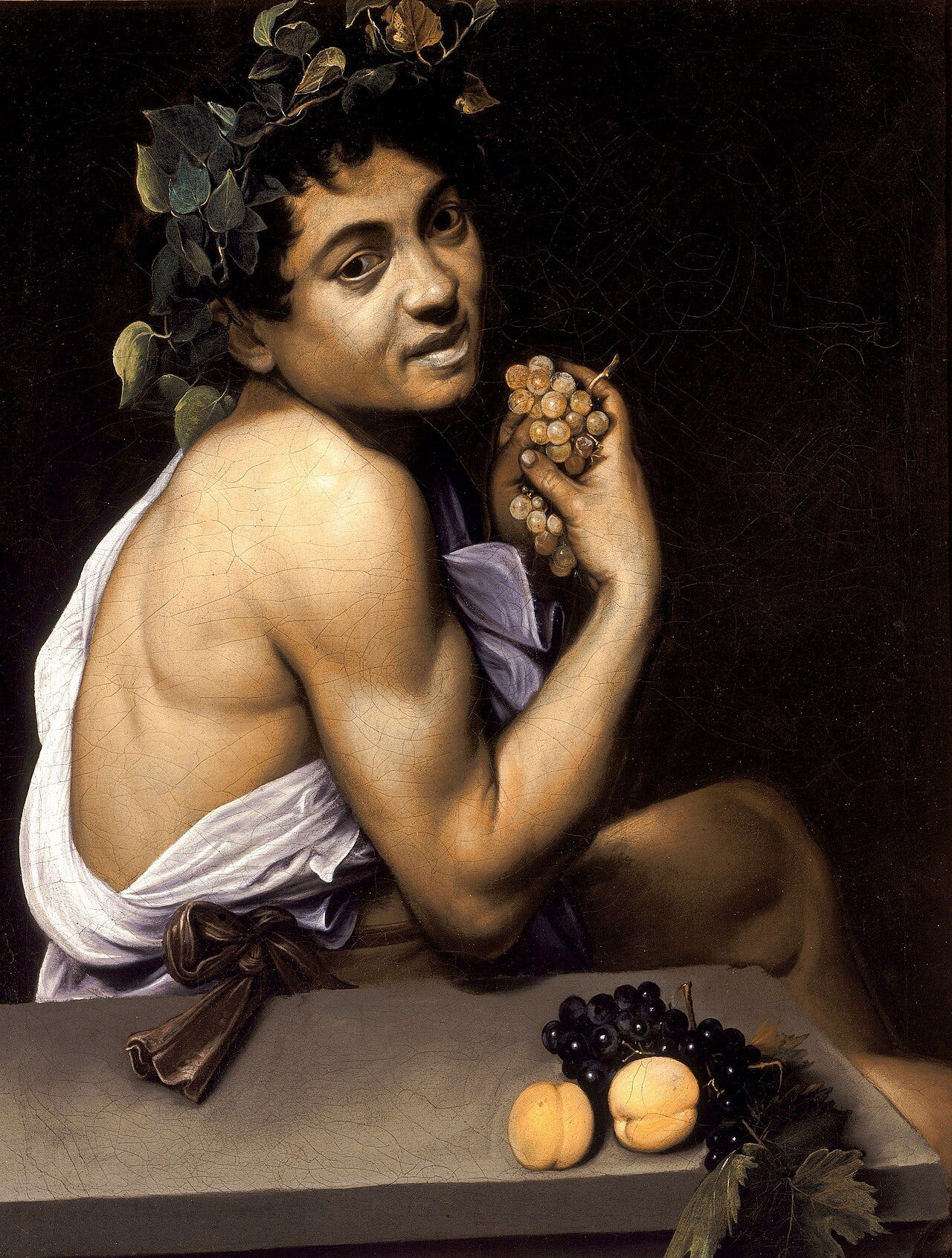
Around 1592 he arrived in Rome with nothing, grinding out fruit and flowers in the corners of other men’s paintings. He was poor enough to land in a hospital, where he probably painted his own sickly green face into a small self portrait.
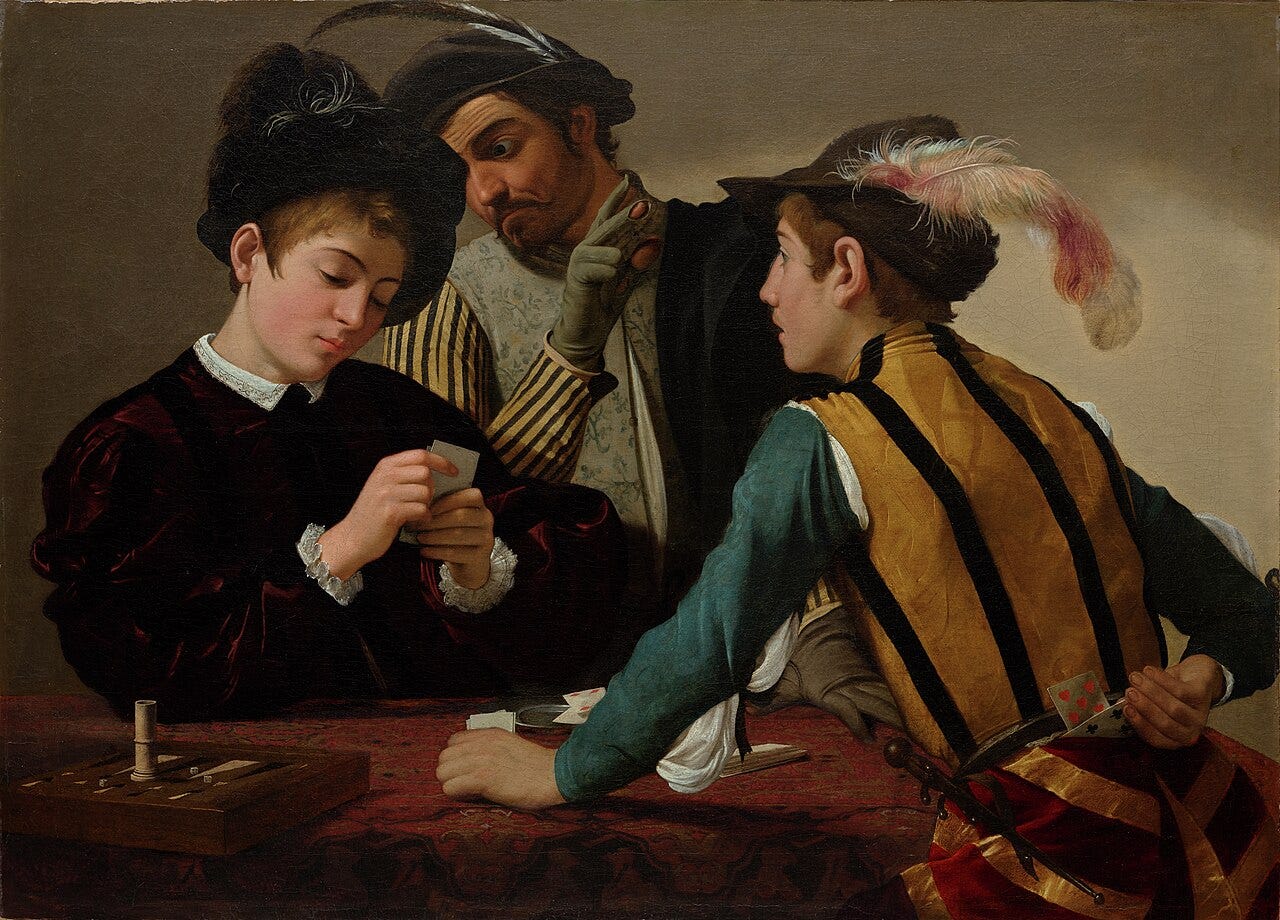
Everything turned when Cardinal Francesco Maria del Monte noticed him around 1595, bought The Cardsharps, and gave him a room in his palace. With that backing, the door to Rome’s richest patrons swung open.
Fame arrived in one night. In 1600 he unveiled the side walls of the Contarelli Chapel in San Luigi dei Francesi.
The Calling of Saint Matthew stopped the city cold: a shaft of light cutting across a dark tavern, landing on a tax collector at the instant Christ points him out.
Every man is dressed in the clothes of Caravaggio's own day. Overnight he was the most talked about painter in Rome.
Read one painting: The Calling of Saint Matthew
Spend a minute inside that one canvas and you understand the whole man.
Christ enters from the right, half hidden in shadow, and lifts his hand toward a table of men counting money. The hand is borrowed on purpose.
It echoes the hand of Adam reaching toward God in Michelangelo’s Sistine ceiling, so the gesture of creation becomes the gesture of calling.
Then comes the puzzle scholars still argue about. Which man is Matthew? For centuries everyone read it as the bearded man pointing to his own chest, as if to say “me?
” Lately some insist Matthew is the young man at the end of the table, head down, still counting his coins, too sunk in money to notice God has walked in.
Caravaggio leaves it open. That refusal to spell it out, in a picture meant to teach, is exactly what made him feel modern and made the priests nervous.
Saints with dirty feet
His realism was the point, and it kept getting him thrown out of churches.
He used the people around him as models, prostitutes for the Virgin, laborers for apostles, and refused to tidy them. The pilgrims in his Madonna of the Pilgrims kneel with filthy soles toward us.
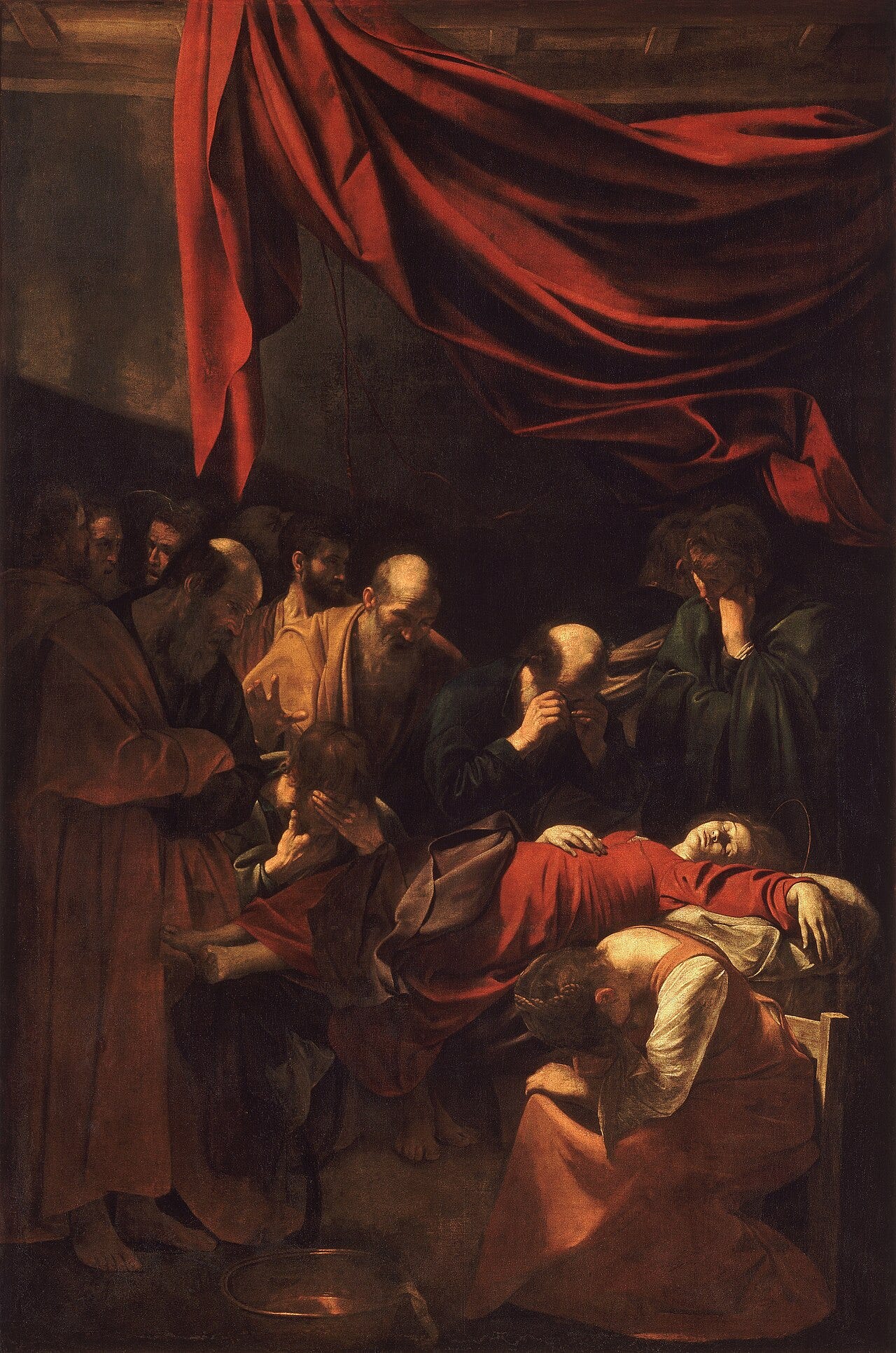
His Death of the Virgin was rejected by the church that ordered it, because the dead Mary looked like a swollen corpse, with a rumor that the model was a drowned woman.
His first Saint Matthew and the Angel showed the saint as a bald, barefoot peasant whose hand an angel guided like a struggling pupil. The priests refused it. He painted a calmer second version.
To Caravaggio the rejected ones were the holy ones. God among the real poor, not a pageant.
Armed, and looking for trouble
Fame did not calm him. It armed him.
The Roman police records read like a charge sheet. A sword carried without a permit. A plate of cooked artichokes thrown at a waiter.
Brawls, insults, stones at a landlady’s shutters. He moved through the city hunting a fight and usually finding one, until the night the fight turned fatal.
The rival who hated him
Some of what we know about Caravaggio comes straight from a man who could not stand him.
Giovanni Baglione was a successful Roman painter who copied Caravaggio’s style and got mocked for it. Caravaggio and his friends passed around crude poems ridiculing Baglione’s work.
In 1603 Baglione hit back with a libel suit, and Caravaggio landed in jail over a few dirty verses.
Decades later Baglione wrote one of the first lives of Caravaggio, sour and grudging, yet packed with detail. A large part of the legend, the temper, the arrogance, the danger, reaches us through the pen of an enemy.
Worth remembering before you take every story as gospel.
Four years on the run
Exile turned him into a wanderer painting for his life.
He fled first to estates south of Rome, then to Naples, then sailed to Malta in 1607. There he talked his way into the Knights of Malta and was made a knight himself, an astonishing leap for a commoner with a murder charge.
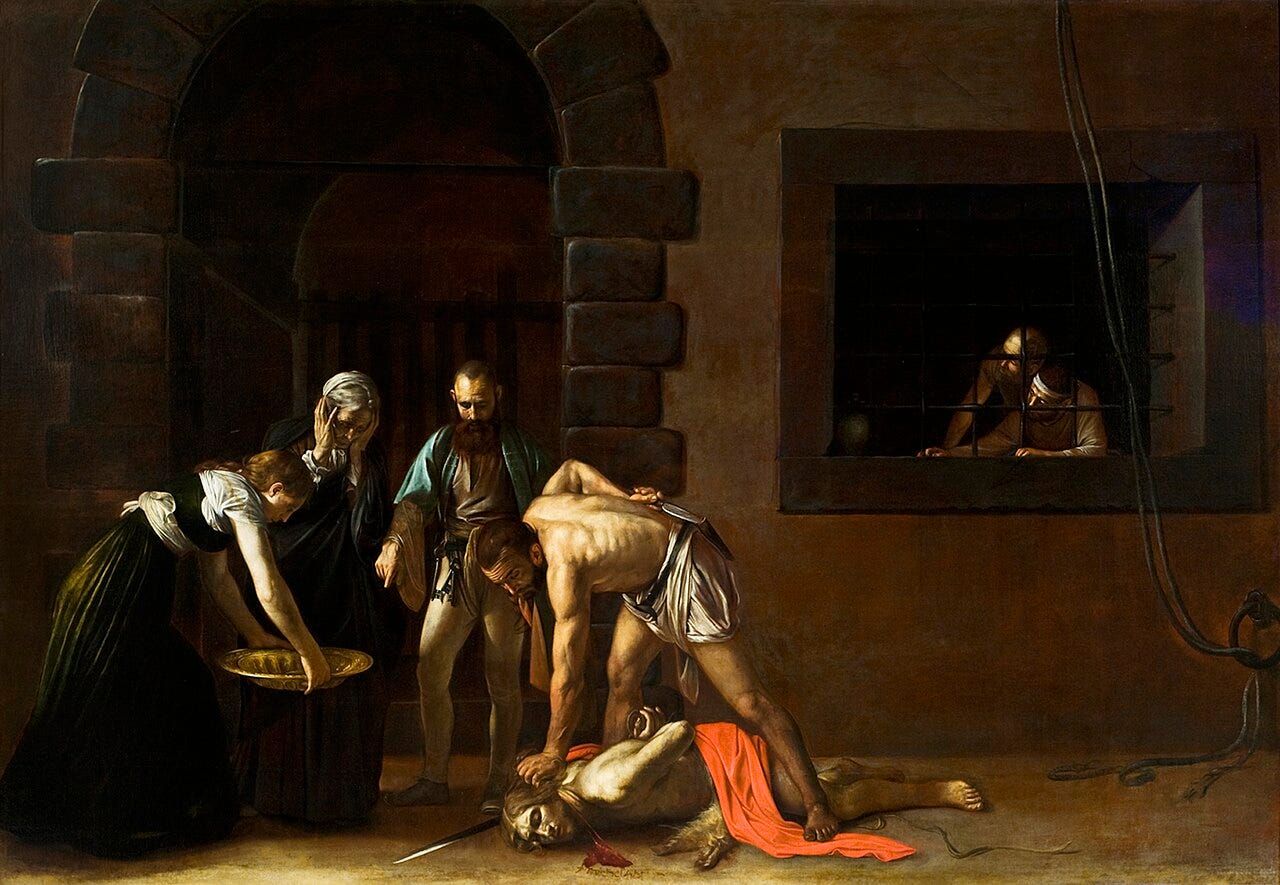
For their cathedral in Valletta he painted his largest canvas, The Beheading of Saint John the Baptist, the only work he ever signed.
Then he brawled with a senior knight, was jailed, escaped, and was expelled from the order he had just joined. He ran on to Sicily, working fast in Syracuse, Messina and Palermo, his style growing darker at every stop.
One Palermo altarpiece, a Nativity, was cut from its frame and stolen in 1969, never recovered, the subject of The Mafia and the Missing Caravaggio.
Back in Naples he was ambushed outside a tavern and his face was badly cut. Still chasing a pardon, he loaded paintings onto a boat in 1610 and sailed north.
He died at Porto Ercole within days, aged 38, of causes still argued over, and his body was never properly found. I dig into it in How Did Caravaggio Die.
The people who carried him
A handful of protectors kept this impossible man alive and working.
Simone Peterzano, the Milan master who trained him.
Cardinal del Monte, the patron who made his Roman career.
Costanza Colonna, the marchesa who shielded him from childhood to his final voyage.
Mario Minniti, the painter friend who modeled for him and found him work in Sicily.
Scipione Borghese, the art hungry cardinal who collected him and dangled the pardon.
Ranuccio Tomassoni, the man he killed.
The cities that used him up
His life reads as a line that starts in a studio and ends as a manhunt: Milan for the plague and the training, Rome for the fame and the killing, Naples for refuge and then the ambush, Malta for the knighthood and the signed altarpiece, Sicily for the dark late altarpieces, and Porto Ercole for the beach where it ended.
Painting with the lights off
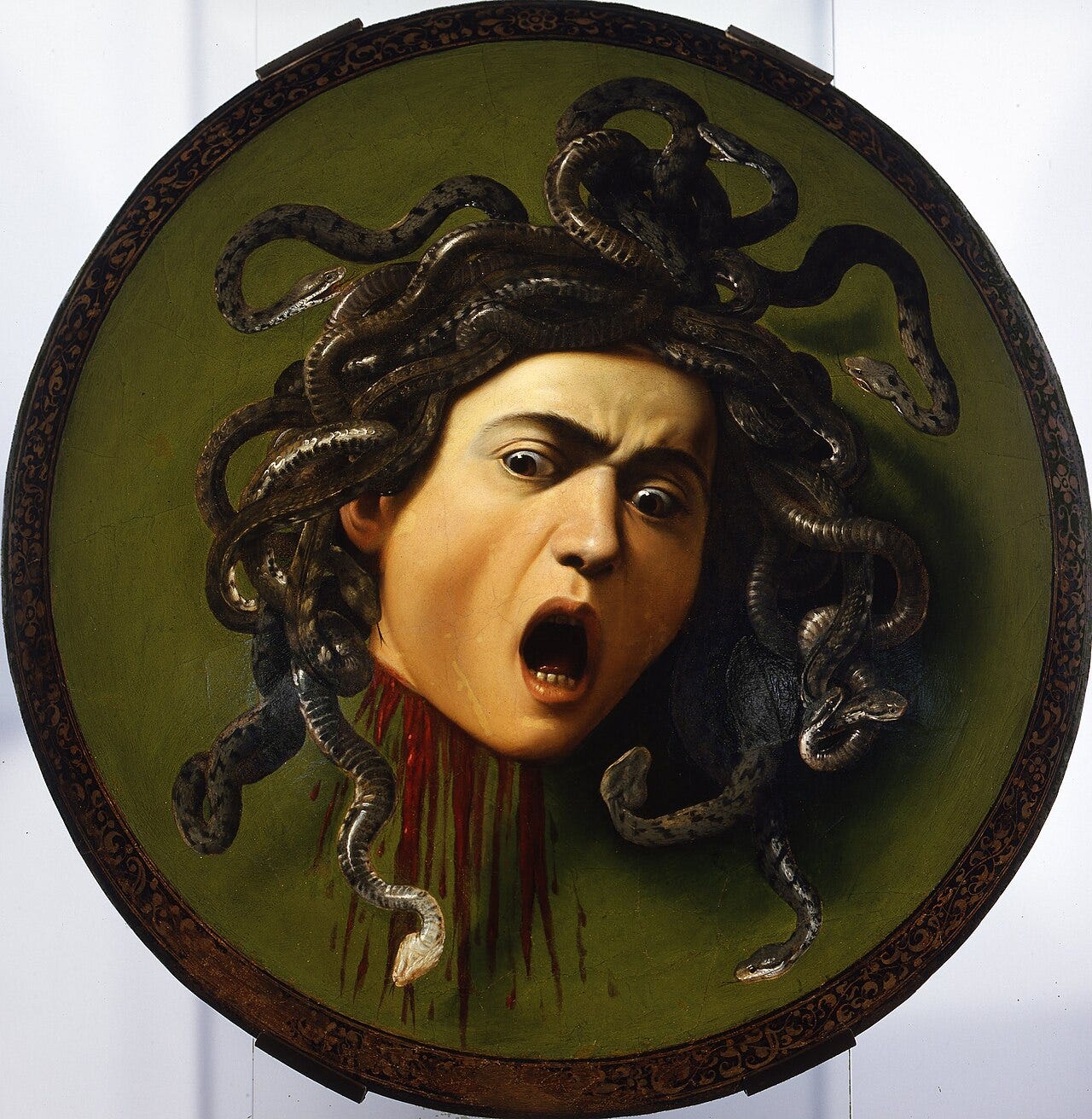
Stand in front of a real Caravaggio and the room falls away into black, with one cruel light picking out a hand, a face, a blade.
He pushed shadow further than anyone before him, drowning whole figures so a single beam could carry all the drama. The deep dark style is called tenebrism, built on the older play of light and shade, chiaroscuro.
Why his whole world is so dark is its own story in Why Is Caravaggio's Art So Dark.
No sketches, only bodies
The technical shock is that he left almost no drawings.
Other masters filled sketchbooks first. He set living models in a darkened room under a high lamp and painted straight onto the canvas.
Instead of the usual white base he worked on a dark brown ground, so shadow was the starting point and light had to be carved out of it.
The only planning he left are thin lines scratched into the wet priming, called incisions, still visible under raking light.
His people feel present because they are not ideas of bodies. They are the bodies that stood in his studio. The realism is so exact that some, including David Hockney, suspect he used lenses or mirrors to project his models. Most historians doubt it.
What is certain is that no one had ever read real light so closely.
Where he stands, and who he made
Caravaggio opens the Baroque, the dramatic style that ruled the 1600s, and more than that, he founds a school.
His roots are Lombard realism, the Venetian color he absorbed through Peterzano, the soft shadow of Leonardo, and the taverns of Rome he treated as his real studio.
What he sent forward was even bigger. The painters who copied his light were called the Caravaggisti, and within a decade they carried it across Europe.
Artemisia Gentileschi answered his Judith with one of her own, bloodier and more determined, painted from a woman's side. Jusepe de Ribera carried his darkness to Naples and Spain, where it shaped the young Velazquez.
Georges de La Tour lit whole rooms in France with a single candle in his debt. In the Netherlands a circle of painters brought the style home to Utrecht, and through them it reached the young Rembrandt.
For a hundred years, a large part of Europe painted in the shadow he cast.
Forgotten, then crowned
Then taste turned, and the world dropped him.
As painting moved toward smoother, grander work, Caravaggio came to be seen as a crude provocateur who wasted his gift on low subjects. For most of the 1700s and 1800s he was a footnote, some of his pictures hanging under other men's names.
The rescue came in the twentieth century. The scholar Roberto Longhi championed him, and a landmark 1951 exhibition in Milan drew huge crowds. The footnote became a founder.
The Caravaggio mania we live in is barely seventy years old.
The painting that hid for 200 years
The rediscovery is still going on, sometimes in the strangest places.
In 1990 a painting that had hung for decades in the dining room of a Jesuit house in Dublin, dismissed as a copy, was cleaned and examined.
It turned out to be Caravaggio’s lost Taking of Christ, painted around 1602 and missing for two centuries. A patient curator, Sergio Benedetti, recognized the real thing under the grime.
It now hangs in the National Gallery of Ireland. Only about sixty paintings by Caravaggio survive, so finding one is like raising the dead. Given his story, it fits that even his pictures keep going missing and turning up again.
Three Caravaggios to start with
The Calling of Saint Matthew, around 1600. The light beam that made his name, in a Roman back room.
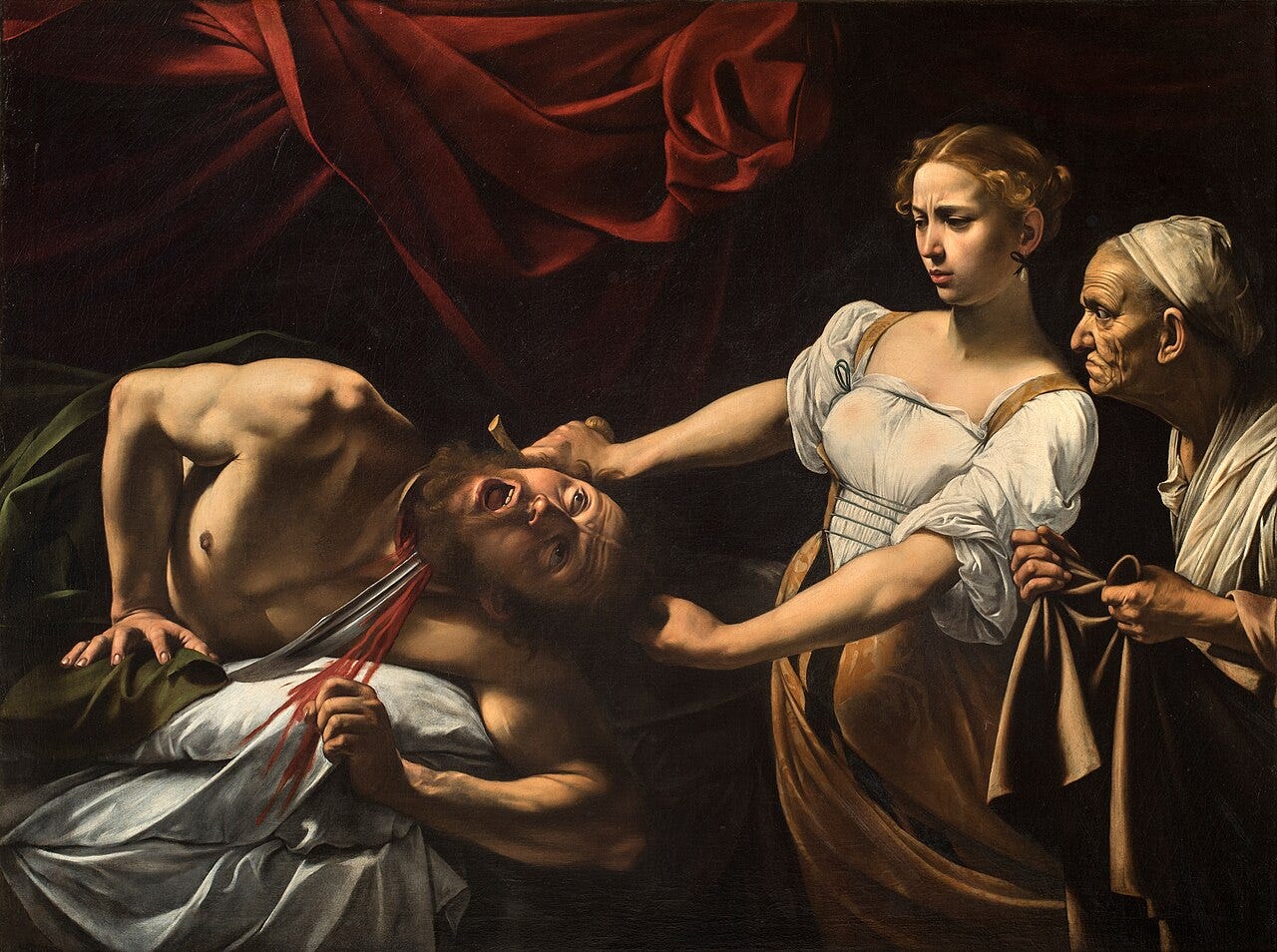
Judith Beheading Holofernes, around 1599. Violence shown plainly, with a girl’s frown of effort.
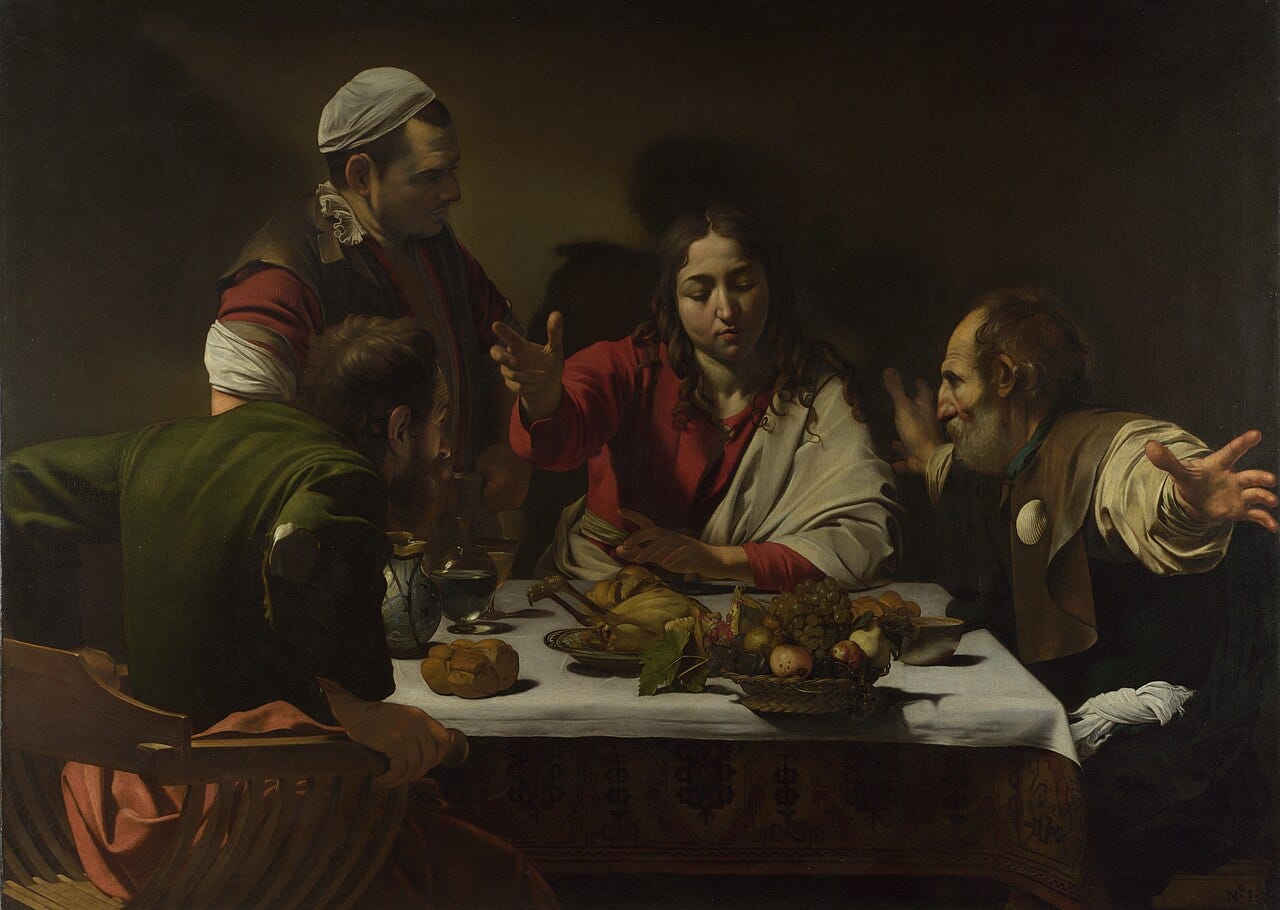
The Supper at Emmaus, 1601. The instant of recognition, close enough to touch.
See them for real
Much of his best work still hangs where it was made for, in Roman churches you can walk into for free.
San Luigi dei Francesi and Santa Maria del Popolo in Rome hold the Saint Matthew cycle and the Cerasi Chapel in place. In London, the National Gallery has The Supper at Emmaus.
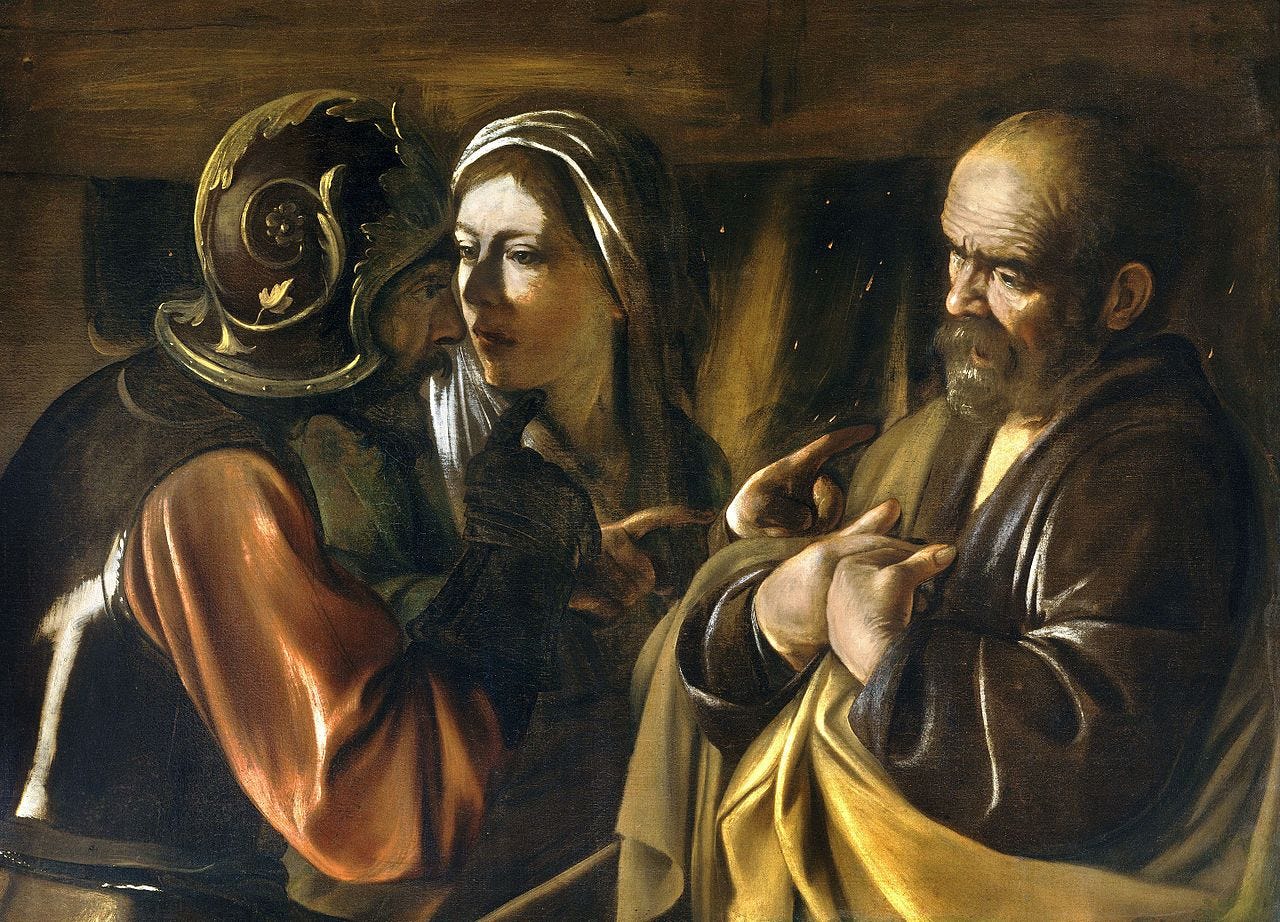
In New York, the Metropolitan Museum of Art has The Denial of Saint Peter, from his final year.
Caravaggio's harsh light and dark backgrounds spread through Rome by way of painters who copied his method without ever meeting him, a group later called the Caravaggisti; Artemisia Gentileschi, trained by her father in that same circle, used the technique to paint Judith beheading Holofernes with unusual physical force.
The Caravaggio questions that keep coming up
Why is Caravaggio famous? He invented a stark new way of painting with light and shadow, and gave sacred scenes shocking realism.
Did Caravaggio really kill someone? Yes. He killed Ranuccio Tomassoni in Rome in 1606 and fled with a death sentence.
How did Caravaggio die? Alone on the Tuscan coast in 1610 at 38, of causes still argued over, from fever to lead poisoning to murder.
What is tenebrism? The extreme dark style, mostly shadow with one strong light, that he made his own.
Why was his work controversial? He modeled saints on poor and ordinary people and refused to idealize them.
When was Caravaggio born? On 29 September 1571, most likely in Milan, in Italy.
What was Caravaggio's real name? Michelangelo Merisi. He is called Caravaggio after his family's home town near Milan.
How many paintings did Caravaggio make? Only around 60 survive, from a career of barely fifteen years.
What movement did he belong to? He launched the early Baroque.
Where is Caravaggio buried? Most likely Porto Ercole, where he died in 1610.
More secrets to unlock


He signed only once, and he signed in blood
Forget the bad boy legend for a second and the work gets stranger still. A man who never sketched, never softened a face, never once flattered a saint, and still painted the holiest pictures of his age.
In his whole violent career he put his name on exactly one canvas, The Beheading of Saint John the Baptist. He wrote it into the dark red blood running from the saint’s cut neck.
The single time Caravaggio claimed a painting as his own, he did it in blood.
