
Because by the time he painted David with the Head of Goliath, around 1610, Caravaggio was a wanted man with a price on his head, and he gave the severed monster his own face.
The painting works as a confession and a plea: look at what I have become, and let me come home.
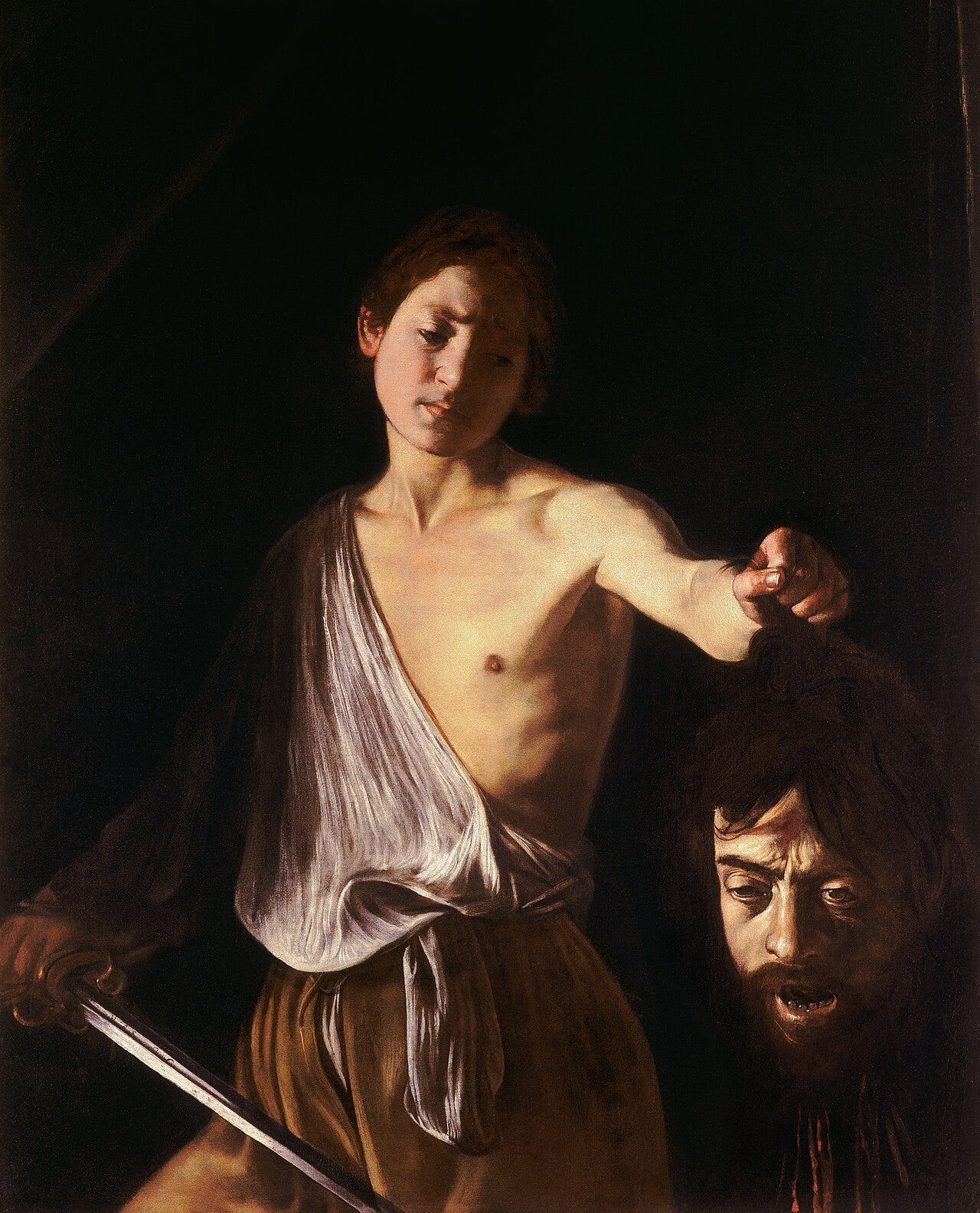
It is one of the rawest things any painter ever did. He cast himself not as the hero, but as the dead giant held up by the hair.
To see why, you have to know what he was running from.
A killer on the run
In 1606 Caravaggio killed a man.
In a brawl in Rome he fatally wounded a young man named Ranuccio Tomassoni, possibly during a duel over a debt or a woman.
The authorities placed Caravaggio under a bando capitale, a sentence that made him fair game: anyone in the Papal States could legally kill him and collect a reward by presenting his severed head.
So he fled. Naples, then Malta, then Sicily, then back to Naples, painting major works in city after city while always looking over his shoulder. Living under threat of beheading, he began returning to one subject again and again.
Keep learning art the fun way


The obsession with severed heads
David and Goliath did not come out of nowhere. The chopped head runs through his whole late career.
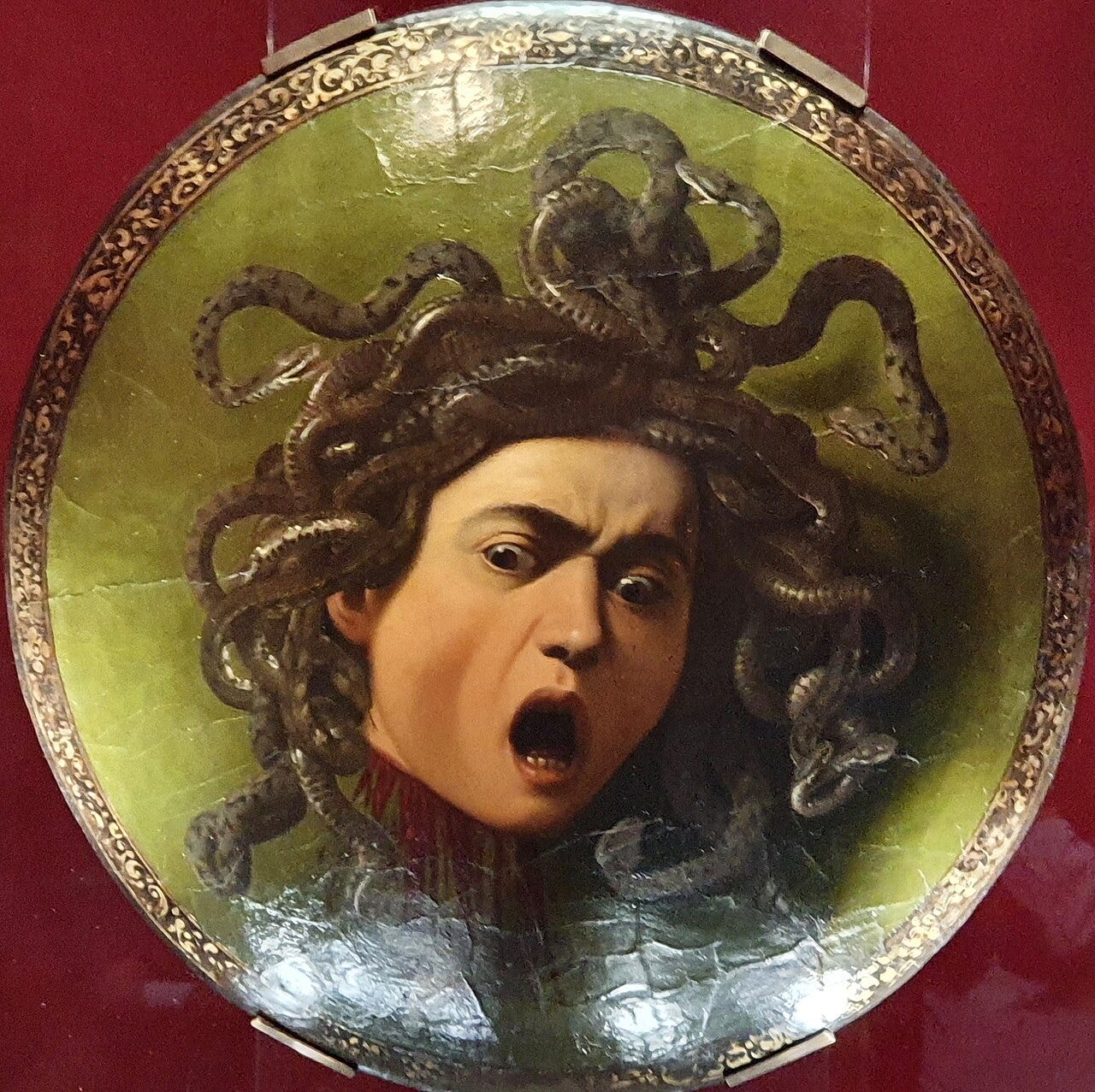
He had already painted the snake haired Medusa screaming at the instant of decapitation, Judith sawing through the neck of Holofernes, and Salome receiving the head of John the Baptist.
In his huge Beheading of Saint John, painted in Malta, he even signed his name in the spreading blood, the only painting he ever signed.
The man with a price on his own head kept painting the moment a head comes off. By 1610 that obsession turned personal.
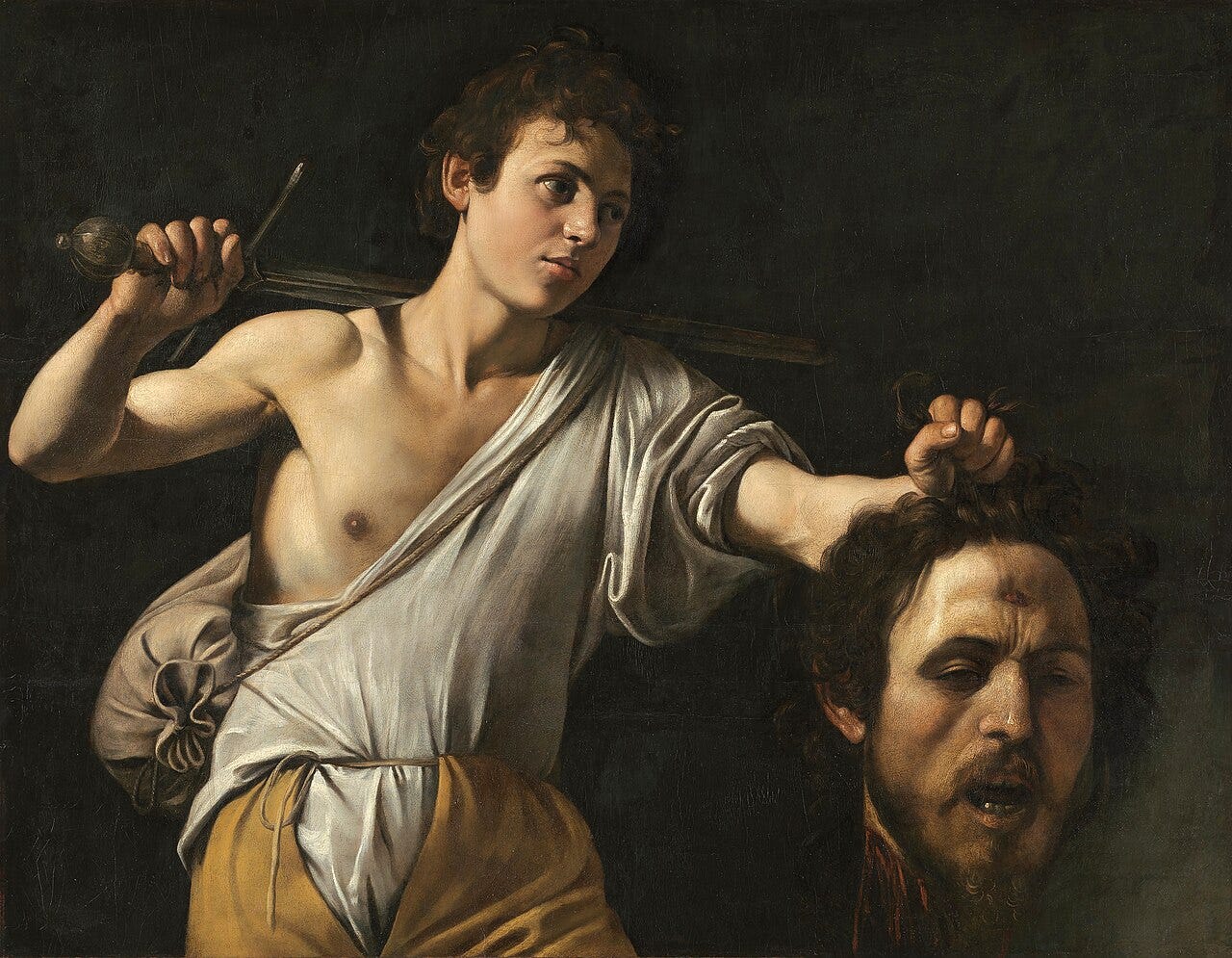
The face on the dead giant is his own
Look at Goliath’s head, dripping and slack jawed, lifted by the young David.
That ravaged face is Caravaggio. Scholars have long recognized the giant as a self portrait, an aging, beaten version of the painter, eyes not quite shut, mouth open as if mid groan.
He painted himself as the thing that gets killed, and to me that is the bravest self portrait in art. He had used the same trick years earlier, giving his own face to a severed Medusa.
David, the boy with the sword, looks less like a winner than a mourner, studying the head almost with pity rather than triumph. There is no glory in the picture, only weight and regret.
Two faces, one man
Here is the detail that deepens it.
Some scholars argue that David, too, is a self portrait, a younger Caravaggio gazing at his older, ruined self. If they are right, the painting shows one man at both ends of his life: the hopeful boy and the monster he became, the executioner and the victim sharing a single face.
Either way, the picture is not a Bible illustration. It is a man putting himself on trial inside his own canvas.
A painting sent as a plea for mercy
Now the move that makes it brilliant.
The likely recipient was Cardinal Scipione Borghese, the art loving nephew of Pope Paul the Fifth, and one of the very few men who could arrange a papal pardon. Caravaggio appears to have aimed the painting straight at him.
The message is almost unbearable in its humility. He offers up his own head on a platter, in paint, to the man who held his life in his hands.
It says: I submit, I am already punished, please let me return to Rome. He was begging for his life with a brush instead of words.
The line hidden on the sword
There is a clue carved into the weapon.
On David’s blade some scholars read the abbreviation H AS OS, taken to stand for the Latin humilitas occidit superbiam, humility kills pride.
If that reading holds, the picture is not just a crime scene. It is a moral confession, with the artist casting himself as the slain pride and David as the humility that ends it.
A written apology would have been less personal. He carved his guilt into the design itself.
What the painting is really doing
It is tempting to read all this as simple morbid theatre, as if Caravaggio just liked gore. That misses the point. He had painted plenty of severed heads before, but here, with his own life on the line, he turned the violence inward and made the victim himself.
And the gamble nearly worked. A pardon was reportedly being arranged. In the summer of 1610 Caravaggio loaded paintings onto a boat and set out for Rome to claim his freedom.
He never arrived. He died on the coast at Porto Ercole at 38, of fever by most accounts, before mercy could reach him. The plea outlived the man who painted it.
Questions about Caravaggio’s David and Goliath
Who is the severed head in the painting? It is a self portrait. Caravaggio painted his own face onto Goliath.
Why would he paint himself as the loser? He was under a death sentence and used the image as a plea for a pardon.
Who was it painted for? Most likely Cardinal Scipione Borghese, who could help arrange that pardon.
Is David also a self portrait? Some scholars think so, showing a young and an old Caravaggio in one picture.
What does the sword inscription mean? Possibly humilitas occidit superbiam, humility kills pride.
Where is the painting now? In the Galleria Borghese in Rome.
More secrets to unlock


The head that came home before he did
Caravaggio never made it back to Rome alive, but his painted head did.
David with the Head of Goliath hangs today in the Galleria Borghese, inside the very collection of the cardinal he was begging. The plea reached its address; the man never did. I trace his whole violent life in Caravaggio: The Complete Story.
