Plague in Art: 12 Paintings of the Black Death
Plague has shadowed European painting for seven hundred years, from Bruegel's army of skeletons to Poussin's streets full of rats, Gros showing Napoleon touching a plague sore, and Bocklin's Death riding through a town.
These pictures are how each age looked its worst fear in the eye.
Plague was the defining disaster of European life, killing tens of millions in waves for centuries, so of course it flooded into art.
Some of these paintings were made to beg a saint for mercy, some to frighten sinners, some as raw propaganda, and a few by people who had watched the carts of bodies go by.
These twelve span from the Black Death to the last great outbreaks, and I have opened with the most famous of them all.
Four things a plague painting is doing:
Leveling. Death takes king and beggar alike, which was the plague's most shocking lesson.
Begging. Many are prayers in paint, asking a plague saint like Sebastian or Roch to hold back the arrows.
The nose. Figures covering their faces are a clue, a sign of the old belief that bad air carried the sickness.
The witness. A few were painted by people who had actually seen it, and those hit hardest of all.
The deeper cuts
If you want the detail rather than the summary:
Twelve famous portraits and the real people, the faces behind the paintings
The Last Supper, detail by detail, the detail hiding at that table
Six women, one monster, what Picasso did to the women who loved him
1. Pieter Bruegel the Elder, The Triumph of Death (about 1562)
An army of skeletons sweeps across a burnt land, herding the living into a giant trap, ringing a bell, dragging a cart of skulls. This is death as a whole society ending at once, and it is probably the most famous image of plague ever painted.
Nobody is spared by rank. A king in ermine has his gold counted by a skeleton, a cardinal is helped along by his own bony double, and lovers sing in a corner while death tunes an instrument behind them.
Bruegel painted it around 1562, when waves of plague still swept Europe every few years. It hangs in the Prado, and up close it is a catalogue of every way the century thought a person could die.
2. Pierart dou Tielt, Burying the Dead at Tournai (about 1349)
Men in hoods lower coffin after coffin into the ground while more bodies wait in a row, drawn by someone who was actually alive when it happened.
This little picture shows the Black Death hitting the town of Tournai in 1349, at the very peak of the disaster.
It is a rare eyewitness. Most plague art came later, but this illustration sits inside a chronicle written as the pandemic raged, which gives its plain coffins a terrible weight.
The scale is almost unimaginable. The Black Death killed perhaps half of Europe in a few years, and images like this are among the few made while the graves were still being dug.
3. Josse Lieferinxe, Saint Sebastian Interceding for the Plague Stricken (1497 to 1499)

In a city street the dead are being buried, and one of the gravediggers has just collapsed, struck down by the plague as he works. Above the chaos Saint Sebastian kneels in heaven, pleading with God to lift the sickness.
Sebastian was the great plague saint. Because he survived being shot full of arrows, and plague was imagined as arrows raining from the sky, people prayed to him for protection, and paid for pictures like this to beg his help.
It is really an altarpiece as medicine. Hung in a church, it was meant to work, a painted appeal to stop the next wave before it started.
4. Hans Holbein the Younger, The Dance of Death (about 1526)
A grinning skeleton drags off a pope, then an emperor, then a merchant, a plowman, a child, one tiny scene after another. Holbein designed this set of prints as a memento mori, a run of little woodcuts where Death comes for every rank in turn.
The idea was born from plague. The dance of death spread across Europe after the Black Death, a grim comedy in which no title, no fortune and no age can buy you out of the final partner.
Holbein's version is the sharpest ever made. Each skeleton is almost cheerful, yanking a bishop from his throne or upending a rich man's table, and the joke is always the same, and always on us.
The tiny blocks were cut by the brilliant Hans Lutzelburger, and the set was not even printed until 1538, after both men had died.
5. Marcantonio Raimondi after Raphael, The Plague (about 1515)
A family slumps in the dark, a dying man, a limp child, a woman covering her face against the stench, while a sick animal collapses nearby.
This engraving, known as Il Morbetto, was designed by Raphael and cut by Marcantonio Raimondi from a plague scene in Virgil's Aeneid.
Look for the rat. A small rodent creeps near the corpses, which is uncanny, because plague really did travel with rats and their fleas, a link no one would work out for another four hundred years.
The print spread the image far and wide. Prints were the internet of their day, and this bleak little plague scene reached artists all over Europe who never saw the original drawing.
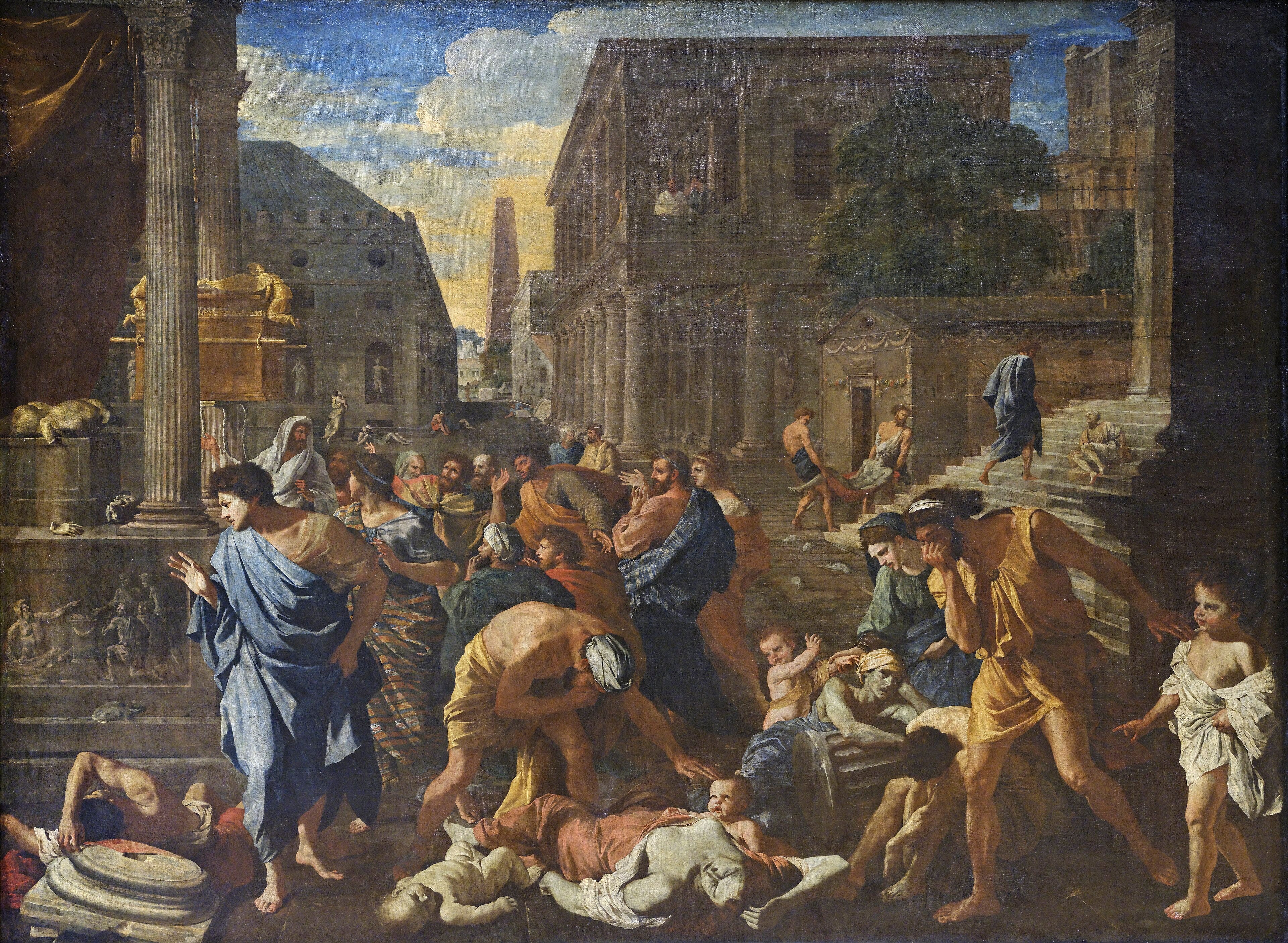
6. Nicolas Poussin, The Plague of Ashdod (1630 to 1631)
Bodies sprawl across a grand classical square, a baby still trying to feed at its dead mother's breast, rats scurrying across the paving. Poussin painted a plague from the Bible, sent by God on the Philistines who had stolen the Ark of the Covenant.
He painted it during a real outbreak. Plague was sweeping Italy as Poussin worked, and he gives half his figures a hand clamped over the nose, a sign of the belief that the disease rode on foul air.
Those rats are not decoration either. The Bible even speaks of a plague of rodents, and Poussin, like Raphael before him, put the real, unknowing clue to the disease right there on the ground.
7. Michael Sweerts, Plague in an Ancient City (about 1652)
A cold gray light falls on a heap of the dead and dying at the foot of vast ruins, the living stepping over bodies, a mother collapsed beside her still living child. Sweerts imagined an ancient plague with the stillness of a bad dream.
The quiet is what unsettles. There is no skeleton army here, no demons, just the slow, ordinary horror of a city where too many have died to bury, painted with terrible calm.
He sets it among crumbling Roman ruins, an imagined plague of the ancient world rather than one he had lived through.
Sweerts knew about dying far from home. He left Europe as a lay missionary and died in India, still young, which gives his hushed city of the dead a strange personal weight.
8. Domenico Gargiulo, Naples during the Plague of 1656

A great city square is carpeted with bodies, carts hauling more away, smoke and grief in every direction. This is not a myth or a Bible story. Gargiulo painted the plague that struck Naples in 1656 as it happened around him.
The numbers are staggering. The outbreak is thought to have killed around half the people in one of the largest cities in Europe, and the painter turned the real Largo Mercatello into an open grave.
It survives as a record. Kept in Naples to this day, it is less a work of imagination than a report from inside a catastrophe, painted by a man who lived through it.
9. Antoine Jean Gros, Bonaparte Visiting the Plague Victims of Jaffa (1804)
A calm Napoleon reaches out and touches the sore of a plague stricken soldier, unafraid, like a king healing by his touch. Gros turned a grim episode from the Egyptian campaign into glowing history painting, and pure propaganda.
It was made to fix a story. Rumors said Napoleon had poisoned his own plague ridden troops to speed a retreat, so the state commissioned this heroic scene of him fearlessly among the sick to bury the ugly version.
The setting does half the work. The grand arches, the golden light and the Christlike gesture cast the general as a miracle worker, an early piece of political image making at the highest level of art.
10. Michel Serre, The Plague of Marseille (1720)
Bodies lie stacked along a real street while carts collect the dead and stunned survivors look on. Serre painted the Great Plague of Marseille of 1720, which he lived through, and which turned out to be the last major plague in Western Europe.
He painted the actual places. This is a named street in a real city on a real, catastrophic day, roughly one of the last times this particular horror would visit the continent.
The plague reached Marseille by ship. It came in on a trading vessel from the eastern Mediterranean, and Serre's calm, wide view of the street makes the everyday setting of the disaster all the more chilling.
11. Jules Elie Delaunay, The Plague in Rome (1869)
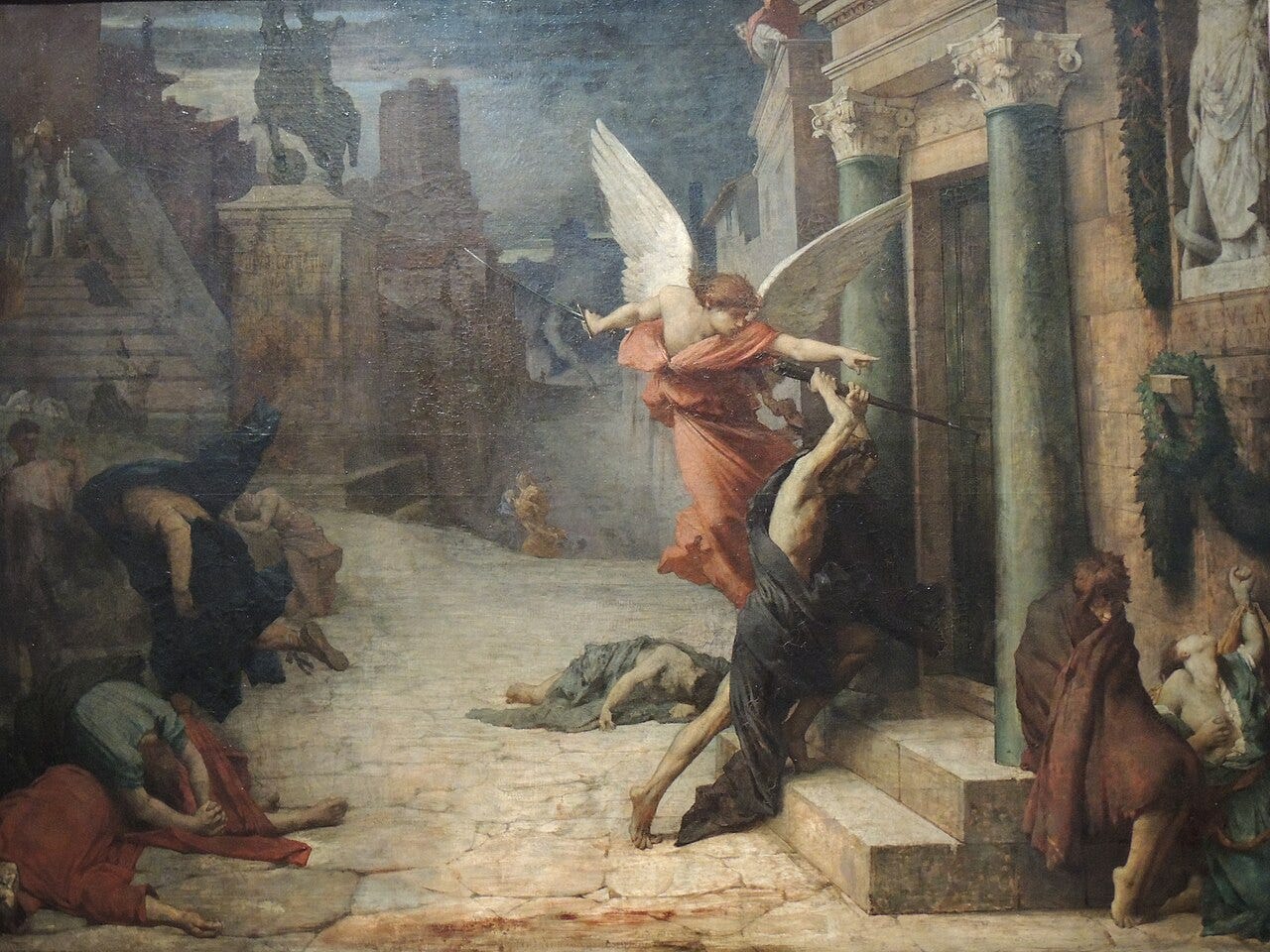
An avenging angel stands in a marble street and points, while a dark demon beside it knocks on a door, sending the plague inside.
Delaunay took the scene from a medieval legend in which an angel ordered the demon to strike each house as many times as it held people to die.
The knock is the whole horror. There is no gore, only that calm, methodical pointing, house after house, a bureaucratic vision of death that feels colder than any skeleton army.
It caused a stir at the Salon. Painted in 1869 and now in the Musee d'Orsay, its eerie stillness struck viewers used to noisier disaster scenes as something genuinely modern and strange.
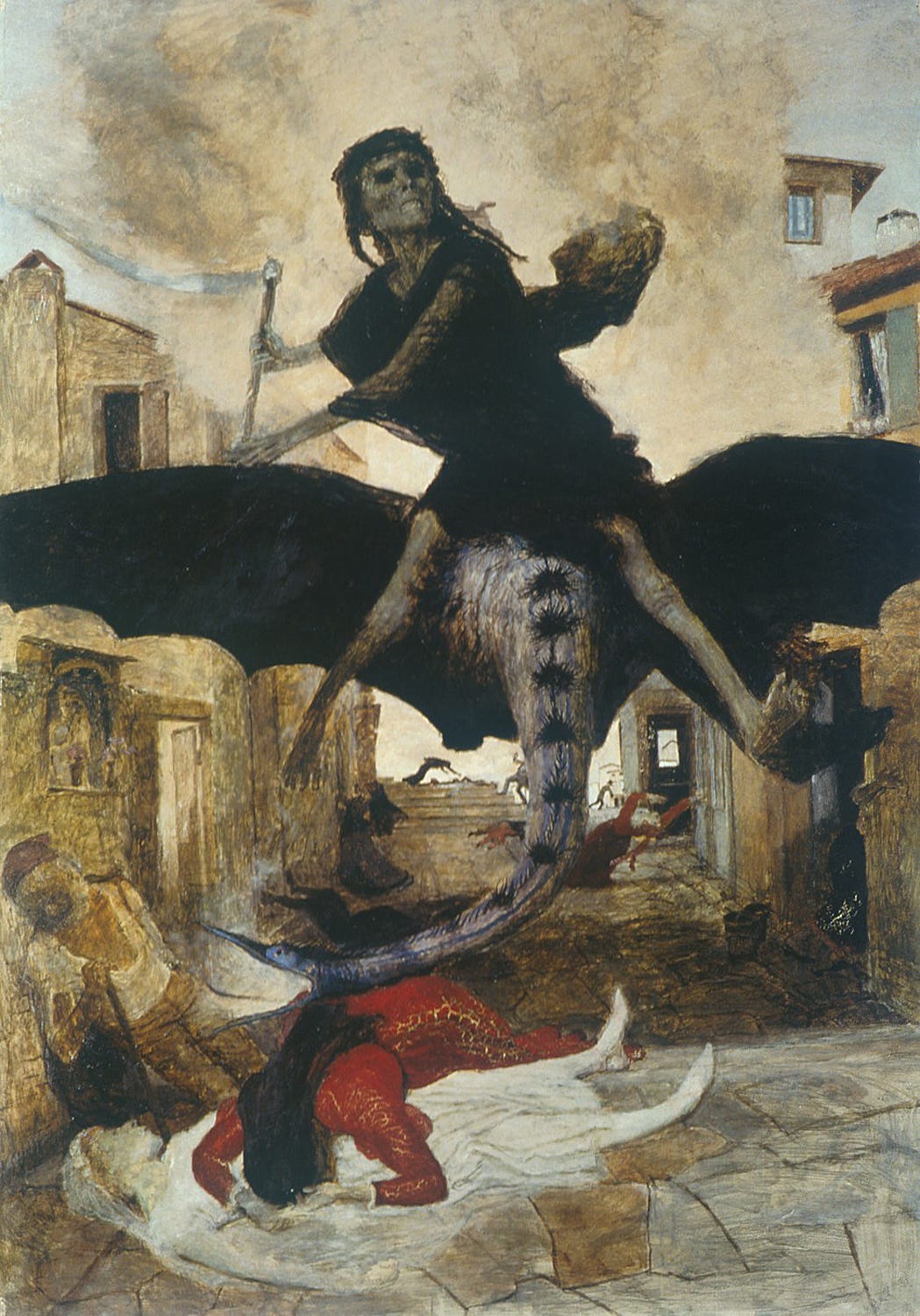
12. Arnold Bocklin, The Plague (1898)
Death rides a huge bat winged beast low through a narrow medieval street, and bodies already lie in the doorways below. Bocklin painted this in 1898, at the very end of the long age of plague.
It was ripped from the news. A fresh outbreak of plague had broken out in Bombay in 1898, and Bocklin, who was haunted by war and pestilence, turned that headline into a nightmare in tempera.
It closes the story where it began. Five hundred years after the Black Death, a painter is still imagining the same winged killer moving down a European street, proof of how deep the fear had sunk into the culture.
Where to face the plague
Bruegel, The Triumph of Death: the Prado, Madrid.
Poussin, The Plague of Ashdod: the Louvre, Paris.
Gros, Bonaparte Visiting the Plague Victims of Jaffa: the Louvre, Paris.
Delaunay, The Plague in Rome: the Musee d'Orsay, Paris.
Bocklin, The Plague: the Kunstmuseum Basel.
Keep reading in the dark
Plague pushed art toward death, judgment and the fragile body. These go deeper:
The Arnolfini Portrait, detail by detail, the mirror, the dog, and the question everyone asks
The darker truth about Gauguin, the part of the Tahiti story that never makes the wall label
Vermeer, Woman Holding a Balance, what is actually on those scales
Questions people ask about plague in art
What is the most famous plague painting? Pieter Bruegel the Elder's The Triumph of Death, about 1562, in the Prado, a panorama of skeletons taking every rank of society at once.
Why did people paint the plague? To beg saints for protection, to warn about sin and death, and sometimes to record a real outbreak they had survived.
Who is the patron saint of plague in art? Saint Sebastian, shown pierced with arrows, and Saint Roch, who shows a sore on his leg, are the two most common plague saints.
Why do figures cover their noses in plague paintings? It reflects the old belief that plague spread through bad or corrupted air, so covering the face was thought to keep the sickness out.
Did artists know rats caused the plague? No. But painters like Raphael and Poussin included rats and mice in plague scenes, an accidental clue to a link only proven around 1900.
The fear that shaped a continent
Look across seven centuries and the same disaster keeps returning to the wall. A chronicler sketches coffins at Tournai in 1349, Bruegel builds a whole world of skeletons, Poussin lays a baby beside its dead mother, and Bocklin sends the winged killer down one more street in 1898.
The plague killed tens of millions and never fully lost its grip on the imagination. These are not morbid curiosities. They are the record of how people painted their way through the worst thing that ever happened to them, again and again.
The last of them, Bocklin's, went up in 1898, the very year plague was killing thousands in Bombay, proof the old fear had never really left.