
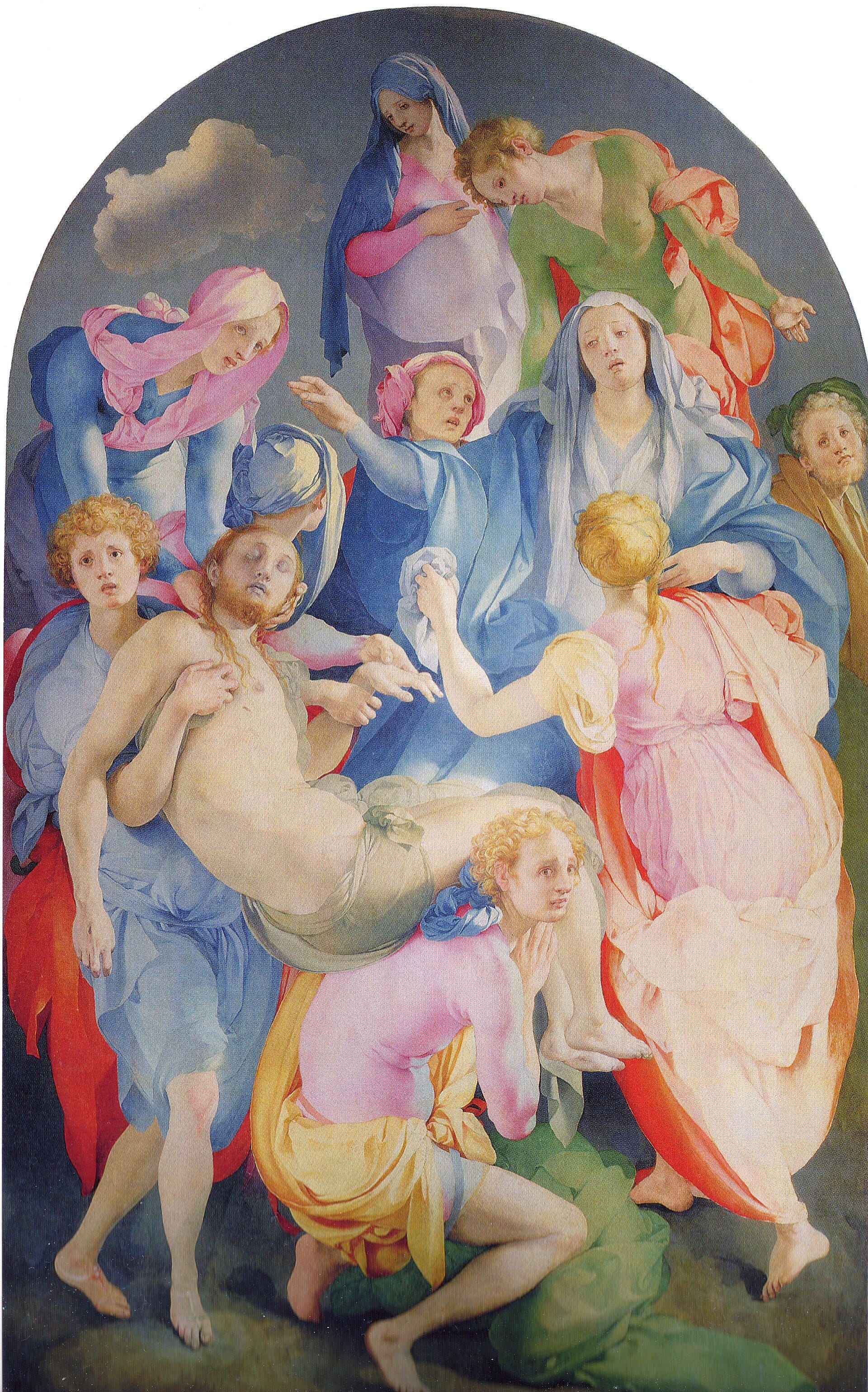
Jacopo Carucci, known as Pontormo, was a Florentine painter, born near Empoli in 1494 and dead in Florence in 1557. He is remembered for one altarpiece, the Deposition in Santa Felicita, where the dead Christ is carried through a pink and blue sky with no cross and no ground. He also left a diary, and most of it counts what he ate.
Most of what Pontormo painted has been moved, locked up or destroyed. The Deposition is still in the chapel it was made for, in its original frame.
Cool Stories About Art is a newsletter to learn art the fun way.
Join 200,000+ readers and get:
10 new art stories / month
The entire archive of content (1,000+ articles)
Comment, ask questions, and chat with other readers
It looks wrong at first. A heap of figures twists upward in an oval, dressed in pink, powder blue, green and faded yellow. There is no cross for Christ to come down from and no floor under anyone's feet. A small patch of sky with a single cloud sits in one corner, and that is all the landscape the picture allows. It is a few steps from the Ponte Vecchio, and few visitors walk in expecting it.
Pontormo worked on it for about three years, and he worked in secret. Vasari, the painter and biographer who knew the Florentine art world of the time, reports that he screened off the chapel and kept the picture hidden from everyone, the banker Ludovico Capponi who had paid for it included, until the day it was unveiled in 1528.
The bearded man on the right, Nicodemus, wears a face that the scholar Luciano Berti identified in 1956 as Pontormo's own. If he is right, the painter put himself among the men who carry Christ. The strangest work of his life came last, on the walls of a Medici church, and it no longer exists.
What You'll Discover
Whose workshops he passed through.
What he borrowed from Germany.
What gives the pink its glow.
What Michelangelo asked him to paint.
What the San Lorenzo walls showed.
What he wrote down every evening.