
Theodore Gericault was the young firebrand of French Romanticism, the painter who turned a real political scandal into one of the most harrowing pictures ever made.
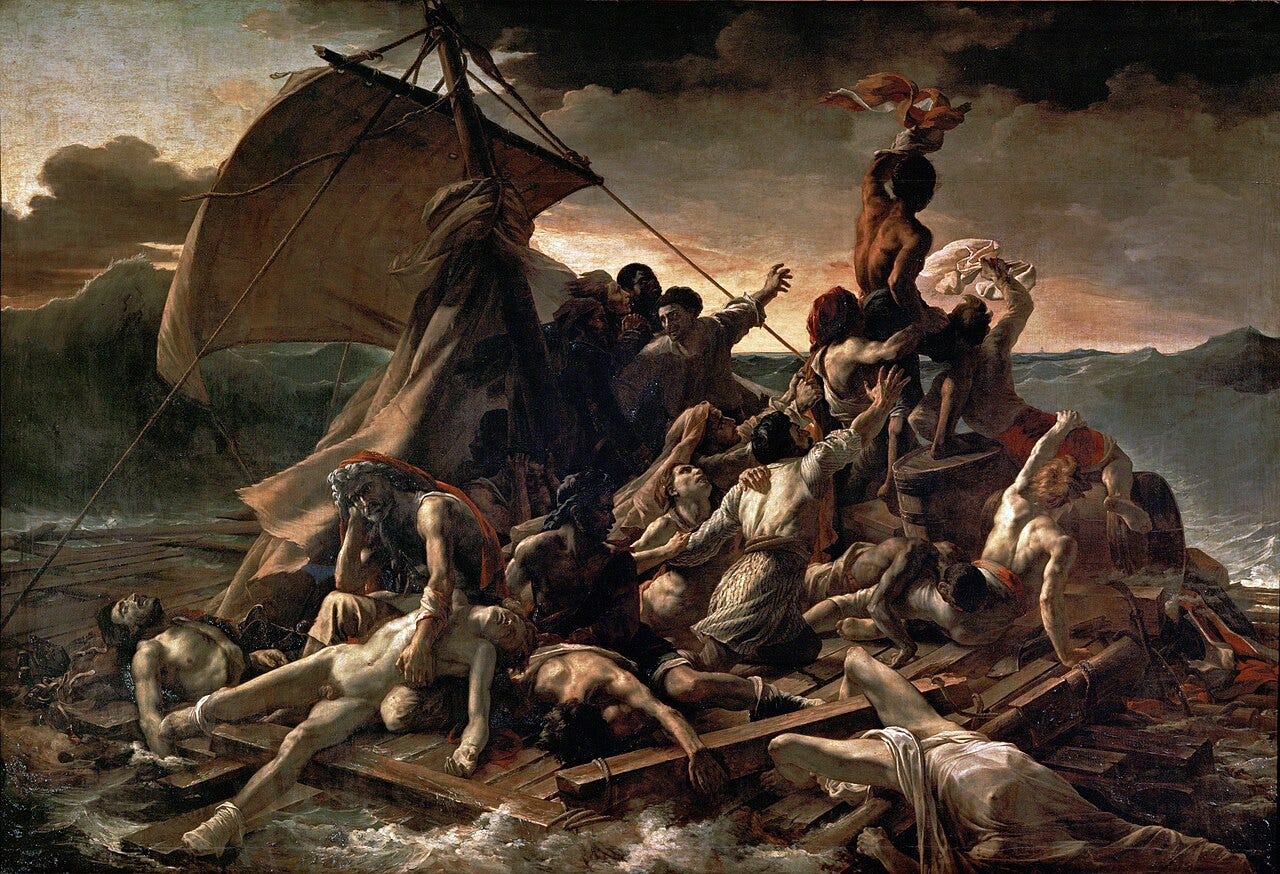
His giant Raft of the Medusa put shipwreck, death and government failure on the wall of the Salon. He chased raw truth so far that he studied corpses to paint it, and he was dead at thirty two.
Born into a wealthy Rouen family in 1791, he trained on horses and battle scenes before the Medusa shipwreck gave him the subject that made his name. Several of those horse paintings are still ranked among the most famous of the genre today.
To get the bodies right, he brought severed limbs and heads into his studio from the morgue.
Born: Rouen, France, 1791
Known for: The Raft of the Medusa, Romanticism, horses, portraits of the insane
Died: Paris, 1824
More incredible painter stories
If Théodore Géricault pulled you in, you will love these too:


Théodore Géricault at a glance
1791. Born in Rouen to a family made comfortable by tobacco money.
1816. The Medusa ran aground off Africa. The scandal became his subject.
1819. The Raft of the Medusa hung at the Salon, barely acknowledged by the crown.
1820. Took the Raft to London, where paying crowds filed past it.
1824. Died at 32 after riding falls and a long illness.
A scandal turned into a giant painting
In 1816 the French frigate Medusa ran aground through official incompetence, and around 150 people were cast onto a makeshift raft.
After days of thirst, madness and cannibalism, only a handful survived. The affair became a national scandal. See what is history painting.
Gericault chose this fresh disaster, not an ancient myth, for a huge heroic painting. He interviewed survivors, had a model of the raft built, and showed the exact moment the dying first glimpse a rescue ship on the horizon.
Painting from the morgue
His pursuit of truth was extreme. He visited hospitals and morgues, studied the dying and the dead, and kept severed limbs and a head in his studio to paint decay and flesh accurately.
The result has a terrible reality. The Raft of the Medusa is built like a pyramid of bodies, climbing from despair at the bottom to a desperate flash of hope at the top. See what is romanticism.
Horses and the human mind
Gericault loved horses and painted them with thrilling energy, from cavalry charges to the Epsom Derby. Fittingly and tragically, riding accidents helped kill him young. See what is oil painting.
Near the end he made a startling series of portraits of psychiatric patients, men and women with single obsessions, for a doctor friend. Calm, dignified and deeply human, they were centuries ahead of their time.
The tobacco fortune that set him free
Theodore Gericault was born in Rouen, in Normandy, on 26 September 1791. His family had money from tobacco trading and the law, and while he was still a child they moved to Paris.
That wealth shaped everything. A private income meant he never had to chase commissions or flatter a patron to eat. He could paint what disturbed him, at any size, and take years over one canvas.
Most painters of his day survived on portraits and official orders. Gericault answered to almost no one. It is one reason a young man could spend a fortune and eighteen months on a single picture of a shipwreck that no minister had asked for.
Two teachers and the Louvre
Around 1808 Gericault entered the studio of Carle Vernet, who loved horses and English sporting pictures. The young painter drew stables and races for hours.
He then moved to the stricter studio of Pierre Narcisse Guerin, who drilled him in classical figure drawing and firm composition.
The real school, though, was the Louvre. Gericault spent long days there copying the old masters, above all the warm color and heavy muscle of Peter Paul Rubens.
From Rubens he took a taste for drama and thick, worked paint. From Guerin he kept the discipline that holds a crowded scene together. Two habits pulled against each other in him for life, careful structure and raw feeling.
The riderless horse races of Rome
In 1816 Gericault traveled to Italy and stayed through 1817, working in Florence and Rome. Michelangelo shook him. So did a yearly spectacle in the Roman streets.
During Carnival, riderless horses were set loose to gallop down a long avenue while crowds pressed in on both sides. Gericault watched grooms fight to hold the animals at the start, then let them tear away.
He planned a huge frieze of the race and made many studies for it.
The picture was never finished. But it fixed something in him: the moment when muscle, fear and force are barely under control. He would return to that same knife edge of tension in almost everything he painted next.
Two Salons, two horses
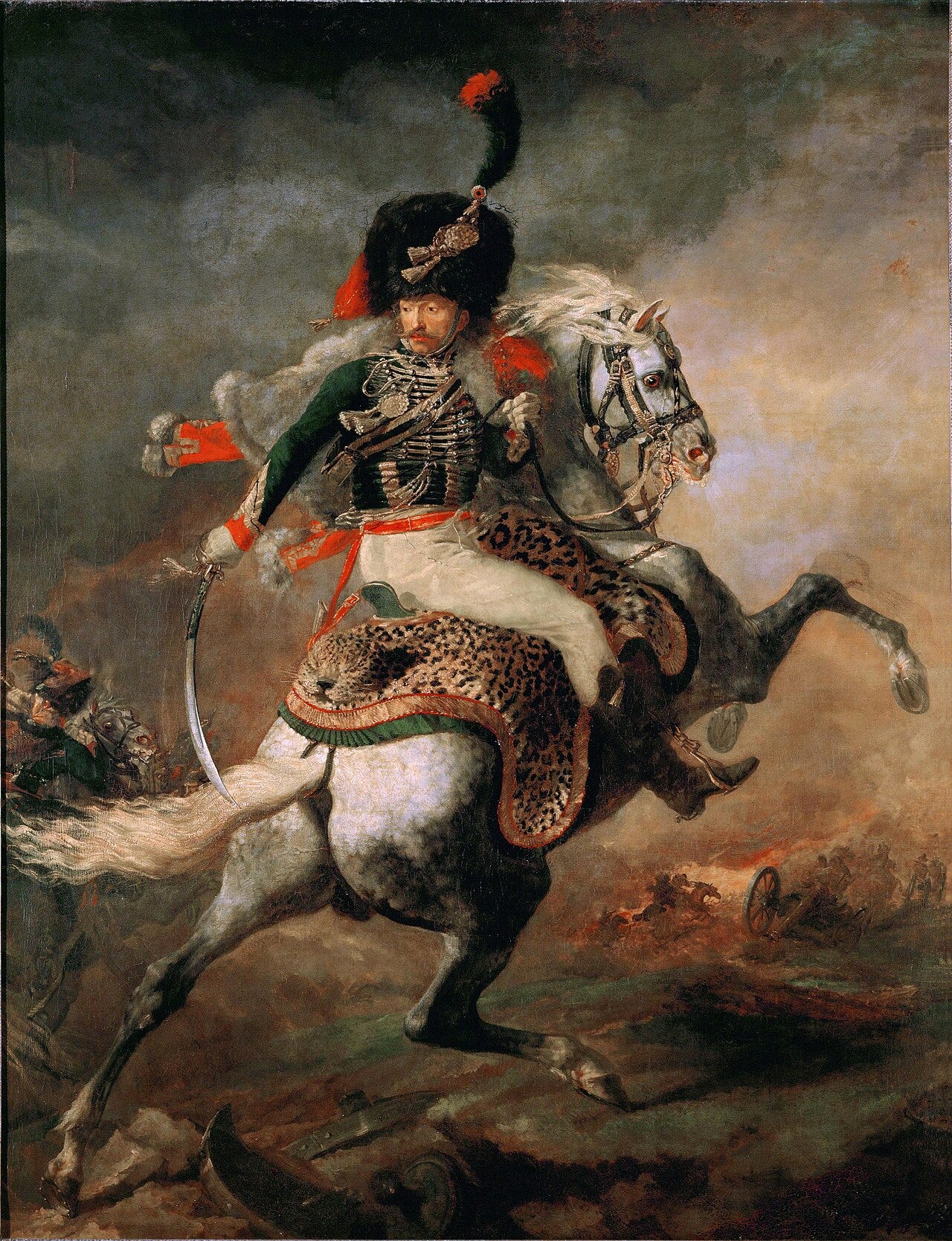
Gericault first showed at the Paris Salon in 1812, at about twenty one. His entry, an officer of the imperial guard on a rearing horse in the smoke of battle, is known as The Charging Chasseur. It won a gold medal and announced a real talent.
Two years later the mood had changed. At the Salon of 1814, with Napoleon fallen, he showed the Wounded Cuirassier, a soldier leading his horse down from the fight, beaten and alone. Critics disliked its gloom and its heavy, dark color.
The pairing tells his whole story early. One picture is a nation charging forward, the other is that same nation limping away. Gericault was already drawn to loss rather than glory.
The secret son
In the years around the Raft, Gericault was carrying a private crisis. He had begun an affair with Alexandrine, the young wife of his uncle, and so his aunt by marriage.
In August 1818 she gave birth to their son, Georges Hippolyte. The child was quietly placed away and the father was not named. The scandal stayed hidden for decades.
Some writers believe the strain of it drove him deeper into the grim, all consuming work of the shipwreck picture. He threw himself at that canvas with a force that looked almost like penance.
Whatever the private cost, the public result was the largest and most ambitious painting of his life.
He built a model to paint the wreck
Thirteen days later, when rescue finally came, only around fifteen of the castaways were still alive.
Gericault wanted the truth, not a legend. He tracked down survivors and questioned them closely. Two of them, the engineer Alexandre Correard and the surgeon Henri Savigny, had published an account of the ordeal, and Gericault leaned on it hard.
He even had the raft's carpenter, another survivor, build him a scale model. He arranged small wax figures on it to test the crush of bodies and the build of the composition.
For a year and a half he lived inside the disaster. The finished canvas runs more than seven meters wide.
A wreck the crown did not want painted
The Medusa ran aground because of its captain, Hugues Duroy de Chaumareys. He had barely sailed in years and owed his command to loyalty to the restored Bourbon king, not to skill.
When the ship struck a sandbank off West Africa, the lifeboats were kept for the officers. The lower ranks were left on the raft and cut loose.
So the painting was never only about the sea. It pointed straight at a government that handed jobs to friends and let ordinary men die.
When Gericault showed it at the Salon of 1819, officials were cold to the subject. Yet the jury could not deny the skill, and, against the common belief that the picture was rejected, it took a gold medal.
London paid to see it
Stung by the mixed welcome in Paris, Gericault took the Raft to England in 1820, and there it caused a sensation.
Shown to a paying public in London, the picture drew about 40,000 visitors, a huge number for a single painting. The English were used to exhibitions where you bought a ticket to see one large canvas, and the shipwreck suited that appetite for spectacle exactly.
Gericault stayed in Britain for roughly two years. He loved the horse culture and made lithographs, watercolors and oils of jockeys, cart horses and street life.
The London money and attention did what Paris had not. It proved that his enormous, difficult painting could move a whole crowd.
Faces for a doctor of the mind
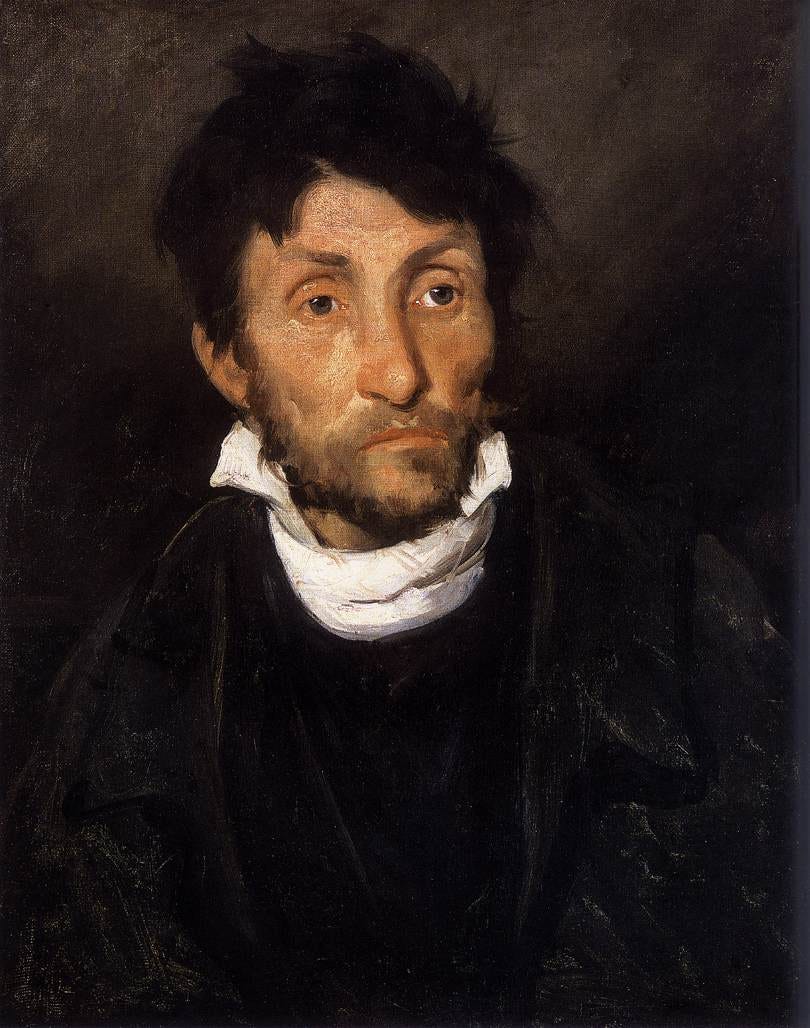
Back in France, Gericault made a set of portraits unlike anything else of the period. A friend, the young doctor Etienne Georget, was studying mental illness at a moment when it was barely understood.
Gericault painted individual patients, each locked on one obsession: a man convinced he held military rank, a woman consumed by envy, a compulsive gambler, a kleptomaniac. He gave them no mockery and no theatre, only steady human attention.
He is thought to have painted about ten of these portraits. Five are known to survive, now scattered across museums in Paris, Lyon, Ghent and beyond. They read today as some of the first honest portraits of the mentally ill in Western art.
A fall at 32, and the friend who carried it forward
Gericault rode hard and fell often. A run of riding accidents, on top of a tubercular illness that attacked his spine, wore his body down. He was bedridden and in pain for a long time before the end.
He died in Paris on 26 January 1824, aged only thirty two.
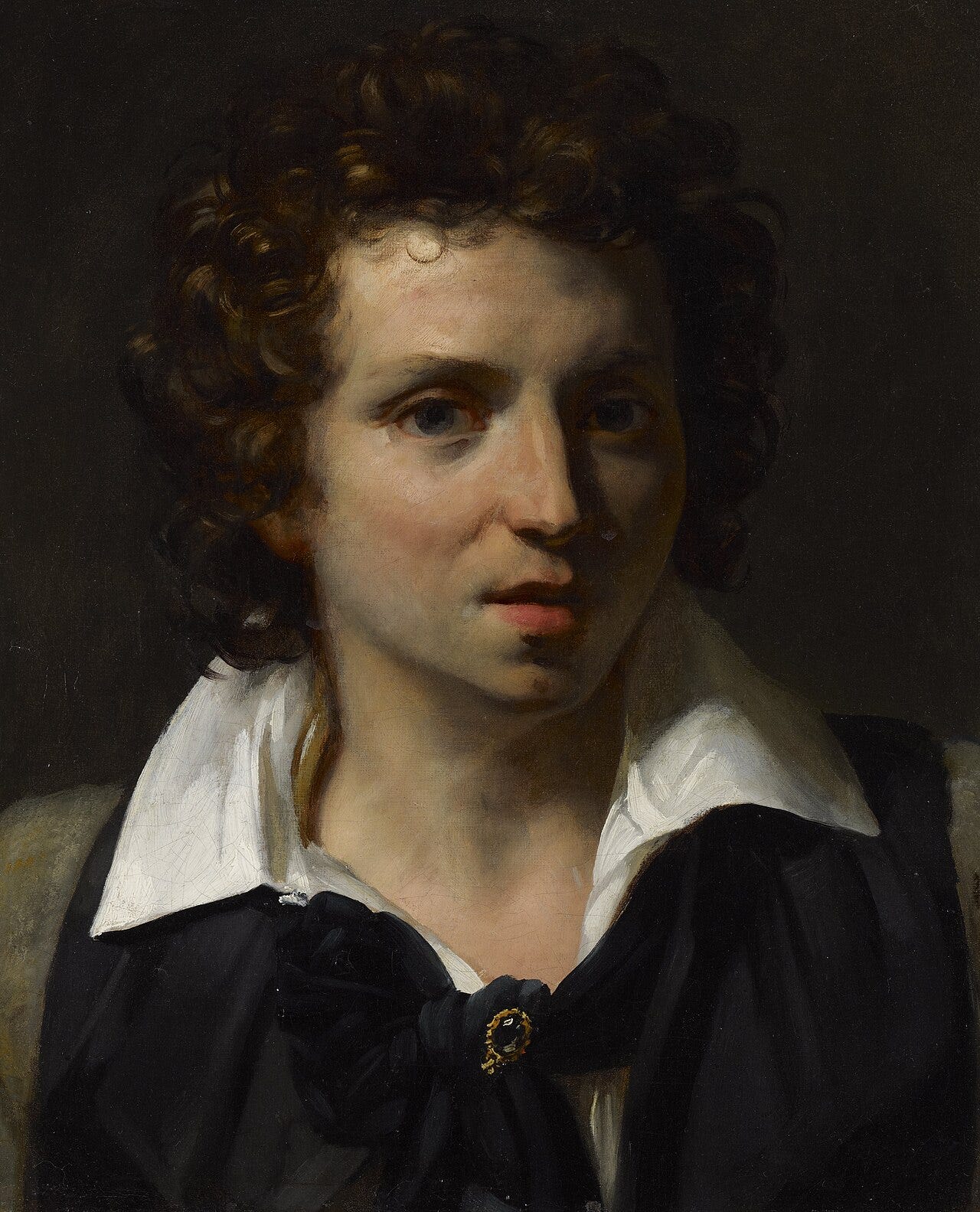
His work did not die with him. A younger painter named Eugene Delacroix, trained under the same teacher, Guerin, is by the usual account one of the figures who posed for the Raft.
Delacroix found in Gericault a way out of cold classical rules and toward feeling, color and modern subjects. Through him, Gericault became a starting point for French Romanticism.
The Théodore Géricault questions that keep coming up
What is Theodore Gericault famous for?
The Raft of the Medusa and for launching the drama and realism of French Romanticism.
Was the Raft based on real events?
Yes, the 1816 wreck of the Medusa, a scandal of incompetence and survival at sea.
Did he really study corpses?
Yes, he brought body parts from the morgue into his studio to paint death truthfully.
When did he die?
In 1824, aged only 32, after a series of riding accidents.
More secrets to unlock


Why the raft still grips
Gericault crammed a lifetime into a short career and changed art on the way. The Raft of the Medusa hangs in the Louvre near the Mona Lisa, and crowds still fall silent before its wall of bodies reaching for a horizon that may not save them.
One last detail. His friend Eugene Delacroix posed for one of the dead figures on the raft, then went on to lead Romanticism into the next generation. The torch passed across a single painted corpse.