
Thomas Eakins was the American painter who refused to flatter anyone. Working in Philadelphia, he painted surgery, rowing and plain unsmiling portraits with a scientist's honesty, studying anatomy and photography to get the body exactly right.
His truthfulness was so blunt that it kept getting him into trouble. He studied anatomy in the dissecting room and motion photography in the darkroom, and it cost him friends, sitters and his teaching post.
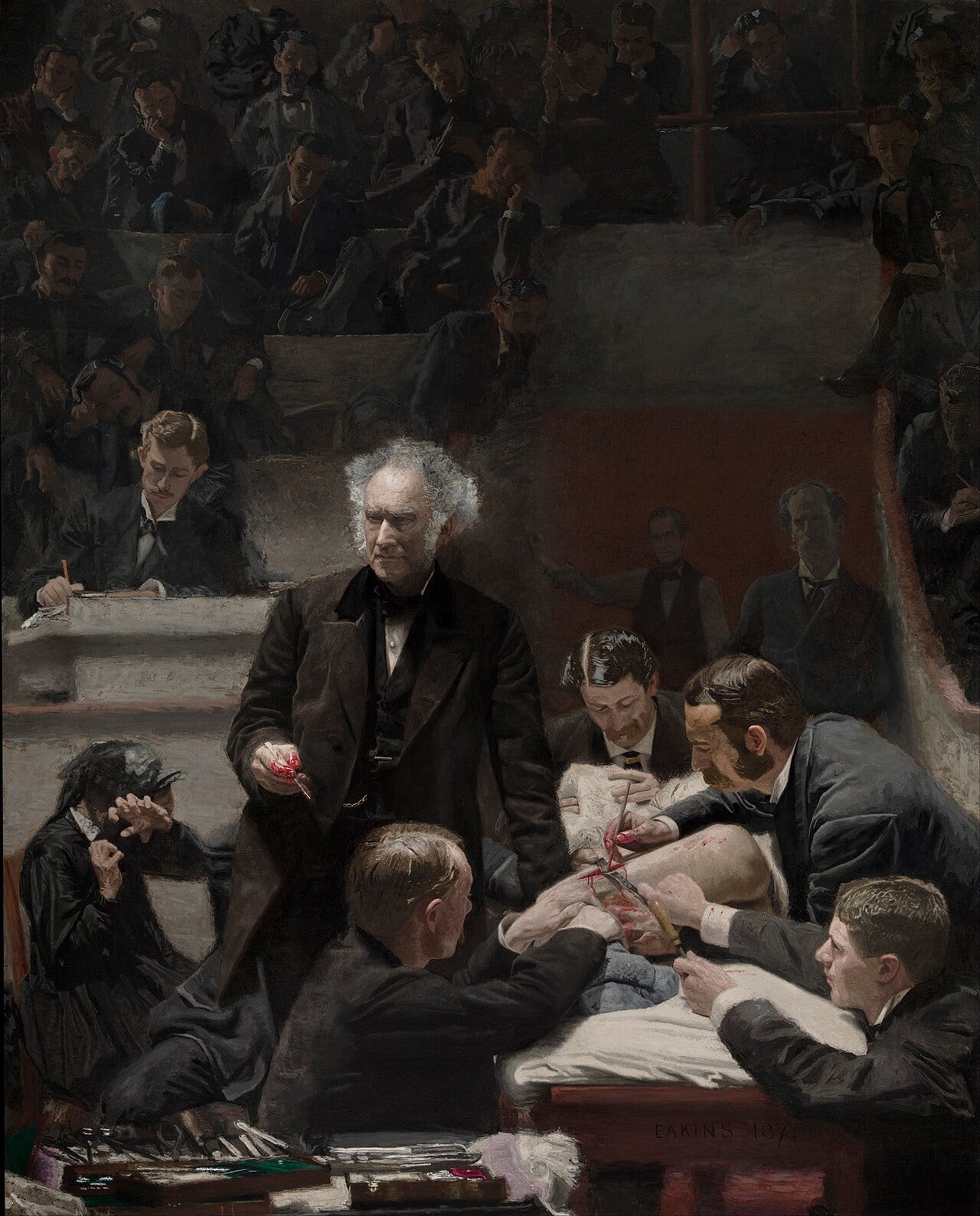
His greatest painting was thrown out of an art exhibition for being too bloody.
Born: Philadelphia, 1844
Known for: The Gross Clinic, rowing scenes, unflinching realist portraits
Died: Philadelphia, 1916
More incredible painter stories
If Thomas Eakins pulled you in, you will love these too:


Thomas Eakins at a glance
1844. Born in Philadelphia, where he would spend nearly his whole life.
1866. Left to study in Paris under Gérôme.
1875. Painted The Gross Clinic, which the 1876 Centennial jury shunted to a medical display.
1886. Forced out of the Pennsylvania Academy over a loincloth removed in a class with women present.
1916. Died in Philadelphia. His widow, Susan Macdowell, spent decades securing his fame.
The painting too real for the show
In 1875 Eakins painted The Gross Clinic, a famous surgeon operating in a packed lecture theatre, his bloodied hand and scalpel lit like a stage. A relative shields her eyes from the wound.
Judges for the 1876 Centennial art display found it too brutal and refused it. It ended up hung in a medical section instead, art exiled to the hospital. See what is realism.
Painting with a stopwatch
Eakins treated the body as a problem to solve. He dissected cadavers, studied perspective like an engineer, and used the new motion photography of Eadweard Muybridge to see exactly how people and horses move.
His rowing pictures, like Max Schmitt in a Single Scull, place a real man on real water under real light, the reflections worked out almost mathematically.
The scandal that cost him his job
As a teacher he insisted students draw from the fully nude model, men and women alike. In a mixed class he removed the loincloth from a male model so students could see the body whole.
Philadelphia was scandalised, and the Pennsylvania Academy forced him out. His devotion to the naked truth, in every sense, made him an outsider in his own city. See what is the nude in art.
The portraits nobody wanted
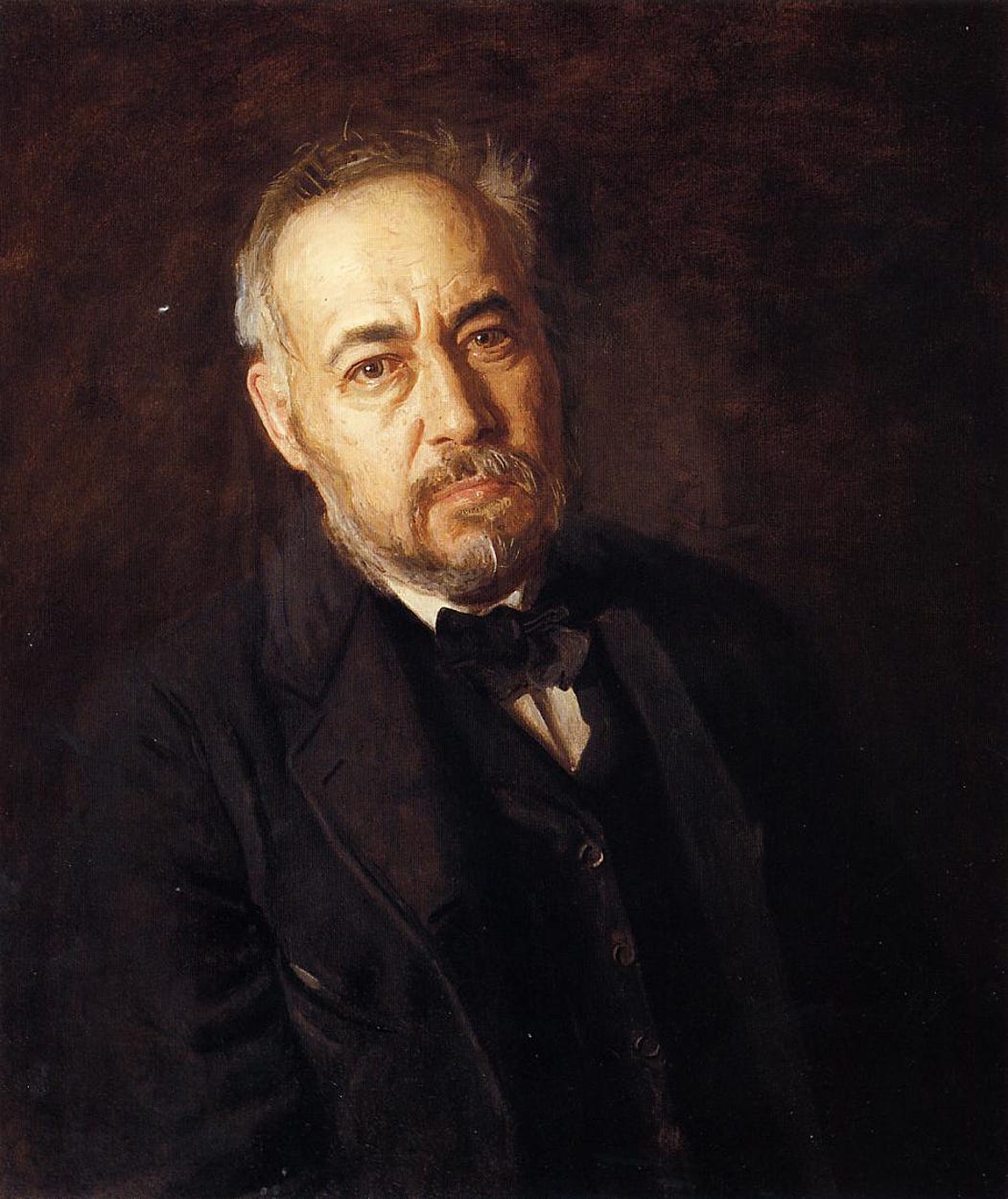
Eakins painted more than two hundred portraits, most of them unpaid and unasked for. He chose his own sitters, scientists, doctors, musicians, and gave them no flattery, only the truth of a tired face.
Many subjects disliked the result and refused to take the picture home. He kept the rejects stacked in his studio. The honesty that built his later reputation cost him sitters while he lived.
Born and rooted in Philadelphia
Thomas Eakins was born in Philadelphia on 25 July 1844, and the city held him for almost his entire life.
His father, Benjamin Eakins, made a good living as a writing master, teaching elegant penmanship to a rising middle class. That steady income let Thomas study art without ever depending on sales.
The family settled at 1729 Mount Vernon Street, and Eakins lived in that house until he died. He painted the people he already knew: rowers on the Schuylkill, surgeons at the local medical college, friends sitting in shaded parlors.
Where Whistler chased London and Sargent chased Europe, Eakins stayed put. Philadelphia was his studio, his subject, and his loyalty all at once.
The academy and the dissecting room
Eakins enrolled at the Pennsylvania Academy of the Fine Arts in 1862 and studied there until 1866. Drawing from plaster casts and live models was not enough for him.
He wanted to know how a body worked under the skin. So he crossed town to Jefferson Medical College, sat in on anatomy lectures, and took part in dissections beside the medical students.
Few American painters went that far. Eakins treated the human figure as an engineering problem: bone, muscle, tendon, and weight.
That habit of looking hard at real anatomy would shape every canvas he made, from athletes in motion to surgeons at the operating table.
Paris and the school of Gerome
In 1866 Eakins sailed to Paris and won a place at the Ecole des Beaux Arts, the most demanding art school in Europe.
His teacher was Jean Leon Gerome, a French painter known for polished, exact scenes. Gerome drilled him in careful drawing and honest observation rather than easy prettiness. Eakins also spent a short time with the portrait painter Leon Bonnat.
Nearly three years of French training gave him a lesson he never dropped: build a picture from solid form and real light. He carried that discipline home to America, where most painters were still devoted to landscape instead of the human figure.
The winter in Spain that changed everything
Before heading home, Eakins spent the winter of 1869 to 1870 in Spain. In Seville he tried his first serious outdoor figure painting.
In Madrid he walked the Prado and stood in front of the old Spanish masters. Diego Velazquez and Jusepe de Ribera hit him harder than anything in Paris. Here were painters who showed people exactly as they were, with weight, shadow, and no flattery.
Eakins filled his notebook with admiration. He returned to Philadelphia in July 1870 with a plan: paint modern American life with the same unblinking honesty the Spaniards had used on kings and beggars alike.
The rowing pictures on the Schuylkill
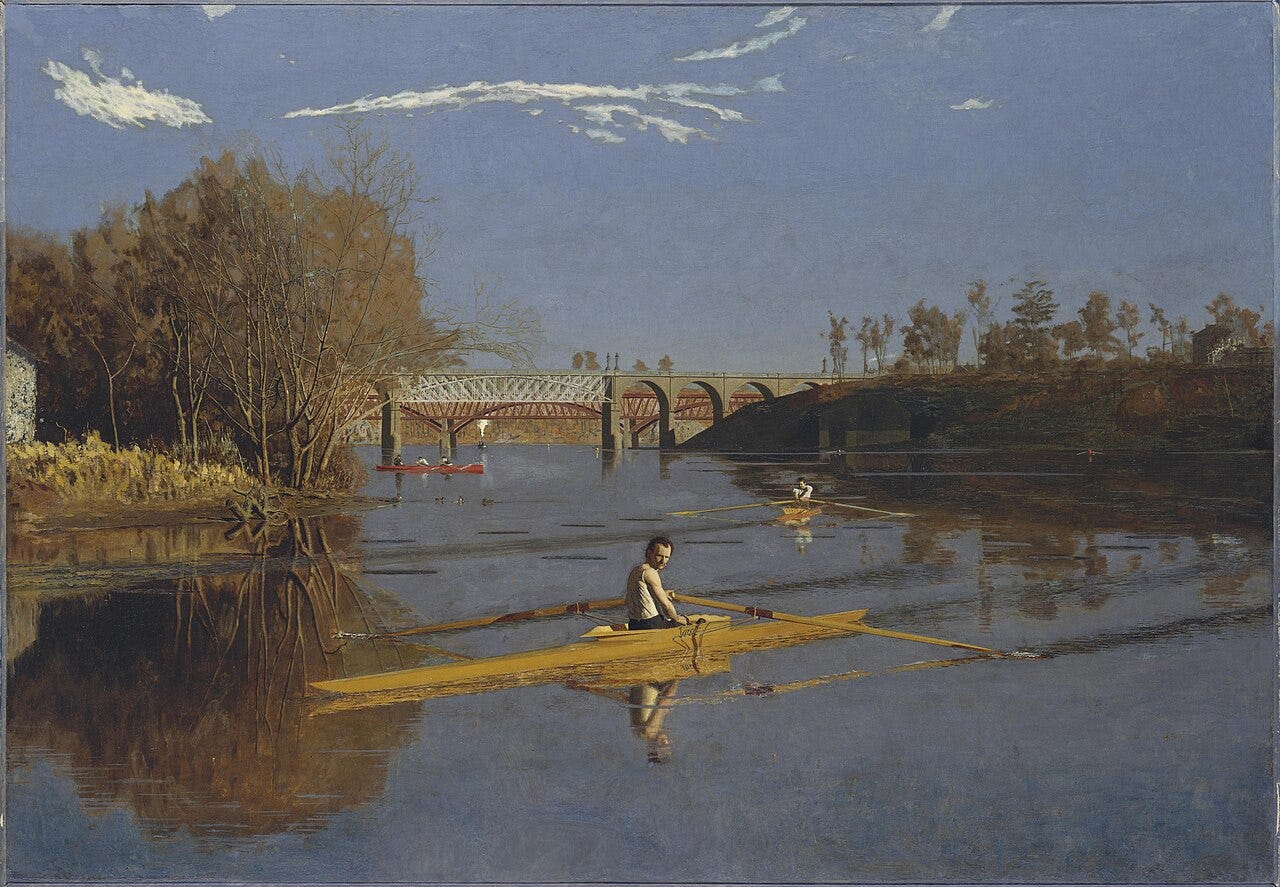
Back home, Eakins turned to the Schuylkill River, where amateur rowing was a local passion. In 1871 he painted his friend Max Schmitt, a champion sculler, gliding across still water in Max Schmitt in a Single Scull.
Here is the detail most viewers miss. The lone rower is not the only figure in the boat traffic. In the second, smaller scull behind Schmitt, Eakins painted himself, and signed his own name on that boat.
So the picture is really a double portrait, artist and athlete sharing one calm afternoon. It launched a series of rowing scenes that measured oars, ripples, and muscle with almost scientific care.
How Philadelphia fought to keep The Gross Clinic
Eakins built The Gross Clinic in 1875 for Philadelphia's 1876 Centennial. He set it inside the surgical theater of Jefferson Medical College, with Dr. Samuel Gross pausing above a patient, scalpel bloody.
Once again he wrote himself into the scene, seated by the tunnel railing, sketching. The fair's art jury refused the canvas, likely finding it too brutal, and it hung instead in a model army field hospital display.
The picture's fortunes later reversed completely. In 2007, after a public fundraising campaign, the Philadelphia Museum of Art and the Pennsylvania Academy bought it together, for a reported 68 million dollars, to keep it in the city.
The Agnew Clinic and a rare commission
Thirteen years later Eakins returned to the operating room. In 1889 three classes of medical students at the University of Pennsylvania paid him about 750 dollars to paint Dr. D. Hayes Agnew, their retiring surgery professor.
The result, The Agnew Clinic, is the largest canvas Eakins ever made, roughly 7 feet tall and nearly 10 feet wide. Agnew asked him to show less blood than in the Gross picture, and Eakins agreed.
It still reads as a working clinic rather than a tribute pose. The painting stayed with the University of Pennsylvania, exactly where the students wanted it, one of the few commissions Eakins actually received and finished.
Swimming and the buyer who backed away
In 1885 Eakins painted Swimming, showing six naked men and boys resting and diving at a swimming hole outside the city. The models were his own students and friends, and Eakins put himself in the lower right, paddling in the water with his dog.
Edward Coates, a leader at the Pennsylvania Academy, had commissioned the picture. When he saw the frank nudity, he decided it would not do and quietly swapped it for a tamer painting.
Swimming shows Eakins at his most relaxed and his most stubborn at once. Today it hangs at the Amon Carter Museum in Fort Worth, admired for the very honesty that once embarrassed its buyer.
Susan Macdowell, the student who saved his legacy
In January 1884 Eakins married Susan Hannah Macdowell, a gifted painter who had studied under him at the Pennsylvania Academy. She set aside much of her own career to support his.
Susan modeled for him, kept his studio running, and defended his work when critics and neighbors would not. After the teaching scandal drove him out, she stood by him without flinching.
When Eakins died, she became the guardian of his reputation. She held on to hundreds of his paintings, lent them to exhibitions, and helped museums acquire them.
Much of what we know of Eakins survives because Susan Macdowell Eakins refused to let it scatter.
The one sitter who loved the honesty
Few sitters enjoyed Eakins's frankness, but one famous man loved it. Around 1887 and 1888 Eakins painted the poet Walt Whitman, then living across the river in Camden, New Jersey.
Whitman hated most portraits of himself, calling them polished and false. Eakins gave him a ruddy, aging, rumpled figure, and Whitman approved at once.
He reportedly said that Eakins was not a painter but a force, and praised him as the rare artist who painted what he saw rather than what people wished to see.
Coming from Whitman, who spent his life chasing plain truth in words, it was the perfect blessing on Eakins's plain truth in paint.
The Thomas Eakins questions that keep coming up
What is Thomas Eakins famous for?
Brutally honest realist paintings like The Gross Clinic, plus rowing scenes and portraits.
Why was The Gross Clinic rejected?
Exhibition judges thought its blood and surgery were too graphic for an art display.
Why did he lose his teaching post?
He removed a male model's loincloth in a mixed class, causing a scandal that ended his job.
When did he die?
In 1916, in Philadelphia.
Who taught Thomas Eakins? Jean-Léon Gérôme in Paris, whose rigorous method Eakins imported to Philadelphia and pushed further with photography, dissection, and mathematics.
How much is an Eakins worth? The Gross Clinic was valued at 68 million dollars when Philadelphia rallied to keep it in 2006-07, the most public campaign ever fought over an American painting.
More secrets to unlock


Why the honesty finally won
Eakins was underappreciated in his lifetime, but The Gross Clinic is now considered one of the greatest American paintings, and the city that once rejected it paid a fortune to keep it from leaving Philadelphia in 2007.
One last detail. Eakins photographed his own students swimming and used the shots to compose his painting Swimming, an early case of a painter building a finished painting directly from the camera.