
William Holman Hunt was the most devout and most stubborn of the Pre-Raphaelites. A founder of the Brotherhood, he pushed its rules to the limit, painting every leaf, stone and thread from life and loading each picture with religious and moral meaning.
He travelled to the Holy Land to get the details right, and one of his images circled the globe.
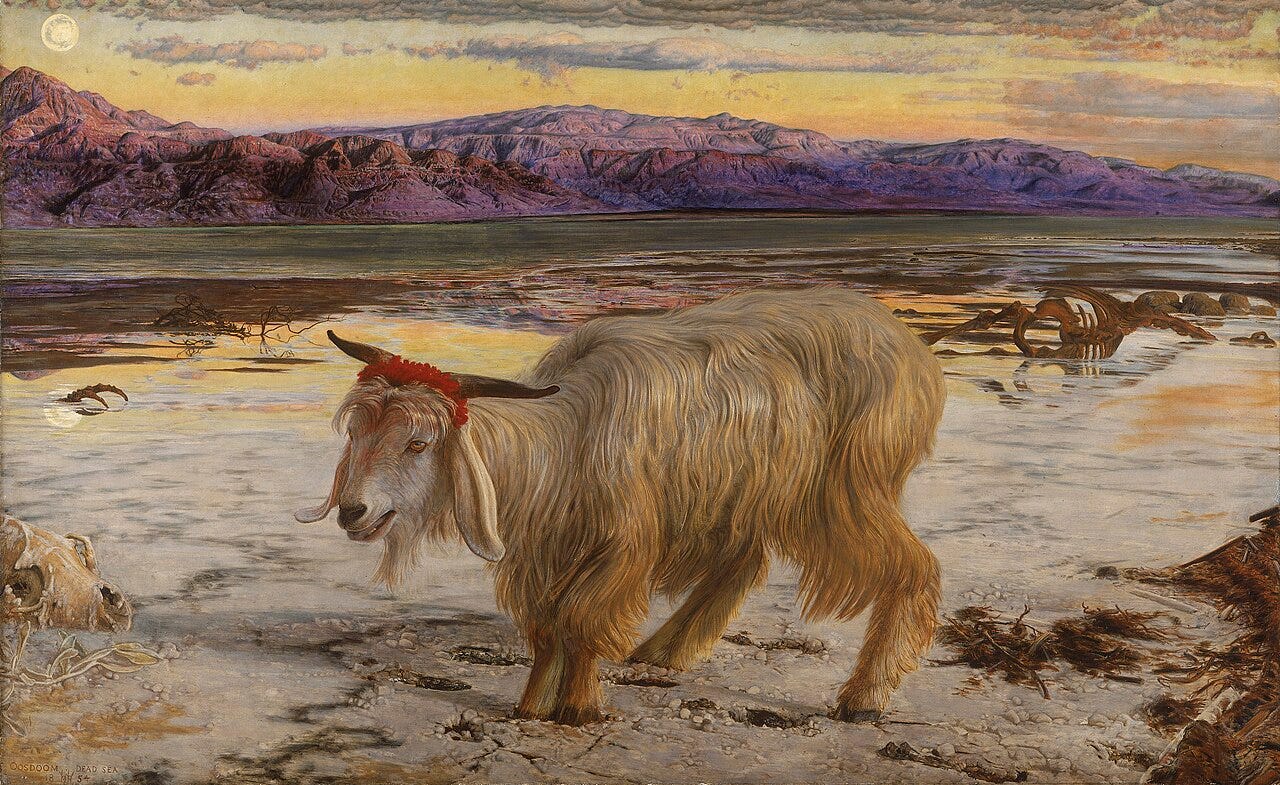
To paint a goat by the Dead Sea, he hauled his easel to the actual shore and worked with a real animal dying in the heat.
Born: London, 1827
Known for: the Pre-Raphaelites, The Light of the World, intense moral symbolism
Died: London, 1910
More incredible painter stories
If William Holman Hunt pulled you in, you will love these too:


William Holman Hunt at a glance
1827. Born in Cheapside, London, a warehouse manager’s son.
1848. Founded the Pre-Raphaelite Brotherhood with Millais and Rossetti. He was 21.
1854. First journey to the Holy Land, painting The Scapegoat on the Dead Sea shore.
1875. Married Edith Waugh, his dead wife’s sister, in Switzerland because the marriage was illegal in England.
1910. Died at 83. His ashes lie in St Paul’s Cathedral, under the roof that houses his Light of the World.
The Brotherhood and its rules
In 1848 Hunt, Millais and Rossetti founded the Pre-Raphaelite Brotherhood, rebelling against the dark, formula bound art of the academies. Their canvases now anchor most lists of famous Pre-Raphaelite paintings.
They wanted brilliant colour, sharp detail and truth to nature, painting as if before Raphael. See what is pre-raphaelite art.
Hunt took the truth to nature rule most literally of all, painting outdoors for hours and rendering every blade of grass with stinging clarity. See what is oil painting.
The picture that toured the world
His most famous work, The Light of the World, shows Christ in the night holding a lantern, knocking at a long closed, overgrown door that has no handle on the outside. It must be opened from within. See what is symbolism in art.
A later version toured Britain and its colonies, drawing enormous crowds across the world. For decades it was one of the most reproduced religious images anywhere, printed in countless homes and churches.
Truth at any cost
Hunt chased authenticity to extremes. For The Scapegoat he travelled to the salt shore of the Dead Sea and painted a real goat in the punishing landscape, determined that the setting be exactly true.
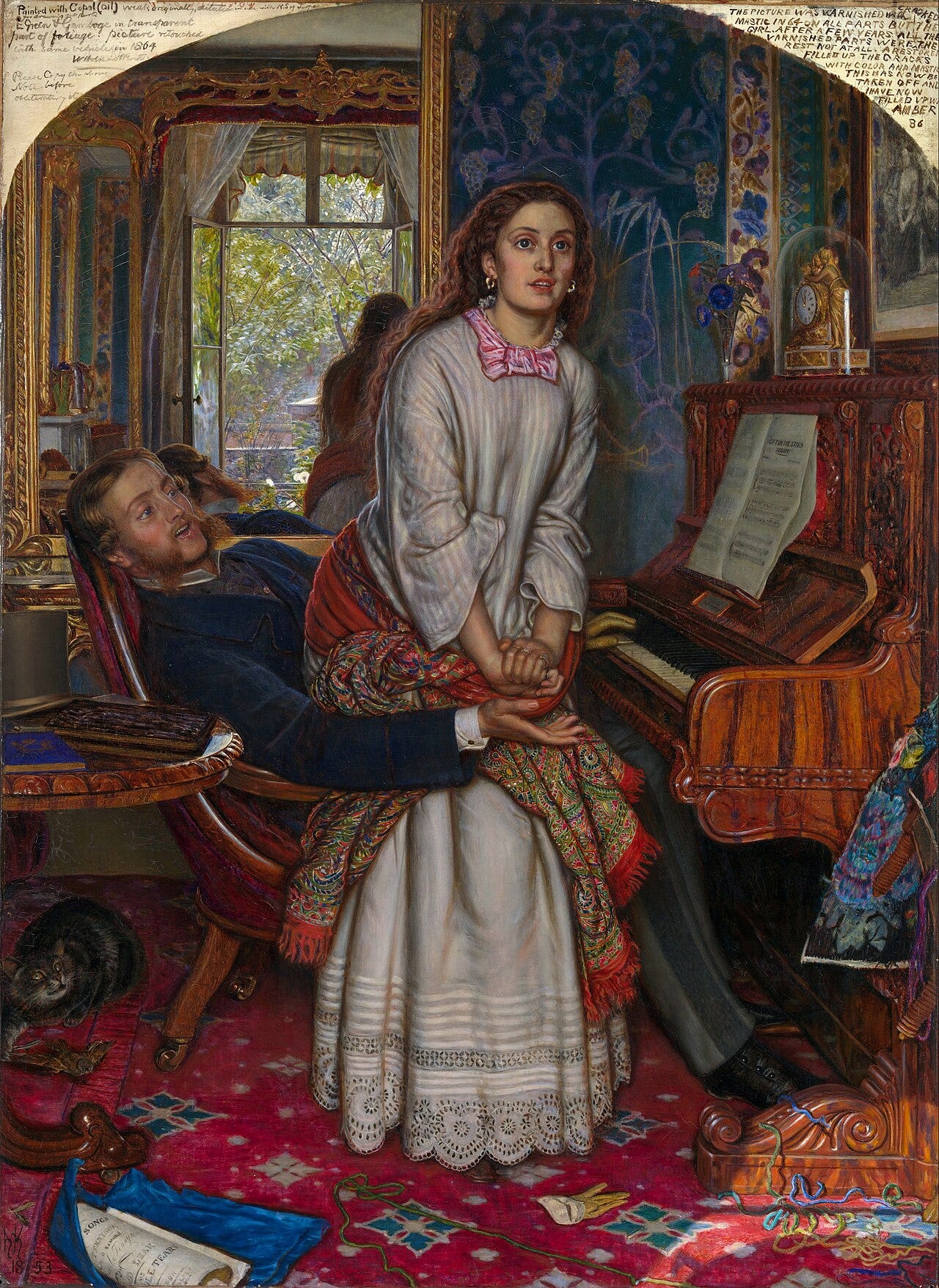
His moral pictures, like The Awakening Conscience, hide their meaning in tiny details: a tangled thread, a caged bird, a glove on the floor. Every object is a clue. Nothing is decoration.
Two sisters, one scandal
Hunt married Fanny Waugh in 1865. She died in Florence the next year, days after giving birth.
Nine years later he married her sister Edith, a union English law then forbade. They wed in Switzerland.
Part of the family, including the sculptor Thomas Woolner, never spoke to them again.
The memoir that settled scores
In 1905 Hunt published Pre-Raphaelitism and the Pre-Raphaelite Brotherhood, two volumes of history written by the last man standing.
It fixed his own version of who invented what, with Rossetti trimmed down to size. Rossetti gets his due elsewhere, in Dante Gabriel Rossetti, the complete story.
Historians have been re-litigating it ever since, which is exactly what he wanted to prevent.
Borrowed eyes for the last pictures
By the 1900s glaucoma was taking Hunt’s sight.
The painter Edward Robert Hughes worked as his hands on the final Light of the World and The Lady of Shalott.
Hunt directed every touch. The signature stayed his.
What readers want to know about Holman Hunt
What is William Holman Hunt famous for?
Co founding the Pre-Raphaelites and painting The Light of the World and The Scapegoat.
What is The Light of the World about?
Christ knocking at a door with no outside handle, meaning the soul must open it from within.
Did he really paint by the Dead Sea?
Yes, he took his easel to the shore to paint The Scapegoat with a real goat on the spot.
When did he die?
In 1910, in London, and was buried in St Paul's Cathedral.
Who were Holman Hunt’s wives? Fanny Waugh, who died in Florence in 1866, and her sister Edith, whom he married abroad in 1875 because English law forbade the union.
Did Hunt paint his late works alone? No. With his eyesight failing, Edward Robert Hughes worked with him on the last Light of the World and The Lady of Shalott.
More secrets to unlock


Why the lantern still glows
Hunt outlived the other founders and never wavered from the Brotherhood's ideals, even as taste moved on. His glowing, detail packed pictures, and that lantern in the dark, remain the most sincere expression of what the Pre-Raphaelites set out to do.
One last detail. His devotion to truth meant paintings took years, and he made the third, largest version of The Light of the World in his sixties, eyesight failing, with an assistant's help. That canvas toured the world from 1905 to 1907, drawing crowds counted in the millions, and hangs today in St Paul's Cathedral.