

170 000+ readers. Learn art the fun way.
This is a preview. Paid subscribers get the full story.
You’ll also get:
10 new stories every month
The full archive (130+ Art stories)
Your personal art guide. Comment, ask questions, DM me anytime
iPhone user? Subscribe at coolstoriesabout.art, not via the app. Apple adds 30% to the price.
Discover my new newsletter !

London, May 1972. One in the morning.
On the top floor of 17 Powis Terrace, in Notting Hill, in a large apartment turned into a studio, a man of 34 stands painting at a canvas ten feet wide and seven feet tall.
Round glasses, black frames. Hair bleached blond, a shapeless sweater. A cigarette burning down, forgotten, in an ashtray on the floor.
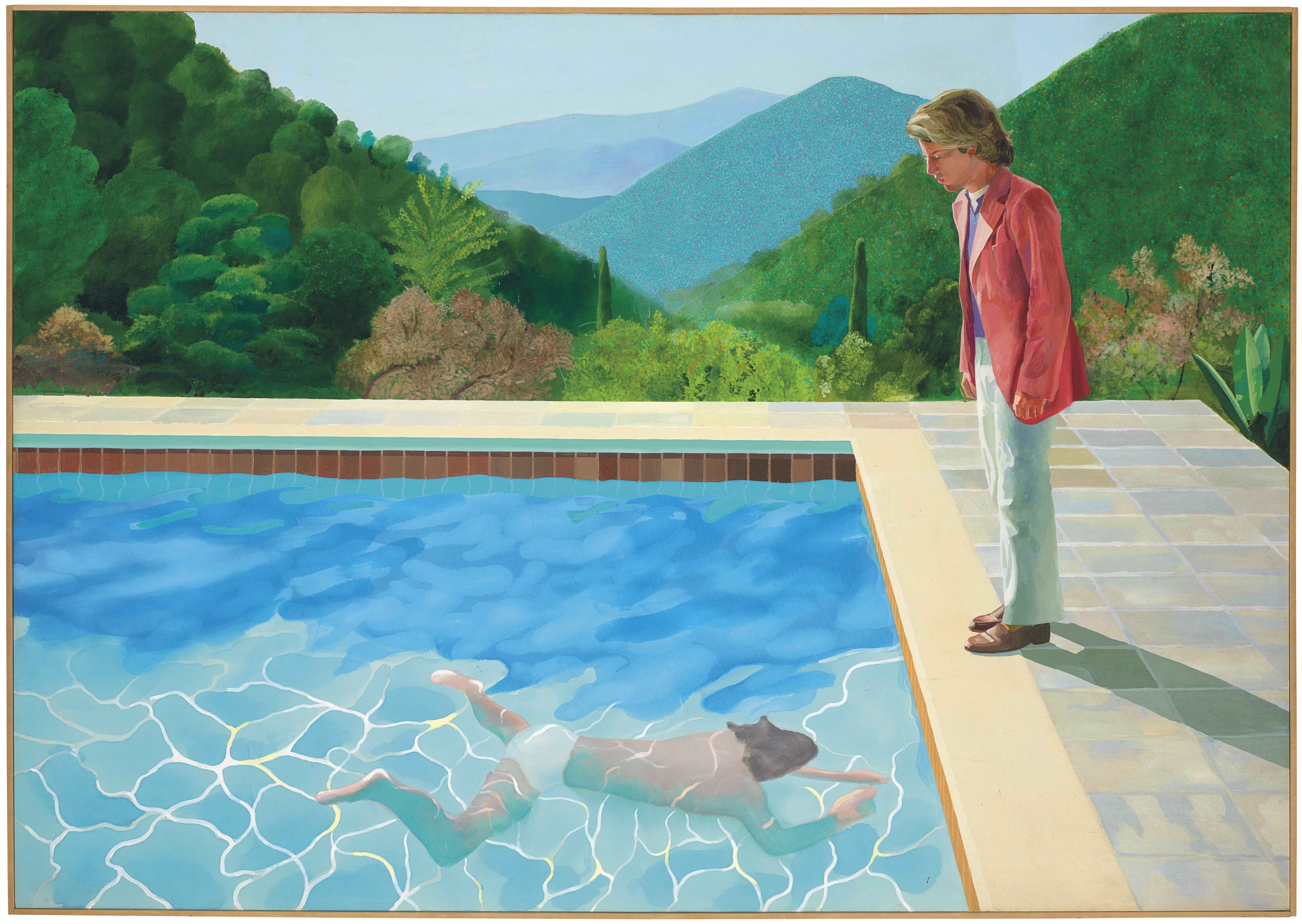
On the canvas, a blue pool under dry hills.
A man in a pink jacket stands at the water’s edge, his eyes lowered to the surface. Below him, a second man swims, his face broken up by the ripples.
In a few hours, the movers will come for the canvas. They will roll it, crate it, load it onto a plane for New York. It has to be on a gallery wall on 57th Street by May 13.
The canvas isn’t finished. He’s still painting the standing man’s face.
Hockney has already painted this picture once. A whole version, months of work, that he ended up throwing out.
Two Photographs on the Floor
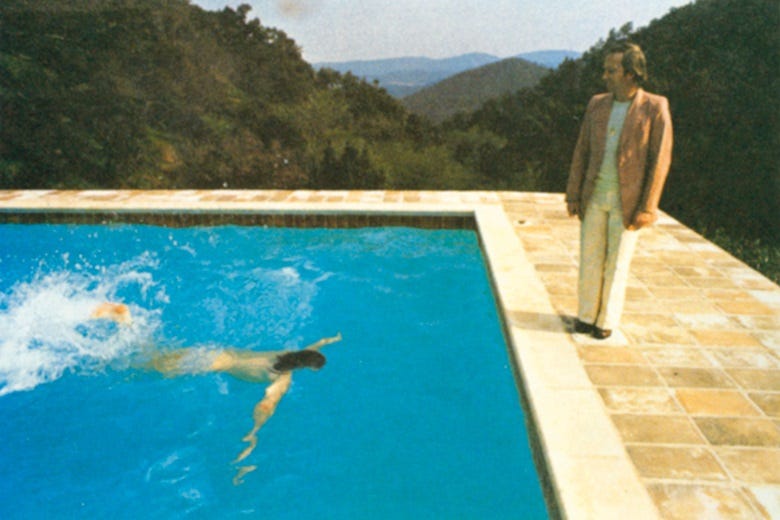
It all began by chance, a few months earlier, on the floor of this studio.
Two forgotten photographs had come to rest side by side. In one, a boy swam underwater, a shot brought back from California. In the other, a young man stood still, his eyes lowered to the ground.
The standing boy was no one. A figure caught on another day, for another reason, left there by accident.
But chance had composed a scene. The standing man seemed to be watching the swimmer below his feet. Two bodies, two unrelated moments, brought together by the floor.
The idea seized him at once. That same evening, he was at work.
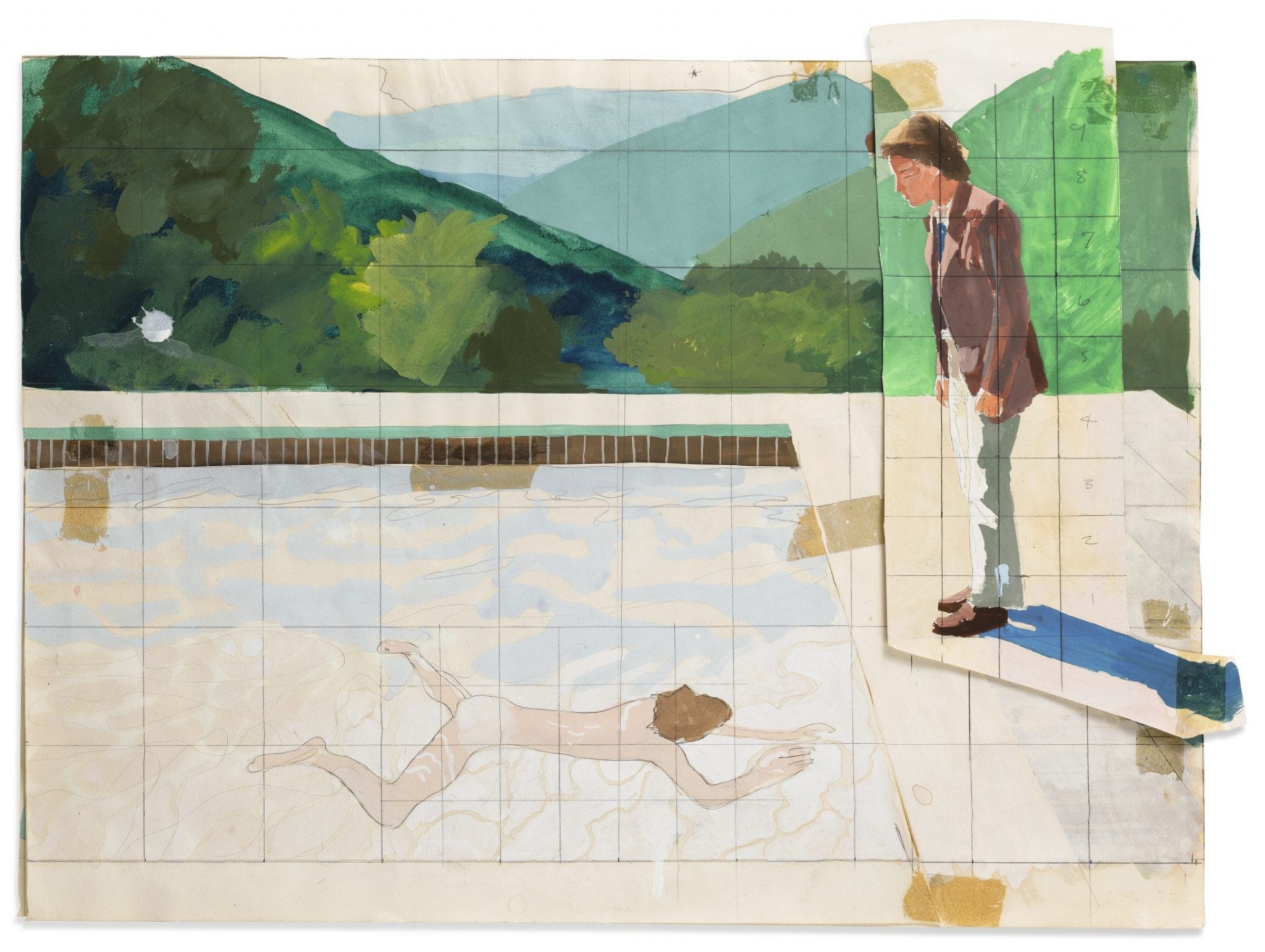
For four months, he wore himself out on it. The angle of the pool rang false, refused to be fixed, threw everything else off. He gave up, threw out the whole canvas.
When he took it up again, in early April, New York was only weeks away. He repainted it all from scratch, eighteen hours a day.
Keep learning art the fun way


The Boy from Bradford


By then he had painted dozens of pools. They had become his signature. Nothing in his childhood had pointed him toward blue water.
He grew up in Bradford, a mill town in the north of England, its bricks blackened with soot, its rain eight months out of twelve. A private pool, up there, no one had ever seen one.
His father bought up old bicycles and repainted them to look new. The boy watched him do it, fascinated to see paint turn one thing into another.
In 1964, he flew to Los Angeles. The plane came down over San Bernardino, and below it appeared hundreds of little blue rectangles between the houses. Pools, everywhere.
For a man from the North, gay in a country that still sent people like him to prison, California was a liberation as much as a light. He settled there, and painted men, openly.
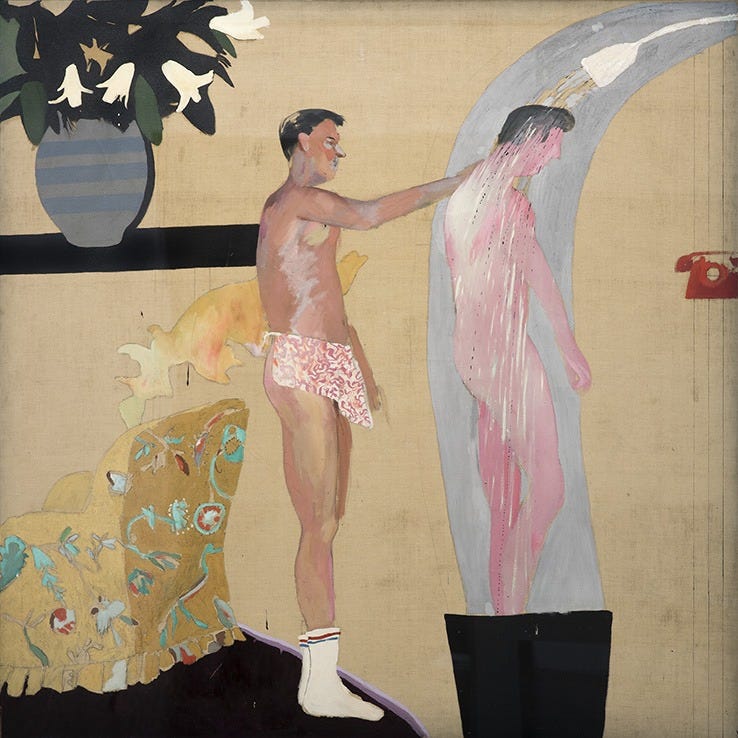
There, his painting found its form. Flat colors, a shadowless light, and the challenge that would never let him go: catching moving water with a few white strokes.
He didn’t paint from a single view either. He built his canvases by assembling photographs taken separately. A true image, made of pieces that weren’t.
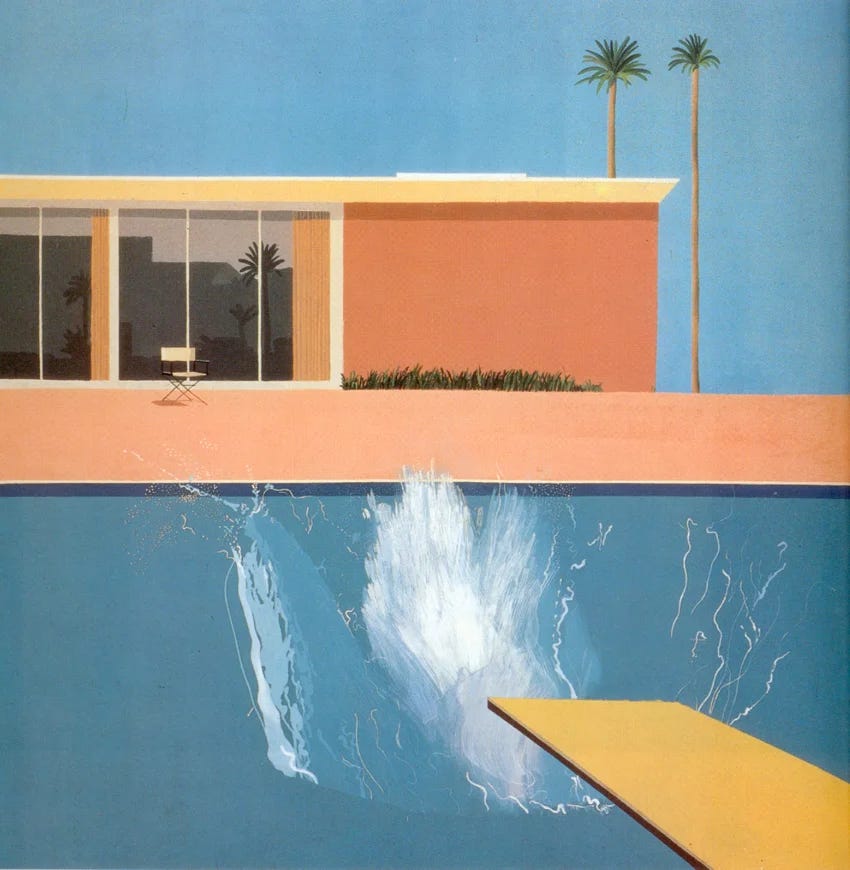
In 1967, a white splash frozen over an empty pool. A Bigger Splash. The boy from Bradford had become one of the most watched English painters on either side of the Atlantic.
The Last Face
In the studio, it’s almost two in the morning. Hockney is on the last figure now, the man standing at the water’s edge.
On the canvas, the two men are painted in two opposite styles. The swimmer in soft, dissolved strokes, half swallowed by the water. The standing man sharp and hard, cut out like a photograph.
The anonymous boy from the old photo is gone. In his place, Hockney paints another face. The face of a man he knows better than any other in the world, a man he has painted a hundred times.
A man who has walked out of his life…