
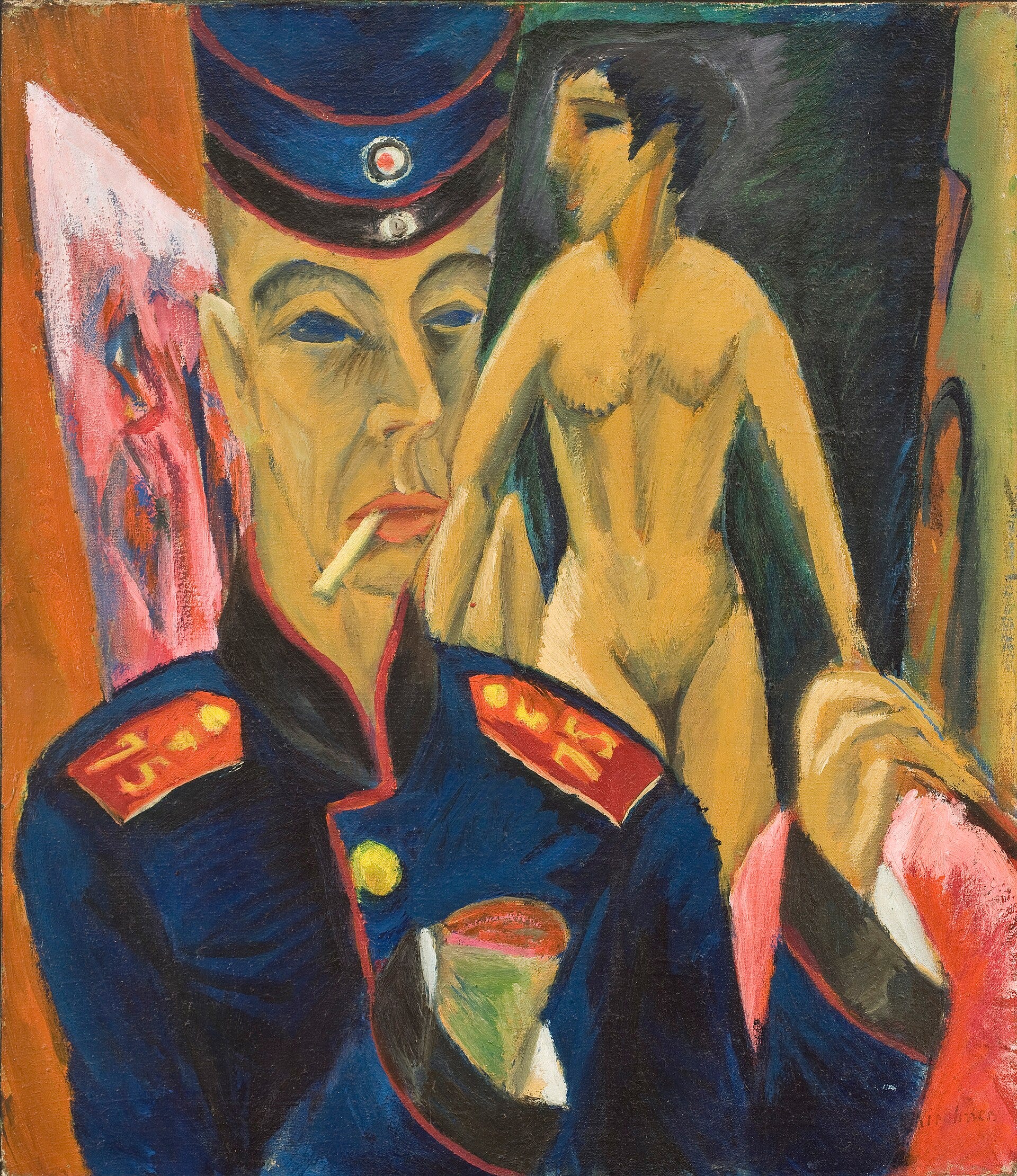
Ernst Ludwig Kirchner was a German painter and printmaker, born in Aschaffenburg on 6 May 1880, who died in Davos, Switzerland, on 15 June 1938. In 1905 he helped found Die Brücke, the Dresden group that launched German Expressionism, and in 1913 he began the Berlin street scenes that made his name. He is also remembered for a self-portrait in which his painting hand has been cut off, a wound he never suffered.
The uniform in that picture is real. The wound is not.
Cool Stories About Art is a newsletter to learn art the fun way.
Join 200,000+ readers and get:
10 new art stories / month
The entire archive of content (1,000+ articles)
Comment, ask questions, and chat with other readers
Kirchner painted it in 1915, in his studio, with a nude model standing behind him. He wears a soldier's uniform, and where the hand he paints with should be there is a bloody stump. It looks like a battlefield casualty, and it has often been read as one. But Kirchner never lost a hand, and he never fought in the war.
When Germany mobilized in 1914, he put his name on a recruitment list for the artillery, hoping to choose his own service before he was drafted into something worse. In April 1915 he told the critic Gustav Schiefler that he had gone to the muster for the field artillery, "a beautiful and for me interesting division." He spent a few months as a recruit in a field artillery regiment in Halle, found the drilling and the barracks hard to bear, and was out of the army before the year ended.
Why he painted that hand is the question that follows him through the rest of his life. So does a sentence he wrote in 1916, comparing himself to the women he had painted in the streets of Berlin two years earlier. Keep both in mind.
What You'll Discover
How four students built a Bridge.
Who the women in plumed hats were.
What the army did to him.
Why a sick painter chose the Alps.
Who the French critic really was.
What the Nazis took from German museums.