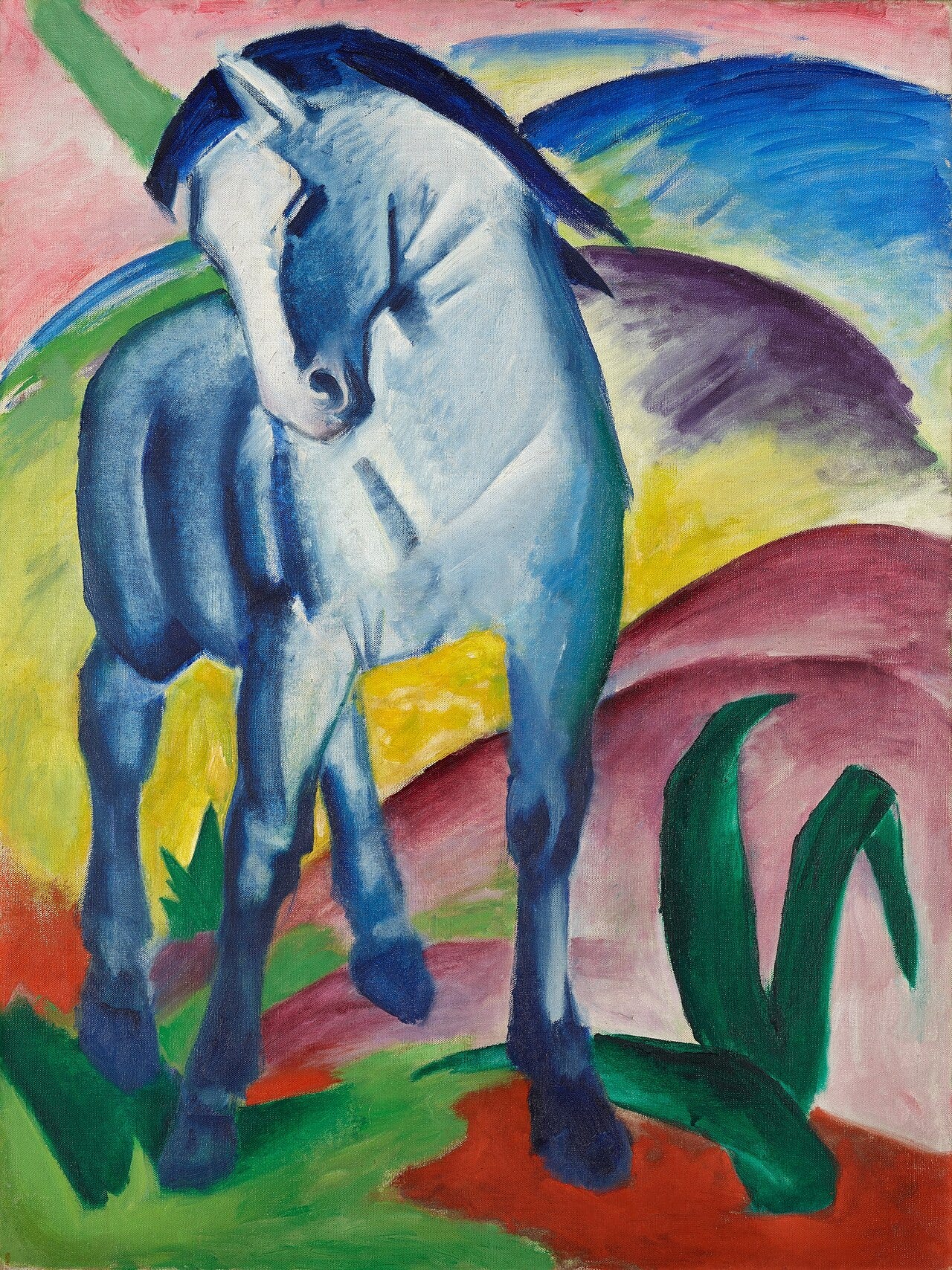
Franz Marc: The Complete Story
Franz Marc was the German Expressionist who painted animals as purer and more spiritual than people. His blue horses, red deer and yellow cows glow in strong colour against rhythmic landscapes, each hue chosen for its meaning.
A co founder of the Blue Rider group, he was reaching toward abstraction when the First World War cut his life short at thirty six.
He built a private code in which the colour blue itself carried the spirit.
Born: Munich, Germany, 1880
Known for: the Blue Rider, vivid animal paintings, colour symbolism
Died: Verdun, France, 1916
More incredible painter stories
If Franz Marc pulled you in, you will love these too:
Franz Marc at a glance
1880. Born in Munich, son of a landscape painter.
1911. Founded the Blue Rider with Kandinsky after a jury rejection.
1913. Painted The Tower of Blue Horses and Fate of the Animals within months of each other.
1914. Volunteered for the war that would swallow his generation of painters.
1916. Killed by shell splinters near Verdun at 36.
Animals as the better souls
Marc grew disillusioned with people and turned to animals, which he felt were more innocent and in tune with nature. Horses, deer and foxes became his main subject, painted as if seen from inside their own calm awareness. See what is expressionism.
His Blue Horses and the haunting Fate of the Animals show creatures woven into landscapes of pure energy, beautiful and, in the late work, full of foreboding.
A language of colour
Marc gave colours fixed meanings. Blue stood for the spiritual and the masculine, yellow for gentleness and joy, red for the heavy, violent world of matter. He combined them like notes in a chord. See what is symbolism in art.
So a blue horse is not a fantasy whim but a statement, an animal carrying the spirit. The colour is the message.
The Blue Rider
In 1911 Marc and Wassily Kandinsky founded Der Blaue Reiter, the Blue Rider, a circle that believed art should express inner spiritual truth.
They published a famous almanac and pushed German art toward the edge of abstraction. See what is abstract art.
Marc's last works dissolve into shards of colour and form, on the verge of leaving the visible animal behind altogether.
Postcards for a poet
Between 1912 and 1914 Marc mailed the poet Else Lasker-Schüler dozens of small painted postcards.
Blue horses, towers, and animals for the imaginary prince of her poems.
The cards now count among his most loved works: a private correspondence, museum framed.
Camouflage, painted like Kandinsky
At the front, Marc was assigned to camouflage, painting tarpaulins to hide artillery from aircraft.
He joked in letters that he worked in styles from Manet to Kandinsky, depending on the viewing distance.
It is the strangest late body of work in Expressionism, and none of it survives.
The list that came too late
By 1916 the German command was drawing up lists of notable artists to pull back from combat.
Marc’s name was on the list.
The reassignment had not reached his unit when a shell splinter killed him near Verdun on March 4, 1916.
The Franz Marc questions that keep coming up
What is Franz Marc famous for?
Vivid paintings of animals, especially blue horses, and co founding the Blue Rider group.
Why did he paint animals?
He saw them as purer and more spiritual than humans, closer to nature.
What did the colours mean?
Blue for the spiritual, yellow for joy, red for the material world, a fixed personal code.
How did he die?
He was killed in action at Verdun in 1916, aged 36.
Who received Marc’s painted postcards? The poet Else Lasker-Schüler, who got dozens of small watercolors with blue horses between 1912 and 1914.
Did Marc paint at the front? Yes, camouflage. He painted tarpaulins to hide artillery and joked that he worked in styles from Manet to Kandinsky depending on the distance.
More secrets to unlock
Why the blue horse endures
Marc died young, with his work still racing toward abstraction, so we will never know where he would have gone. What he left, glowing animals charged with meaning, remains some of the most loved and most quietly sad painting of its era.
One last detail. The German army ran a list of important artists to pull from the front line for their own safety. Marc's name was on it, and the order to withdraw him arrived just days too late.