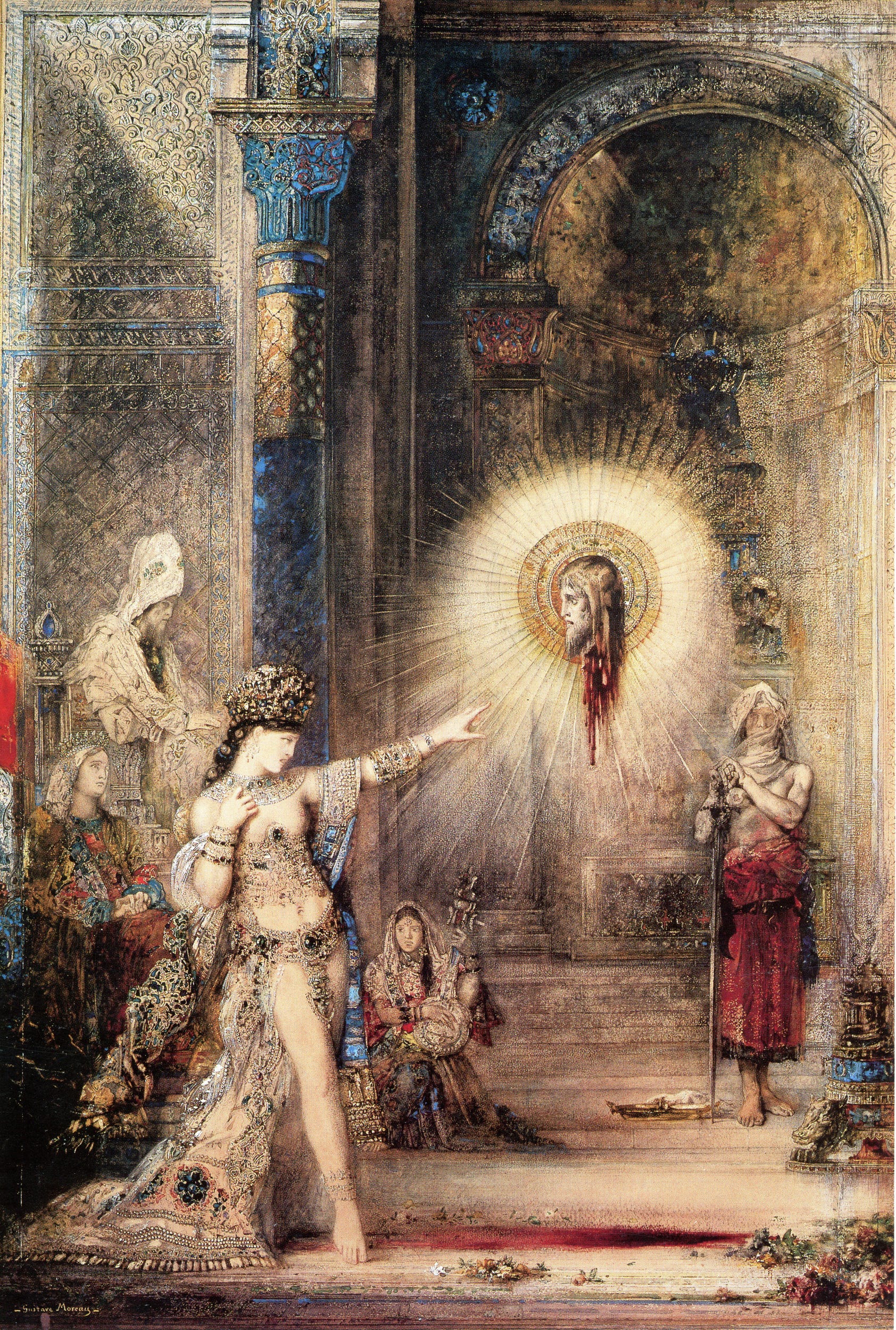
Gustave Moreau was Symbolism's high priest, the painter of jewelled Salomes and dying poets. Born in Paris in 1826, he lived like a hermit, wrote like a mystic, and then, in his last act, taught the young men who would invent Fauvism.
The most backward looking painter of his century turned out to be a secret door into the next one. Both halves of that sentence need telling.
Gustave Moreau at a glance:
1826: born in Paris, son of an architect who planned his education like a building.
1857: two years in Italy copying Carpaccio and Michelangelo, alongside the young Degas.
1876: shows Salomé and The Apparition at the Salon; Paris finally has a name for him.
1892: becomes a professor at the École des Beaux-Arts; Matisse and Rouault pass through his atelier.
1898: dies leaving his house and its thousands of works to the state, curated by himself in advance.
The apparition of 1876
Moreau built his fame on biblical and mythic scenes encrusted with ornament, painted, as he said, only what he could not see. At the 1876 Salon his Salome pictures, above all the watercolour The Apparition, where the Baptist's severed head floats blazing before the dancer, fixed his reputation: history painting turned inward, into dream.
Made a cult by a novel
In 1884 Huysmans published A Rebours, whose decadent hero Des Esseintes owns two Moreaus and worships them in a shuttered house.
The novel made Moreau the idol of the Symbolist generation, a role the real man, reclusive, unmarried, living with his mother on the rue de La Rochefoucauld, accepted mostly by staying home.
He showed less and less, and legend grew accordingly.
More incredible painter stories
If Gustave Moreau pulled you in, you will love these too:
The myth: the decadent dead end
Moreau reads like the end of a line, the last gasp of mythological painting.
Then look at his classroom: appointed professor at the Ecole des Beaux-Arts in 1892, he taught Matisse, Rouault and Marquet, sent them to copy in the Louvre but also to paint in the streets, and told them to think colour rather than describe it.
The future Fauves came out of the hermit's studio. He liked to say he was the bridge some of them would cross.
The house that became a museum
Knowing his work would fall from fashion, Moreau spent his last years converting his house into a museum of himself, rebuilding it around two vast studios linked by a spiral staircase, and left it to the French state at his death in 1898.
The Musee Gustave Moreau opened in 1903 with some 14,000 paintings, watercolours and drawings, and its first curator was his student Rouault. It survives intact, one of the strangest and most loved small museums in Paris.
Where to see Moreau
The Musee Gustave Moreau in Paris is the essential visit, the whole mind in one house. The Apparition's watercolour belongs to the Louvre's cabinet; Orsay, the Met and Harvard's Fogg hold the exported Salomes and Oedipus pictures.
The unfinished abstractions
The museum's reserves hold hundreds of small panels that look like nothing painted before 1890: storms of pure color, no subject, no drawing.
They were rehearsals, color trials for mythologies he never finished. Some historians promote them as abstraction before abstraction; others say they are an engine room left running.
Either way, visitors regularly mistake them for twentieth-century paintings that wandered into the wrong museum.
Salomé's tattoos
In the Tattooed Salomé he inked ornament straight over the dancer's painted body, patterning flesh like an engraver possessed.
He preached what he called the necessity of richness: surfaces loaded with jewels, architecture and pattern until the story nearly drowns in it.
It was theology as much as taste. For Moreau the divine hid in accumulation, and a bare surface was an empty prayer.
The secret love
Officially the hermit of the rue de La Rochefoucauld lived with his mother. In fact there was Alexandrine Dureux, a governess he loved, discreetly, for some thirty years.
He taught her to draw, installed her a few streets away, and kept her out of every account of his life he could control.
When she died in 1890 he painted Orpheus at the Tomb of Eurydice in her memory and preserved a room of her belongings. The painter of femmes fatales had one woman in his life, and mourned her like a widower.
The Gustave Moreau questions that keep coming up
What is he known for? Jewelled Symbolist visions, above all the Salome paintings of 1876.
What novel made him famous? Huysmans' A Rebours in 1884, whose hero collects and worships his work.
Who were his students? Matisse, Rouault and Marquet among them, at the Beaux-Arts from 1892.
When did he die? In Paris in 1898; his house museum opened in 1903.
How big is the museum's collection? About 1,300 paintings and cartoons and many thousands of drawings, hung and stacked as he arranged them. The crammed walls are part of the will.
How many Salomés are there? More than a hundred paintings, watercolors and drawings of her. Huysmans' novel fixed on two, and the obsession became mutual between painter and public.
More secrets to unlock
A staircase into his mind
He designed his own afterlife down to the furniture: the spiral staircase between the two studio floors was installed so visitors could climb through his work as through his mind. Andre Breton later called the museum the place that determined his idea of beauty; the Surrealists made pilgrimages to the hermit's stairs.