Ilya Repin painted a tsar murdering his own son so convincingly that the canvas has been attacked twice, once with a knife in 1913 and once with a metal pole in 2018. When his right hand failed, he strapped his palette to his neck and painted with the left.
The greatest Russian realist chronicled the empire from barge ropes to the throne, then refused to come home to the Soviet Union that claimed him.
Ilya Repin at a glance:
1844: born in Chuguev, in present-day Ukraine, to a military settler family; first training in an icon workshop.
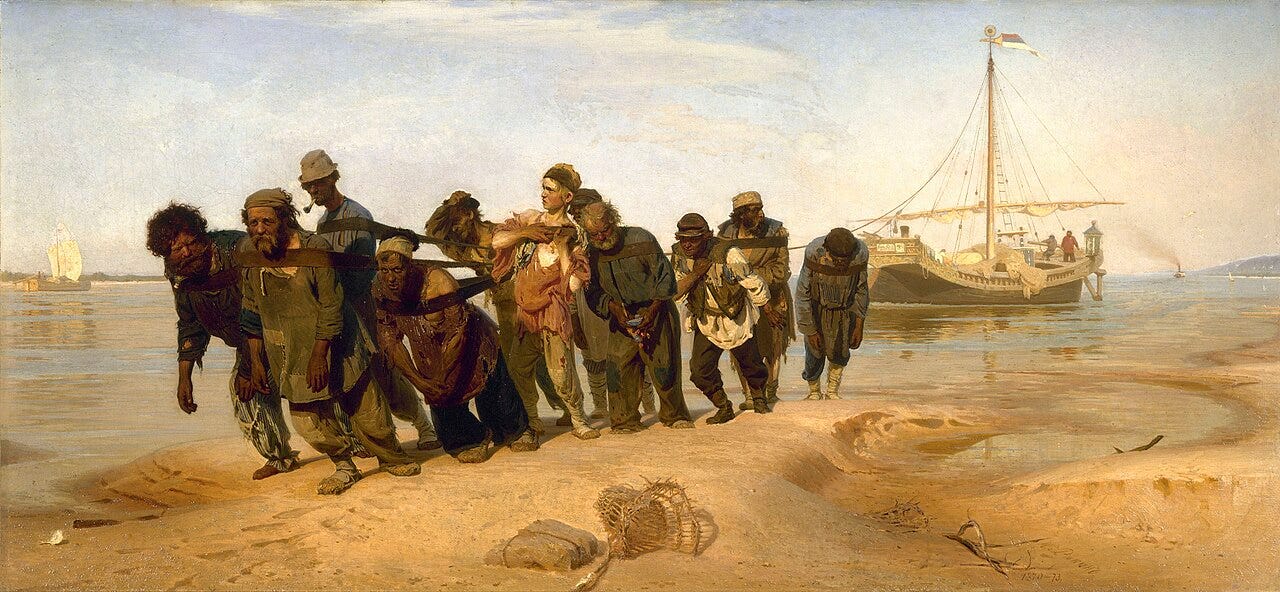
1873: Barge Haulers on the Volga makes him famous at 29, praised by Dostoevsky for refusing to preach.
1885: Ivan the Terrible and His Son unnerves the empire; censors ban it, briefly, before the public wins.
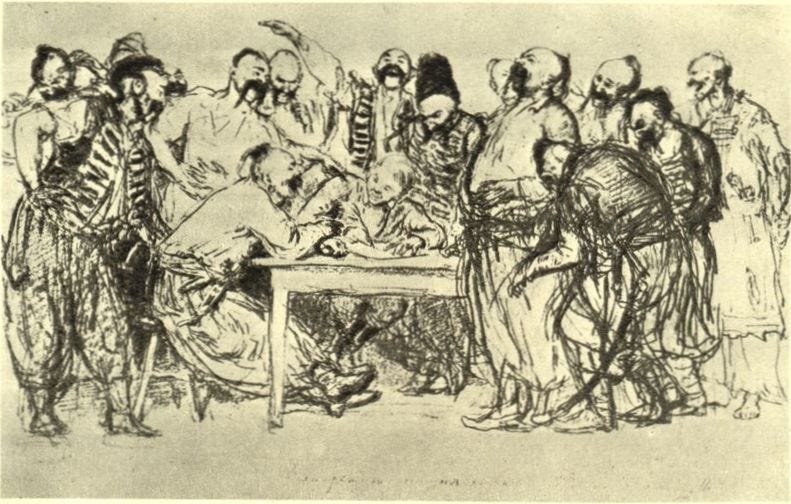
1891: the Zaporozhian Cossacks sells to Alexander III for 35,000 rubles, a record for a Russian painting.
1930: dies at Penaty, his Finnish home, having painted a quarter century left-handed.
From icon workshop to the Volga
Repin was born in Chuguev, in what is now Ukraine, on August 5, 1844, and began as an apprentice icon painter before reaching the St Petersburg Academy.
Barge Haulers on the Volga, finished in 1873 after summers sketching on the river, made him famous at 29: eleven straining men, each an individual portrait, hauling a ship like a hymn to endurance.
Dostoevsky praised it for preaching nothing and showing everything.
The chronicler of the empire
With the Peredvizhniki, the Wanderers who took exhibitions across the provinces, Repin painted Russia in motion: the swarming Religious Procession in Kursk Province of 1883, the returning exile of They Did Not Expect Him of 1884, and the roaring Reply of the Zaporozhian Cossacks, which Alexander III bought in 1891 for 35,000 rubles, the highest price yet paid for a Russian painting. His portrait of Mussorgsky, painted in four days just before the composer's death in 1881, remains the definitive image.
More incredible painter stories
If Ilya Repin pulled you in, you will love these too:


The painting Russia keeps attacking
Ivan the Terrible and His Son Ivan, of 1885, shows the tsar cradling the son he has just fatally struck, blood between his fingers, madness draining into grief. Alexander III banned it from exhibition for a time. This painting and Barge Haulers on the Volga both make our list of famous Russian paintings, where Repin is one of only two artists to appear twice.
In 1913 an icon painter slashed it three times with a knife; in 2018 a drunk visitor smashed the canvas with a metal security pole at the Tretyakov.
Restored twice, it hangs again, the most dangerous picture in Russian art in both directions.
The myth: father of Soviet realism
Soviet textbooks claimed Repin as the ancestor of Socialist Realism, which required ignoring his last act.
From his estate, Penates, at Kuokkala in Finland, he watched the revolution close the border in 1918 and simply never crossed back.
Soviet delegations, letters from Voroshilov, and offers of honors followed for a decade; he declined them all and died at Kuokkala on September 29, 1930, at 86. The village is now called Repino, a name he never lived under.
The left hand, and where to see him
Around 1900 his right hand began to fail from overwork, so Repin hung his palette from a strap around his neck and taught himself to paint left-handed, working almost to the end. The Tretyakov Gallery in Moscow holds Ivan the Terrible and the Kursk procession, the Russian Museum in St Petersburg has Barge Haulers and the Cossacks, and Penates near St Petersburg is a house museum.
The Zaporozhian laugh
The Cossacks drafting their insulting reply to the sultan took him eleven years, with expeditions to Ukraine for faces, pipes and sabers.
Alexander III paid a record price for it: an emperor buying, among other things, a picture about telling an emperor to go to hell.
Laughter is rare in Russian painting, and it is Repin's under-credited specialty. The canvas is a catalogue of forty ways to laugh.
Tolstoy, barefoot
For thirty years he kept painting Leo Tolstoy: at the plough, barefoot under the trees, at the writing desk.
The count approved of the barefoot pictures; the countess did not. The argument over how a prophet should look ran through the whole friendship.
The portraits fixed the image so firmly that when the world pictures Tolstoy, it pictures Repins.
Penaty, the exile that came to him
From 1900 he lived at Penaty, in Kuokkala on the Finnish side of the old border: glass-roofed studio, and a revolving round table where Wednesday guests served themselves.
The revolution moved the border, not the man. Kuokkala became Finland, and Repin, in his seventies, became an emigrant without leaving his garden.
He died there in 1930. The house burned in the war and was rebuilt as a museum, round table included; the town is now called Repino.
The Ilya Repin questions that keep coming up
What is Barge Haulers on the Volga? His 1873 breakthrough: eleven portrait-true laborers hauling a ship, admired by Dostoevsky precisely because it refused to preach.
Why was Ivan the Terrible attacked? Its violence against a sacred ruler has enraged nationalists since 1885: banned briefly by the tsar, knifed in 1913, and struck with a pole in 2018.
Did Repin return to Soviet Russia? No. The 1918 border left his home in Finland, and despite a decade of Soviet courtship he stayed put until his death in 1930.
Where can I see Repin? The Tretyakov in Moscow, the Russian Museum in St Petersburg, and his estate Penates at Repino, preserved as he left it.
Was Repin Ukrainian or Russian? Born in Chuguev, in what is now Ukraine; Russia claims the painter, Ukraine the birthplace and the Cossack laughter. He answered mostly with paintings of both.
How much does a Repin cost? Rarely tested: the state museums hold the icons, and when a major canvas surfaces abroad it draws millions and diplomatic attention in equal measure.
More secrets to unlock


The left-handed self-portraits
When his painting hand gave out, Repin did not stop for a single season: he slung the palette from his neck, switched hands, and painted for another quarter century. The last self-portraits are left-handed.