James Ensor: The Complete Story

James Ensor was the Belgian painter who filled his art with carnival masks, skeletons and leering crowds. Strange, biting and years ahead of his time, he turned the souvenir masks of his home town into a whole world of satire and dread. He helped open the door to Expressionism and Surrealism, mostly while working alone in a seaside resort.

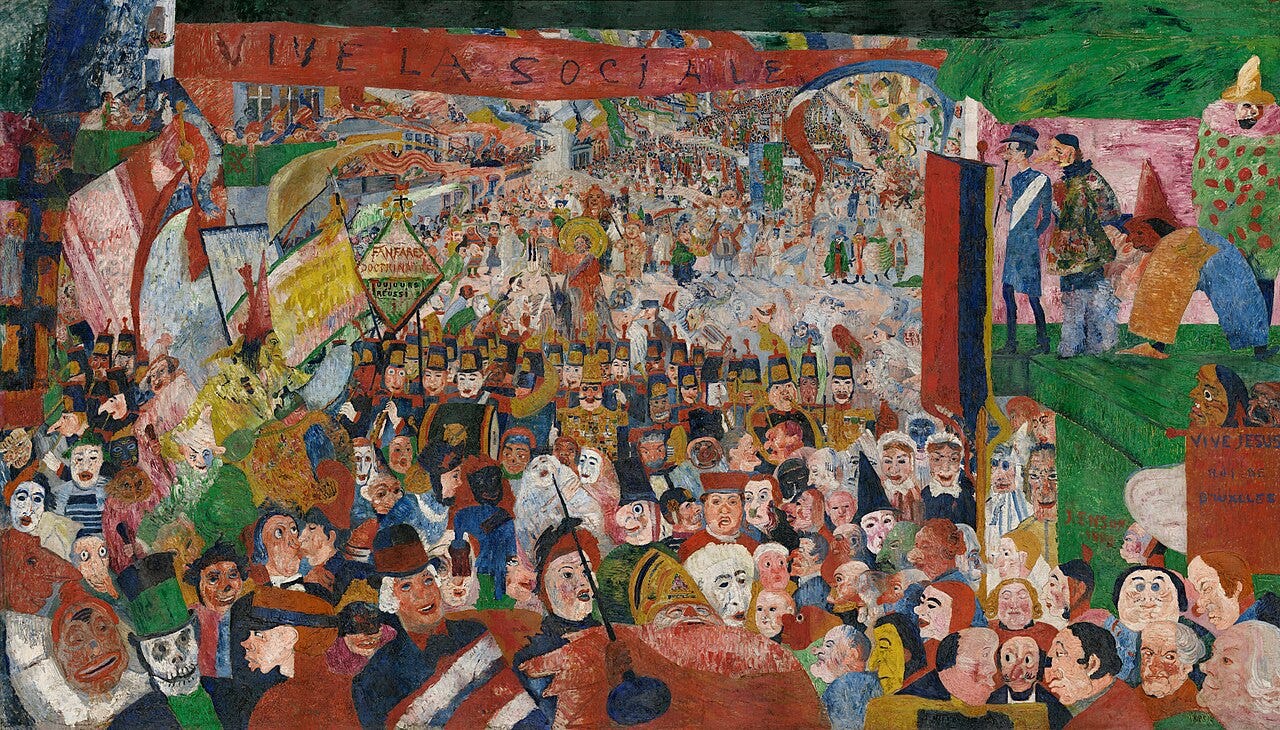
Christ Entry into Brussels by Ensor
James Ensor, Christ Entry into Brussels in 1889.

The masks came straight from his family shop.

  • Born: Ostend, Belgium, 1860

  • Known for: masks and skeletons, satire, Christ Entry into Brussels

  • Died: Ostend, 1949


Hooked on James Ensor? Get more art secrets and stories in your inbox, free.


Music, satire and a long second act

Ensor was more than a painter. He composed music for a ballet of masks, wrote sharp satirical texts, and turned self mythology into a performance, posing as a misunderstood genius long before the world agreed with him.

He spent decades above the family shop with his mother and aunt, rarely selling, endlessly reworking the same masks and skeletons. The isolation that looked like failure was really a stubborn refusal to chase fashion.

Masks from the family shop

Ensor grew up over his family curiosity shop in the seaside town of Ostend, which sold seashells, carnival masks and oddities to tourists. Those grinning masks crept into his art and never left. See what is symbolism in art.

He used them to strip the politeness off people, painting crowds of masked, hollow faces, as if everyone were already wearing a disguise.

The scandal of the great entry

Intrigue by Ensor
James Ensor, Intrigue, 1890.

His giant greatest work, Christ Entry into Brussels in 1889, shows Christ swallowed up in a vast, garish carnival mob beneath a banner of political slogans. It is huge, loud and deliberately ugly.

Even his own avant garde circle found it too much and refused to show it. Today it is treated as a landmark and hangs as a star attraction in a major museum.

Ahead of everyone, alone

Masks by Ensor
James Ensor, masks and skeletons.

Ensor anticipated the raw emotion of Expressionism and the dream logic of Surrealism before either movement existed. His skeletons fight over a hanged man, masks squabble around a stove, the everyday turns macabre and funny at once. See what is expressionism.

He was also a fine printmaker, etching the same crowds and skeletons in dense, scratchy detail. See what is etching.

What readers ask about James Ensor

Self portrait of Ensor
James Ensor, self portrait.

What is James Ensor famous for?

His paintings of carnival masks and skeletons, and the huge Christ Entry into Brussels.

Why so many masks?

His family ran a shop selling carnival masks, which became his lifelong symbol for human pretence.

What movement did he influence?

He was a forerunner of both Expressionism and Surrealism.

When did he die?

In 1949, in his home town of Ostend.

Why the masks still grin

Ensor did his strangest work young, then mellowed and was finally showered with honors, even made a baron. The early carnival pictures are what endure, a crowd of masks that still feels like a mirror held up to every polite society.


Join 110,000 readers who learn art the fun way. Free.


One last detail. He spent almost his entire life in Ostend, rarely leaving, painting a global vision of humanity from a single seaside town. The man who saw through everyone barely needed to travel to do it.


One good art story at a time. Join free, no catch.