Joaquín Sorolla was orphaned by cholera at two, drew 160,000 New Yorkers to a single exhibition in 1909, and spent eight years painting a 70 meter mural of Spain outdoors. A stroke took his hand at 57, mid-portrait, in his own garden.
They called him the painter of light. What he actually painted was speed: the sea, children, and Spain itself, faster and larger than anyone thought possible.
Joaquín Sorolla at a glance:
1863: born in Valencia; orphaned at two by cholera and raised by an aunt and a locksmith uncle.
1888: marries Clotilde García del Castillo, model, manager and addressee of two thousand letters.
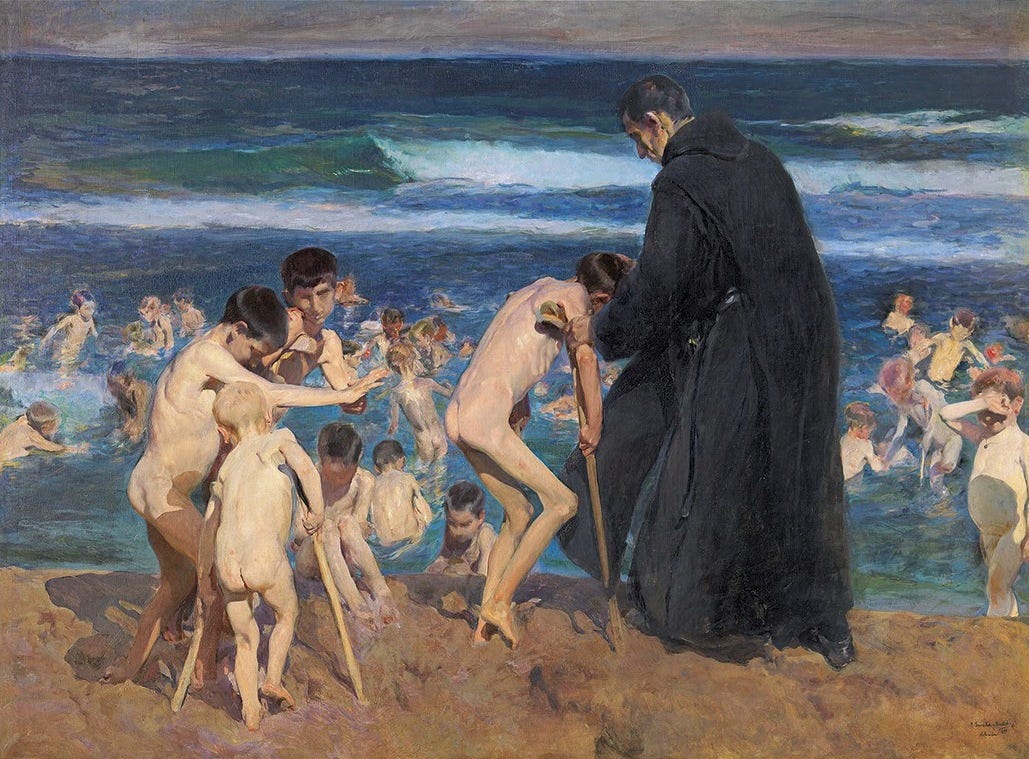
1900: Sad Inheritance, children of polio bathing under a monk's watch, wins the Paris Grand Prix and his freedom.
1911: signs the Hispanic Society contract for Vision of Spain: 14 murals, 70 meters, eight years of his life.
1923: dies at Cercedilla, three years after a stroke stopped his right hand in the garden he had built.
Valencia, orphaned at two
Sorolla was born in Valencia on February 27, 1863. A cholera epidemic killed both his parents before he was three, and an aunt and uncle, a locksmith, raised him. By his teens he was winning every prize Valencia offered, and by his twenties he was in Rome and Paris on scholarship, learning what the Salons wanted.
1900: the sad painting that made him
His breakthrough was not a beach. Sad Inheritance, painted in 1899, shows disabled children bathing in the sea at Valencia under a monk's care, and it won the Grand Prix at the Paris Exposition of 1900.
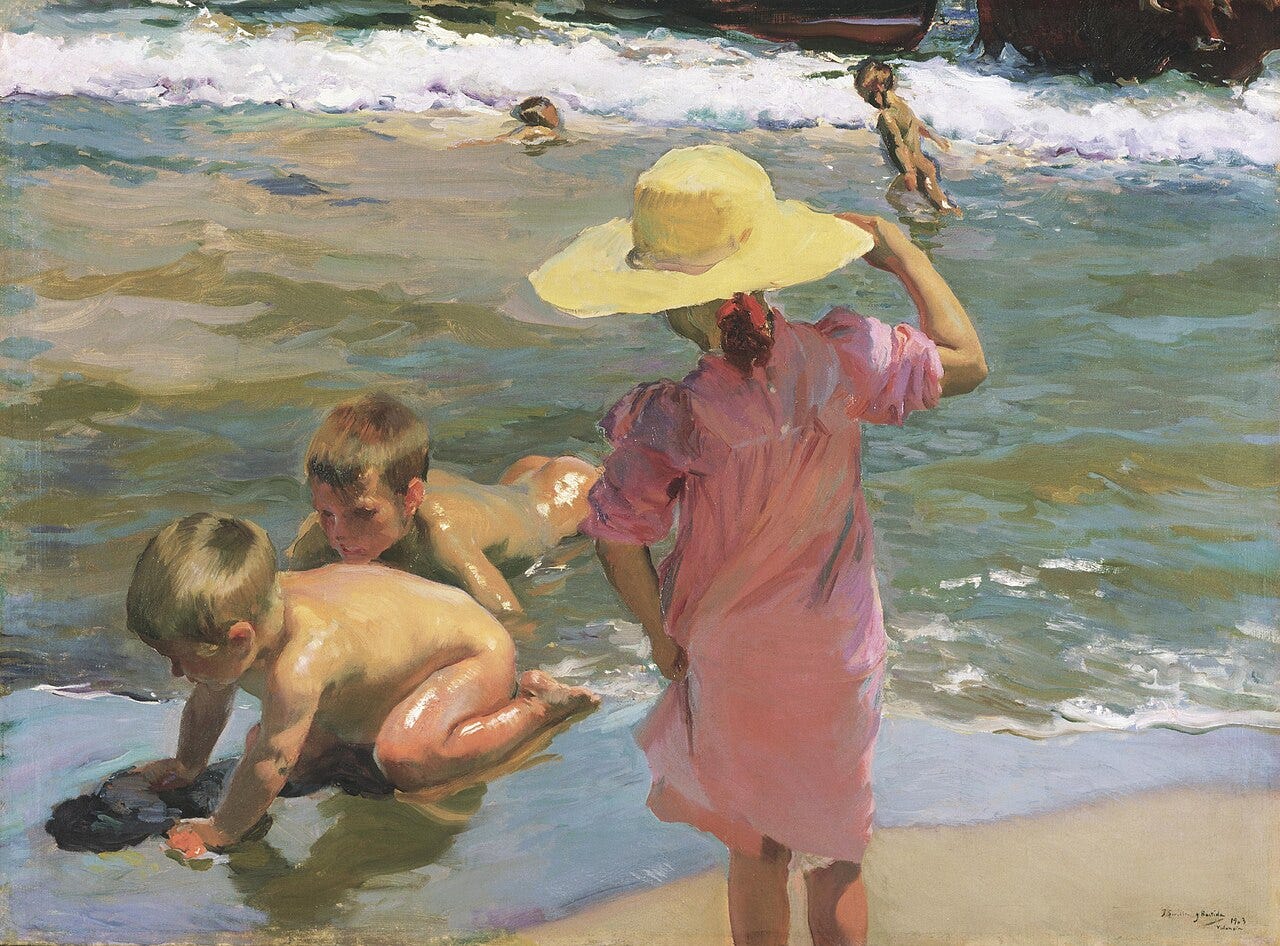
Having conquered the juries with grief, Sorolla earned the right to spend the rest of his life on joy: sails, oxen, wet children, and water in full sun.
More incredible painter stories
If Joaquín Sorolla pulled you in, you will love these too:


New York, 1909: 160,000 visitors
In 1906 a show at Georges Petit in Paris sold out.
Then Archer Huntington brought him to the Hispanic Society in New York in February 1909, and about 160,000 people pushed through in a month, a phenomenon no living painter had matched in America.
Huntington followed with the great commission of 1911: Vision of Spain, fourteen murals of the regions of Spain, around 70 meters of canvas in all.
The myth of the Spanish Impressionist
Sorolla is routinely filed under Impressionism, and he did chase light outdoors. But he painted three meter canvases in single sessions from life, drew like an academician, and never dissolved form the way Monet did.
His real school was Velazquez, studied in the Prado, and his method was closer to a matador's: enormous risk, in public, at full speed. Sargent, his mirror image in Boston, understood him best.
The garden, the stroke, and where to see him
He painted Vision of Spain across the country, outdoors, from 1912 to 1919, and it wore him out. In June 1920, painting a portrait in the garden of his Madrid house, Sorolla suffered a stroke that ended his work.
He died on August 10, 1923, and the Hispanic Society's Sorolla room opened in 1926 without him. His house is now the Museo Sorolla, the most complete painter's house in Spain.
Two thousand letters to Clotilde
Whenever work separated them he wrote to Clotilde, sometimes twice a day: paint counts, money counts, homesickness, jokes.
The letters survive, published, and double as the best studio journal of Spanish painting: what dried badly, who paid late, how the sea looked at four.
He painted her constantly for thirty-five years, in black, in white, pregnant, reading, asleep. The marriage is the catalogue's spine.
Painting against the clock of the sun
Sorolla worked outdoors at speed, chasing a light that moved: big canvases pinned against the wind, brushes long as walking sticks, a straw hat and three hours.
Film of him at work survives, shot in 1920: he attacks the canvas at arm's length, steps back, returns, a fencer with oil paint. Visitors said watching him was a spectacle in itself.
The speed was method, not bravado: only a fast hand could hold a fixed instant of Mediterranean noon.
The garden he painted last
With Vision of Spain delivered, he came home to the Madrid house he had built and painted its garden: fountains, tiles, roses, Clotilde in the shade.
The garden pictures are small, private and among his best, the painter of crowds finally alone with water and walls.
The house is now the Museo Sorolla, garden included, still arranged as the family left it, easel standing.
The Joaquín Sorolla questions that keep coming up
Why is Sorolla called the painter of light? Because his subject was sunlight itself, on water, sand, and white cloth, painted outdoors at speed on canvases the size of history paintings.
What is Vision of Spain? Fourteen murals of Spain's regions, about 70 meters in total, commissioned by Archer Huntington in 1911 and painted on location from 1912 to 1919. They fill a room at the Hispanic Society in New York.
Where can I see Sorolla? The Museo Sorolla in Madrid, his own house and garden, the Hispanic Society in New York, and the Prado, which now hangs him near Velazquez.
How did Sorolla die? A stroke while painting in his garden in June 1920 ended his career; he died three years later, in August 1923, at 60.
How much does a Sorolla cost? Major beach scenes have passed 5 million dollars at auction, and Spain treats the best works as national patrimony, rarely exportable.
What happened to his studio? Nothing, which is the point: the Museo Sorolla in Madrid preserves it intact, palettes, unfinished canvases and the garden he painted at the end.
More secrets to unlock


A room finished three years after its painter
Sorolla finished the last mural of Vision of Spain in 1919 and never saw the room built for it: it opened in New York in 1926, three years after his death, and has never been dismantled since.