
Odilon Redon was a French painter, born in Bordeaux on 20 April 1840 and dead in Paris on 6 July 1916. For some twenty years he drew almost only in black, in charcoal and lithographs full of floating eyes, winged heads and a smiling spider. In the 1890s he turned to pastel and oil and became a painter of flowers, Buddhas and glowing color. He is remembered for both lives, and for a late picture of a one-eyed giant, The Cyclops.
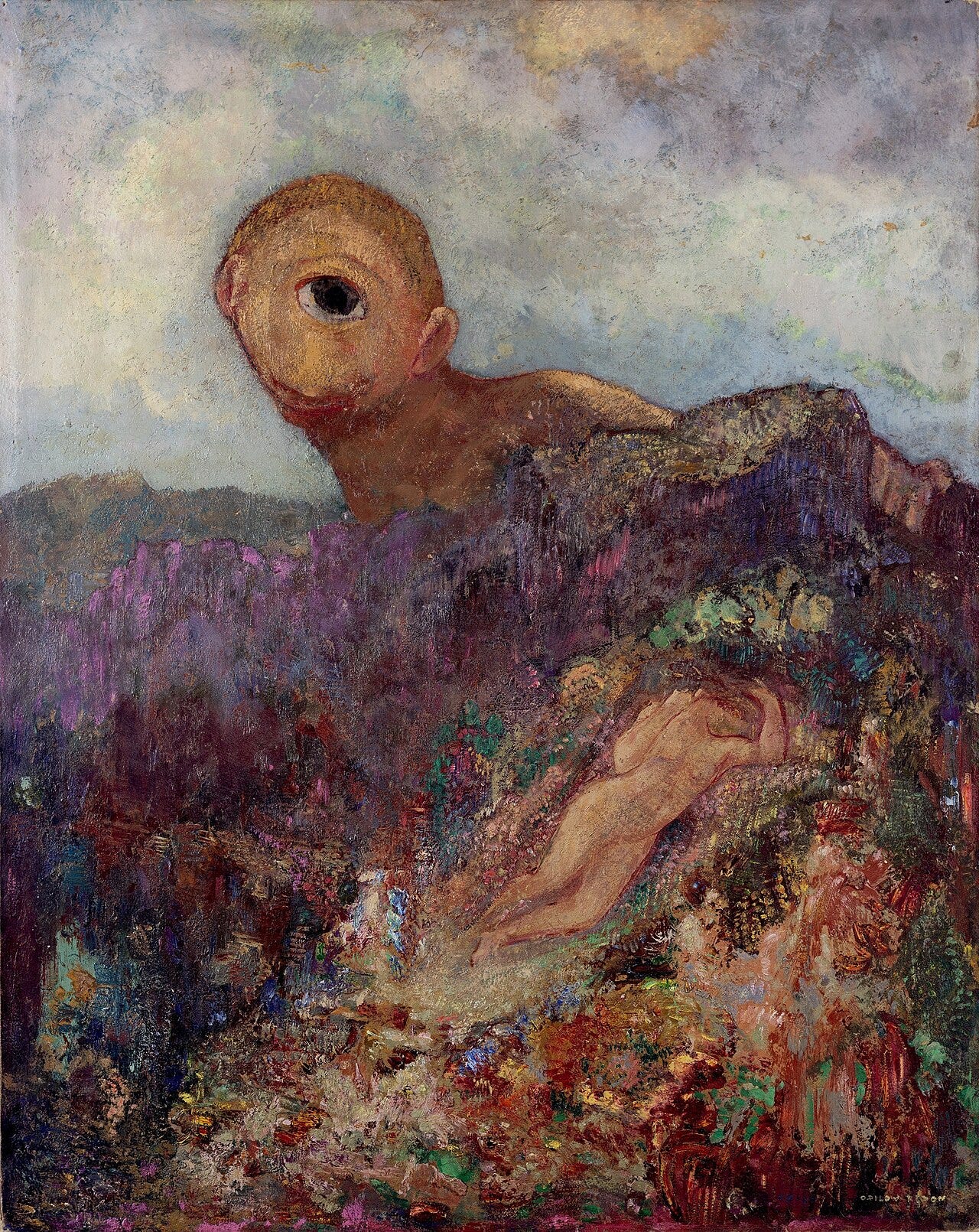
Most people meet Redon through that giant. A single enormous eye, set in a head that rises over a mountain ridge, stares at a woman asleep in the flowers below.
Cool Stories About Art is a newsletter to learn art the fun way.
Join 200,000+ readers and get:
10 new art stories / month
The entire archive of content (1,000+ articles)
Comment, ask questions, and chat with other readers
The odd thing is who painted it. For about twenty years Redon had built his name on black. He worked in charcoal and chalk and printed lithographs, and he wrote that one must admire black, "an agent of the spirit far more than the fine color of the palette or the prism." His eyes floated in the dark like balloons. His spider had a human face and smiled.
Then the black loosened. From about 1895 he worked more and more in pastel, which he told a Dutch collector "supports me materially and morally" and "rejuvenates me." By 1900 he was decorating a baron's dining room in yellows and greys.
The Cyclops comes from the end of that road, two years or so before his death, and the creature of the nightmares is back, this time in color. He is no longer lurking in the dark. He hides behind a ridge, too shy to face the sleeping woman he loves, who loves someone else.
What You'll Discover
Who taught him to draw monsters.
Why he filled the dark with eyes.
Why the black gave way to color.
What he painted for a baron.
Who the giant is spying on.