
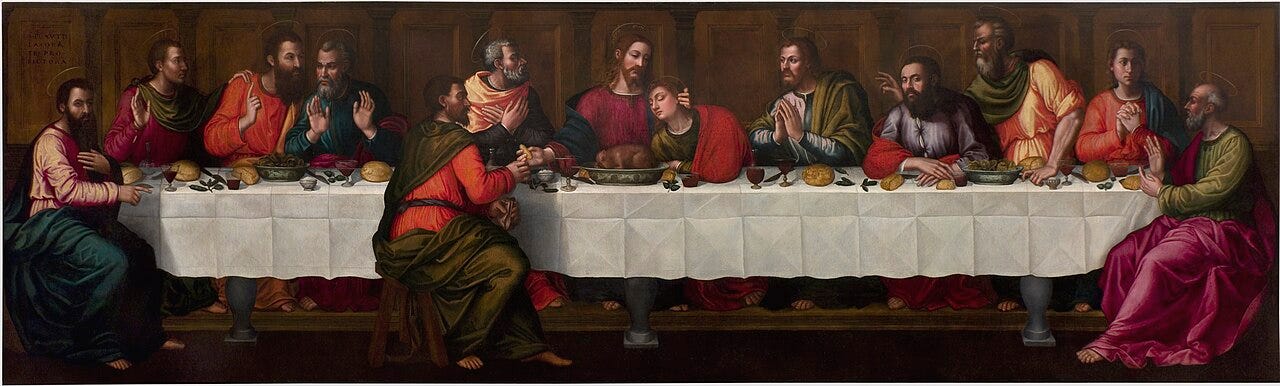
Plautilla Nelli, 1524 to 1588, was the first known woman painter of Florence. A self taught Dominican nun, she ran a convent workshop of women and made the only Last Supper known to be painted by a woman in the Renaissance.
Barred from the painters guild and from studying anatomy, she learned by copying, built the largest women’s workshop in Renaissance Florence, and signed her panels asking viewers to pray for the paintress.
For centuries her name slipped out of the story of Florentine art. It is being put back. Here is who she was.
More incredible painter stories
If Plautilla Nelli pulled you in, you will love these too:


Plautilla Nelli at a glance
1524. Born Pulisena Margherita Nelli in Florence, a merchant’s daughter.
1538. Entered the convent of Santa Caterina at fourteen.
1568. Vasari noted in his Lives that her paintings filled Florentine homes.
1570. Painted her seven meter Last Supper for the convent refectory around this time.
1588. Died at Santa Caterina after serving as its prioress. Rediscovery waited four centuries.
The first woman painter of Florence
Nelli was born into a well off Florentine family and entered the convent of Santa Caterina as a teenager. There she taught herself to paint.
The art historian Giorgio Vasari, who chronicled the great masters, noted her by name. That alone tells you she was known in her own day.
A nun who ran a workshop
Inside the convent, Nelli led a workshop of other nuns who painted and sold devotional works. She was effectively the head of a small business in an age that barred women from the painters' guild.
Demand was real. Her works went into convents, churches and private homes across Tuscany.
The Last Supper no one expected
Her most radical work is a Last Supper almost seven metres wide, with life sized apostles. No other woman of the Renaissance is known to have attempted the subject at that scale.
Hidden for years and badly aged, it was restored and unveiled in 2019 at the basilica of Santa Maria Novella in Florence. Visitors can now stand before it.
Painting without the rules men had
Women were forbidden to study anatomy or the male nude. Nelli worked around that, copying and adapting from prints and from masters she admired.
Her style is tender and devotional, rooted in the warm Renaissance of Florence. She worked in oil and tempera rather than grand fresco.
Three Nelli works worth tracking down
First, the Last Supper, her monumental statement and the reason she is back in the spotlight.
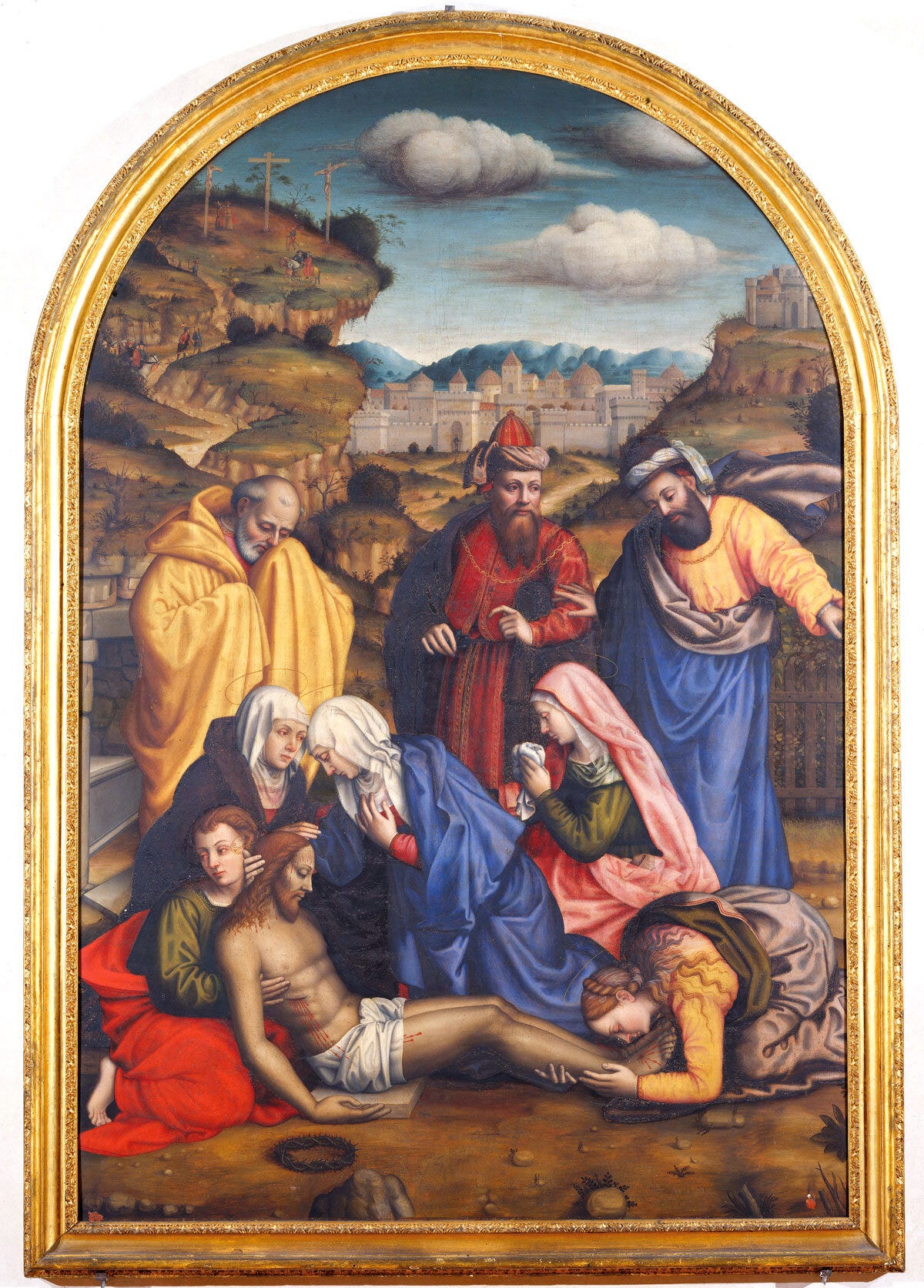
Second, the Lamentation with Saints, a grieving scene now in the museum of San Marco.
Third, her Saint Catherine works, the kind of intimate devotional image her workshop made again and again.
The myth of the minor nun
Nelli is often filed as a pious amateur. The scale and ambition of her Last Supper say otherwise.
Her near disappearance was not about talent. It was about who gets remembered. A foundation devoted to women artists in Florence has spent years restoring and showing her again.
Where her Last Supper hangs
Her restored Last Supper is at Santa Maria Novella in Florence. The Uffizi holds and has exhibited her work too.
What time nearly erased
Much of Nelli’s output is lost or hidden under other names, the fate of many women who worked outside the guild.
A Florence foundation devoted to women artists spent years tracing and restoring her work, including the long cleaning of her Last Supper. Each new attribution adds a little more to a story that was almost deleted.
Born Pulisena, in a Florence of merchants and monks
She was born in Florence in 1524, and her first name was not Plautilla. She was baptized Pulisena Margherita Nelli. A few sources give 1523, so treat the exact year as close but not certain.
Her family was well off. They belonged to the class of Florentine merchants who did well in the city's cloth trade.
That background mattered. A comfortable family could place a daughter in a respected convent and pay the dowry that entry required.
So the girl who would one day sign paintings as a nun began life inside the merchant Florence of the early 1500s, a city still arguing over religion, money and art.
The teenager who entered Santa Caterina
Nelli entered religious life young. Sources place her in the Dominican convent of Santa Caterina in Cafaggio, near Piazza San Marco, at about the age of fourteen.
When she took her vows, she took a new name too. Pulisena became Suor Plautilla, the name history now uses.
The convent was not a quiet corner. It was a working community of women, and Nelli rose within it. By several accounts she served as prioress, the nun in charge, and some sources say she held that office more than once.
She spent her whole adult life inside those walls and built her art there rather than in any city workshop.
Why a preacher wanted nuns holding brushes
To understand why a nun became a painter, you have to meet Girolamo Savonarola. He was the Dominican preacher who dominated Florence in the 1490s and was executed in 1498.
Her convent followed his teaching for generations after his death. Savonarola distrusted worldly luxury, but he did not ban art. He told monks and nuns to draw, paint and model, as long as the work stayed religious and plain.
His reason was practical. Idleness, he warned, was a sin, and a nun with a brush in her hand was a nun kept busy with devotion. Nelli's convent took that to heart, which is how a woman there could learn to paint at all.
The sketchbook of a dead friar
Nelli had no teacher in the usual sense. She was self taught, and she learned the way beginners often do, by copying.
She copied prints and drawings she could get her hands on. Her main model was Fra Bartolomeo, a friar painter who had worked at nearby San Marco and died in 1517.
Here is the lucky part. When Fra Bartolomeo died, his drawings passed to a pupil, and that collection eventually reached Nelli's own convent.
So she learned from the actual working sheets of a respected painter, kept close at hand. Copying them gave her figures, poses and whole compositions, and it shaped the calm, devotional look that runs through her work.
The one line Vasari gave her
Nelli got a rare thing for a woman of her time. She got a mention from Giorgio Vasari.
Vasari wrote the Lives of the Artists, the book that shaped how the Renaissance remembered its painters. In it he named Nelli among a short list of women who painted.
He also noted that her pictures hung in homes across Florence, so many that it would be tedious to list them all.
That single passage is worth pausing on. It tells us Nelli was collected and known in her own century, not a hobbyist. It is also one of the few period sources we have, which is part of why the record on her stays thin.
How her paintings paid the convent's bills
Nelli's paintings were not only devotion. They were income. Her convent sold devotional images, and that money helped keep the community running.
Demand was steady, because a wide network of Dominican convents and their families wanted sacred pictures.
The selling grew more important after 1566. Church reforms tied to the Council of Trent tightened the rules on convents and limited their right to seek donations beyond their walls.
With that door narrowing, art the nuns made and sold became a real financial lifeline. So when Nelli organized the making of small saints and larger altar pieces, she was not only creating art. She was helping fund the place she lived.
The painting she signed pray for the paintress
Most Renaissance nuns worked without ever putting a name to anything. Nelli did, at least once.
On one of her paintings she added a Latin line beneath her signature: orate pro pictora. It means pray for the paintress. The word choice matters. Pictora is a feminine form, so she was naming herself plainly as a woman who paints.
The work that carries this idea most famously is her large signed Lamentation with Saints, now in the Museo di San Marco in Florence.
It was the first Nelli painting the modern restoration effort took on, cleaned and returned to view in 2006 after years of neglect and even woodworm.
Why the same faces keep coming back
Look at several Nelli paintings together and you notice something. Certain faces and poses repeat. There is a reason, and it is not carelessness. Women were shut out of the training male painters took for granted.
Nelli could not study anatomy from dissections, and she could not draw from male nude models. Those were the ordinary tools of a Renaissance workshop, and they were closed to a nun.
So she leaned on what she had: inherited drawings, prints and cartoons she could reuse. Reusing a proven figure was safer than inventing a body she had never been allowed to study. The repetition is really a map of the limits placed on her.
Her death in 1588, and the silence that followed
Nelli died in 1588, in the convent where she had spent nearly her whole life. She was in her early sixties.
For a while her name traveled with her paintings. Then it faded. Over the centuries some of her works were quietly reassigned to male artists, or simply forgotten in storerooms and sacristies.
A signed woman painter became an anonymous one on the label.
The turn came in the 2000s. Researchers and the Advancing Women Artists project, founded by the American writer Jane Fortune, tracked down and restored more than twenty of her paintings.
Four hundred years after her death, the paintress finally got her name back on the wall.
More secrets to unlock


The Plautilla Nelli questions that keep coming up
Why does she matter? She is the first known woman painter of Florence and led a workshop of nuns.
What is her most famous work? A nearly seven metre Last Supper, the only one known by a Renaissance woman.
Where can I see her work? Santa Maria Novella and the Uffizi in Florence.
When was Plautilla Nelli born, and what was her real name? She was born in Florence in 1524, though a few sources give 1523, so the exact year is not fully settled. Her birth name was Pulisena Margherita Nelli. She took the name Plautilla when she entered the Dominican convent of Santa Caterina in Cafaggio as a teenager.
Did Plautilla Nelli train as a painter? Not formally. Women were shut out of the workshops and life drawing that trained male artists. Nelli was self taught, learning by copying prints and the drawings of Fra Bartolomeo, which her convent had inherited. She never studied anatomy, which was off limits to women of her day, and that shows in the repeated figures across her work.