
What Is Sfumato? The Art Lover's Guide
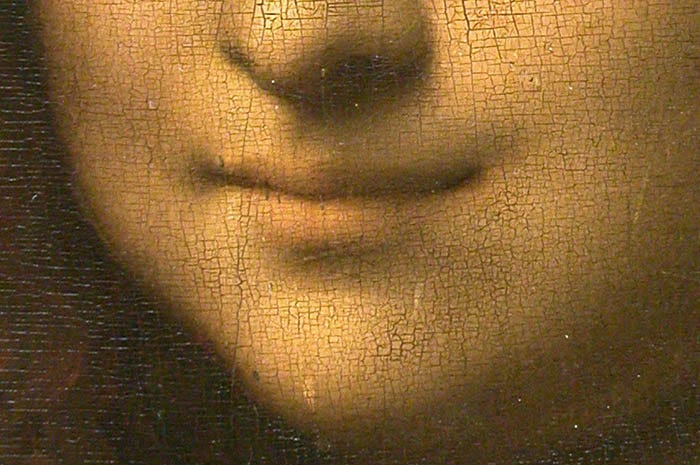
Sfumato is a painting technique where tones blend so gradually that no edge has a visible line. The word comes from the Italian “fumo,” meaning smoke. Leonardo da Vinci perfected it in the late 1400s, and the Mona Lisa is its most famous example.
Now the part nobody tells you. Everyone thinks the magic of the Mona Lisa is her smile. It isn’t. The magic is that she has no outlines. Look anywhere on that painting and try to point to the exact line where one thing ends and the next begins. You can’t. There is no line. That absence has a name, and it is the single most misunderstood word in art.
I’ve been writing about art for years, and sfumato is the technique readers ask me about most. Everyone has heard the word, almost nobody can explain it, and the truth is far stranger than the textbook version. So here is everything you need, from someone who has spent way too much time standing too close to Leonardo’s paintings in museums.
Sfumato in one minute:
It means “in the manner of smoke,” from the Italian “fumo.”
The effect: no visible lines, no hard edges, tones that melt into each other.
Invented and perfected by Leonardo da Vinci around 1490 to 1519.
Best example on earth: the Mona Lisa, Louvre, Paris.
Its opposite is chiaroscuro, the dramatic light and shadow of Caravaggio.
What does sfumato actually mean?
Open the word and you get the whole idea for free.
Sfumato comes from the Italian “sfumare,” to evaporate, to fade like smoke. The root is “fumo,” smoke. So the word does not describe a trick or a tool. It describes a disappearance. Paint that behaves like smoke, with no border you can put a finger on.
Leonardo himself gave the definition that still hasn’t been beaten. He wanted shapes “without lines or borders, in the manner of smoke.” Five hundred years later, every art historian still quotes him, because no one has said it better.
Here is the trap most articles fall into. They tell you sfumato means “blurry.” It does not. A blur is a mistake, an out of focus photo. Sfumato is the opposite of a mistake. It is the most controlled thing a painter can do: dozens of deliberate, transparent layers, each one calculated to remove a line that your eye expected to find.
Is the Mona Lisa sfumato?
Yes, and it is the single best place on earth to see the technique work.
Look at the corners of her mouth. There is no line where her lips end and her skin begins. The tones dissolve into each other like smoke, which is exactly what the word promises.
Now look at the veil on her forehead. You can barely see it, because Leonardo blended it into her skin and hair with layer after layer. According to a 2010 study by the Centre de Recherche et de Restauration des Musees de France, some areas of the Mona Lisa hold over 30 individual layers of paint, each less than 40 micrometers thick. That is thinner than a human hair.
If you ever make it to the Louvre, Room 711, fight your way past the crowd and look at her hands, not her smile. The transition between her fingers and the dark fabric is pure sfumato, and almost nobody looks at it. There is far more hiding in this painting than the grin (I wrote about the medical secrets people have spotted in the Mona Lisa if you want to go down that rabbit hole).
Why is sfumato so difficult to master?
Because the whole point is that you cannot see how it was done.
In most techniques, you put paint down and move on. With sfumato, each layer has to be nearly transparent, and you have to wait for it to dry before the next one. Leonardo sometimes waited months between layers on a single cheek.
And you will say: months, for one face? Yes. That is why the Mona Lisa took somewhere between four and sixteen years. Art historians, including Martin Kemp of Oxford University, still argue about the exact timeline. What no one argues about: Leonardo carried the painting with him until his death in 1519, in France. He never called it finished.
This is what separates sfumato from every other technique in art history. You can learn chiaroscuro in a weekend workshop. Sfumato asks for a patience that looks a lot like obsession, and Leonardo himself admitted he never fully got there. The most famous painting in the world is, by its own author’s standard, unfinished.
Chiaroscuro vs sfumato: what is the difference?
Both use light and shadow. They use them in opposite directions.
Chiaroscuro is a spotlight. Strong contrast, a single beam cutting through darkness, sharp edges, high drama. Think Caravaggio.
Sfumato is dusk. No contrast, no edges, everything melting into everything. Think Leonardo.
One says “look at this dramatic moment.” The other says “nothing in the real world has an outline, so why should a painting?”
The art historian Giorgio Vasari, writing in 1550, called Leonardo’s method painting “in the manner of smoke” (”a uso di fumo”). The line is five centuries old and still the best one going. If you want the full story of the opposite philosophy, I took Caravaggio apart in The Caravaggio Code.
So here is the one sentence to keep. Chiaroscuro is a spotlight. Sfumato is the moment the light goes soft and the edges give up.
How do you pronounce sfumato?
sfoo-MAH-toh. Stress the middle syllable. If you are standing in a museum and want to sound like you belong, now you do.
5 artists who mastered sfumato
Wikipedia gives you a list of names. Here is what it won’t give you: who did it best, and why. This is my own ranking, built from years of looking at these paintings in person, not from a database.
1. Leonardo da Vinci.
The inventor and the ceiling everyone else paints under. His Saint John the Baptist at the Louvre, Room 710, is, in my opinion, the most extreme sfumato ever made: the figure rises out of pure black with no transition at all, as if he were made of smoke. According to art historian Frank Zollner, the soft shadows there “convey the religious content of the picture,” giving the figure an almost otherworldly presence. If you want the man behind the technique, I wrote a full story on Leonardo’s Last Supper.
2. Correggio.
He took Leonardo’s smoke and made it sensual. His paintings in Parma feel soft to the eye in a way that is almost physical. David Ekserdjian described Correggio’s sfumato as “so gentle it seems the figures might dissolve if you touched them.” He is underrated. Seriously underrated.
3. Raphael.
Raphael studied Leonardo’s sfumato in Florence around 1504 and it rewired his work. Put his stiff early Madonnas next to La Belle Jardiniere at the Louvre, Room 710: the Virgin’s face is pure sfumato. He saw the master do it and absorbed it within a few years.
4. Giorgione.
His Sleeping Venus in Dresden is sfumato applied to an entire body, the contours melting straight into the landscape. He died at 33, possibly of plague, and left fewer than 40 paintings. According to the National Gallery of Art in Washington, only about 6 can be firmly attributed to him. Every one uses sfumato.
5. Andrea del Sarto.
Vasari called him “the faultless painter,” and his sfumato is part of the reason. His Madonna of the Harpies at the Uffizi rivals Leonardo for tonal blending. He never got Leonardo’s fame, which I think is one of art history’s quiet injustices.
See it yourself: where to find sfumato in museums
Next time you are near one of these, here is exactly where to stand and what to look for.
Louvre, Paris, Room 711. Mona Lisa. Look at the mouth corners, the forehead veil, the hands. Stand to the left for the best angle.
National Gallery, London, Room 66. Virgin of the Rocks. Watch the angel’s face dissolve into the cave and the rocks fade into mist. Virgin of the Rocks at the National Gallery
National Museum, Krakow. Lady with an Ermine. The ermine’s white fur melts into the black background. The only Leonardo you can see outside Western Europe’s big capitals.
Louvre, Paris, Room 710. Saint John the Baptist and La Belle Jardiniere hang in the same room: two artists, one technique, side by side.
Gemaldegalerie Alte Meister, Dresden. Giorgione’s Sleeping Venus. Worth the trip on its own.
Sfumato FAQ
Who invented sfumato?
Leonardo da Vinci is credited with perfecting it in the late 1400s. He did not invent soft shading from nothing, painters before him softened edges, but Leonardo turned it into a system and pushed it further than anyone, which is why his name and the technique are inseparable.
What does sfumato mean in English?
Literally, “shaded off” or “faded like smoke,” from the Italian “fumo,” smoke. In practice it means tones blended so smoothly that no outline remains.
Is sfumato still used today?
Yes. Any painter who blends edges into soft gradients is using sfumato, and so, in a sense, is every portrait photographer who softens a background. The principle Leonardo described, that real things have no outlines, never went out of date.
The thing Leonardo was really doing
Step back from the technique for a second.
We draw outlines because it is convenient. A line around an apple, a line around a face. But go to a window right now and look at a distant hill at dusk. Try to find the exact line where the hill ends and the sky begins. There isn’t one. Your eye invents it.
That was Leonardo’s real discovery. Outlines are a lie we agree to. Nothing in nature has them. So when he removed every edge from the Mona Lisa, he was not adding a special effect. He was taking one away. He painted the world the way your eye actually receives it, before your brain tidies it up into lines.
That is why the painting feels alive five centuries later. Sfumato is not smoke added to a picture. It is the lie of lines removed from it.
If sfumato hooked you, two more stories that connect directly: