Who Painted the Sistine Chapel?
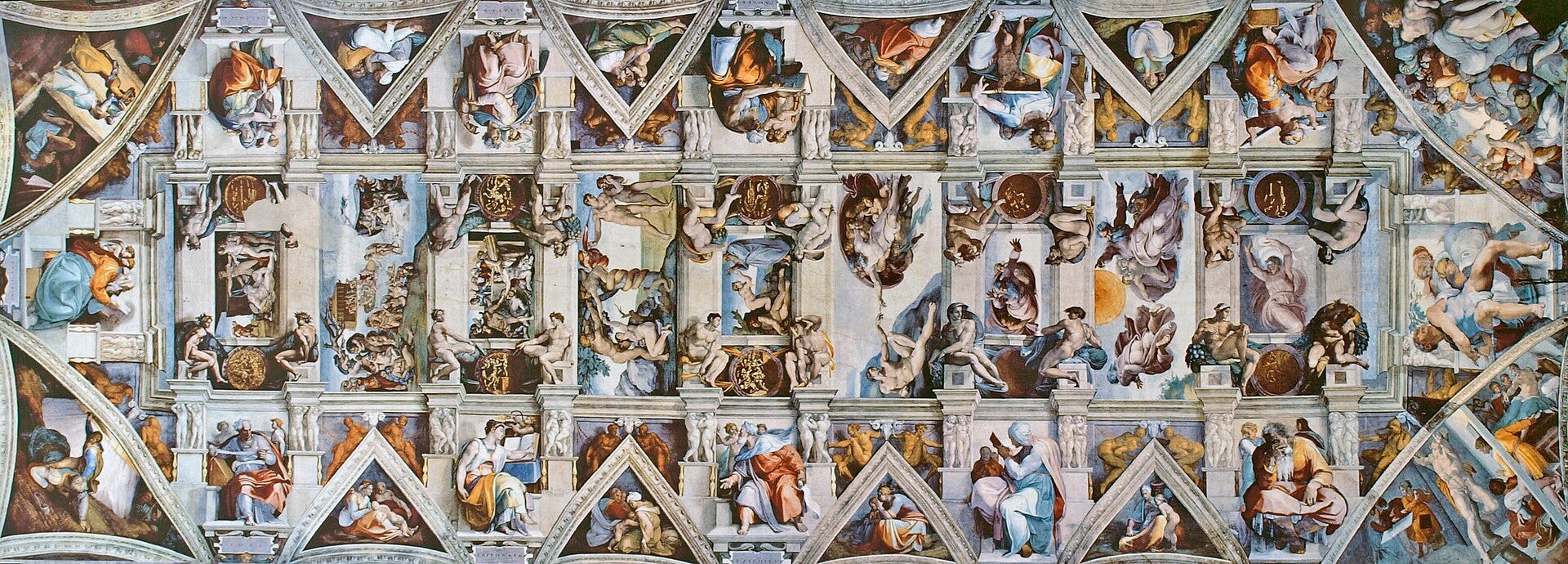
Michelangelo painted the ceiling and the altar wall of the Sistine Chapel, but he did not paint the whole room.
The long side walls were already covered with frescoes before he ever picked up a brush there. They were done in the 1480s by a team of star painters that included Botticelli.
So the honest answer has two halves. Here is who did what, and why one name swallowed all the others.
The Sistine Chapel in five lines
Ceiling, 1508 to 1512: Michelangelo. The Genesis scenes, including the Creation of Adam.
Altar wall, 1536 to 1541: Michelangelo again. The Last Judgment.
Side walls, 1481 to 1482: a team of Florentine and Umbrian masters. Scenes from the lives of Moses and Christ.
Named after: Pope Sixtus IV, who had the chapel built.
Pushed Michelangelo onto the ceiling: Pope Julius II.
The chapel had a first life before Michelangelo
Pope Sixtus IV built the chapel between 1473 and 1481. The name Sistine comes straight from his: Sisto.
As soon as the walls were dry, he hired the best painters in Italy to cover them. Pietro Perugino led the team. Working with him were Botticelli, Domenico Ghirlandaio, Cosimo Rosselli and later Luca Signorelli.
They painted two stories facing each other. The life of Moses runs down one wall, the life of Christ down the other. Botticelli alone painted three of the large panels.
So before Michelangelo arrived, the chapel already held a row of Renaissance masterpieces at eye level.
Why Julius II handed the ceiling to a sculptor
In 1508, Pope Julius II wanted the plain ceiling redone. Until then it was just a blue sky scattered with gold stars.
He gave the job to Michelangelo, who fought it. Michelangelo thought of himself as a sculptor, not a painter, and suspected he was being set up to fail by rivals at court.
He took the commission anyway. It would keep him on his feet, head tilted back, for four years, and to me that is the most heroic grind in all of art.
What Michelangelo painted overhead
The ceiling holds more than 300 figures. Nine central panels tell the book of Genesis, from the creation of the world to the drunkenness of Noah.
Around them sit the prophets and the sibyls, and the famous nude youths known as the ignudi.
The single most reproduced detail is the Creation of Adam, where two fingers almost touch. It is one small patch of a vast painted ceiling.
The ceiling hides more than it shows. Some scholars even read the shape around God in the Creation of Adam as a human brain, one of many secrets buried in famous paintings: seven secrets hidden in famous art.
The wall he came back for twenty four years later
Michelangelo returned in 1536, now in his sixties, to paint the wall behind the altar.
The Last Judgment took him until 1541. It is darker and more crowded than the ceiling, a storm of bodies rising and falling around Christ.
Its many nudes caused a scandal. After his death, a painter nicknamed the breeches maker was hired to add drapery over the most exposed figures.
So who really painted the Sistine Chapel
If you mean the ceiling and the altar wall, the answer is one man: Michelangelo.
If you mean the whole room, it is a roll call of the Renaissance, with Botticelli and Perugino on the walls and Michelangelo overhead. I trace how he built the rest of his life around these years in Michelangelo: The Complete Story.
And to understand the technique that made the ceiling possible, see what fresco painting is.
FAQ about who painted the Sistine Chapel
Did Michelangelo paint the whole Sistine Chapel? No. He painted the ceiling and the altar wall. The side walls were painted by others in the 1480s.
Who painted the Sistine Chapel ceiling? Michelangelo, between 1508 and 1512.
Who painted the side walls? Perugino, Botticelli, Ghirlandaio, Rosselli and Signorelli, around 1481 to 1482.
Why is it called the Sistine Chapel? After Pope Sixtus IV, who had it built.
What are the most famous parts? The Creation of Adam on the ceiling and The Last Judgment on the altar wall.
The room still picks popes
The chapel was never just a gallery. It is a working space.
When a pope dies, the cardinals lock themselves inside, under Michelangelo's ceiling, to elect the next one. The smoke that tells the world they have chosen rises from a small stove set up on the floor, right below the Creation of Adam.