
William Adolphe Bouguereau was the most admired painter in France in his lifetime and, soon after, the most mocked. His flawless, glassy smooth nudes, angels and peasant girls were the height of official taste, winning every prize and selling for fortunes.
Then the modern world turned on him so hard that his very name became an insult, before the wheel turned once more.
Few artists have ridden so high, fallen so far, and climbed back again.
Born: La Rochelle, France, 1825
Known for: flawless academic nudes and mythologies, peasant girls, angels
Died: La Rochelle, France, 1905
More incredible painter stories
If William Adolphe Bouguereau pulled you in, you will love these too:


William Adolphe Bouguereau at a glance
1825. Born in La Rochelle, a wine merchant’s son.
1850. Won the Prix de Rome and left for four years in Italy.
1875. Began teaching at the Académie Julian, one of the few Paris studios open to women.
1876. Elected to the Académie des Beaux-Arts, the heart of the machine that ran French art.
1905. Died in La Rochelle, the town where he began.
The king of the Salon
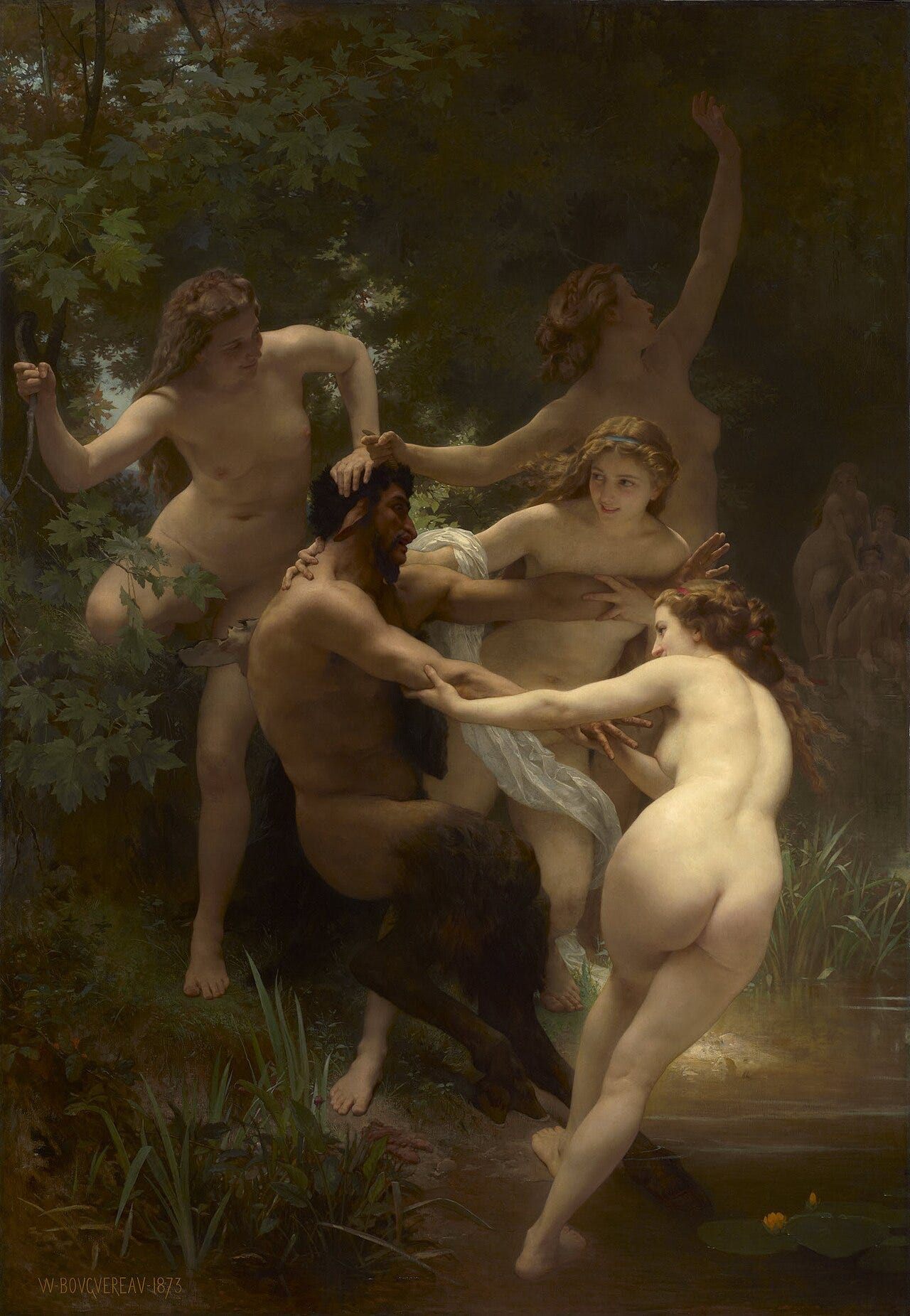
Bouguereau was the perfect academic painter. His surfaces are so smooth they seem to have no brushstrokes at all, his figures idealised into glowing, polished perfection.
He took the old subjects, Venus, nymphs, mothers and children, and finished them to a porcelain shine. See what is academic art.
The official Salon adored him. He won the top prizes young, sold to collectors across Europe and America, and trained crowds of students. He was, by every official measure, the greatest painter alive.
Beauty as the whole goal
His nudes are his signature: The Birth of Venus, Nymphs and Satyr, bodies rendered with cool, seamless grace. He chased an ideal beauty with no rough edges, no dirt, no doubt. See what is the nude in art.
He also painted tender religious and peasant scenes, barefoot girls and grieving mothers, that pulled hard on the heart. To his admirers it was sublime. To his enemies it was sugar. See what is history painting.
The most hated man in modern art
As the Impressionists rose, Bouguereau became the symbol of everything they wanted to destroy: slick, safe, official art. He sat on juries that rejected them, which sealed his fate.
Modernists turned his name into a curse. To call a picture a Bouguereau meant empty, lifeless polish. For most of the twentieth century he was the painter it was fashionable to despise.
The American who painted beside him
Bouguereau married twice, and his second wife was the American painter Elizabeth Jane Gardner. She trained in Paris when the doors were barely open to women and learned to paint so close to his manner that their work can be hard to tell apart.
She was a pioneer in her own right, among the first women to win at the Salon, and she defended the academic tradition long after fashion had moved on. Their partnership was a quiet two artist household at the centre of official French art.
A wine merchant's son from La Rochelle
William Adolphe Bouguereau was born on 30 November 1825 in La Rochelle, the old Atlantic port on the west coast of France. His family were wine and olive oil merchants, so trade, not art, was the plan for him.
It was a practical, commercial household, and for a while young William was expected to fold into the business. The sea town shaped him early, and he drew constantly as a boy, copying what he saw around the harbour and the shops.
Nobody in the family imagined a painter. In the France of his day, art was a respectable career only if you reached the top of a rigid official system. Bouguereau would spend his whole life climbing that system, then defending it.
The uncle who changed his path
The turn came from an uncle. Eugene Bouguereau, a Catholic curate, spotted the boy's talent and his restlessness.
Eugene taught him classical and biblical subjects, the kind of stories that would fill his later canvases. He also arranged for William to attend school rather than stay behind a shop counter.
Money was tight, so to fund his training Bouguereau took paid work, painting portraits of local people for small fees.
He studied at the art school in Bordeaux and won a first prize there. That result convinced him to try Paris, and he entered the Ecole des Beaux Arts in 1846.
Without his uncle's push, the most successful academic painter of the century might have stayed a wine merchant.
Prix de Rome and four years in Italy
Paris was brutal for a poor outsider, but Bouguereau was disciplined. In 1850 he won the Prix de Rome, the top honour a young French painter could take. The prize sent him to Italy for roughly four years, based at the Villa Medici in Rome.
There he studied the Renaissance in person. He copied Giotto, Raphael and other Italian painters, and travelled to see frescoes and antique sculpture.
That Italian training set his direction for life. He came home committed to the smooth, sculpted human figure and the grand mythological and religious subjects the Salon rewarded.
Within a decade of his return he was one of the most talked about painters in France.
The highest paid painter in France
Bouguereau became more than famous. He became rich, on a scale few painters ever reach. He exhibited at the Salon almost every year for decades and built a large, loyal market. Dealers in Paris and abroad competed for his output.
He worked relentlessly. His catalogue raisonne, compiled by Damien Bartoli and Frederick Ross, lists more than 800 finished paintings.
That productivity fed the demand. Wealthy buyers, especially in the United States, paid high prices for his polished nudes, saints and peasant girls.
For much of the late nineteenth century he was arguably the most commercially successful painter in France, and his name on a canvas was close to a guarantee.
The polished surface and the goddess who made him famous
Bouguereau's trademark was finish. He blended his brushwork so smoothly that the paint surface looks almost like enamel, with no visible strokes.
His most repeated subject was the female nude, dressed up in classical stories. The Birth of Venus, shown at the 1879 Salon, is the best known example. The state bought it, and it now hangs in the Musee d'Orsay in Paris.
Earlier, in 1873, he showed Nymphs and Satyr at the Salon, and an American collector bought it almost at once. That painting later ended up on the wall of the bar at New York's Hoffman House hotel, where crowds of men came to look at it.
It now belongs to the Clark Art Institute in Massachusetts.
Saints, angels and Madonnas
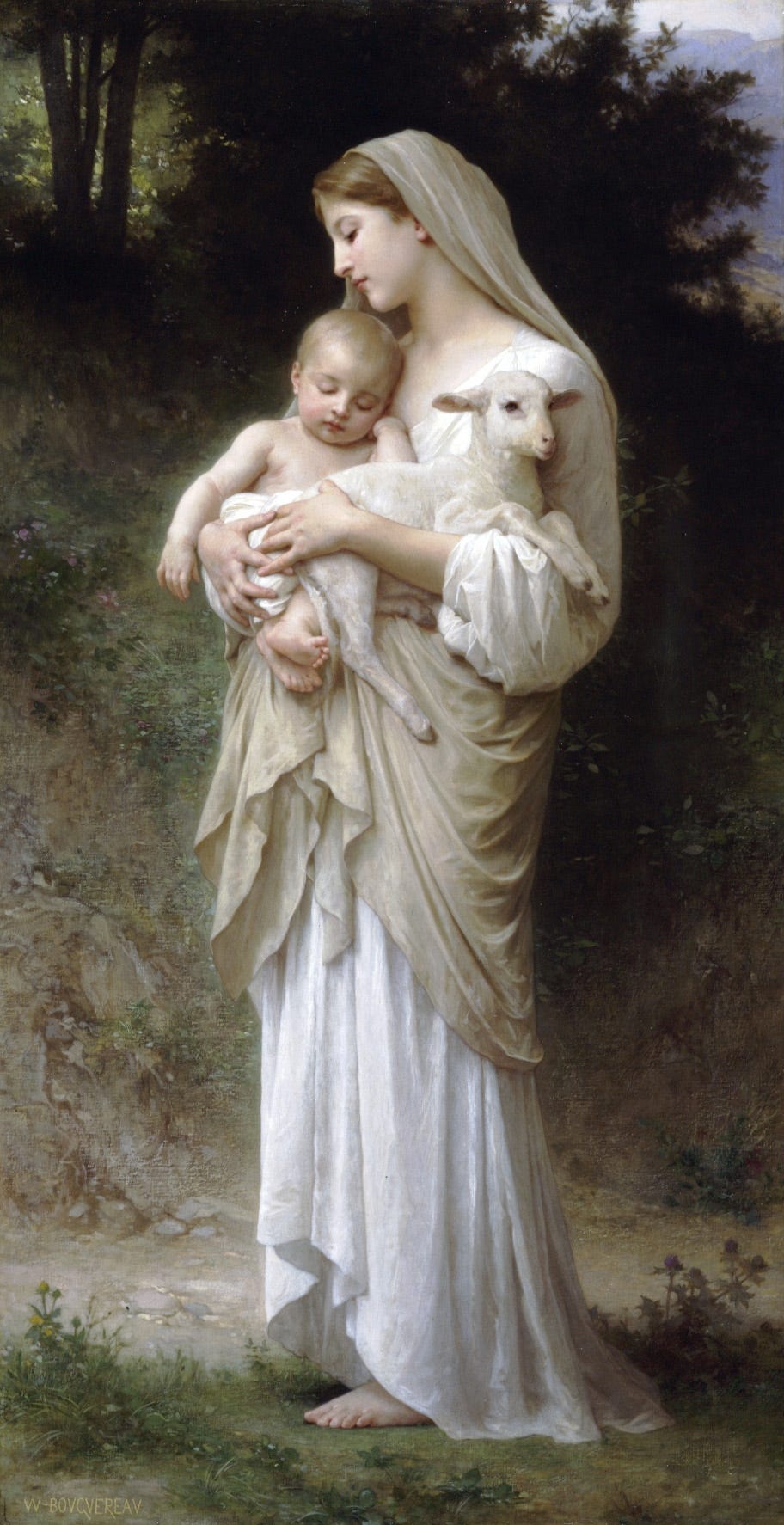
Bouguereau was not only a painter of nudes. Religious work runs right through his career. He painted Madonnas, saints and biblical scenes, and in his later years he decorated chapels in several Paris churches.
His large canvas of the Virgin surrounded by angels, La Vierge aux anges of 1881, is one of the calmest and most reproduced of these.
Faith and grief met in this side of his art. After his young son Georges died in 1875, Bouguereau painted a mourning Pieta the following year, the dead Christ held by a grieving Virgin.
For a painter often dismissed as merely sweet, these religious pictures carry real weight, and they were steady, respectable commissions in a Catholic country.
The peasant girls that America bought
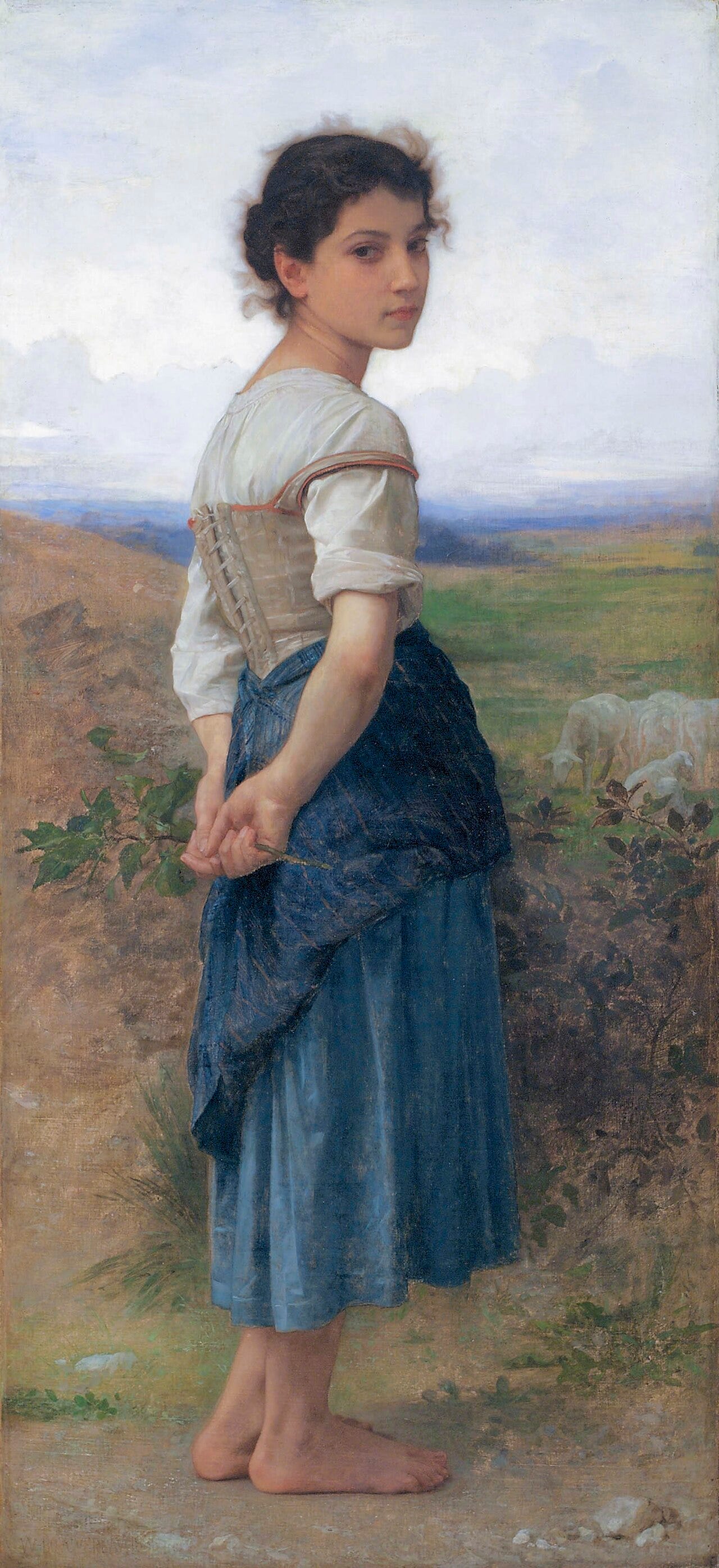
Alongside the goddesses came a softer, hugely popular product: young peasant women and children. Bouguereau painted barefoot shepherd girls, sisters, beggars and infants, always clean, calm and idealised.
They were sentimental by design, and buyers loved them.
American collectors in particular could not get enough. In the late nineteenth century, newly wealthy United States families wanted refined European art, and Bouguereau supplied exactly the polished, pretty pictures they were after.
Many of his best works crossed the Atlantic. That is why American museums hold so many of them today. This American appetite made him money, but it also tied his reputation to a taste that would soon be mocked as old fashioned and saccharine.
Teacher of women at the Academie Julian
Here is a fact that cuts against the usual picture of Bouguereau as a pure reactionary. From 1875 he taught at the Academie Julian, a private Paris studio that, unlike the official Ecole des Beaux Arts, admitted women and charged modest fees.
Bouguereau became a genuine advocate for female art students. He encouraged them, took their training seriously and supported their right to study the human figure.
He also backed the campaign to open the state Ecole des Beaux Arts to women, which finally happened in 1897.
So the idea that Bouguereau simply blocked everything new is too simple. He fought the Impressionists at the Salon, but on the question of women's art education he stood, for his time, on the progressive side.
Honours and the machinery of the Salon
Bouguereau collected official honours the way his buyers collected his paintings. In 1876 he was elected to the Academie des Beaux Arts, part of the Institut de France, the summit of the French art establishment.
He was also raised through the ranks of the Legion of Honour over his career.
Those titles were not just decoration. They came with power. Bouguereau sat on Salon juries, the committees that decided which paintings the public would see.
From that seat he defended academic standards and helped keep experimental work out. That is why the young avant garde saw him not as one painter among many, but as the gatekeeper of the whole system they wanted to break open.
The wife and children he lost
Behind the smooth surfaces was a life shadowed by death. Bouguereau married Nelly Monchablon in 1866, and they had five children. Tuberculosis and illness tore through the family.
His son Georges died in 1875. Nelly died on 3 April 1877, aged 40, and their baby Maurice died only weeks later. In the end Bouguereau outlived four of his five children, and only his daughter Henriette survived him.
He married again in 1896, to the American painter Elizabeth Jane Gardner, but only after the death of his mother, who had long opposed the match.
The man who painted endless serene mothers and children had buried most of his own, and that contrast is one of the hardest things to sit with in his story.
The William Adolphe Bouguereau questions that keep coming up
What is Bouguereau famous for?
Flawless academic nudes and mythologies, plus tender peasant girls and angels.
Why was he so disliked later?
Modernists saw his slick official style as the enemy of new art, and his name became an insult.
What is his style called?
Academic art, the polished, idealised manner taught by the official Salon system.
When did he die?
In 1905, in his home town of La Rochelle.
More secrets to unlock


Why he came back
The verdict has flipped again. Collectors and a new generation tired of irony now prize his sheer skill, and his paintings sell for millions. The most despised painter of the modern era turned out to be one of its great comeback stories.
One last detail. He worked at a relentless pace, producing more than eight hundred finished paintings, because demand never stopped. Even at the height of fashion against him, he never lacked buyers somewhere in the world.