
August Macke, 1887 to 1914, was the brightest and most joyful painter of the German avant garde. A founder of the Blue Rider group, he filled his canvases with sunlit gardens, hat shops and people at ease, then was killed in the first weeks of World War One, aged 27.
Klee and Kandinsky went on for decades, but Macke had barely five years as a mature painter, which is why his sunlit world feels frozen mid step.
His life was short and his art is happy, which makes the loss sharper. Here is the painter, and the world that ended him.
More incredible painter stories
If August Macke pulled you in, you will love these too:


August Macke at a glance
1887. Born in Meschede, Westphalia.
1907. First trip to Paris and the shock of the Impressionists.
1909. Married Elisabeth Gerhardt, his model and anchor since their teens.
1911. Joined Kandinsky and Marc in the Blue Rider.
1914. Two weeks of light in Tunisia in April. Killed in Champagne in September, at 27.
The sunniest of the Blue Rider
Macke painted ordinary modern pleasure: a woman pausing at a shop window, families strolling, a park in the afternoon. His color is warm and balanced, never harsh.
Among his intense German peers, he is the one who looked for harmony and light rather than angst.
What the Blaue Reiter was
Der Blaue Reiter, the Blue Rider, was a group of artists in Munich around 1911, led by Wassily Kandinsky and Franz Marc. They believed color and form could express the spirit, not just copy the world.
Macke was part of the core. He brought a lighter, more human note to a circle that often reached for the mystical.
Tunisia, 1914: two weeks of light
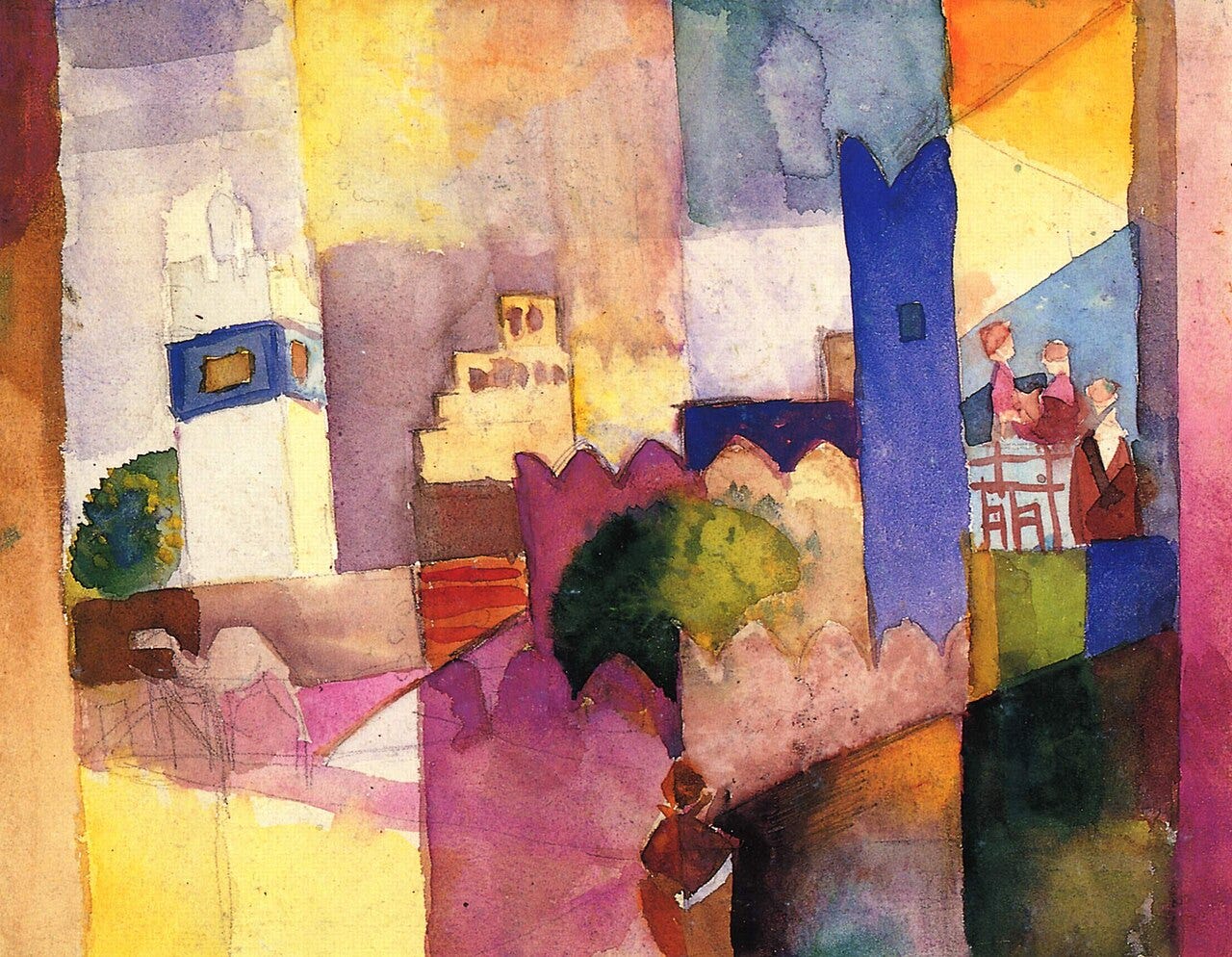
In April 1914 Macke traveled to Tunisia with the painters Paul Klee and Louis Moilliet. The trip lasted about two weeks and changed all three.
Macke poured the North African light into glowing watercolor, scenes of markets and white houses under hard sun. They are among the loveliest works of early modern art.
Expressionism without the scream
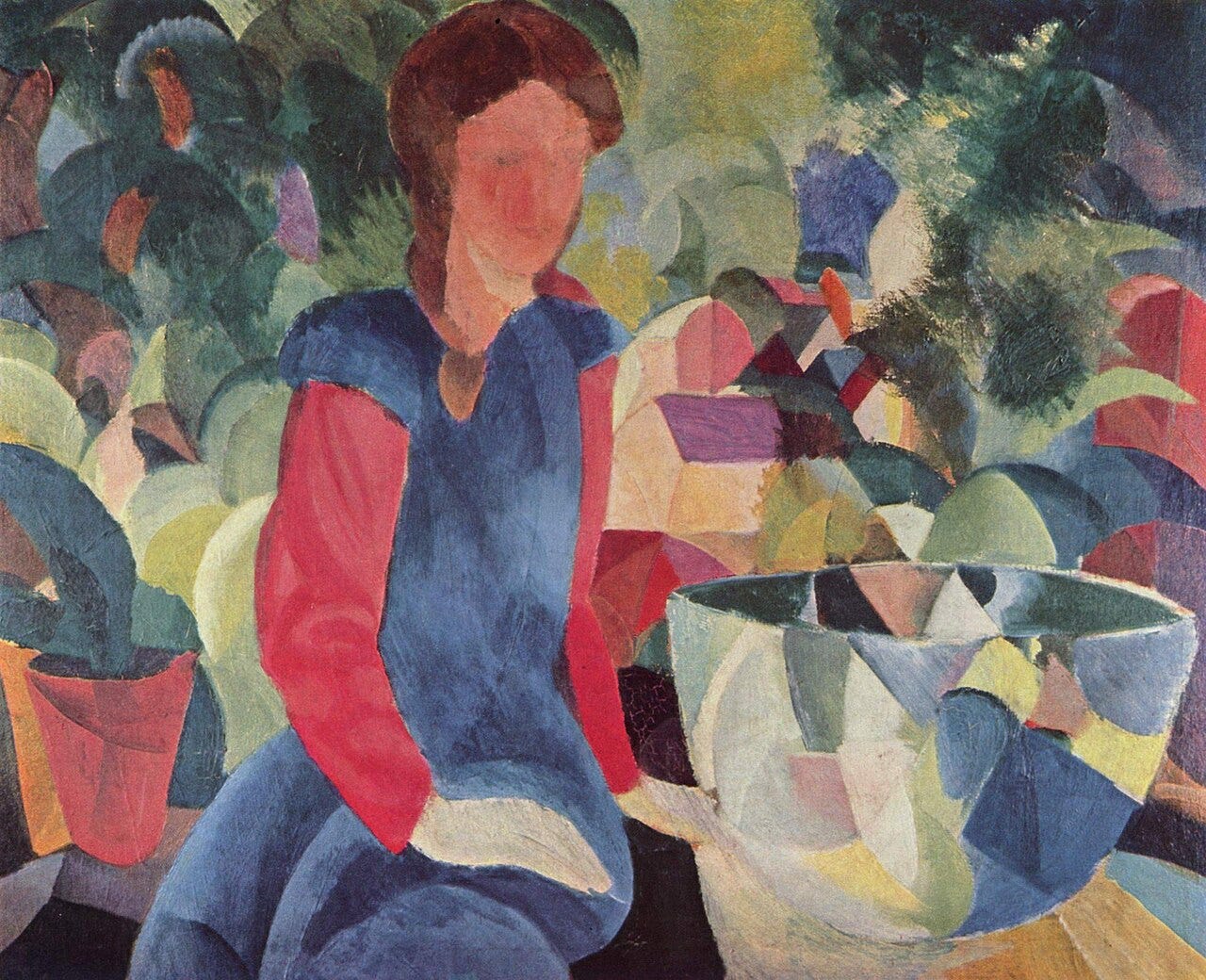
Look for the calm. He simplified figures into clear shapes and let pure, singing color do the feeling. It is Expressionism without the scream.
He loved windows, mirrors and thresholds, people looking in or stepping through, small moments of modern life.
Three works that show his joy
First, Lady in a Green Jacket, a woman in a garden, all glowing color and quiet poise.
Second, the Tunisia watercolors of 1914, his luminous response to the desert light.
Third, his shop window and promenade scenes, where strangers share a sunny street.
The myth of the long career
It is tempting to treat Macke as a settled master. He never got the chance.
He was killed at the front in September 1914, barely a month into the war, at 27. His friend Franz Marc, who would die at Verdun two years later, called the loss irreplaceable.
Where his color lives
The Kunstmuseum Bonn holds a major collection in his home city. The Lenbachhaus in Munich shows him among the Blue Rider.
The friendship that shaped him
Macke’s closest bond was with Franz Marc, his fellow Blue Rider. The two argued, painted and theorized together, and Marc mourned him as a brother.
His wife Elisabeth Gerhardt appears throughout his work, reading, walking, pausing at a window. The August Macke Haus in Bonn, his old home, keeps that intimate world alive.
Born in Meschede, raised between Cologne and Bonn
August Robert Ludwig Macke was born on 3 January 1887 in Meschede, a small town in Westphalia. His father was a self employed building contractor and his mother came from a farming family.
The family soon moved, and August grew up first in Cologne and then in Bonn. Money was often tight, because his father's firm kept running into trouble.
Even as a schoolboy, Macke thought about little except drawing, and he helped design the sets for school plays. At the age of seventeen he left school against his father's wishes, determined to become an artist.
It was a leap that shaped everything that followed.
Dusseldorf, the academy that bored him
Macke studied at the Dusseldorf Academy from 1904 to 1906. His professors thought him very talented, yet the training left him cold.
The academy still treated history painting and exact, careful drawing as the highest goals. To Macke, that had almost nothing to do with the art of his own moment.
He looked for fresher ideas elsewhere. He took evening classes at the Dusseldorf School of Arts and Crafts, a more reform minded place, and worked at the Dusseldorf Theatre as a set and costume designer.
He was even offered a permanent job at the theatre, but he turned it down and chose the harder path of finding his own language.
Paris, and the shock of the Impressionists
In 1907, black and white photographs of French Impressionist paintings opened a new world for Macke. He did the obvious thing and travelled straight to Paris.
There he studied the real paintings in the galleries of dealers such as Durand Ruel, Vollard and Bernheim Jeune. He fell hard for the city, and wrote that Paris was surely the loveliest city in the world, adding that he was becoming fonder and fonder of the impressionists.
Two more visits followed, in 1908 and in 1909. Between 1907 and 1912 he returned again and again, each trip feeding his eye and pulling him further from the academic world he had left.
A season in Berlin with Lovis Corinth
Later in 1907, Macke went to Berlin to study for a time with Lovis Corinth. Corinth was one of the leading champions of Impressionist painting in Germany.
For a young man hungry to move past academic drawing, this was a useful bridge. Corinth showed him a looser, more modern handling of paint than the Dusseldorf classroom ever had.
The Berlin stay was short. Macke was restless, and France kept pulling him back. His real teachers, in the end, were the paintings he saw in Paris galleries and the friendships he built over the next few years.
Corinth gave him a start, but Macke was already reaching for something of his own.
Elisabeth Gerhardt, the second self
In 1909 Macke married his childhood sweetheart, Elisabeth Gerhardt. The couple left Bonn and thought about settling in Paris, but the rents were too high, so they went to Tegernsee near Munich instead.
Their son Walter was born, and a second son followed later.
Elisabeth was his model and his muse. Macke himself called her his second self, and she appears again and again in his work.
At the end of 1910 they returned to Bonn. Elisabeth's mother gave them a small house by the family factory, and its attic became the studio where many of his best known paintings were made.
Shop windows, hat shops and people out strolling
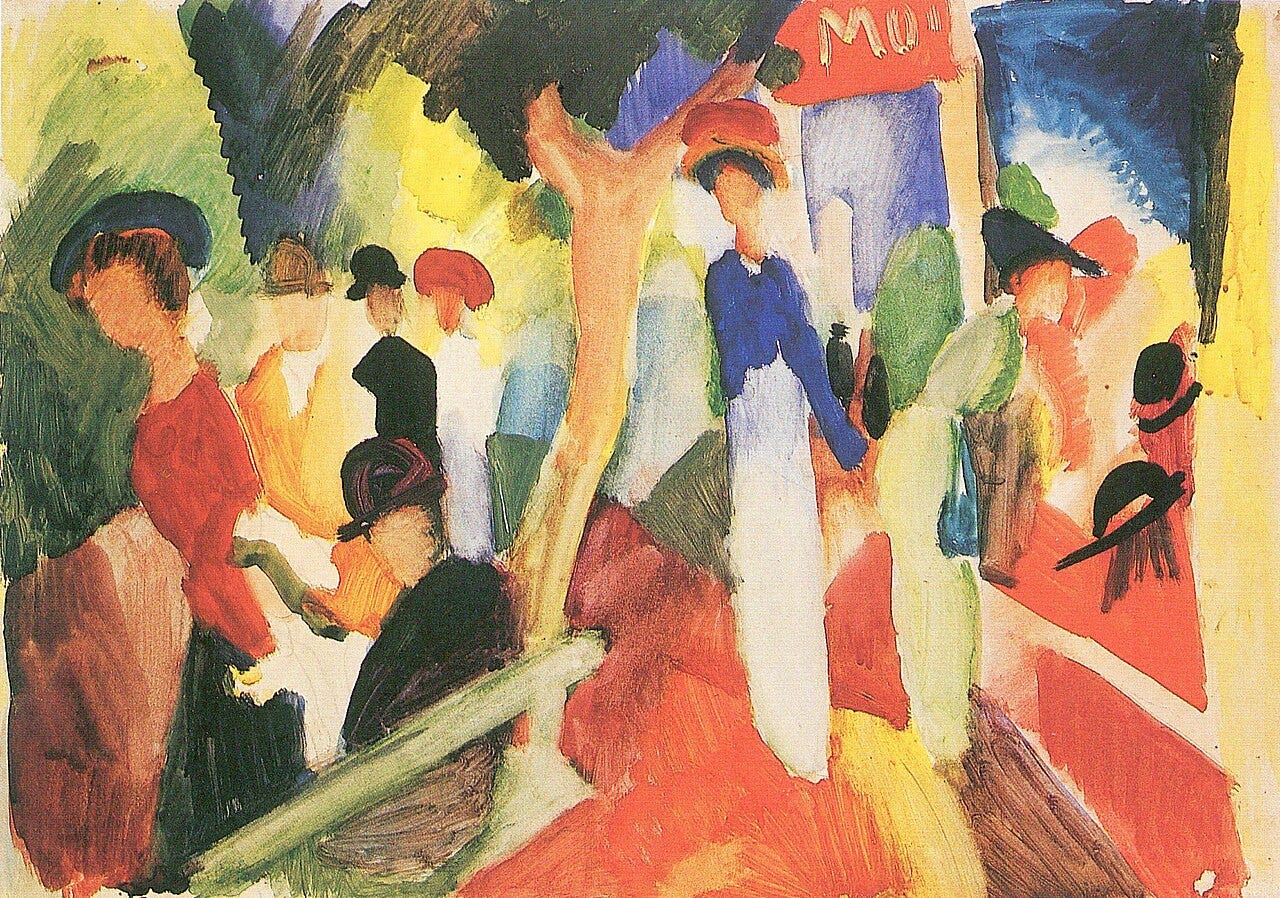
Macke rarely painted big dramatic events. He preferred the small pleasures of modern city life.
His pictures are full of people walking in parks, women in long dresses pausing at shop windows, and figures gazing into fashion shops and hat displays. A painting like Fashion Shop, from 1913, is a good example.
When the family moved to Lake Thun in Switzerland in October 1913, he made a series of shop window pictures. In these, the glass, reflections and goods dissolve into panes of colored light.
The mood is calm and happy, never anxious, and his large promenade scenes of 1914 turn an ordinary afternoon stroll into a small paradise of color.
The Blaue Reiter almanac and his essay on masks
The first Blaue Reiter exhibition opened in Munich in December 1911, and Macke took part alongside Kandinsky, Marc and their circle.
The following year the group published its famous book, the Blaue Reiter Almanac. It appeared in 1912 through the Munich publisher Reinhard Piper, edited by Wassily Kandinsky and Franz Marc.
Macke's own contribution was an essay titled Masks. In it he wrote about masks and objects made far from Europe, and he helped gather the almanac's material from many cultures.
His argument fit the book's spirit. Art from every time and place, folk carving and children's drawing included, could sit together as one living tradition.
Delaunay, Apollinaire and colored light
In 1912 Macke met the French painter Robert Delaunay, whose colorful, Cubist tinged style was known as Orphism. Macke and Franz Marc visited Delaunay's Paris studio that year.
The friendship grew quickly. In January 1913, Delaunay and the poet Guillaume Apollinaire stopped in Bonn to visit Macke, and from then on the two painters traded ideas by letter.
Delaunay's love of prism like color and light gave Macke a way forward. He began breaking his surfaces into planes of clear, glowing color.
He did not simply copy Delaunay, though. He turned those French abstractions into something warm and easy to read, full of people and sunlight rather than pure theory.
From Bonn to the front, 1914
Back in Bonn in the summer of 1914, Macke worked in a rush of energy and produced some of his most admired paintings. Then the war arrived.
When the German Empire ordered mobilization on 2 August 1914, Macke, a trained reservist, was called up at once. He was killed on 26 September 1914 in the Champagne region of France, only about seven weeks after the fighting began.
He was twenty seven, and a dark, unfinished painting was left on his easel.
His friend Franz Marc wrote a grieving tribute, calling the loss to German art irreplaceable. Marc himself would die in the war less than two years later.
More secrets to unlock


August Macke, what readers want to know
When was August Macke born? In 1887 in Meschede, Germany. He died in 1914 in Champagne, France.
What is he famous for? Bright, joyful Expressionism and his role in the Blue Rider group.
What was the Tunisia trip? A 1914 journey with Klee and Moilliet that produced his glowing watercolors.
Where can I see his work? The Kunstmuseum Bonn and the Lenbachhaus in Munich.
How did August Macke die? He was killed in action as a German soldier on 26 September 1914, in the Champagne region of France, in the opening weeks of the First World War. He was only twenty seven, and had been called up in early August 1914.
Who was Elisabeth Gerhardt? She was Macke's childhood sweetheart and, from 1909, his wife, as well as his main model and muse. He called her his second self, and she, their children and the family garden in Bonn are among his most frequent subjects.