
Gustav Klimt (1862 to 1918) was the Austrian painter who covered Vienna in gold, scandal and desire, and made The Kiss, the most reproduced love painting in the world.
He founded the Vienna Secession, was cancelled over the naked university paintings the SS later burned, and turned Adele Bloch Bauer into the Woman in Gold that sold for 135 million dollars.
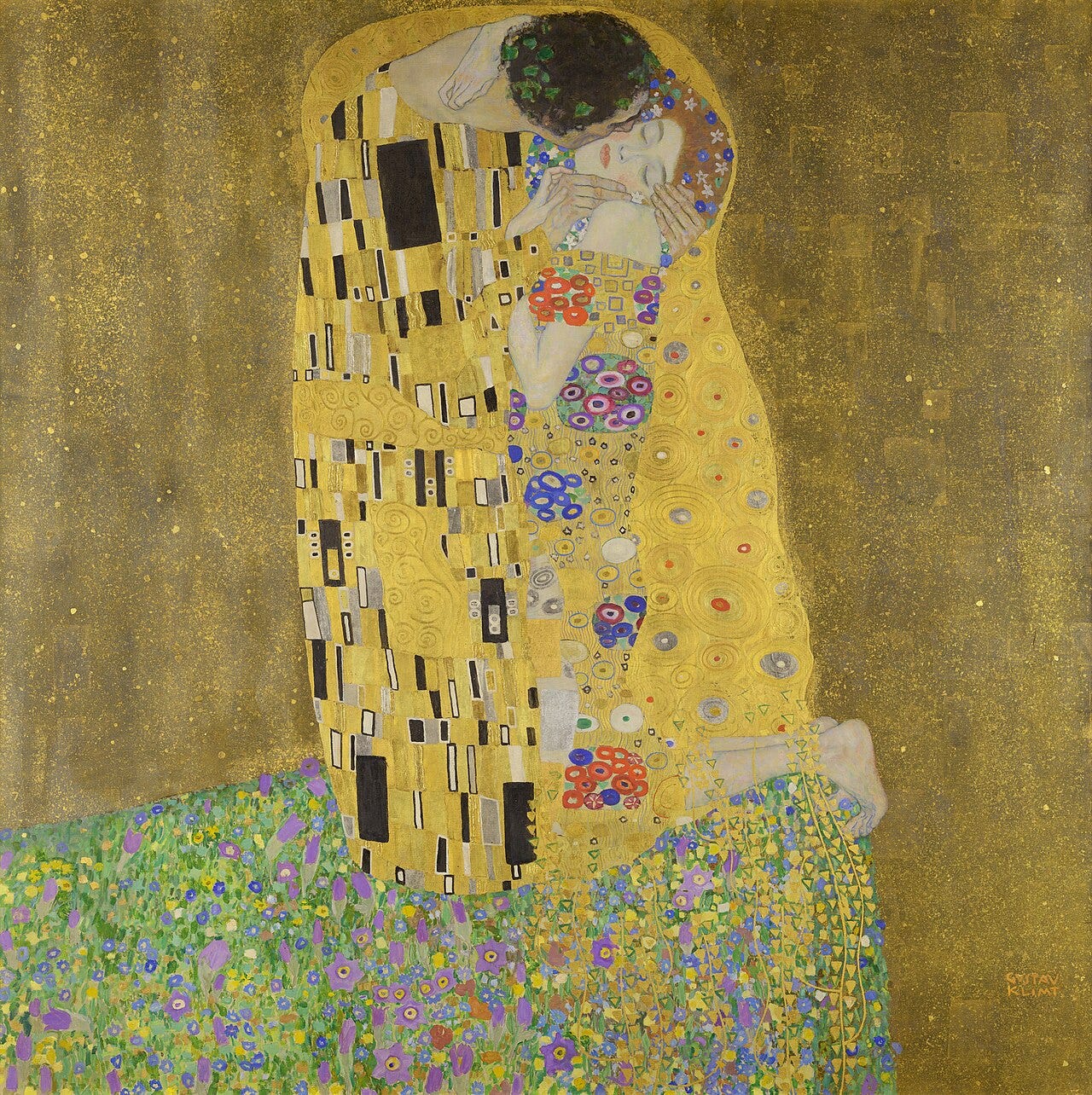
He broke from the official art world to lead the Vienna Secession, painted naked truth onto a university ceiling and got cancelled for it, and left behind a portrait that would later become the most expensive painting ever sold at the time.
Behind the gold leaf is a stranger, wilder story than the posters suggest. Here is the whole man.
Klimt in sixty seconds
Lived: 1862 to 1918, born and died in Vienna, dead at 55.
Famous for: The Kiss, the Tree of Life, and the golden portraits.
Movement: he founded and led the Vienna Secession.
Signature: real gold leaf, learned from his father the gold engraver.
Scandal: his university paintings were rejected, then burned by the SS in 1945.
More incredible painter stories
If Gustav Klimt pulled you in, you will love these too:


The gold engraver's son
Klimt grew up poor in a suburb of Vienna. His father was a gold engraver, and the boy learned early how to handle metal leaf and ornament.
He trained as a decorative painter and started out doing respectable ceilings for theaters and museums. He was good, conventional, and on his way to a safe career. Then he blew it up.
The Secession and the break with Vienna
In 1897 Klimt and a group of younger artists walked out of the conservative art establishment and founded the Vienna Secession.
Their motto, carved over the door of their new building, read: to every age its art, to art its freedom. Klimt became their first president and the face of modern art in Austria.
He was now a provocateur, embracing Symbolism, dreamlike and erotic, against everything the academy wanted.
The Golden Phase
After a trip to Ravenna, where he saw the glittering Byzantine mosaics, Klimt began pressing real gold leaf into his paintings. Where does that decorative gold work fit in the wider period? this survey of Art Nouveau's most famous pieces places Klimt beside Mucha and Beardsley among its defining names.
The result was his Golden Phase, around 1899 to 1910, the most famous decade of his life. It produced The Kiss, two lovers wrapped in a single golden cloak. Why he reached for actual gold is its own story, told in why Klimt painted in gold.
Klimt finished The Kiss in 1908, the same year the Vienna Academy of Fine Arts turned down a young applicant for the second time, a story told in why Hitler was rejected from art school.
The scandal that got him cancelled
Around 1900 Klimt was commissioned to paint three huge ceiling panels for the University of Vienna: Philosophy, Medicine and Jurisprudence.
He gave them naked bodies, despair and sex instead of noble reason. Professors signed a petition against them. Klimt returned the fee, took the paintings back, and never accepted a public commission again.
The works met a grim end: retreating SS troops burned them in a castle in 1945. We only have black and white photographs.
Woman in Gold and the Nazis
His golden portrait of Adele Bloch Bauer, a Viennese society hostess, became one of the most fought over paintings in history.
The Nazis looted it from her Jewish family in 1938. Decades later her niece, Maria Altmann, sued the Austrian state to get it back, and won. It sold for around 135 million dollars, a record at the time.
The full saga is in Klimt's Woman in Gold, and for another looted treasure, The Mafia and the Missing Caravaggio.
The women, the cats and Emilie
Klimt rarely left his studio, and when he worked he often wore a long robe with nothing underneath.
He was surrounded by models, kept cats wandering through the studio, and made hundreds of frank erotic drawings. He never married, fathered several children by different women, and yet his great lifelong companion was the designer Emilie Floge, who may never have been his lover at all.
The Tree of Life and the Stoclet Frieze
One of his most copied images is not a painting on canvas at all.
The Tree of Life comes from a mosaic frieze he designed for a private mansion in Brussels, the Stoclet Palace. Its swirling golden branches now sell on more posters and mugs than almost anything he made.
The year that erased a generation
In early 1918 Klimt suffered a stroke that paralyzed one side of his body.
Weakened, he caught the Spanish flu sweeping the world and died in February 1918, at 55. I dig into that end in how Gustav Klimt died. Vienna lost much of its art world the same year.
The protege: Egon Schiele
Klimt mentored a raw young talent named Egon Schiele, giving him models, buyers and encouragement.
Schiele pushed Klimt's eroticism into something harsher and more modern. He died in the same 1918 flu pandemic, just months after his master.
Where his gold still hangs
The Kiss is the pride of the Belvedere in Vienna. The Metropolitan Museum of Art in New York holds several of his landscapes and portraits.
A scholarship at fourteen
Klimt was born in 1862 just outside Vienna into a family with very little money. In 1876, at fourteen, he won a place at the Vienna School of Applied Arts, the Kunstgewerbeschule, on a scholarship. His younger brother Ernst enrolled soon after.
The school trained craftsmen and decorators, not studio rebels. Klimt learned to copy, to gild, and to design to order. He drew from plaster casts and old masters for about seven years.
He left in 1883 as a skilled decorative painter for hire. Nothing in that schooling pointed to the gold and the scandal that came later.
What it gave him first was plainer and more useful: a trade, and the discipline to finish huge commissions on time.
The Ringstrasse company
Around 1883 Klimt, his brother Ernst, and their friend Franz Matsch set up a studio together called the Kunstlercompagnie, the Artists' Company.
Vienna was rebuilding its grand boulevard, the Ringstrasse, and needed painters to fill new theaters, museums and palaces with ceilings and murals.
The three young men took the work and did it well. They painted the staircase of the Burgtheater between 1886 and 1888, and the panels above the grand staircase of the Kunsthistorisches Museum around 1890 and 1891.
In 1888 the Emperor Franz Joseph gave Klimt the Golden Order of Merit for the Burgtheater ceilings. He was in his twenties, respectable, and in demand. This was Klimt the safe hire, long before Klimt the outrage.
The two deaths of 1892
1892 broke the pattern. That year Klimt lost his father, and then his brother and business partner Ernst, who died in December at only twenty eight.
The company fell apart. Klimt now had to support his mother, his sisters, and Ernst's widow and baby daughter.
He stopped chasing easy decorative jobs and went quiet for a few years. When he came back, his work had changed. The polished historical style gave way to something stranger and more personal, full of symbols, desire and death.
Grief alone did not cause that shift, but the timing is hard to ignore. The comfortable young decorator never fully returned.
The ceiling paintings lost to fire
In 1894 the University of Vienna asked Klimt for three large ceiling paintings, on Philosophy, Medicine and Jurisprudence. He delivered drifting naked bodies and human suffering instead of proud reason, and professors signed petitions against them.
Philosophy went on show in 1900, Medicine in 1901, and Jurisprudence was finished by 1907. Klimt eventually refused the commission and, in 1905, bought the paintings back with a collector's help. He never took a state job again.
The three works were stored at a castle called Immendorf. In May 1945, retreating SS troops set the castle on fire and the paintings burned. Only black and white photographs survive, which is why no one alive has seen their real colors.
The Beethoven Frieze of 1902
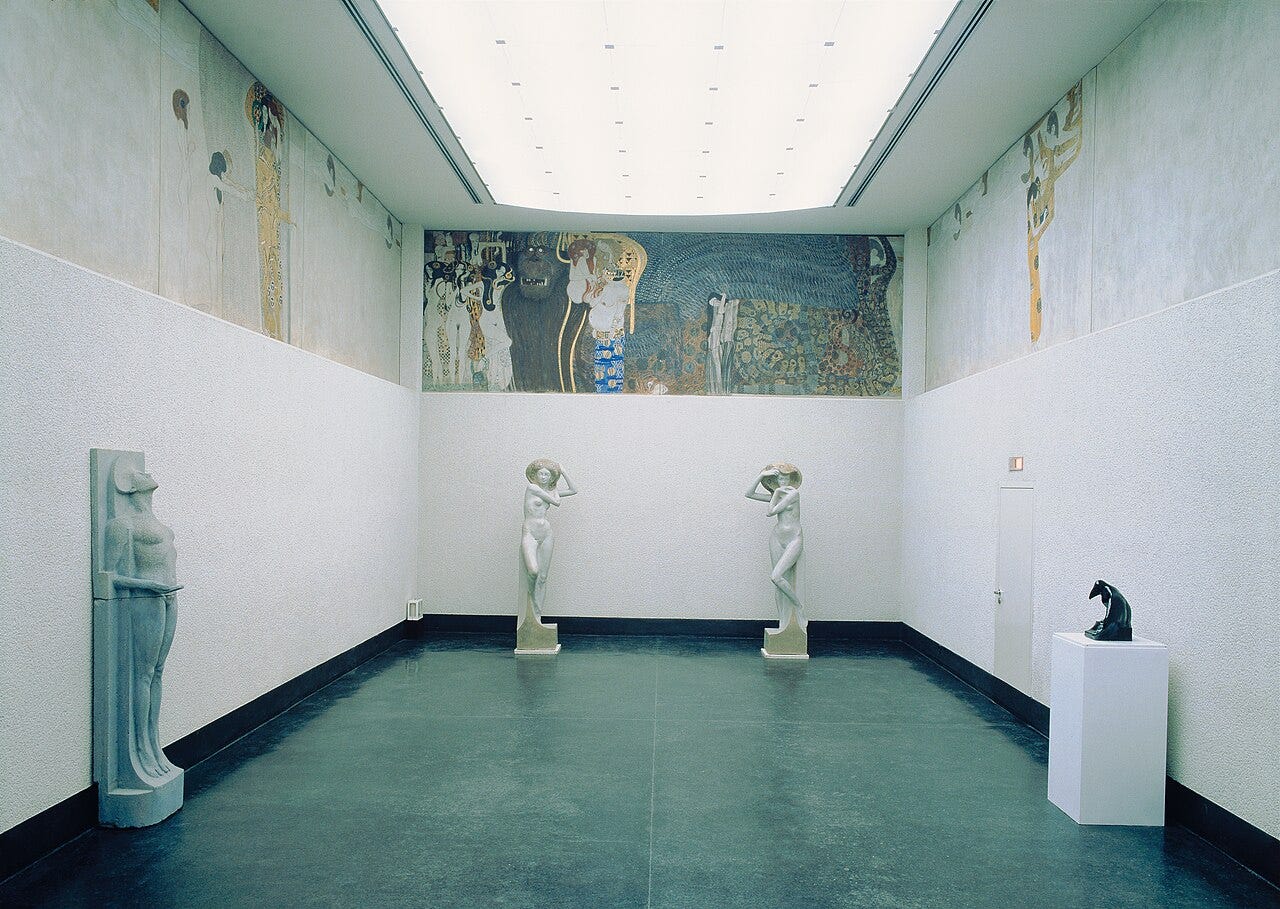
In 1902 the Vienna Secession gave its whole spring exhibition to Ludwig van Beethoven. Klimt's contribution was a long painted frieze that ran high along three walls of the hall.
It reads left to right like a story. Frail humanity asks for help, a knight sets out to fight, hostile forces and temptations block the way, and at the end a choir and an embrace stand for joy and art.
He painted it in light materials, meant to last only for that show. It survived by luck. Today the Beethoven Frieze is back in the Secession building in Vienna, in its own room, where you can walk its full length.
It is one of the few large public Klimt works you can still stand in front of.
The square landscapes of Lake Attersee
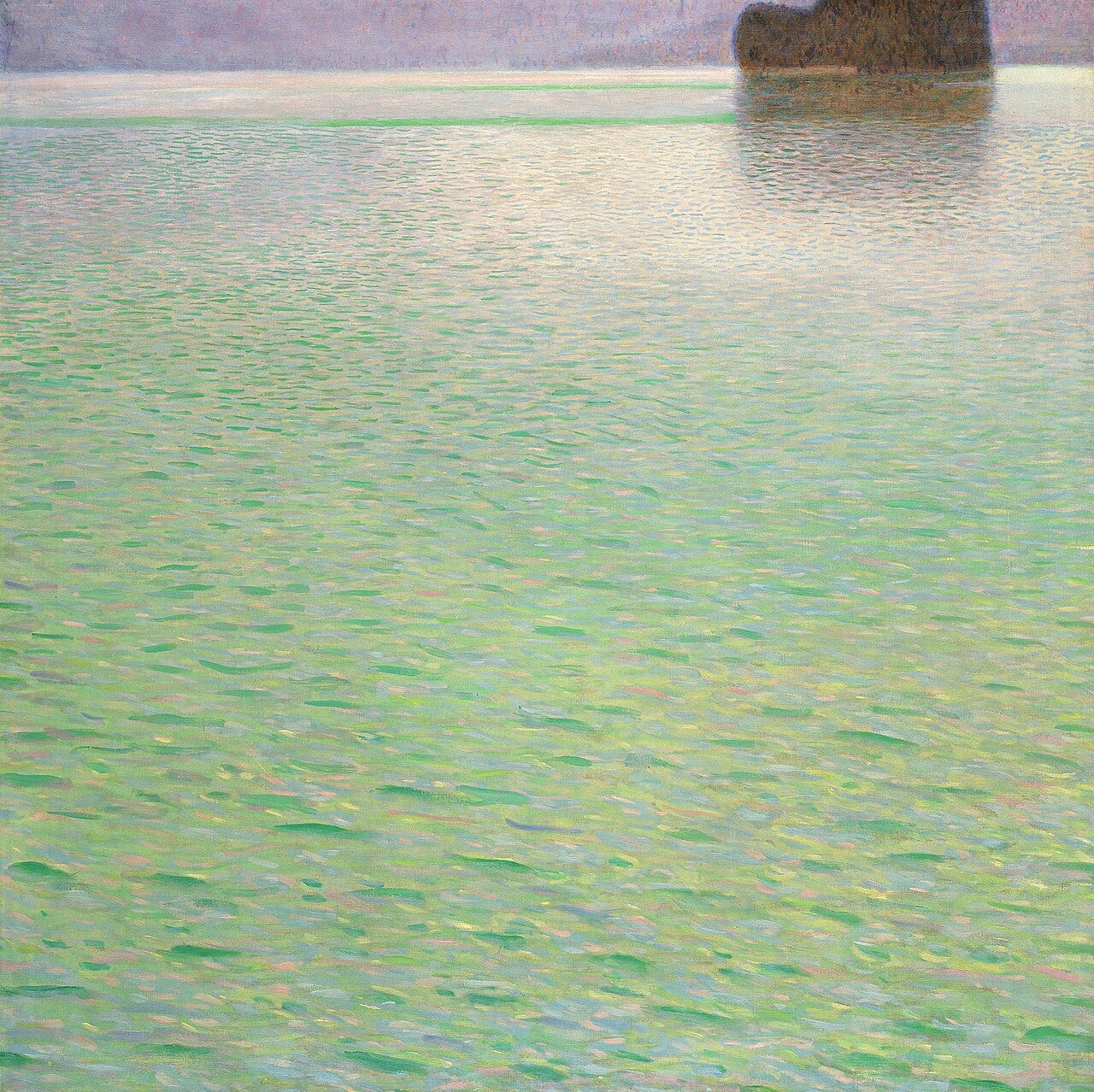
Most people know Klimt for gold and for women. Fewer know that roughly a quarter of his paintings are landscapes.
Almost every summer from about 1900 he left Vienna for Lake Attersee, in the lake district called the Salzkammergut. There he painted still water, orchards, birch woods and flower meadows.
He liked to look through a small viewfinder or a telescope, pulling a distant patch of trees flat against the canvas. Nearly all of these landscapes are square, an unusual choice he kept for years.
They have no drama and almost no people. After the fights over the ceiling paintings, Attersee was where Klimt seemed to rest.
The thousands of drawings
Before most of his paintings came drawings. Klimt filled sheet after sheet with quick studies of women, and thousands of them survive today.
Many are openly erotic. Women recline, drift half asleep, or fold into themselves, caught in pencil with a few sure lines. He kept models moving around the studio so he could seize a pose the moment it appeared.
Most of these sheets were private working tools, not made to sell, and they were rarely shown while he lived. They reveal a different Klimt from the gold pictures: fast, plain and stripped down.
The drawings are prized in their own right now, and many sit in the Albertina in Vienna. They are the bones under all that ornament.
The private man in the smock
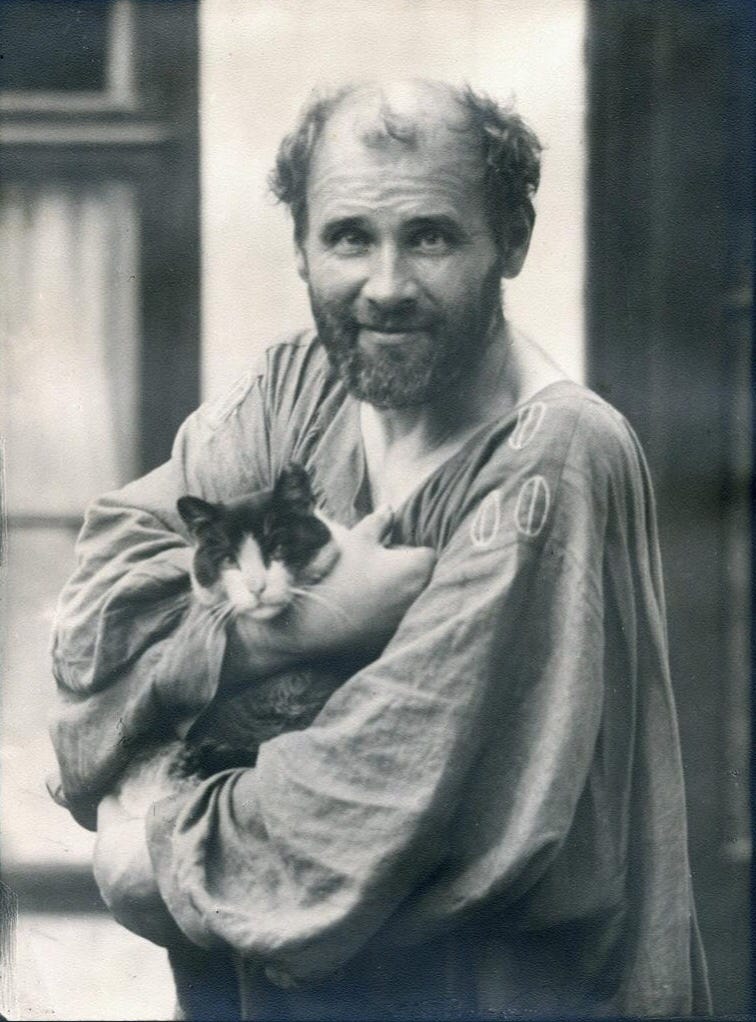
Klimt guarded his private life closely. At home in the studio he often worked in a long loose smock of his own design and sandals, with nothing formal underneath. Cats wandered the room while he painted.
He rose early, took a walk, ate a big breakfast, then painted for the rest of the day. He disliked travel, parties and interviews, and he almost never explained his pictures. Reporters who came for a quote were sent away with a shrug.
That silence fed the legend, because the less he said, the more Vienna gossiped. The gap between the calm man in the smock and the charged paintings he made is part of what still draws people in.
The self portrait he never painted
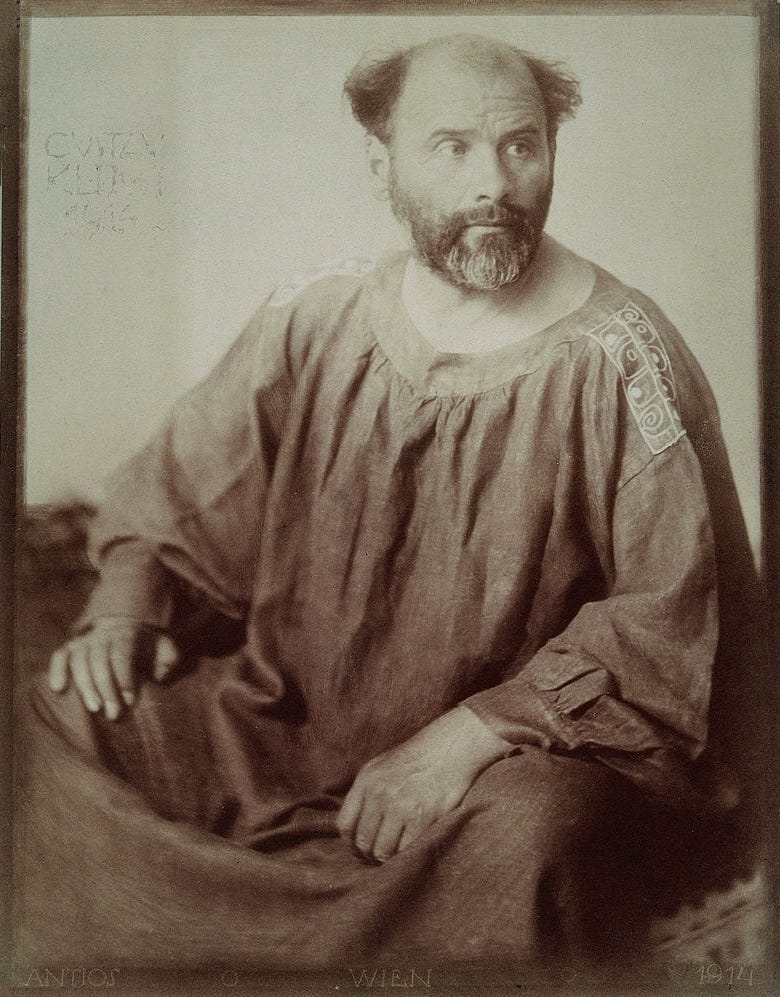
Here is a surprise. Klimt left no true self portrait. He painted dozens of women in close detail, yet he almost never turned the brush on his own face.
Asked about himself, he waved it away. He said there was nothing much to see in him as a person, and that anyone curious should look hard at his pictures instead.
So the familiar image of a bearded man in a smock comes from cameras, not from his own hand. This upsets a common assumption, that a great painter of faces must have studied his own.
Klimt did the reverse. He hid the man and poured everything into the work, which is exactly why the paintings, not the biography, stay the real record.
Ranked only by what changed hands and for how much, Woman in Gold outranks The Kiss. It sold for 135 million dollars in 2006, a record for Klimt, after Maria Altmann's long legal fight to get it back from Austria. The Kiss has never been sold, and has hung at the Belvedere in Vienna since the Austrian state bought it in 1908, at the Kunstschau exhibition where it was first shown.
Between master and student, I would put Schiele ahead on line and Klimt ahead on nearly everything else that made him famous. Klimt learned gold leaf work from his father, a gold engraver, and used it across two decades of society portraits. Schiele worked mainly in graphite and gouache, with none of that surface or that training, and had only a few years before the same 1918 flu that killed Klimt killed him too, at 28.
The golden decade gets the posters. The landscapes are the steadier body of work. Klimt painted at Attersee nearly every summer from about 1900, using the same square format for two decades, and unlike the society portraits and the university ceilings, nobody commissioned them.
The Gustav Klimt questions that keep coming up
What is Klimt most famous for? The Kiss, the Tree of Life, and his golden portraits.
Why did he use gold? His father was a gold engraver, and Byzantine mosaics inspired him to use real gold leaf.
What is Woman in Gold? His portrait of Adele Bloch Bauer, looted by the Nazis and later returned.
How did Klimt die? A stroke followed by the Spanish flu, in Vienna in 1918, aged 55.
Was Klimt part of a movement? Yes, he founded and led the Vienna Secession.
Was Klimt Jewish? No, he was raised Catholic. His famous sitter Adele Bloch Bauer was Jewish.
Where was Klimt from? Vienna, Austria, born in 1862.
Did Klimt paint cats? He loved cats and let them roam his studio freely.
Did Klimt marry? No. His lifelong companion was the designer Emilie Floge.
Was Klimt successful in his lifetime? Yes, he was famous and wealthy when he died.
Was Gustav Klimt rich when he started out? No. He was born in 1862 near Vienna into a poor family and was one of seven children. Money was tight throughout his childhood. He won a scholarship to art school at fourteen and only reached steady income in his twenties, once his studio company began decorating grand buildings along Vienna's Ringstrasse.
Can you still see Klimt's University ceiling paintings? Not the originals. Philosophy, Medicine and Jurisprudence were destroyed by fire in 1945, when SS troops burned the castle where they were stored. Only black and white photographs survive. In recent years the Belvedere worked with Google to reconstruct their likely colors on screen, but the actual canvases are gone for good.
More secrets to unlock


The painter who dressed his lovers in gold
Klimt left almost no letters and gave almost no interviews. He said the work was the only thing worth looking at.
When he died in February 1918, felled by a stroke and then by the flu sweeping Vienna, unfinished canvases filled the studio, The Bride among them. Egon Schiele drew him on his deathbed. Eight months later the same flu took Schiele too, at 28, and Vienna's golden age ended twice in one year.