
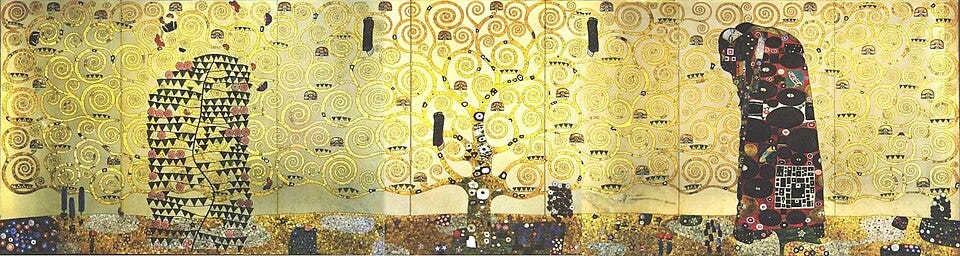
The Tree of Life is Gustav Klimt's golden design of a swirling, spiraling tree, made around 1905 to 1911 for the dining room of a private mansion in Brussels, the Stoclet Palace.
It is one of his most copied images, even though it was never a painting on canvas.
You have seen it on posters, mugs and phone cases. Almost no one has seen the real thing.
Here is what it actually is, what the branches mean, and the dark detail hiding in the gold.
The Tree of Life, in 30 seconds
Artist: Gustav Klimt.
Date: about 1905 to 1911.
Location: the dining room of the Stoclet Palace, Brussels.
Technique: a mosaic of marble, enamel, coral and gold leaf, not paint on canvas.
Access: in situ inside a private home, a UNESCO World Heritage Site since 2009, and almost never open to the public.
Keep learning art the fun way


It was never a painting
This trips most people up. The Tree of Life is not an oil painting.
It is a full size design Klimt drew for a mosaic, which craftsmen of the Wiener Werkstatte then built into a wall of marble, enamel, coral and gold, finished in 1911. The colorful version you buy on a poster is his preparatory study, now kept in the MAK, the museum of applied arts in Vienna.
The commission came from Adolphe Stoclet, a Belgian financier and art collector, and his wife Suzanne. They hired the Viennese architect Josef Hoffmann, a fellow member of the Secession, to build them a mansion in Brussels, completed between 1905 and 1911, and brought in the Wiener Werkstatte, the design workshop Klimt was closely tied to, to decorate it inside and out.
The dining room frieze was the centerpiece of the whole house. Craftsmen built it from marble, ceramic and enamel tiles, coral, and semi precious stones, set behind sheets of gold and silver leaf. Klimt supplied the design; the Wiener Werkstatte workshop did the physical construction.
Klimt's design first existed as a series of full size cartoons, drawn on paper, that told the craftsmen exactly where each piece of stone, enamel or metal should go. Several of these cartoons survive and are now split between museum collections, including the MAK in Vienna.
What the branches mean
The tree of life is an ancient symbol found across many cultures, a link between the earth, the heavens and the world below.
Klimt twisted his branches into tight spirals that seem to grow and curl without end, an image of life as one endless, tangled cycle. The gold turns it from decoration into something closer to a religious icon.
Klimt helped found the Vienna Secession in 1897, a group of artists who broke from the official Academy and elected him their first president. The group chased flat, ornamental pattern work like this, closer to textile or metalwork design than to traditional painting. The Tree of Life fits that project as well as it fits a dining room wall. That flat, pattern driven style also ties Klimt to Symbolism in art, not just the Secession's decorative program.
The figures beside the tree
The tree does not stand alone. In the full frieze it is flanked by two figures: a dancer called The Expectation, and a couple locked in The Embrace, which directly echoes The Kiss.
So the tree sits between longing and union, the two poles of Klimt's whole art.
In the room itself, the tree covers the shorter wall of the dining room. The Expectation and The Embrace face each other on the two long walls, so anyone sitting at the table sits between them.
Klimt made the Tree of Life during what is now called his golden period, the years when he covered his figures in gold leaf. Portrait of Adele Bloch Bauer I and The Kiss both date from 1907 and 1908, right in the middle of the years he spent on the Stoclet frieze. Applying real gold leaf to a painted surface is a technique known as gilding.
The frieze is not solid gold either. Green, coral pink, white and black stone and enamel run through it, set into the gold ground the way stones are set into jewelry.
The black bird people never notice
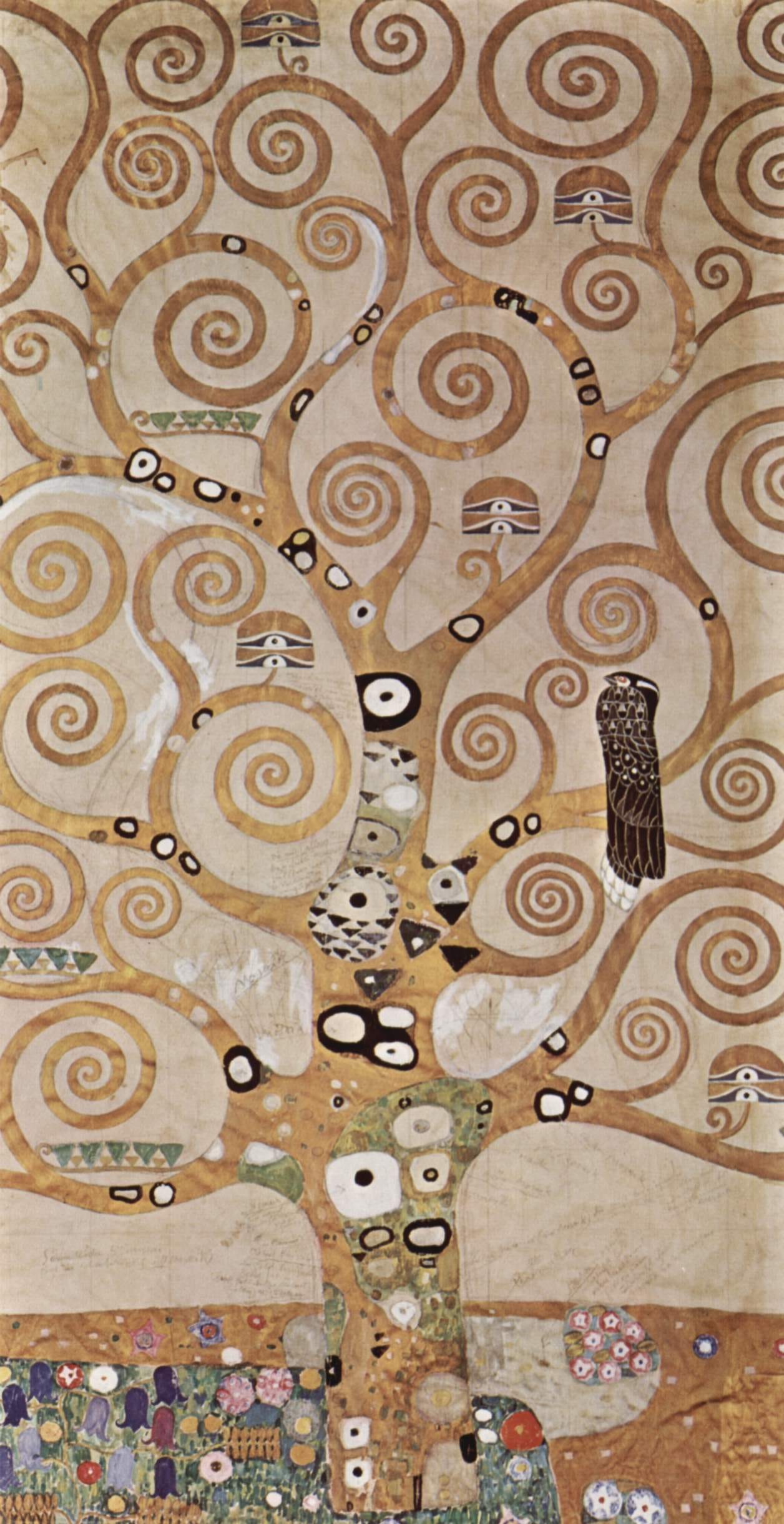
Tucked among the glittering branches sits a single black bird, a rook.
In folklore the rook is an omen of death. Klimt placed it quietly in the middle of all that gold, a small reminder that the tree of life is also the tree that ends, which to me is the sharpest thing in the whole frieze.
Artists love to bury meaning like this, as in these secrets in famous paintings.
The room you cannot enter
The original mosaic still covers the dining room wall of the Stoclet Palace in Brussels.
The house is privately owned and almost never open. It is a protected world heritage site that the public has essentially never been allowed to visit. The most shared tree in art lives behind a locked door.
Belgium listed the Stoclet Palace as a UNESCO World Heritage Site in 2009. The house is still owned by the Stoclet family, and it has never opened to the public on a regular basis, heritage status included.
The rare exception came through Google Arts and Culture, which photographed the interior for its online archive, giving the public one of the only real views inside. Everyone else knows the room from photographs, not from standing in it.

More secrets to unlock


Klimt made this frieze at the height of his fame. Barely a decade later a stroke and the Spanish flu ended his life within weeks, a story I tell in how Gustav Klimt died.
Before you buy the tote bag
Who made it? Gustav Klimt, around 1905 to 1911.
Is it a painting? No. It is a design for a mosaic frieze.
Where is it? The Stoclet Palace, Brussels, a private home.
What does it mean? An ancient symbol linking earth, heaven and the world below.
Can I see it in person? Almost never. The palace is private.
A design on a million tote bags, and the original almost no one alive has stood in front of. I tell the whole story of the man who made it in Gustav Klimt: The Complete Story.
