Childe Hassam: The Complete Story
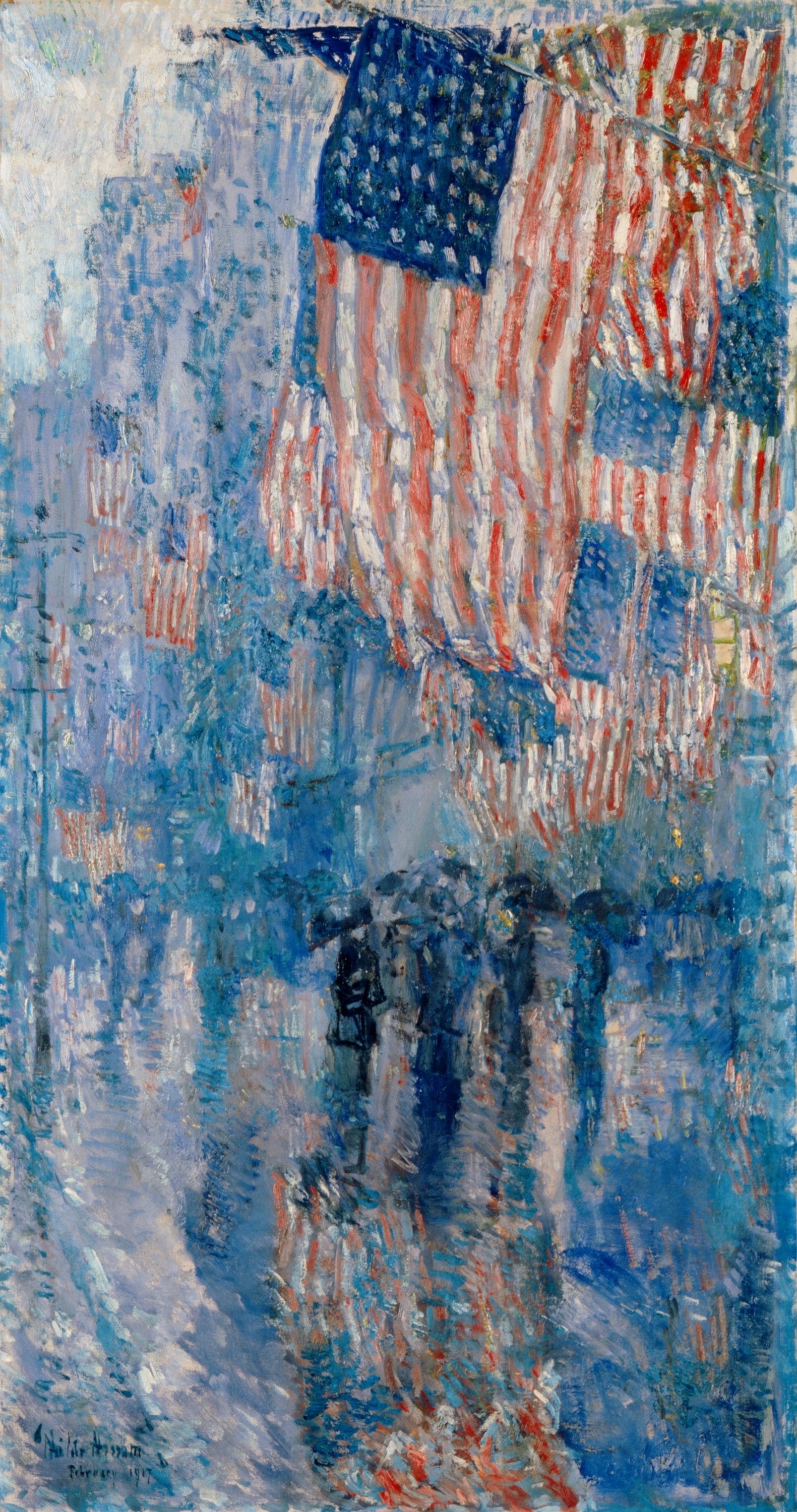
Childe Hassam was the painter who translated Impressionism into American, and his flag filled Fifth Avenue hangs in the Oval Office. Born near Boston in 1859, he became the most successful American Impressionist of his generation, with some 3,000 works to prove it.
He bristled at the label all his life, which is the joke of his career: nobody did more to make broken colour speak with an American accent.
Childe Hassam at a glance:
1859: born Frederick Childe Hassam in Dorchester, Massachusetts, to an old New England family whose name was a corruption of Horsham.
1872: the Great Boston Fire destroys his father's business, ends his schooling, and lands him in a wood engraver's shop.
1890: back from Paris, settles in New York and starts painting the city street by street.
1916: a preparedness parade on Fifth Avenue launches the flag series, about thirty canvases by 1919.
1935: dies at East Hampton, leaving 400 studio works to fund museum purchases of young American art.
From wood engraver to Paris
Hassam started as an illustrator and wood engraver in Boston, painting rainy city streets before he ever saw France. From 1886 to 1889 he studied in Paris at the Academie Julian, watched the Impressionists' last group efforts from close range, and came home with a lightened palette and a conviction: the method belonged wherever there was weather.
New York, and The Ten
Settled in New York from 1889, he painted the city's avenues, parks and winters as Monet had painted boulevards. In 1898, tired of giant juried exhibitions, he and his friends resigned from the Society of American Artists and formed The Ten, a small secession of American Impressionists whose group shows ran for two decades and professionalised the movement in the United States.
More incredible painter stories
If Childe Hassam pulled you in, you will love these too:
Celia Thaxter's island garden
His most loved canvases come from Appledore, in the Isles of Shoals off New Hampshire, where the poet Celia Thaxter kept a cutting garden and a salon.
Through the late 1880s and 1890s Hassam painted her poppies against the granite and sea, and illustrated her book An Island Garden in 1894, the year she died. The island series is American Impressionism's answer to Giverny.
The flags, 1916 to 1919
His late masterwork is a series: around 30 paintings of Fifth Avenue dressed in Allied flags, begun after a 1916 preparedness parade and continued through the war's end. The Avenue in the Rain, from February 1917, entered the White House collection in 1963 and has hung in the Oval Office under presidents of both parties, the most seen American Impressionist painting in the world.
The myth: French paint in American cans
Hassam rejected the Impressionist label, claiming descent instead from English watercolour and plain American sight.
The pictures split the difference: French method, American subjects, and in the flag series something neither country had done, history painting made of weather and bunting.
He died in East Hampton in 1935, leaving the contents of his studio to the American Academy to fund young artists.
Where to see Hassam
The Met holds him in depth and the flag paintings anchor American wings from Washington's National Gallery to the Amon Carter in Texas. The Avenue in the Rain belongs to the White House; loans aside, it hangs where the president works.
A fire, a crescent, a dropped name
The Boston fire of 1872 made the career: with the family cutlery business gone, the teenager was apprenticed to a wood engraver and learned to draw for a living.
He dropped Frederick on advice that Childe sounded better, and drew a small crescent before his signature all his life. Collectors have guessed at its meaning ever since; he enjoyed that and never explained.
The exotic-sounding surname, endlessly assumed to be Middle Eastern, was plain old New England, worn down from Horsham.
Ten thousand windows
After 1910 Hassam kept returning to one quiet motif: a woman at a New York window, curtains filtering daylight, the city reduced to a glow beyond the glass.
The window series is his second most loved after the flags, and the closest American Impressionism ever came to Vermeer.
At 55 he took up etching and pulled more than 350 plates, a parallel career in black and white.
The Academy's banker
Hassam sold well and saved better. At his death in 1935 he left the contents of his studio, more than 400 works, to the American Academy of Arts and Letters.
The bequest came with instructions: sell them, and spend the proceeds on works by young American and Canadian painters, to be given to museums.
The Hassam Fund is still buying art ninety years later. The painter accused of importing French light endowed a permanent subsidy for American painting.
The Childe Hassam questions that keep coming up
What is he known for? American Impressionist city scenes, island gardens, and the Fifth Avenue flag series.
What are the flag paintings? About 30 canvases of Fifth Avenue in wartime flags, painted 1916 to 1919.
Was he an Impressionist? In method yes; he disliked the label and insisted on Anglo American roots.
When did he die? In 1935, at East Hampton, New York, at 75.
Why is he called the American Monet? Dealers coined it to sell him. He hated the label and insisted his sources were English watercolorists and his own eyes; it stuck anyway.
Can you visit Celia Thaxter's garden? Yes. The Appledore Island garden was replanted from Thaxter's own book and is kept blooming by volunteers; summer tours run from Portsmouth, New Hampshire.
More secrets to unlock
A wet afternoon above the Resolute desk
The Avenue in the Rain was painted in February 1917, weeks before America entered the war. Bought for the White House in 1963, it has looked over the Resolute desk during the terms of Kennedy, Obama and Biden among others: a wet afternoon on Fifth Avenue, promoted to the room where the decisions happen.