
Hans Holbein the Younger was the German painter who became court artist to Henry VIII and gave us the faces of Tudor England. His portraits are so sharp and lifelike that almost every image you picture of Henry, his ministers and his wives comes from Holbein's hand or his copyists.
Working from Basel to London between about 1526 and his death in 1543, he left us The Ambassadors, the Anne of Cleves match that undid a marriage, and a gallery of Tudor faces no one has bettered.
He was a foreigner who painted his way to the center of one of the most dangerous courts in Europe, and survived it by being simply the best in the room.
Born: Augsburg, Germany, around 1497
Known for: Tudor court portraits, The Ambassadors
Died: London, 1543, probably of plague
More incredible painter stories
If Hans Holbein the Younger pulled you in, you will love these too:


Hans Holbein the Younger at a glance
1497. Born in Augsburg around this year, into a family of painters.
1526. Left Basel for London with a letter from Erasmus to Thomas More.
1533. The Ambassadors, with its stretched skull waiting for the right angle.
1536. Became King’s Painter to Henry VIII around this year.
1543. Died suddenly in London, probably of plague, in his mid forties.
From Basel to the English court
Holbein trained in the German tradition and made his name in Basel, where he became a friend of the great scholar Erasmus. When religious upheaval dried up church commissions, Erasmus sent him to England with a letter of introduction to Thomas More.
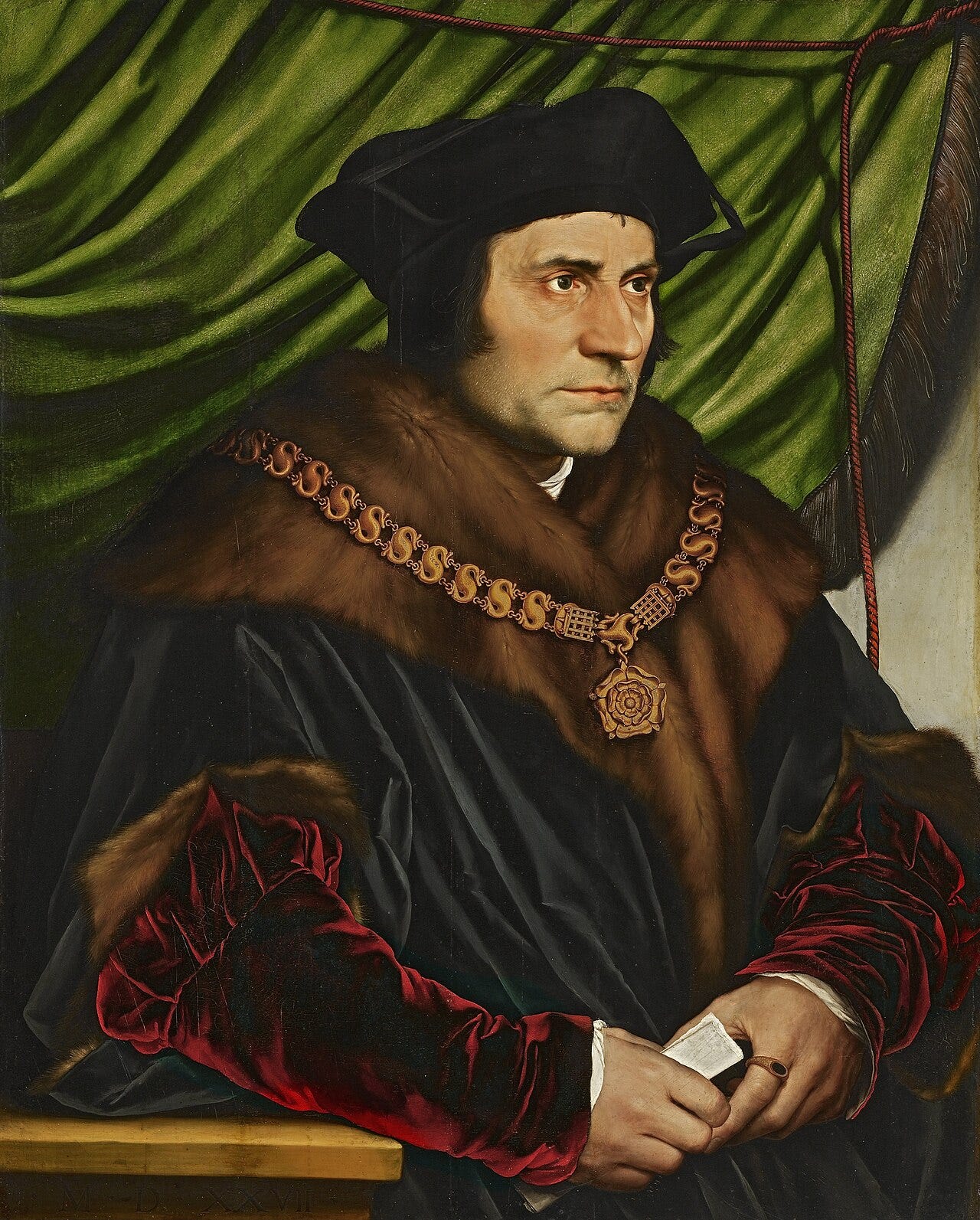
More wrote that Holbein was a wonderful artist, and the door opened. Within a decade Holbein was the King's Painter, recording the most powerful people in the land.
The face of the Tudors
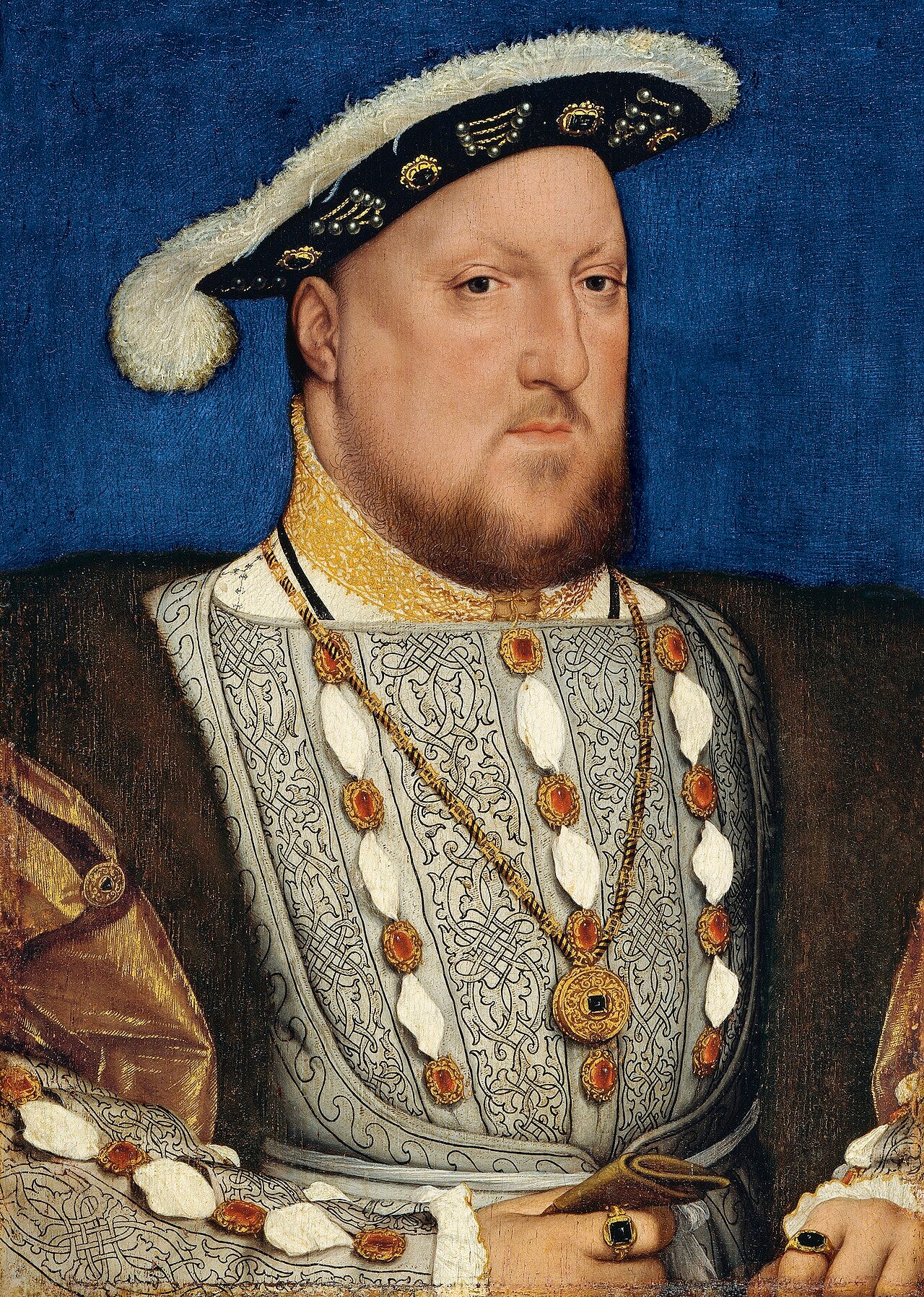
Holbein's portrait of Henry VIII, legs apart, shoulders vast, staring straight out, basically invented the image of the all powerful king. It was royal propaganda done so well that it still shapes every film and textbook.
He painted with merciless precision, every ring, fur and whisker exact. Yet he could also flatter when a king required it, which at that court was a survival skill.
The portrait that helped end a marriage
Holbein was sent abroad to paint Anne of Cleves so Henry could judge a possible bride. The King liked the portrait, agreed to the marriage, then disliked Anne in person and had the union annulled within months.
It is one of the rare moments when a single painting changed the course of a royal marriage. Thomas Cromwell, who had championed the match, was executed within months. Holbein kept his head while others lost theirs.
The skull in The Ambassadors
His most famous painting, The Ambassadors, shows two confident young men surrounded by symbols of learning. Stretched across the floor is a strange smear that only resolves into a human skull when you view it from the side, a hidden reminder of death.
It is one of the most famous optical tricks in art, a device called anamorphosis.
The lost Whitehall mural
Holbein's full length Henry was painted around 1537 for a wall at Whitehall Palace. The mural burned in 1698 and the original was lost. What we picture today survives only through the copies made from it.
The Tudor faces, and where they hang now
The National Gallery in London holds The Ambassadors, with its hidden skull. The Royal Collection keeps his Tudor portrait drawings at Windsor.
Erasmus, More, and the road to England
Holbein was born in Augsburg around 1497, the son of a painter of the same name. As a young man he settled in Basel, a Swiss city humming with printers and scholars, and made his living illustrating books and painting portraits.
There he grew close to the great humanist Erasmus of Rotterdam and painted him several times. When religious work dried up, Erasmus gave the young painter a letter of introduction to his friend in England, the statesman and writer Thomas More.
Holbein sailed to London in 1526 and lived for a time in More's household. His group portrait of the More family, now lost but known from copies, was one of the first of its kind north of the Alps.
The connection put him at the door of the English court.
The Dance of Death
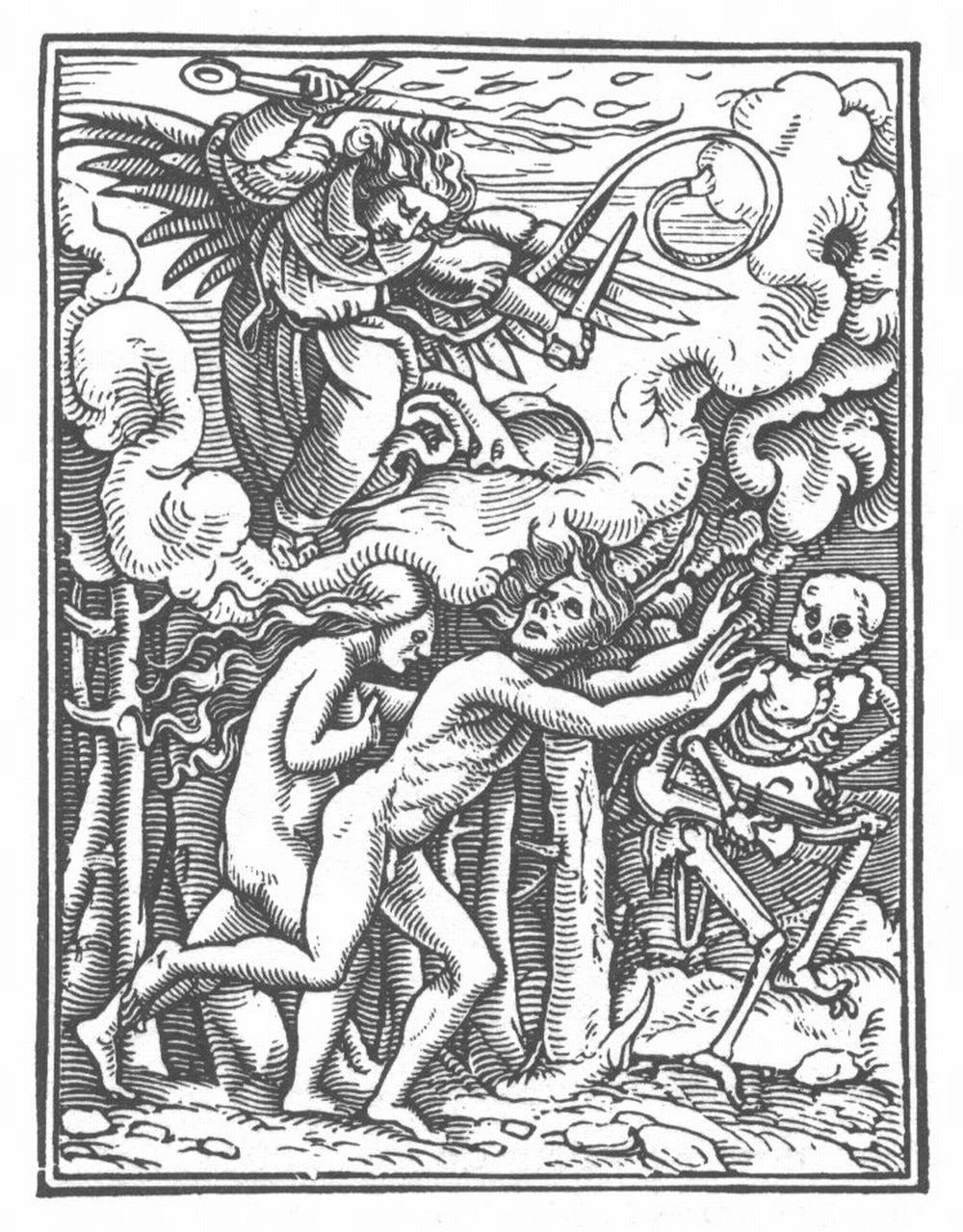
Before he was famous for kings and courtiers, Holbein made a set of small woodcut designs known as the Dance of Death. In scene after scene a grinning skeleton comes for people of every rank, the pope, the emperor, the merchant, the plowman.
The pictures carried an old medieval idea, that death levels everyone, but Holbein gave it a sharp new bite. Death interrupts the powerful at the height of their pride, and no title holds him off.
Designed in the 1520s and printed in book form in 1538, the series spread across Europe and stayed in print for centuries. It is a reminder that Holbein was a designer of prints and ornament as much as a painter of faces.
A city turning against images
Holbein went back to Basel in 1528, but the city he returned to was changing fast. The Reformation was sweeping the Swiss lands, and reformers who distrusted religious images began stripping and smashing the art in churches.
For a painter who had lived partly on altarpieces and devotional pictures, this was a slow disaster. The market for sacred art was collapsing around him.
By 1532 he had made his choice and returned to England for good. What drove one of the finest painters of the age across the sea was not ambition alone but a wave of image breaking that left him little to paint at home.
The King's Painter and his many crafts
In England Holbein first painted the German merchants of the London Steelyard, then rose into the orbit of Henry the Eighth. By about 1536 he was the King's Painter, on a royal salary.
The job was far wider than portraits. Holbein designed jewelry, gold cups, daggers, buttons, book title pages and the settings for court festivals. A number of his designs survive as drawings, a glimpse of a whole vanished world of Tudor luxury.
He became the eye of the court, the man who fixed how the king and his circle wished to be seen. Few painters have ever held such control over the image of a ruling house.
The tiny portraits he perfected
Holbein also worked at the smallest scale. He took up the portrait miniature, a jewel like likeness only a few centimeters across, meant to be held in the hand or worn.
He raised the form to a new level of finish, painting courtiers with the same exact attention he gave to a full sized panel. These little roundels could be sent as gifts, tokens of love or tools of diplomacy.
The fashion he helped set lasted for generations in England. Long after his death, the English miniature remained one of the country's proudest artistic traditions, and Holbein stood near its start.
A sudden death in London, 1543
Holbein died in London late in 1543, probably carried off by an outbreak of plague. He was only in his mid forties, still at the height of his powers.
He left a will and a couple of young children in the city. His death was so abrupt that some commissions were left unfinished on the easel.
He had spent barely two decades in England, yet he shaped how an entire dynasty looks to us now. When we picture Henry the Eighth and his court, we are very often picturing Holbein.
The drawings that outlived the paintings
Behind every Holbein portrait sat a drawing. He would study a sitter from life in colored chalks, catching the exact set of the eyes and mouth, then work the panel up from that sheet.
A large group of these preparatory drawings survives in the Royal Collection at Windsor, roughly eighty of them. They form a gallery of Tudor faces, from great courtiers to people whose names are now lost.
Many viewers find the drawings even more alive than the finished paintings. Quick and unguarded, they show Holbein looking hard at a real person, before the polish of the court portrait smoothed everything into place.
The Hans Holbein the Younger questions that keep coming up
What is Hans Holbein famous for? His portraits of Henry VIII and the Tudor court, and The Ambassadors.
Was there more than one Holbein? Yes. His father, Hans Holbein the Elder, was also a painter. The younger is the famous one.
How did he die? In London in 1543, most likely during an outbreak of plague.
Did a Holbein portrait really end a royal marriage? Yes. Henry VIII approved his fourth marriage after seeing Holbein’s portrait of Anne of Cleves, then disliked her in person and annulled it within months.
Where was Holbein born? In Augsburg, Germany, around 1497. He made his name in Basel before crossing to England.
What are the objects around the skull in The Ambassadors? A shelf of globes and scientific instruments, each one coded like the skull itself. A wider look at maps and globes in painting covers Vermeer's wall map and the moment Elizabeth I put her hand on the Americas.
More secrets to unlock


The court we still see through his eyes
Holbein froze a brutal, brilliant court in paint, and we still see the Tudors through his eyes. For me that is the real trick: look closely and a portrait becomes evidence.
One last fact. So many Tudor portraits are copies after Holbein that museums often label them painted in the manner of Holbein, proof that his version of a face simply became the official one.