
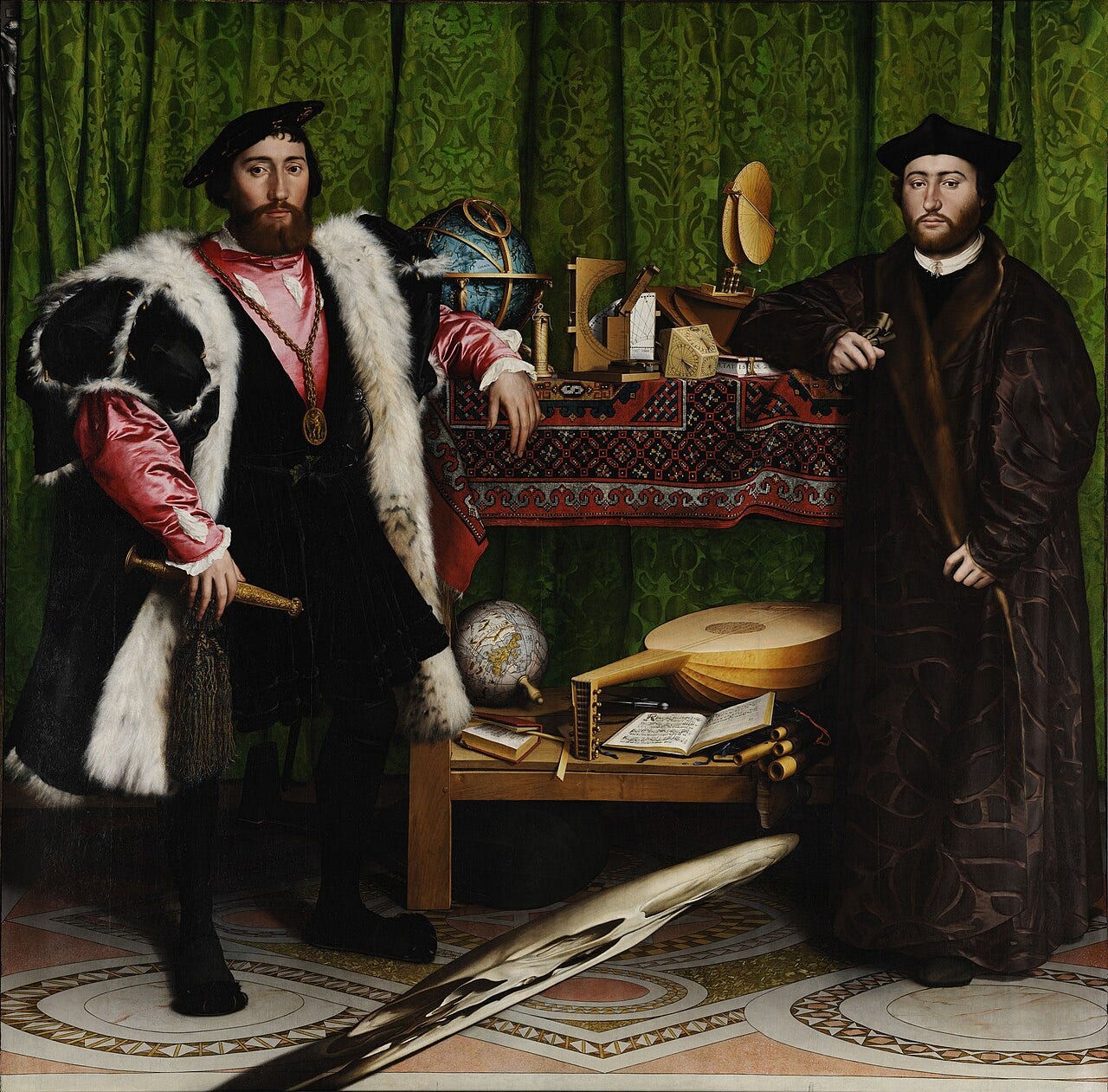
Anamorphosis is a deliberately distorted image that only looks correct from one special viewpoint, or when reflected in a curved mirror. Seen straight on, it is an unreadable smear.
Step to exactly the right angle, and it suddenly snaps into a clear picture. It is a controlled trick played with perspective.
Seen straight on it is an unreadable smear. Step to one exact angle and it snaps into a clear picture.
What I love about anamorphosis is its nerve: it hides the real picture in plain sight and dares you to find it.
Anamorphosis, the short version
What it is: an image that only resolves from one angle or in a mirror.
The effect: a meaningless smear that suddenly becomes a clear picture.
The tool: perspective, pushed to a deliberate extreme.
The famous example: the hidden skull in Holbein's Ambassadors.
The cousin: the everyday street painting that looks 3D from one spot.
Keep learning art the fun way


Perspective, stretched on purpose
Anamorphosis is built from the same maths as ordinary perspective.
Normal perspective and foreshortening stretch and shrink shapes so they look right from where the viewer stands.
Anamorphosis takes that idea and pushes it to an extreme: the image is stretched so violently that it only assembles from one unusual position, often from the very edge of the picture, or by standing a polished cylinder on the surface to gather the reflection.
The earliest known example reaches back to the very birth of perspective. Around 1485 Leonardo da Vinci drew an eye and a child's face stretched sideways in his notebooks, the first anamorphosis we have.
I find it typical of him, turning a geometry exercise into a magic trick.
It is perspective used not to convince you, but to hide and then reveal.
Holbein's floating skull
The most famous anamorphosis in art is also a secret.
In Hans Holbein's The Ambassadors, two confident men stand among symbols of wealth and learning. A strange pale shape floats across the floor at their feet.
Look from straight ahead and it means nothing. Walk to the right edge of the painting and look back across it, and the smear resolves into a perfect human skull. It is a memento mori, a hidden reminder of death, that you only meet if you move.
The picture makes you walk to find your own mortality.
The mirror trick
Some anamorphoses need a tool to be read.
In mirror anamorphosis, the distorted image is painted in a ring, and only makes sense when a mirrored cylinder is stood in the middle, gathering the smear into a clean picture on its curved surface.
These were popular party pieces in the 1600s and 1700s, sometimes hiding portraits of banned kings or rude jokes that only appeared in the mirror. The distortion was a lock, and the cylinder was the key.
The image was there all along. You just needed the right mirror.
Not quite trompe l'oeil
It is easy to confuse two kinds of visual trick.
Trompe l'oeil fools you into thinking a flat painting is a real object, and it works from normal viewing. Anamorphosis does the opposite: it looks wrong from the normal position and only works from a strange one.
One hides the trick to feel real. The other flaunts the trick and dares you to find the angle.
Trompe l'oeil wants you to be fooled. Anamorphosis wants you to move.
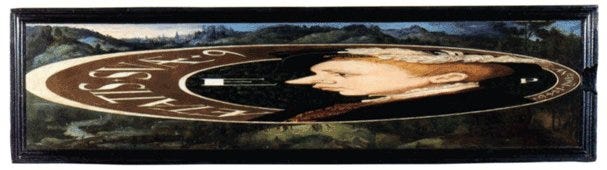
Two anamorphoses survive in London. Holbein’s The Ambassadors is in the National Gallery, and the stretched portrait of Edward VI in the National Portrait Gallery.
Holbein’s hidden skull is one of 7 secrets hidden in famous paintings.
Anamorphosis, questions from the right angle
What is anamorphosis? A distorted image that only looks correct from one special angle or in a curved mirror.
How does it work? It uses extreme perspective so the image only assembles from one viewpoint.
What is the most famous example? The hidden skull in Holbein's The Ambassadors.
What is mirror anamorphosis? A version read by standing a mirrored cylinder on the distorted image.
Is it the same as trompe l'oeil? No. Trompe l'oeil looks real from the front. Anamorphosis looks wrong from the front.
More secrets to unlock


The art that makes you move
Almost every painting asks you to stand still and look. Anamorphosis asks you to walk, hiding its real image as a stretched ghost that means nothing until your body finds the one place where it clicks.
Five centuries before interactive art, Holbein already knew the most unforgettable image is the one you have to chase. That is why, of all the tricks in this glossary, it is the one I would most want to catch in person.
