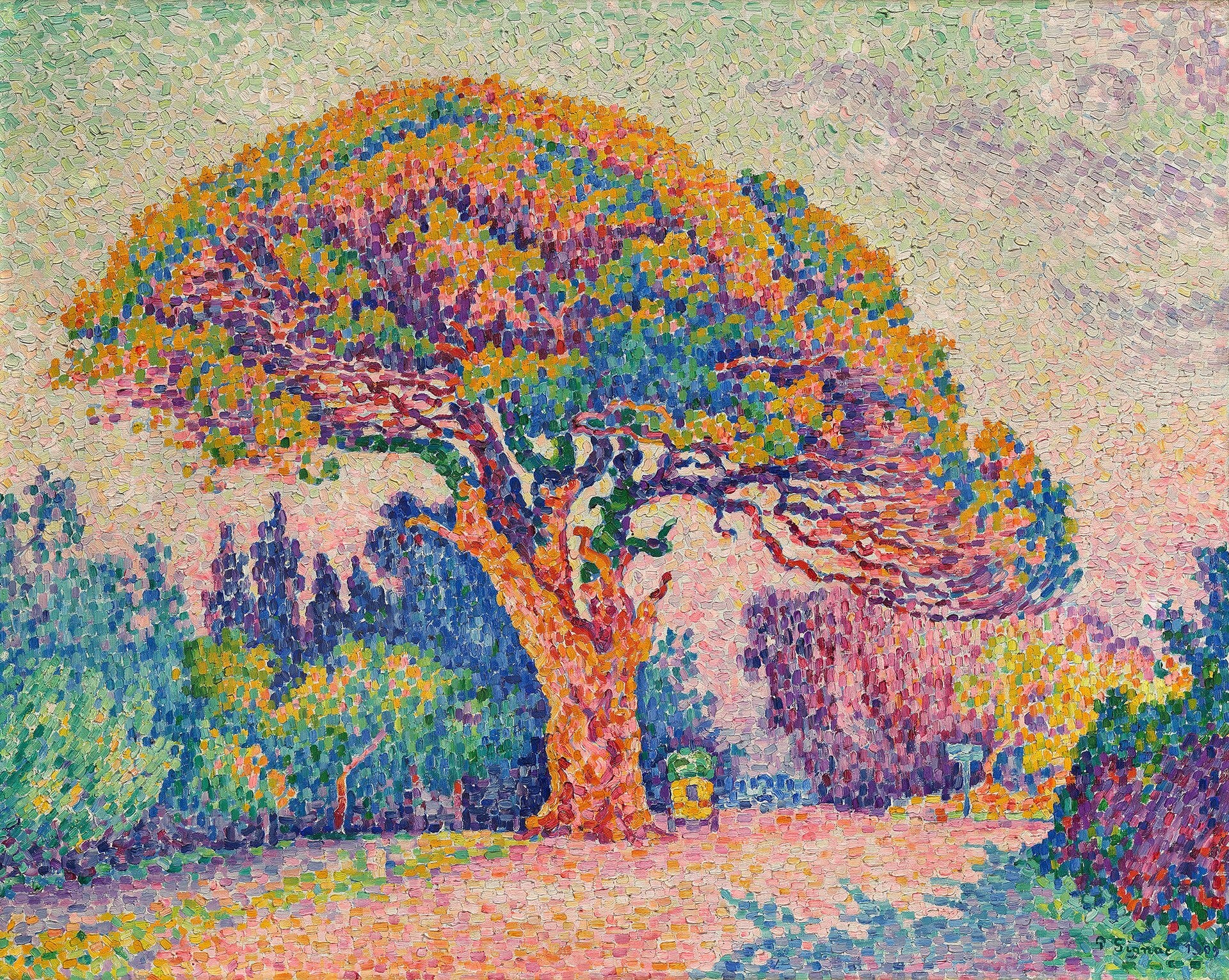
Paul Signac: The Complete Story
Paul Signac quit architecture at 16 after seeing a Monet show, owned some thirty boats, visited Van Gogh in the asylum when almost no one else would, and spent 27 years as president of the salon that let anyone exhibit. The dots were only half the story.
Seurat invented the method and died at 31. Signac kept the flame, loosened the dot, discovered Saint-Tropez, and quietly opened doors for half of modern art.
Paul Signac at a glance:
1863: born in Paris to comfortable shopkeepers; a Monet exhibition at 16 settles the career question.
1884: co-founds the Salon des Indépendants, no jury, no prizes; he will preside over it from 1908 to his death.
1892: sails into Saint-Tropez, then a fishing village without a proper road, and makes it painting's harbor.
1899: publishes From Eugène Delacroix to Neo-Impressionism, the movement's legal brief.
1935: dies in Paris at 71, thirty boats and forty years of coastline behind him.
The convert of 1880
Signac was born in Paris on November 11, 1863, to a prosperous family of shopkeepers, and abandoned his architecture plans at 16 after walking through a Monet exhibition.
In 1884 he helped found the Societe des Artistes Independants, the jury-free salon, and met Georges Seurat there.
He became the first and most loyal convert to Seurat's divisionism, the science of placing pure color side by side for the eye to mix.
Keeper of the flame, breaker of the rule
When Seurat died suddenly in 1891 at 31, Signac inherited the movement and rewrote it.
His dots grew into broad mosaic strokes of saturated color, and his 1899 book, From Eugene Delacroix to Neo-Impressionism, turned the technique into a theory young painters could use.
In 1892 he sailed into a fishing village called Saint-Tropez, bought a house, and made it a painters' colony: Matisse worked beside him there in 1904, and Fauvism caught fire the next year.
More incredible painter stories
If Paul Signac pulled you in, you will love these too:
The sailor and the anarchist
Signac owned around thirty boats across his life and sailed from Holland to Constantinople, leaving thousands of harbor watercolors.
His politics sailed left: an avowed anarchist, he painted In the Time of Harmony, a monumental utopia of leisure and shared work, between 1893 and 1895, and it hangs today in the town hall of Montreuil.
In 1889 he made a quieter gesture, traveling to Arles to visit Van Gogh in the hospital after the breakdown, when most of the avant-garde kept its distance.
The myth of Seurat's shadow
Histories often file Signac as the follower who administered a dead man's idea.
The record is more consequential: as president of the Independants from 1908 until his death, he hung the young without juries, bought Matisse's Luxe, Calme et Volupte when it scandalized, and defended the Fauves and beyond.
The gatekeeper who refused to keep the gate shaped what the twentieth century got to see.
Where to see Signac
He died in Paris on August 15, 1935, at 71. The Musee d'Orsay holds the major canvases, the Musee de l'Annonciade in Saint-Tropez keeps the light he found there, the Montreuil town hall shows the anarchist utopia, and his watercolors surface in cabinets from the Louvre to the Met.
President of the Independents
The Salon des Indépendants was his life's second artwork: founded in 1884 with Seurat and Redon, presided over from 1908 until his death.
The open door let the next revolutions through. He championed the young Matisse and bought Luxe, Calme et Volupté straight off the wall.
Few artists have run their era's infrastructure so long, and fewer used the position mainly for people painting nothing like them.
The watercolor fleet
Divisionism was slow; his other hand was fast. In 1929 he began a commissioned tour of the ports of France, roughly a hundred harbors in two years, watercolors on the spot.
The port sheets trade dots for dashes and take minutes, marine weather permitting. Specialists prize them as his freest work.
Slow oil for doctrine, quick water for joy: one painter, two metabolisms.
The book that built the lineage
From Eugène Delacroix to Neo-Impressionism, published in 1899, is part history, part argument that color obeys laws worth learning.
It traveled far beyond the sect: Matisse absorbed it, and Kandinsky cited it on his way toward abstraction.
By claiming Delacroix as ancestor, Signac reframed a movement mocked as dotty into a lineage with a past and an open future.
The Paul Signac questions that keep coming up
What is the difference between pointillism and divisionism? Divisionism is the theory, separating color into pure touches for the eye to blend; pointillism names the small-dot technique. Signac preferred the first word and outgrew the second.
Did Signac know Van Gogh? Yes. They painted together on the Seine, and in 1889 Signac visited him in the Arles hospital, one of very few colleagues who did.
What is In the Time of Harmony? His huge anarchist utopia of 1893-95, painted in the golden age it imagined, now in the Montreuil town hall near Paris.
Where can I see Signac? The Musee d'Orsay in Paris, the Annonciade in Saint-Tropez, and drawing rooms worldwide for the harbor watercolors.
How much does a Signac cost? Top harbor oils have passed 20 million dollars at auction; the watercolors remain one of the market's better bargains.
Did he really discover Saint-Tropez? For painting, effectively yes: he arrived by boat in 1892, bought a villa, and the painters who followed his invitations built the town's myth.
More secrets to unlock
A boat named Olympia
Signac named his boats after what he loved: one was called Olympia, for Manet's scandal. He reviewed harbors the way other men reviewed salons, thirty hulls and forty years of coastline, and the sea never once appears twice in the same color.