Suzanne Valadon: The Complete Story
Suzanne Valadon fell off a trapeze at fifteen, became the most painted woman in Montmartre, and taught herself art by watching the men who painted her. Degas bought her drawings. Her son became Utrillo. Her nudes still look more modern than theirs.
The laundress's daughter posed for Renoir and Toulouse-Lautrec, then picked up the pencil herself. What followed embarrassed nearly everyone who had underestimated her.
Suzanne Valadon at a glance:
1865: born Marie-Clémentine Valadon in Bessines, illegitimate daughter of a laundress who moves them to Montmartre.
1880: a circus fall at 15 ends the acrobat career; modeling for Puvis, Renoir and Lautrec begins the education.
1894: first woman admitted to the Société Nationale des Beaux-Arts, on five drawings.
1909: leaves her stockbroker husband for André Utter, her son's friend, and comfort for the infernal trio.
1938: dies at 72; Picasso, Braque and Derain walk behind the coffin.
The acrobat who fell into art
Marie-Clementine Valadon was born on September 23, 1865, in Bessines-sur-Gartempe, the illegitimate daughter of a laundress who moved them to Montmartre.
At around fifteen she joined a circus as an acrobat; a fall from the trapeze ended that career within the year, and she began modeling instead.
Renoir posed her for Dance at Bougival, Puvis de Chavannes used her for entire friezes, and Toulouse-Lautrec, painting her hungover portrait, renamed her Suzanne, after the biblical girl watched by old men.
Watching the watchers
While the masters painted her, Valadon memorized what their hands did, and drew at night, self-taught, in harsh confident line.
Around 1890 Toulouse-Lautrec showed her sheets to Degas, who bought several, taught her printmaking on his own press, and remained her advocate for life.
In 1894 she became the first woman admitted to the Societe Nationale des Beaux-Arts, a former circus girl entering by the front door.
More incredible painter stories
If Suzanne Valadon pulled you in, you will love these too:
Utrillo, Utter, and the infernal trio
Her son Maurice, born in 1883 when she was 18, father officially unknown, became the painter Utrillo: she taught him to paint partly as therapy for his drinking.
In 1914 she married Andre Utter, her son's friend and 21 years her junior, and the three exhibited together, a household Montmartre called the infernal trio.
Utter posed for her Adam and Eve of 1909, one of the first canvases by a woman to show a full male nude beside her own self-portrait; she was later made to paint fig leaves for exhibition.
The myth of the model who dabbled
For a century she was a footnote in other men's biographies: Renoir's model, Utrillo's mother. The paintings answer back.
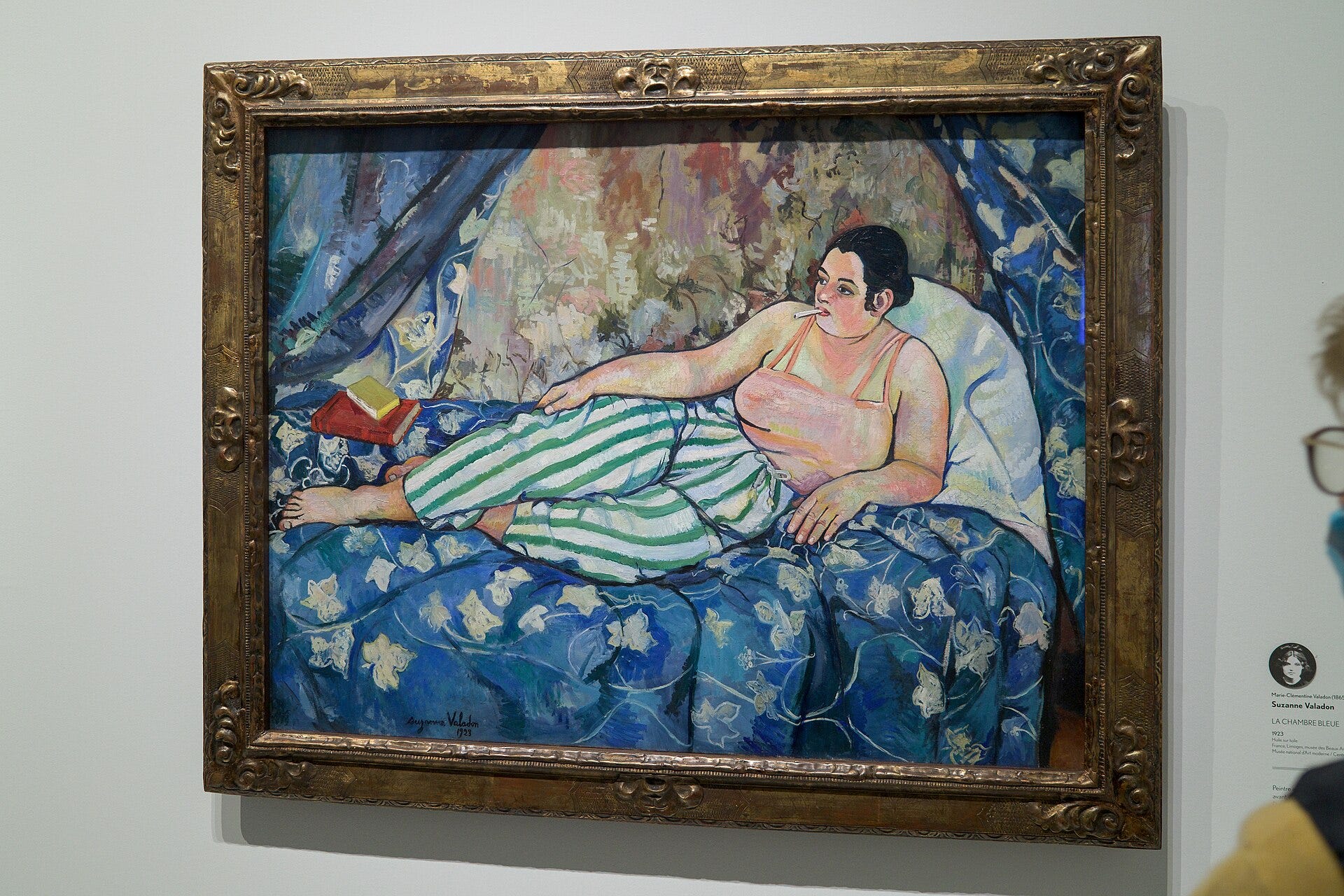
Her nudes, above all The Blue Room of 1923, a woman in striped trousers smoking on the bed where an odalisque should recline, are painted from inside the body rather than at it, and predate by decades the conversations they now anchor.
Degas did not buy her drawings out of kindness.
A funeral full of painters, and where to see her
Valadon died in Montmartre on April 7, 1938, after a stroke at her easel, and Picasso, Braque, and Derain attended the funeral. The Blue Room belongs to the French national collections at the Centre Pompidou, the Musee de Montmartre preserves her actual studio and apartment, and the Met and Ottawa hold strong works.
Degas's discovery
Degas did not paint her; he collected her. He bought her drawings, hung them at home, taught her soft-ground etching on his own press, and addressed her as terrible Maria.
The 1894 admission to the Société Nationale rested on five drawings, and the line stayed primary all her life.
Hard, unflattering contour, learned from nobody: the men who had hired her to stand still spent decades envying it.
The banker interlude
In 1896 she married Paul Mousis, a stockbroker, and painted for thirteen quiet years in suburban comfort.
In 1909 she traded it all for André Utter and Montmartre, at 44 to his 23.
The Mousis years built the technique; the Utter years spent it. After 1909 the color hardens, the outlines go black, and the nudes stop apologizing.
Painting the un-posed body
Her nudes do what almost no painter of the era dared: women bathing, aging, bored, seen from inside the experience of being looked at.
In 1931, at 66, she painted herself bare-chested, chin up, no softening. The former model handed art history its most matter-of-fact self-exposure.
Critics called the manner brutal; she considered it accurate. The Blue Room's smoker in striped trousers is the manifesto: a body at home in itself, cigarette included.
The Suzanne Valadon questions that keep coming up
Who was Suzanne Valadon? A Montmartre model turned self-taught painter, the first woman admitted to the Societe Nationale des Beaux-Arts in 1894, and mother of Maurice Utrillo.
Did Renoir paint Suzanne Valadon? Yes, repeatedly, including Dance at Bougival in 1883. Toulouse-Lautrec and Puvis de Chavannes painted her too, before Degas championed her own work.
What is The Blue Room? Her 1923 canvas of a woman in striped trousers smoking on a bed, now shown at the Centre Pompidou: the odalisque tradition repainted from the woman's side.
Where can I see Valadon? The Centre Pompidou in Paris, the Musee de Montmartre in her old studio, and collections in Lyon, Nantes, and New York.
What was her real name? Marie-Clémentine Valadon. Toulouse-Lautrec proposed Suzanne, after the biblical Susanna watched by the elders: a model's joke she kept as a flag.
How much does a Valadon cost? Long undervalued; major canvases now clear the million mark, and the museum world has been catching up with retrospectives, the Centre Pompidou included.
More secrets to unlock
Caviar for the cats, drawings for the goat
Valadon kept a goat in her Montmartre studio and fed it her failed drawings, and gave her cats caviar on Fridays. The woman painted by half of Montmartre answered to no one's rules, including on housekeeping.