
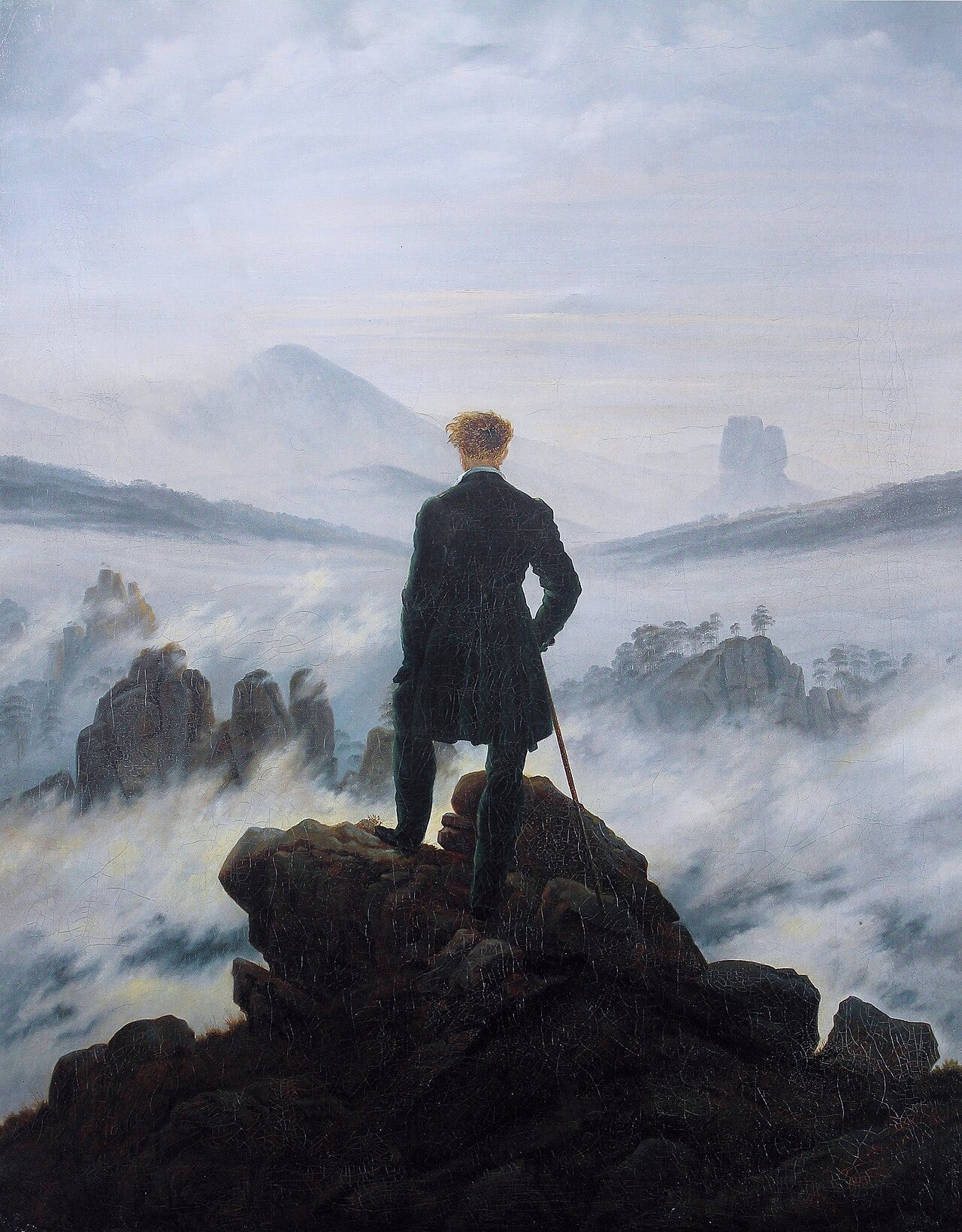
Caspar David Friedrich was the great German Romantic painter who turned empty landscapes into something close to religion. He placed lone figures with their backs to us, staring into fog, mountains and ruins, so that we feel small before nature.
Forgotten for decades after his death in 1840, he is now one of the most recognized painters in the world.
He did not paint pretty views. He painted silence, distance and the feeling of standing at the edge of something vast.
More incredible painter stories
If Caspar David Friedrich pulled you in, you will love these too:


Caspar David Friedrich at a glance
1774. Born in Greifswald on the Baltic, son of a candle and soap maker.
1787. His brother drowned saving him from the ice. Friedrich was thirteen.
1808. The Cross in the Mountains, an altarpiece made of landscape, set off a public quarrel.
1818. Wanderer above the Sea of Fog, painted the year he married.
1840. Died poor in Dresden. Obscurity followed for half a century.
The man who turned his back to us
Friedrich's signature is the figure seen from behind, what the Germans call a Ruckenfigur. The most famous is the lone man on a peak above a sea of fog.
You do not look at him. You look with him, into the void. It is one of the simplest and most copied ideas in all of painting.
Landscape as a kind of prayer
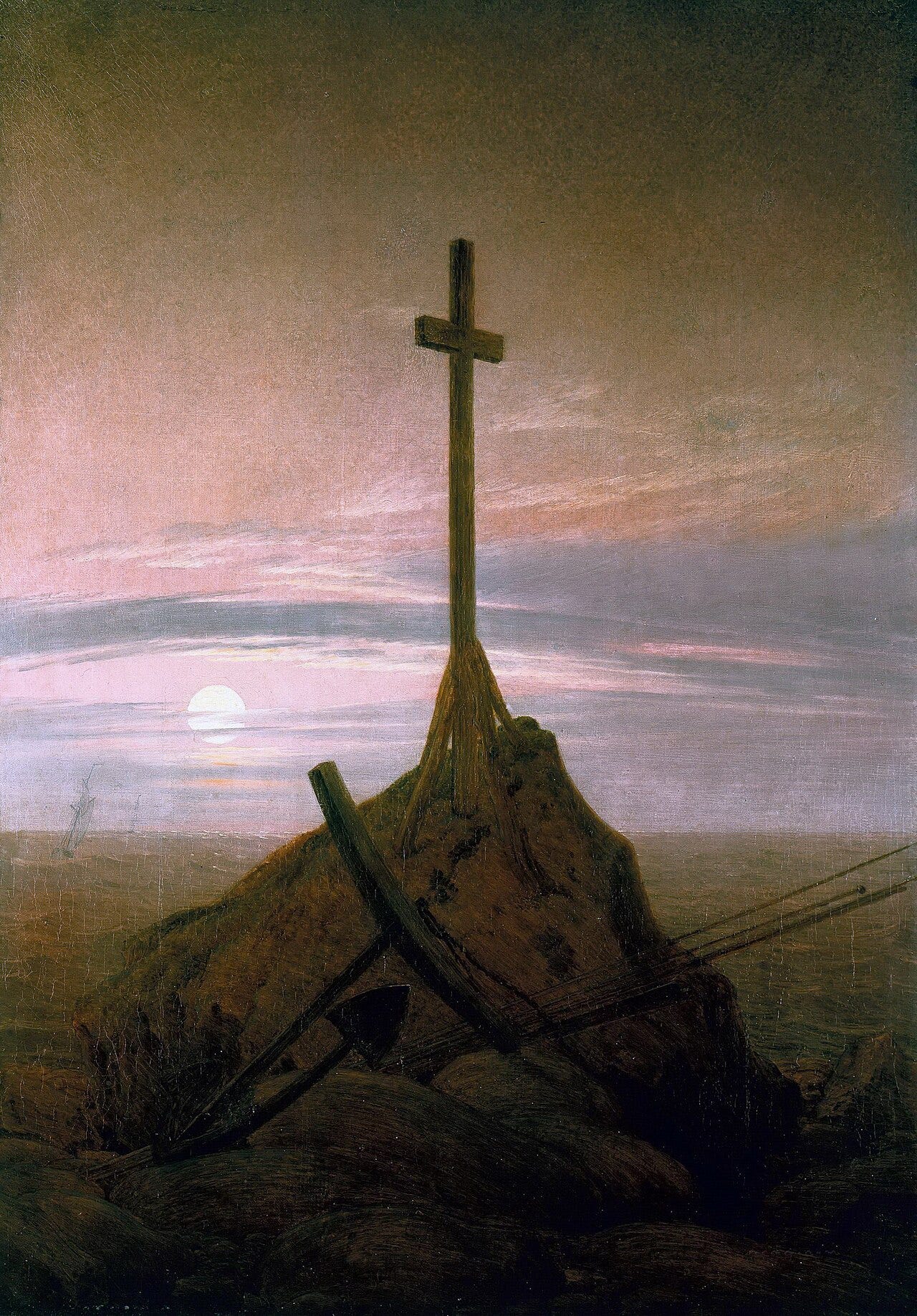
In 1808 he set a crucifix in a mountain sunset and presented the landscape itself as an altarpiece. Critics were furious. An altarpiece was meant to show holy figures, not pine trees and rock.
Friedrich had quietly moved God out of the church and into the weather.
A childhood shadowed by death
He was born in Greifswald in 1774, on the cold Baltic coast. He lost his mother young, and several brothers and sisters. When he was thirteen, his younger brother drowned, in some accounts while pulling Caspar himself from broken ice.
Grief and stillness run through every canvas he ever made.
Fog, ruins and moonlight
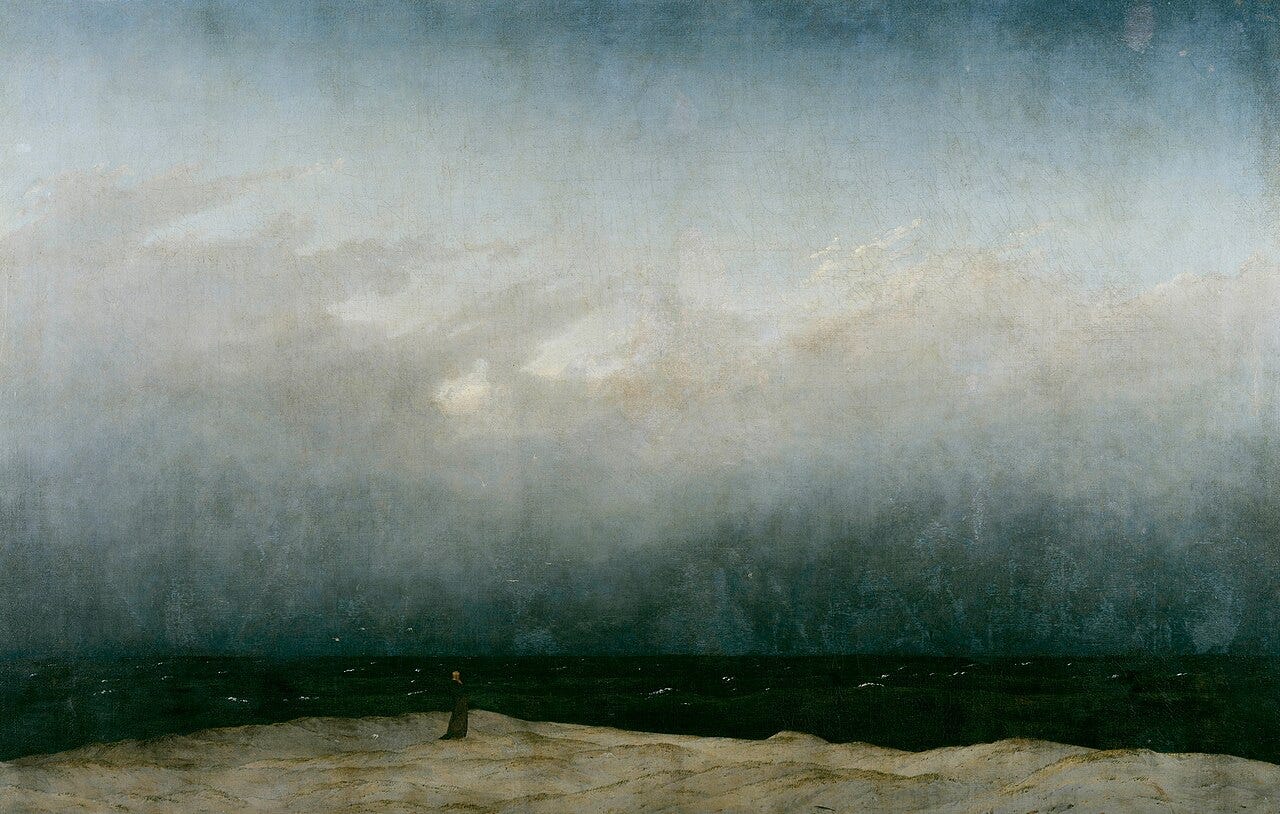
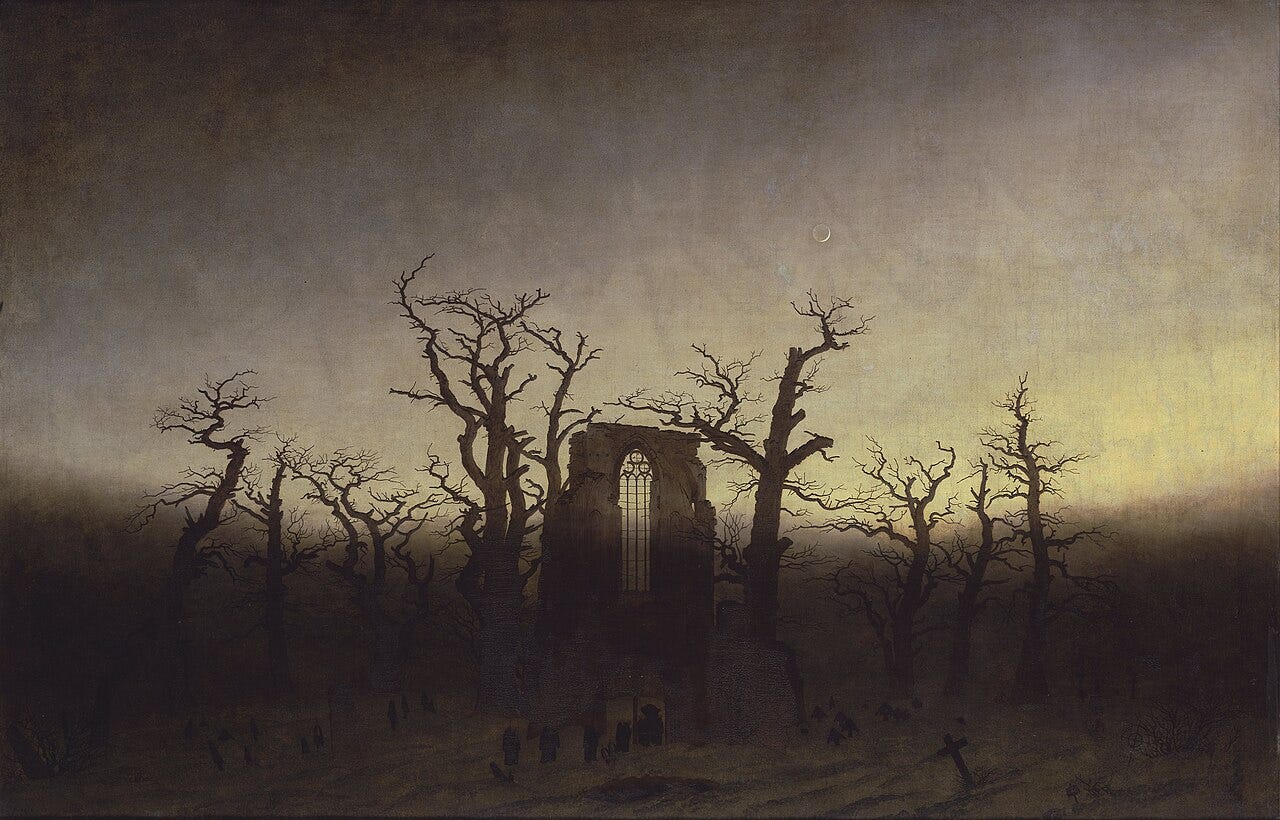
His world is almost empty: a monk alone before a huge grey sea, an abbey rotting among bare oaks, a ship crushed in a field of ice, the moon rising over still water. That oakwood sits among a wider tradition of painted woodland gathered in Forest Paintings: 12 Famous Woodland Works to Know.
He built these scenes from drawings in a bare studio, not outdoors, so the places feel real yet exist nowhere. His Romanticism leans hard on symbolism, and his moonlit scenes are some of the quietest paintings ever made.
How he built a Friedrich
Friedrich rarely painted outdoors. He filled notebooks with exact studies of trees, rocks and ships, then returned to a near empty studio and assembled them into scenes that feel real but exist nowhere.
He worked slowly, in thin layers, coaxing the famous glow into his skies. A visitor once described the room: bare walls, a single chair, and the painter staring at a blank canvas until he could see the finished picture in his head.
Forgotten, then reborn
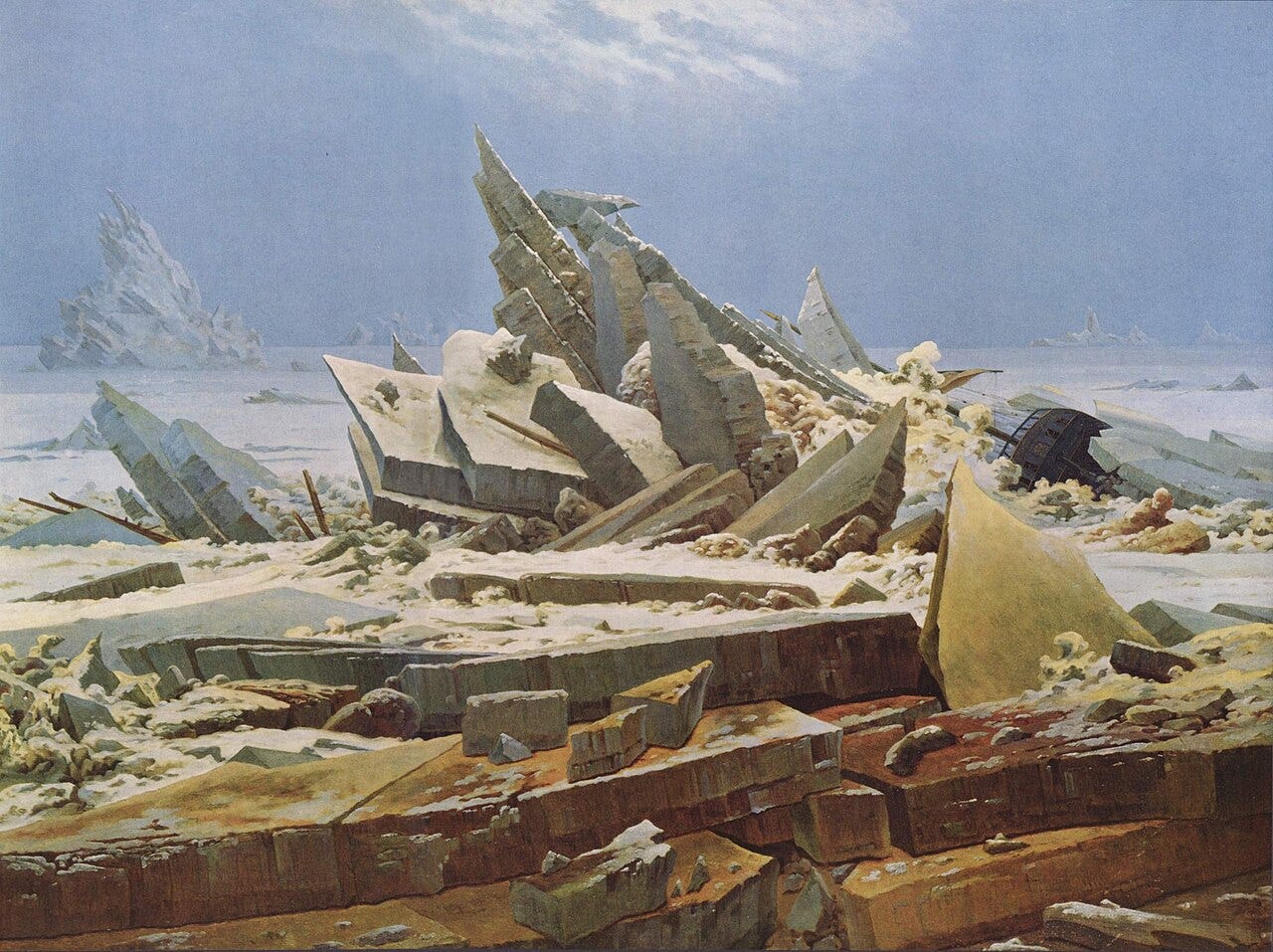
By the time strokes had weakened him and he died in Dresden in 1840, taste had moved on. He died poor and half forgotten. Then around 1900 the Symbolists and Expressionists rediscovered him, and you can feel his lonely figures echo later in painters like Van Gogh. The Nazis later seized on his German nature imagery, which left his name under a shadow for years after the war.
It took decades to separate the painter from that abuse.
The tsar’s buyer
The Russian poet Vasily Zhukovsky, tutor at the imperial court, discovered Friedrich in Dresden and kept buying for decades.
Purchases for the tsar’s family arrived even in the painter’s last, poorest years.
It is why the Hermitage owns one of the best Friedrich rooms anywhere.
Goethe asked for clouds
Goethe, deep in his scientific phase, asked Friedrich to paint classified cloud studies for meteorology.
Friedrich refused. Sorting clouds into types, he felt, would kill what a sky means in a picture.
The two never quite forgave each other the misunderstanding.
The fire that ate nine Friedrichs
In 1931 the Glaspalast exhibition hall in Munich burned down with a survey of Romantic painting inside.
Several major Friedrichs were destroyed, known today only from photographs and copies.
For a corpus already small, the loss was enormous. It is part of why each surviving canvas draws crowds.
The works to know
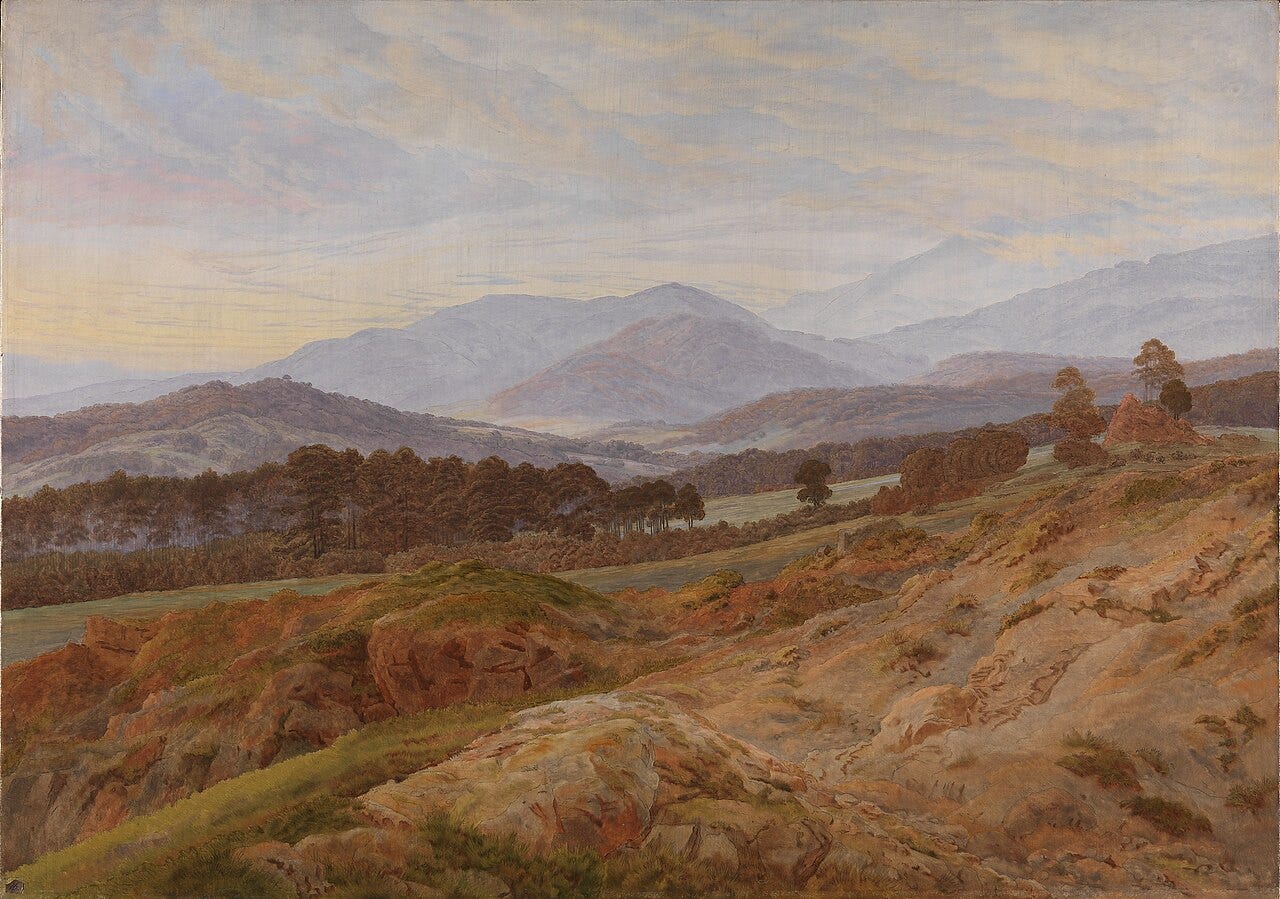
A handful of paintings carry his fame: the Wanderer above the Sea of Fog, the near empty Monk by the Sea, the brutal Sea of Ice, the Abbey in the Oakwood, and the Stages of Life. Each one feels like a held breath.
Chalk Cliffs on Rugen, with three figures looking down toward the sea, is another one of his key works, and it sits among the pictures I chose for our list of green paintings across art history.
Caspar David Friedrich painted solitary figures facing vast German landscapes as a meditation on the sublime; a century and a half later Anselm Kiefer returned to those same scorched fields and forests to confront Germany's own history rather than admire nature.
More secrets to unlock


Quick answers about Caspar David Friedrich
Who was Caspar David Friedrich? The leading painter of German Romanticism.
When was he born? In Greifswald, in 1774.
How did he die? In Dresden in 1840, weakened by strokes, poor and out of fashion.
What is the Wanderer above the Sea of Fog? His most famous work: a man seen from behind, standing on a peak above fog.
What is a Ruckenfigur? A figure shown from behind, so the viewer shares the same view.
What movement did he belong to? Romanticism.
Where can I see his work? Mostly in Germany, above all the Hamburger Kunsthalle in Hamburg.
Is the Sea of Ice typical of his work? It stands out even among his ruins and fog, and it belongs to a much older painted tradition. A dozen frozen scenes, starting with Bruegel, trace how the Little Ice Age gave painters a subject that lasted centuries.
In 2025 the Metropolitan Museum gave him his first major American show, The Soul of Nature, marking two hundred and fifty years since his birth. A painter most Americans had never heard of drew crowds around the block.
Why are so many Friedrichs in Russia? The poet Vasily Zhukovsky, tutor at the Russian court, bought his work for years, even during the painter’s poverty. The Hermitage keeps the harvest.
Have Friedrich paintings been lost? Yes. The Munich Glaspalast fire of 1931 destroyed several major canvases, known now only from photographs.