
Domenico Ghirlandaio, who lived from 1448 to 1494, ran the busiest painting workshop in Renaissance Florence, filled its churches with frescoes full of real local faces, and taught the teenage Michelangelo.
To me he is the man who painted a whole city into its own holy stories. He died of plague in 1494 at the height of his powers, leaving behind the fresco cycles that still show us Renaissance Florence face by face.
In a busy Florence workshop around 1487, a teenage apprentice grinds colours and learns to lay plaster for fresco. His name is Michelangelo, and his teacher is Domenico Ghirlandaio, who ran the most efficient painting business in the city.
The pupil would eclipse him, but the grounding was Ghirlandaio’s gift.
More incredible painter stories
If Domenico Ghirlandaio pulled you in, you will love these too:


Ghirlandaio filled the churches of Florence with frescoes that doubled as group portraits of its richest families, a painter who turned sacred scenes into a record of the city itself.
Domenico Ghirlandaio at a glance
1448. Born in Florence, a goldsmith’s son. The garland nickname came from his father’s craft.
1481. Summoned to Rome to paint the walls of the new Sistine Chapel.
1485. Finished the Sassetti Chapel, with Medici faces planted in the sacred crowd.
1488. Took a teenage Michelangelo into the workshop.
1494. Died of fever at 45. The workshop passed through his family for a generation.
Sacred scenes full of real Florentines
Ghirlandaio painted biblical stories crowded with the faces of living Florentines, slipping the Tornabuoni and Sassetti families, in their finest clothes, into scenes from the lives of the saints.
Patrons paid to appear among the holy figures, so his fresco painting is also a portrait gallery of Renaissance Florence. His largest cycle, the Tornabuoni Chapel in Santa Maria Novella, finished around 1490, is the grandest example.
Florence, Paris, London: where his faces survive
The Met in New York holds his portrait of Francesco Sassetti and His Son Teodoro.
The National Gallery in London holds his work, and his most touching portrait, An Old Man and his Grandson, hangs in the Louvre in Paris. The great fresco cycle stays in Santa Maria Novella, Florence.
A goldsmith's son born in 1448
Domenico was born in Florence, probably in 1448, and christened Domenico di Tommaso Bigordi. His father Tommaso worked as a goldsmith and a broker, and that trade shaped the boy from the start.
He grew up around metal, fine line and small luxury objects made for wealthy clients. The National Gallery in London confirms that the real family name was Bigordi, not Ghirlandaio.
The painting name came later, as a nickname. Growing up in a workshop taught him two lessons he never lost: please the paying customer, and finish on time.
By his teens he was training as an artist in a city that was fast becoming the center of Italian painting.
Learning to paint under Baldovinetti
The National Gallery and older biographers agree that Domenico trained under Alesso Baldovinetti, a Florentine painter known for careful drawing and a real interest in landscape.
The phrase to watch is said to have been. Records from this period are thin, so the pupil and teacher link is likely rather than proven.
What is certain is the result. Domenico learned to build calm, readable scenes and to place figures in believable space. He absorbed the Florentine love of firm outline and clear light, and studied Masaccio and other earlier painters whose frescoes filled the city's churches.
By the late 1470s he was leading his own commissions.
Summoned to Rome for the Sistine walls
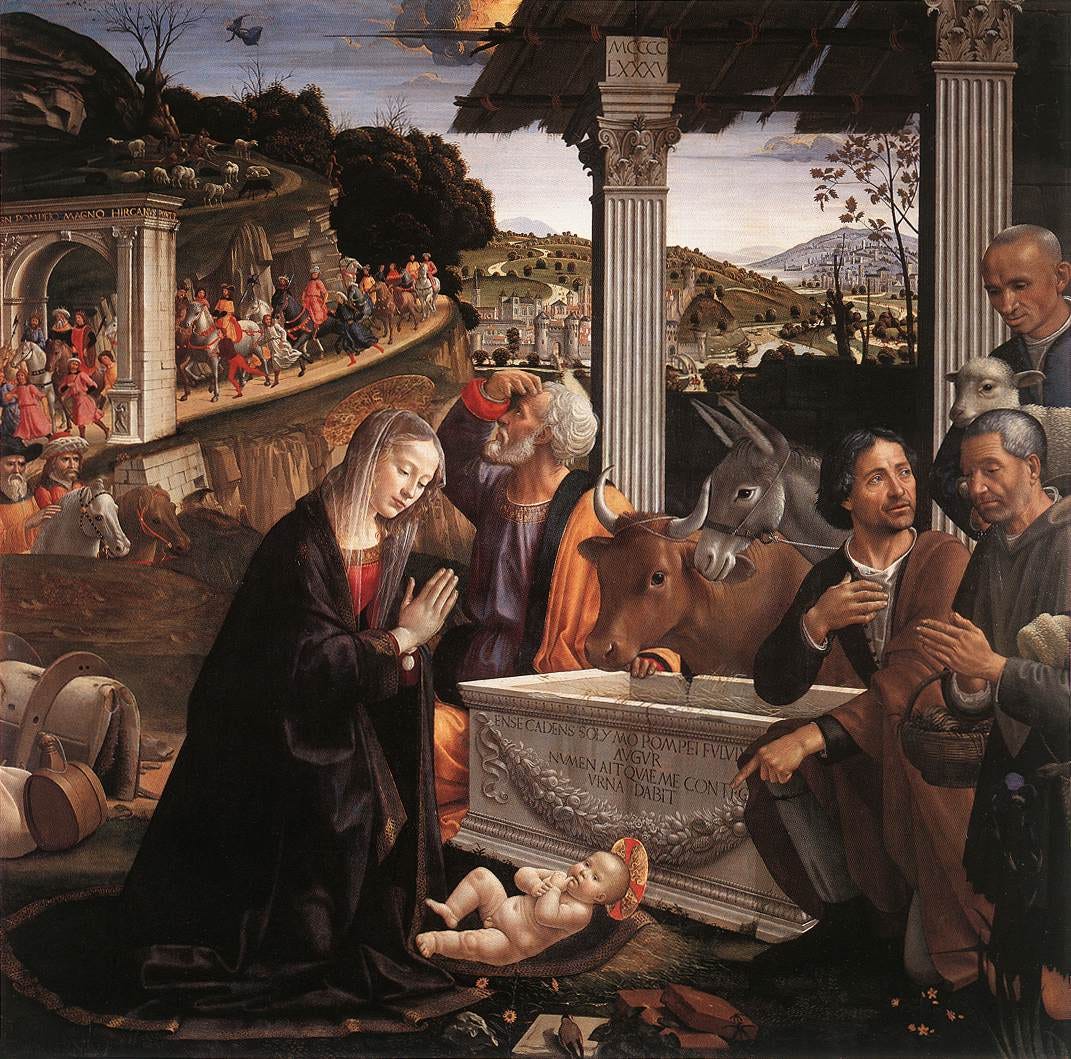
In 1481 the pope called several of Florence's best painters to Rome. The job was the wall frescoes of the Sistine Chapel.
Domenico went, working there through 1481 and 1482 beside Sandro Botticelli, Pietro Perugino and Cosimo Rosselli. His main scene was the Calling of the First Apostles, showing Christ summoning Peter and Andrew by the water.
This was long before Michelangelo. That famous ceiling came around 1508 to 1512, painted by the young man who had once trained in Ghirlandaio's own shop.
So one chapel holds work by teacher and pupil, made about a quarter century apart. For Domenico, the Rome trip proved he ranked among the leading painters in all of Italy.
The Sassetti Chapel and a Medici in the crowd
Back in Florence, Domenico decorated the Sassetti Chapel in the church of Santa Trinita, finishing around 1485. Francesco Sassetti, a banker for the Medici, paid for it.
The scenes tell the life of Saint Francis. Yet they are packed with living Florentines. In one panel, set in the city's own Piazza della Signoria, Domenico painted Lorenzo de Medici standing among the onlookers, with Sassetti and his family nearby.
This was clever flattery. It tied a banker's private chapel to the most powerful man in Florence. It also left us rare, dated faces of the Medici circle.
Sacred story and city life share the same wall, which is exactly what Domenico's patrons were paying for.
Two years inside the Tornabuoni Chapel
Domenico's largest surviving project fills the choir of Santa Maria Novella. Giovanni Tornabuoni, a wealthy Medici relative, hired the shop to fresco the walls between 1486 and 1490.
The two cycles show the Life of the Virgin and the Life of Saint John the Baptist. They are enormous, calm and crowded with detail.
Domenico set the holy stories inside grand Florentine rooms, with real furniture, current fashion and real portraits of the Tornabuoni family.
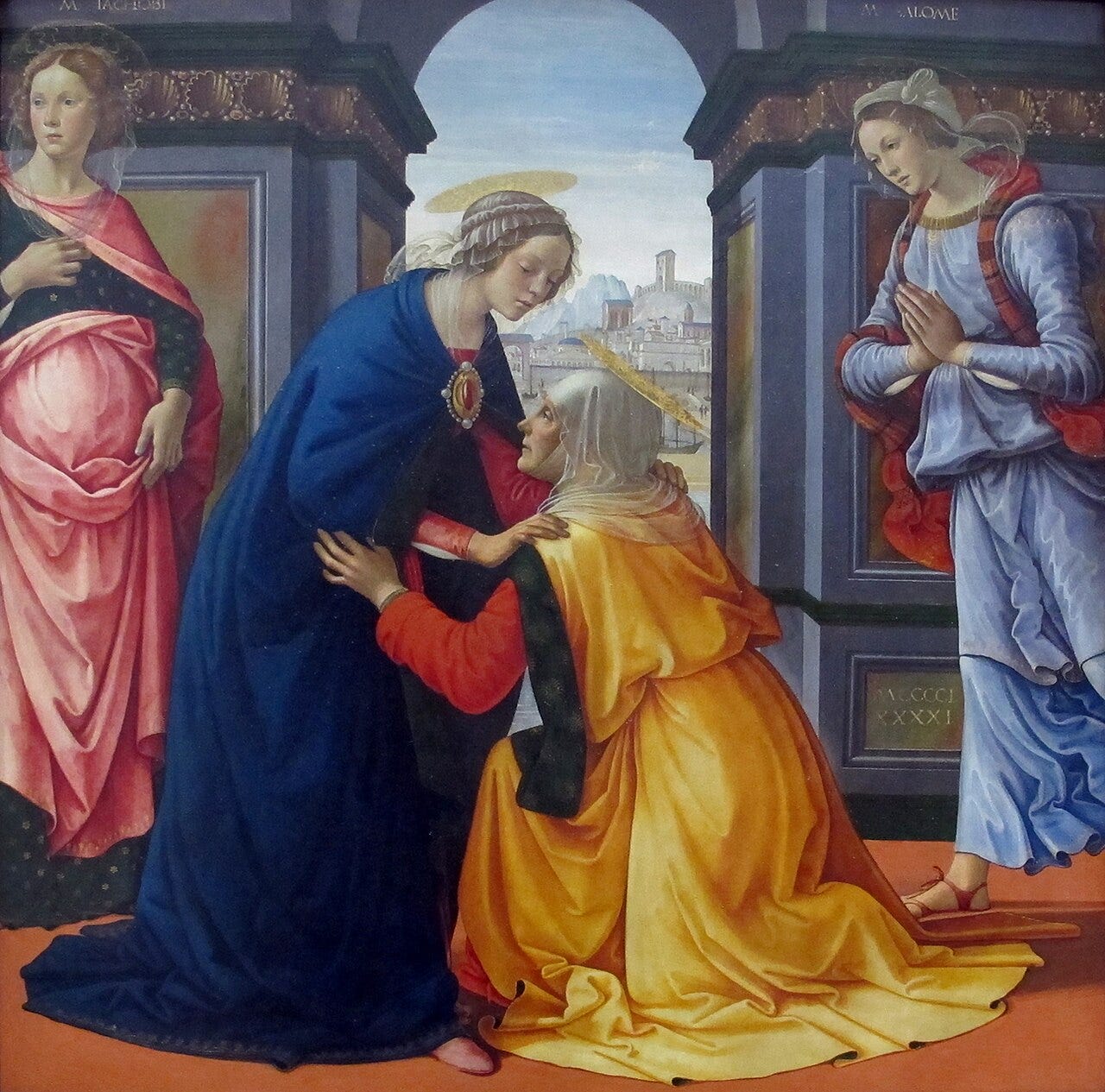
The Birth of the Virgin is the scene most often singled out. It shows a well dressed young woman visiting a new mother in a paneled bedroom. Four years of work turned a church choir into a record of how Florence actually looked.
An Old Man and his Grandson in the Louvre
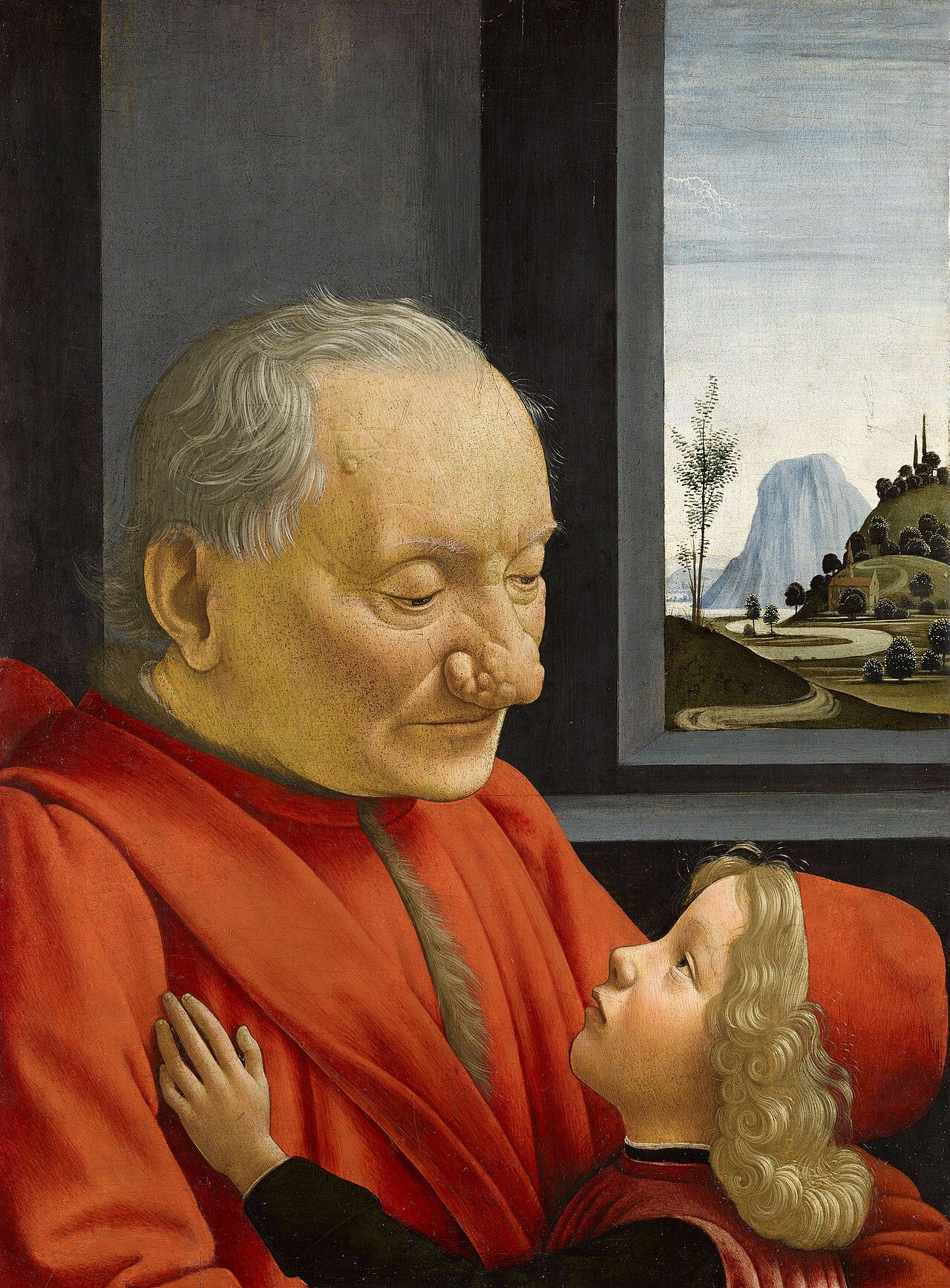
One small panel says more about Domenico than any large wall. Painted around 1490 and now in the Louvre in Paris, it shows an old man holding a young boy.
The man's nose is swollen and lumpy from a skin disease. Domenico does not hide it. He paints every bump with the same care he gives the child's soft cheek. The two look at each other with plain affection.
Behind them a window opens onto a winding road and low hills. Britannica calls it perhaps his finest painting, praised for its tenderness and humanity.
It proves that his honesty was never cold. He could record an unlovely fact and fill it with warmth in the very same picture.
Giovanna, painted after she had died
Around 1489 and 1490 Domenico painted Giovanna degli Albizzi Tornabuoni, wife of Lorenzo Tornabuoni. The panel now hangs in the Thyssen Bornemisza Museum in Madrid.
She is shown in strict profile, in a gold and red gown, her hair bound, her skin pale and smooth. It is one of the most admired portraits of a woman from the whole period.
There is a quiet grief behind it. Giovanna had died in 1488, probably in childbirth, before the picture was finished. So the portrait is really a memorial, made to keep a young woman's face alive for her family.
A Latin inscription in the background wishes that art could show her spirit as clearly as it shows her looks.
A family firm and the son who carried it on
Domenico ran his shop like a family business. His brothers Davide and Benedetto Ghirlandaio worked alongside him, and so did his brother in law, the painter Bastiano Mainardi. Together they could take on giant jobs and still deliver on schedule.
Domenico married twice. His first wife was Costanza Nucci, and after her death he married a second time.
Among his children was Ridolfo Ghirlandaio, born in 1483, who became a painter too and kept the workshop running into the next century.
This family structure was the shop's real strength. When one commission ended, there were always trained hands ready for the next.
The mosaic dream for Florence's walls
Domenico did not only paint. He also worked in mosaic, setting tiny colored pieces of glass and stone into permanent images.
In 1490 he made an Annunciation mosaic above a side door of Florence Cathedral. He loved the medium because it lasts. The biographer Giorgio Vasari reports that Domenico called mosaic the true painting for eternity, and that he boasted he wished he could cover the walls of Florence with it.
That plan never happened. He died too soon, and mosaic was slow and costly. But the remark fits the man exactly. He wanted his images to outlive him, and in fresco, in panel and in glass, he mostly got his wish.
Death from fever in 1494

Domenico died in Florence in 1494, still in his forties. The cause was recorded as a pestilential fever, the kind of sudden sickness that swept through crowded cities in that age.
Vasari, his early biographer, put his age at forty four. Most modern accounts say about forty five. Either way he was young, at the peak of his fame, with the vast Tornabuoni frescoes barely dry.
He was buried in Santa Maria Novella, the same church whose choir he had just covered with his work. His shop did not close with him.
His brothers and his son Ridolfo carried on, and his frescoes kept teaching younger painters, Michelangelo among them, how to fill a wall with life.
The Domenico Ghirlandaio questions that keep coming up
What is he known for? Florentine fresco cycles full of real local faces, and teaching Michelangelo.
Did he really teach Michelangelo? Yes, the young Michelangelo apprenticed in his workshop around 1487.
Why the name Ghirlandaio? It means garland maker, after his goldsmith father; he was born Bigordi.
When did he die? In 1494, in Florence, of the plague, still at his height.
Was Ghirlandaio a portrait painter too? Yes. Alongside his frescoes he painted panel portraits like Giovanna Tornabuoni and the Met’s Francesco Sassetti and His Son Teodoro, prized for their unflinching likeness.
When was Domenico Ghirlandaio born and when did he die? He was born in Florence, probably in 1448, and died there in 1494 at about forty five. The National Gallery in London lists his dates as 1449 to 1494, since the exact birth year is not fully certain.
What is Domenico Ghirlandaio's most famous work? His best known works are the huge fresco cycles in Santa Maria Novella and Santa Trinita in Florence. Among his smaller panels, An Old Man and his Grandson in the Louvre, painted around 1490, is often called his finest.
More secrets to unlock


Why his city still lives
Ghirlandaio was a marketer of genius and a recorder of his world, letting the citizens of Florence pay to stand among the saints.
Five centuries on, his frescoes are how we picture the city in its golden age, and the workshop where Michelangelo first held a brush.