
Frans Hals was the Dutch Golden Age painter who caught people laughing. While other portraitists froze their sitters into stiff dignity, Hals worked with quick, visible brushstrokes that make a smile, a tipsy grin or a sideways glance feel like it happened a second ago.
Born in Antwerp around 1582 and working his whole life in Haarlem, he painted The Laughing Cavalier in 1624, died broke in 1666, and was rediscovered two centuries later by Manet and the Impressionists.
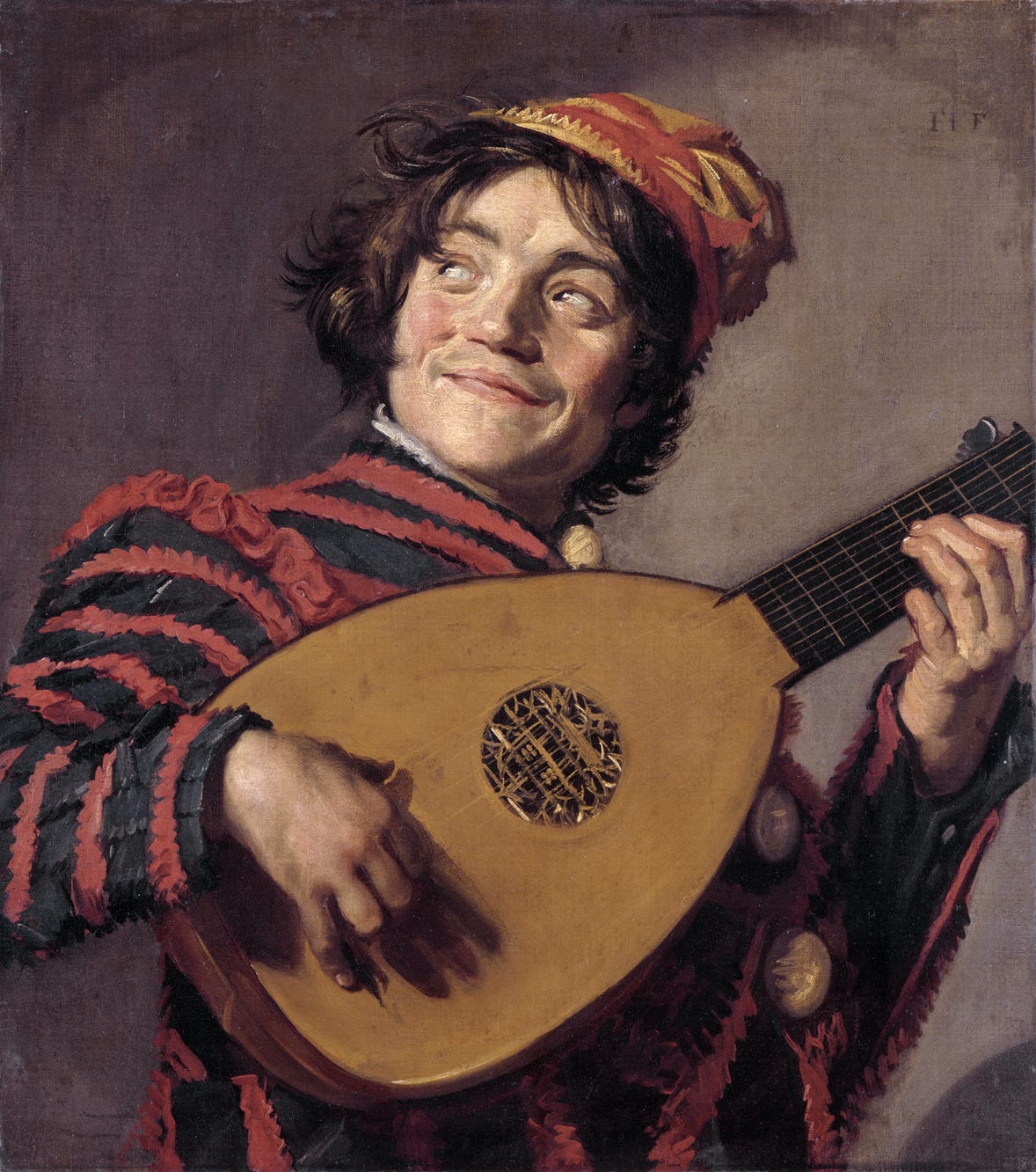
Look closely at a Hals and the magic almost falls apart. Up close it is slashes and dabs of paint. Step back and a living, breathing person snaps into focus. That gap between mess and life is his whole genius.
Born: Antwerp, around 1582, worked in Haarlem
Known for: lively portraits, The Laughing Cavalier, militia groups
Died: Haarlem, 1666, in poverty
More incredible painter stories
If Frans Hals pulled you in, you will love these too:


Frans Hals at a glance
1582. Born in Antwerp around this year. The family fled to Haarlem when he was a child.
1610. Joined the Haarlem painters' guild.
1624. The so called Laughing Cavalier, who is neither laughing nor a cavalier.
1664. Painted the almshouse regents and regentesses at about eighty.
1666. Died in Haarlem and was buried in the choir of St Bavo. The city had been paying him a small pension.
The painter of the fleeting moment
Hals spent almost his whole life in Haarlem, painting the city's merchants, officers and ordinary people. His gift was timing. He painted expressions in motion, the half second of a laugh, when the rules of the day called for solemn, motionless faces.
To do it he loosened his brush. His strokes stay visible, fast and confident, with none of the smooth polish of his rivals. It looks effortless and was anything but.
Haarlem, London, and where his faces hang
In the United States, the Metropolitan Museum of Art in New York holds a full room of his portraits.
The Frans Hals Museum in Haarlem holds the great civic group portraits, whole rooms of militia officers caught at the banquet table. His most famous single face, The Laughing Cavalier of 1624, hangs at the Wallace Collection in London.
A boy from Antwerp who grew up Dutch
Frans Hals was born in Antwerp around 1582, in what is now Belgium. At the time Antwerp was the richest city in northern Europe. That did not last.
In 1585 Spanish forces retook the city after a long siege. Thousands of Protestant families packed up and fled north into the Dutch Republic.
The Hals family was among them. By the late 1580s they had settled in Haarlem, a busy cloth and brewing town near Amsterdam.
Frans would spend almost his whole life there. His younger brother Dirck Hals, born in Haarlem in 1591, also became a painter. So the boy who arrived as a refugee from the south grew up fully Dutch, and Haarlem claimed him as its own.
Learning the trade under Karel van Mander
Around 1600 the young Hals went to train with Karel van Mander. Van Mander was a painter, but he is remembered more as a writer. His 1604 book, the Schilder Boeck, was the first real history of Netherlandish art.
Studying with him placed Hals at the center of Haarlem's art world. The apprenticeship ran until about 1603. Then, in 1610, Hals joined the Haarlem Guild of Saint Luke, the official body every working painter had to enter.
Membership let him take pupils, sell his own work, and run a studio. He was already close to thirty. His earliest known paintings, careful formal portraits, date from only a year or two later, around 1612.
Two marriages and a house full of children
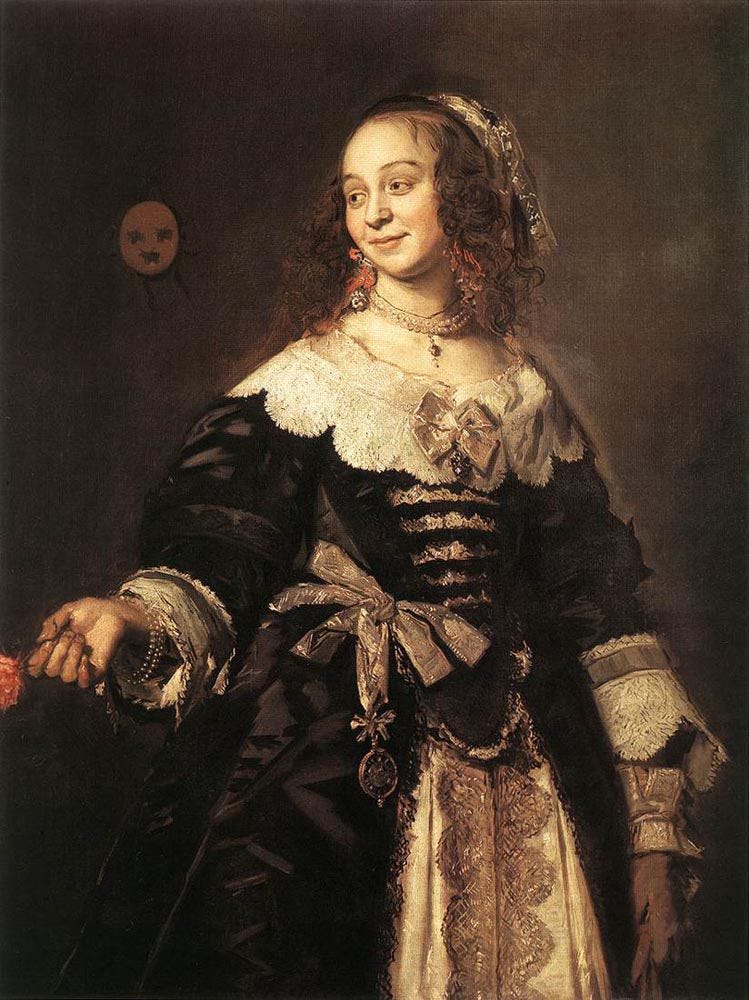
Hals married young, around the time he joined the guild. His first wife died in 1615, leaving him with small children.
In 1617 he married again, to a Haarlem woman named Lysbeth Reyniers. Their first daughter was baptized just nine days after the wedding. At least ten more children followed. The household was large, loud, and permanently short of money.
Several of the sons became painters themselves. Frans Hals the Younger, Reynier, and Nicolaes all worked in the trade, as did his brother Dirck.
That makes the Hals name a small dynasty of Haarlem artists. It also explains why the father spent decades trying to feed so many mouths on a portraitist's uneven income.
The man Haarlem's merchants came to for a face
Hals built his career on portraits, and the timing was perfect. The Dutch Republic had no royal court and few grand churches handing out commissions.
Instead a confident middle class of merchants, brewers, and cloth dealers wanted to see themselves on the wall.
Hals gave them likenesses that looked alive, caught mid breath, mid smile, mid turn. His clients included burgomasters and leading figures in Haarlem's beer and cloth trades.
Yet portrait painters were rarely paid well, even the best of them. Hals stayed respected and busy for fifty years without ever growing rich. The demand was steady, the fees were modest, and his family was very large.
The civic guard, painted life size
Every Dutch town had its militia companies, part defense force and part social club. Their officers liked to be painted together, seated around a banquet table.
Hals served in Haarlem's Saint George civic guard from 1612 to 1624. In 1616 he painted its officers in a group portrait that still hangs in the Frans Hals Museum.
It was the first of about ten large group portraits he made for the city's institutions.
These were the hardest commissions a painter could take. Fitting a dozen proud men into one lively scene, each face sharp and individual, defeated most artists. Hals made it look easy, and no one in Holland did it better.
Laughing children, lute players, and drinkers
Alongside the portraits, Hals painted scenes of everyday pleasure. Grinning children, boys with lutes, fishwives, and tipsy drinkers in taverns.
His Merrymakers at Shrovetide, from around 1616, crowds the whole canvas with color and movement. These pictures were not simple snapshots.
Most used stock characters to poke gentle fun at foolish youth and easy living, and they sold well and shaped a whole local fashion.
His pupil Judith Leyster, one of the few women admitted to the Haarlem guild, took up the same cheerful subjects. For all their looseness, these genre scenes were built with the same sharp eye Hals brought to his paying portraits.
The real name of the Laughing Cavalier
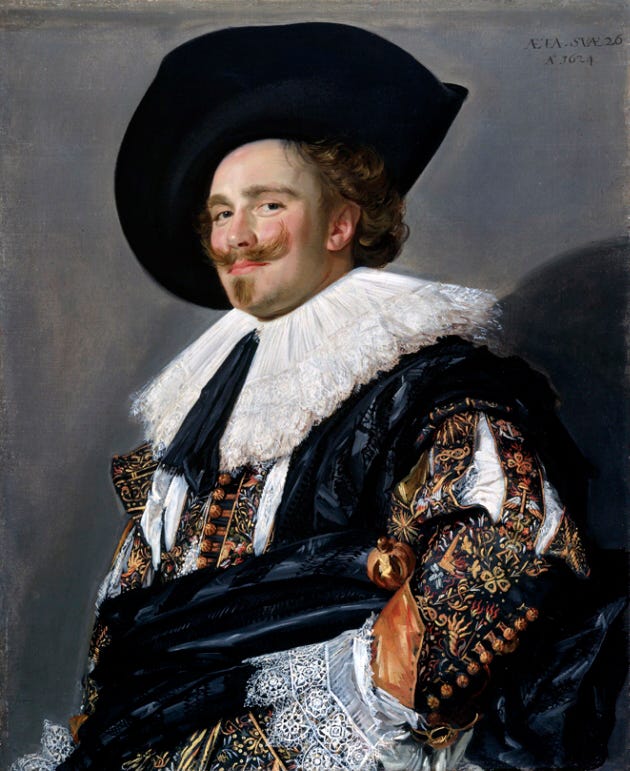
The Laughing Cavalier, painted in 1624, is Hals's most famous single portrait. It now hangs in the Wallace Collection in London.
Here is the twist. The man is not laughing, and he is not a cavalier. He wears no armor and carries no sword. He simply looks out with a faint, confident half smile, one eyebrow slightly raised.
The catchy title was invented much later, in the 1800s, when the painting caused a sensation in Victorian London. An inscription on the canvas gives the sitter's age as twenty six and the date as 1624.
We still do not know his name. The nickname stuck anyway, and it made the picture world famous.
The almshouse regents, painted at eighty

Hals kept working into extreme old age. Around 1664, when he was about eighty two, he painted two group portraits that stand apart from everything before.
They show the regents and the regentesses who governed Haarlem's old men's almshouse, a charity for the elderly poor. Gone are the bright colors and the grins.
The faces emerge from deep shadow in blacks, grays, and worn skin tones. The brushwork is looser and rougher than ever, almost dissolving up close.
Many viewers read these two paintings as the summit of his life's work. Hals died in Haarlem in 1666 and was buried in the choir of the town's great church, Saint Bavo.
The drunkard myth that will not die
A popular story says Hals was a hard drinking brawler who painted between binges. It is almost certainly false.
The tale was first told in 1718 by the writer Arnold Houbraken, who seems to have confused the painter with the rowdy figures in his own tavern scenes. No document from Hals's own lifetime supports it.
What the records do show is money trouble, not drink. Creditors took him to court for years. In 1654 he could not pay a baker, and officials seized his goods, listing only a few mattresses, a cupboard, a table, and five paintings.
In the early 1660s the Haarlem council granted him a yearly pension, a quiet mark of respect for its aging artist.
The Frans Hals questions that keep coming up
What is Frans Hals famous for? Lively, loosely painted portraits, especially The Laughing Cavalier.
What movement did he belong to? The Dutch Golden Age, alongside Rembrandt.
Why did he die poor? A big family and unsteady income left him reliant on a city pension.
How do you spot a real Frans Hals? The brushwork. His strokes stay visible and unblended up close, then snap into a living face only when you step back.
Did Frans Hals and Rembrandt know each other? They were the two giants of Dutch portraiture, working at the same time in different cities. No record says they ever met, but between them they defined the Golden Age of the portrait.
Was Frans Hals really a drunk? Probably not. The image of a heavy drinker came from a biographer writing in 1718, more than fifty years after Hals died, and it appears to be drawn from his jolly tavern paintings rather than his actual life. The surviving records show unpaid debts, not drunkenness.
Where was Frans Hals born? In Antwerp, around 1582, in the Spanish controlled southern Netherlands. His family fled north to Haarlem in the Dutch Republic during the 1580s, and he lived and worked in Haarlem for the rest of his life, dying there in 1666.
More secrets to unlock


The loose stroke that led to Manet
His visible, rapid brushwork pointed straight at modern painting, and at the everyday genre scenes he helped pioneer. To me he is the first portraitist who made a face feel like a snapshot, caught mid laugh.
One last fact. When the young Vincent van Gogh saw Hals in a museum, he marveled that Hals had at least twenty seven different blacks. The loose master was, secretly, a colorist.