
Guido Reni, who lived from 1575 to 1642, was the painter of serene, idealised beauty in Baroque Bologna, once ranked almost beside Raphael.
To me his story is the strangest rise and fall in all of art. Trained in the Carracci academy of Bologna, he conquered Rome with his 1614 Aurora ceiling, ruled Baroque Bologna for decades, then gambled away a fortune and died in debt in 1642.
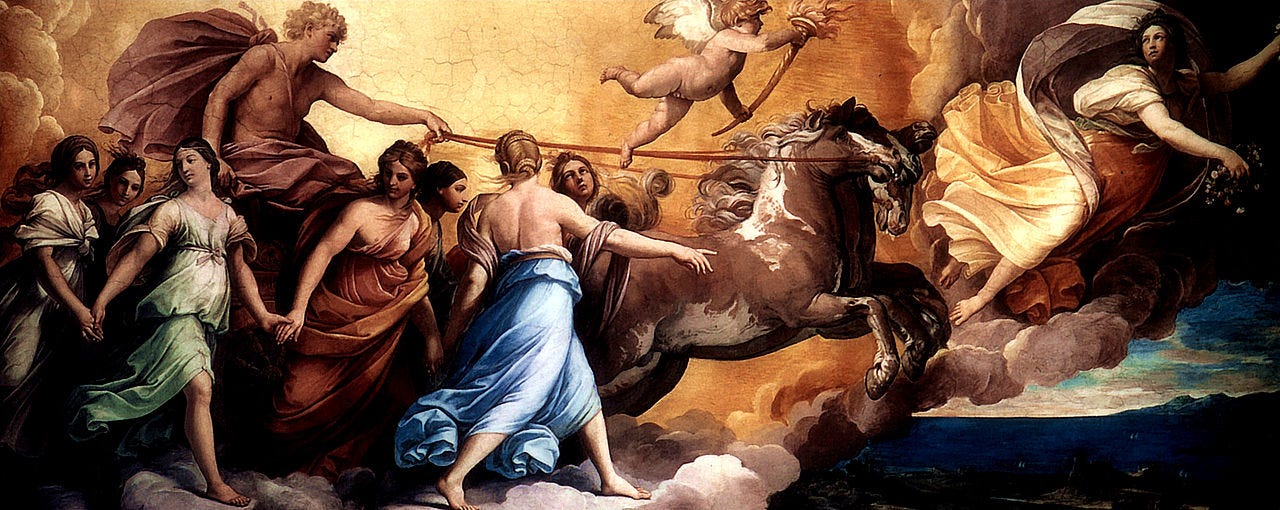
For two centuries he was ranked almost beside Raphael, the divine Guido, whose serene saints and goddesses were copied across Europe.
Then the modern age decided Guido Reni was too sweet, too easy, and dropped him almost entirely. His rise, his fall and his slow return make one of the strangest reputations in art.
More incredible painter stories
If Guido Reni pulled you in, you will love these too:


Reni ruled Baroque Bologna with idealised beauty and heavenly light, even as a secret turmoil, a gambling habit that swallowed his fortune, drove him to paint faster and faster to pay his debts.
Guido Reni at a glance
1575. Born in Bologna to a family of musicians.
1595. Moved from a Flemish master’s shop to the Carracci academy around this year.
1614. The Aurora fresco, his calling card in Rome.
1630. By now his workshop ran like a factory, and his gambling debts ran faster.
1642. Died in Bologna. He is buried in the Rosary Chapel of San Domenico.
The painter of heavenly grace
Reni specialised in upward gazing saints, calm goddesses and soft, glowing skies, all idealised toward a perfect, gentle beauty. His Aurora, a ceiling fresco of dawn driving her chariot, is the high point of that serene manner.
He stands at the elegant end of Baroque art, where drama gives way to harmony.
Light without the shadow
Where his great forerunner Caravaggio plunged everything into darkness, Reni did the opposite, bathing his figures in clear, even light. He softened the harsh contrasts of chiaroscuro into something calm and radiant.
That serenity made him beloved for generations, and later made him an easy target for critics hungry for grit.
The gambler in debt
Behind the calm pictures was a turbulent man. Reni was a compulsive gambler who ran up enormous debts, and in his last years he turned out pale, unfinished works at speed, selling whatever the studio could produce to pay his creditors.
The serene master died deep in debt, his fortune lost at the card table.
The face of Beatrice Cenci
One small painting carried his name far beyond the art world: a melancholy young woman in a white turban, long believed to show Beatrice Cenci, the Roman noblewoman executed in 1599 for plotting her abusive father's death.
Romantic writers were obsessed with it; Stendhal, Dickens, Hawthorne and Melville all wrote about the haunting face. Scholars now doubt both that Reni painted it and that the sitter is Beatrice, but the legend made it one of the most visited heads in Rome.
Bologna's golden boy
Reni was born near Bologna in 1575 and trained in the academy of the Carracci, the workshop that taught a whole generation. He then went to Rome and made his name fast.
Where Caravaggio reached for shock, Reni reached for serene, idealized beauty. His ceiling fresco of Aurora, painted in Rome in 1614, became one of the most copied images of the age.
The copper jewel in London and the Aurora in Rome
The Met in New York holds his oil The Immaculate Conception, painted in 1627.
The National Gallery in London holds his jewel like Coronation of the Virgin, painted on copper. His Aurora ceiling is still in place in the Casino dell'Aurora in Rome.
Born to music in Bologna, 1575
Guido Reni was born in Bologna on 4 November 1575, then a city of the Papal States.
By tradition, and according to his early biographer Carlo Cesare Malvasia, his father was a musician who hoped the boy would take up music too. That part of the story is old and hard to prove, so treat it as tradition rather than settled fact.
What is clear is that Reni showed a gift for drawing early. Bologna was one of the liveliest art centers in Italy, and a talented child could find a workshop to take him in.
He would spend most of his life tied to this one city. He was born there, trained there, and died there in 1642.
From a Flemish master to the Carracci academy
Reni's first teacher was a foreigner. He was apprenticed at the age of ten to Denis Calvaert, a Flemish painter working in Bologna. That places the start of his training around 1585.
He did not stay. In the 1590s he moved to the teaching academy run by the Carracci family, Ludovico, Agostino and Annibale, known as the Accademia degli Incamminati, or the academy of the progressives.
This was the reforming art school of its day. It pushed students to draw from life and from the model, away from stiff routine. In 1599 Reni was received into the Bologna guild of painters, already busy as a young man.
Rome, and the shadow of Caravaggio
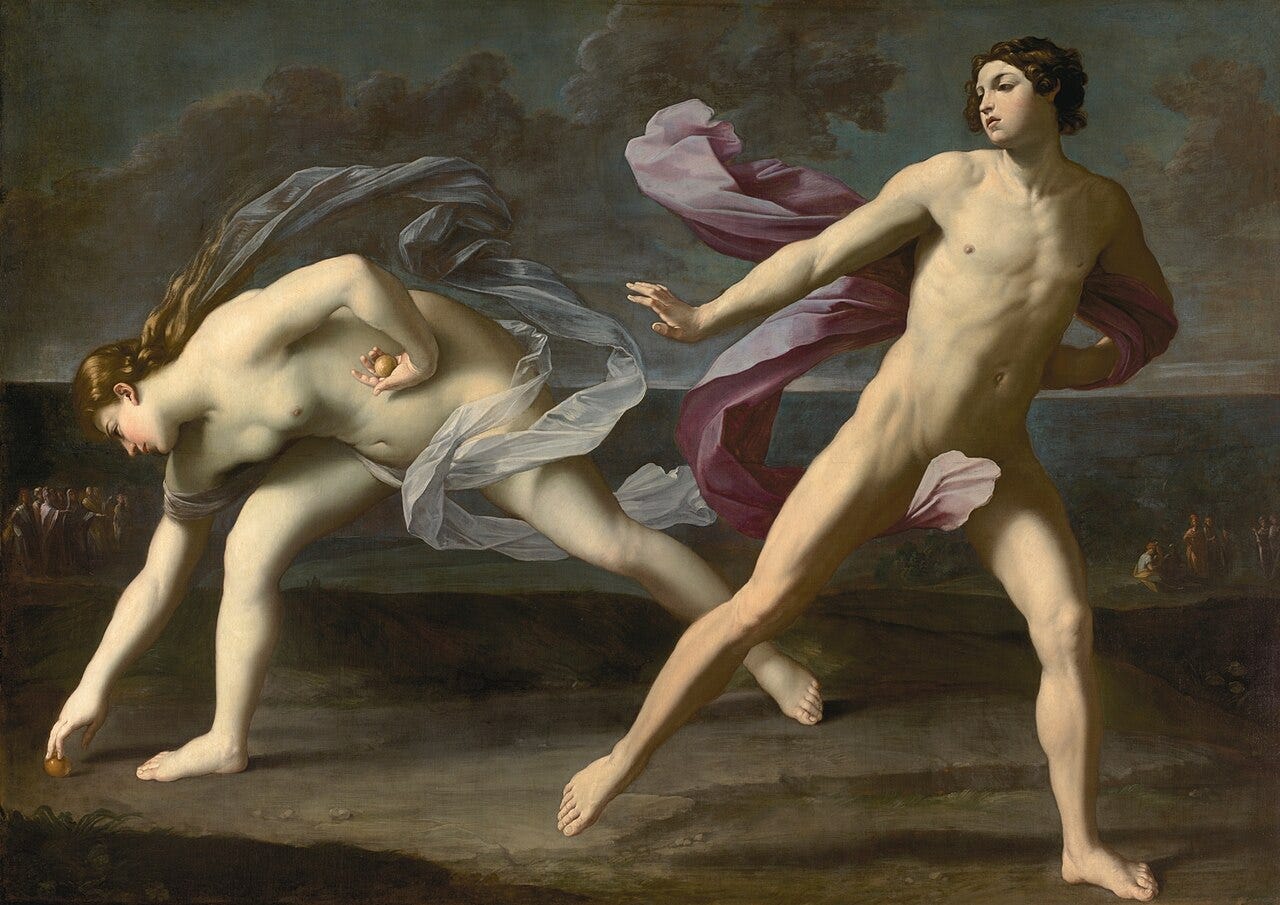
After 1601 Reni split his time between Bologna and Rome, where the biggest commissions and richest patrons were.
Rome was also where Caravaggio was turning painting upside down with harsh light and raw realism. Reni is reputed to have met, and quarrelled with, Caravaggio there.
For a while the young Bolognese tried on that dramatic manner. Then he pulled back from it. Where Caravaggio pushed deep gloom and violence, Reni cooled everything down toward calm, clear light and graceful order.
That choice defined his whole career. He offered patrons the emotional pull of the new painting without its rough edges.
The workshop that ran like a machine
By 1613 Reni had returned to Bologna, and he ran one of the busiest studios in all of Italy.
The National Gallery describes a workshop kept fully occupied with commissions from many Italian cities at once. Demand was so heavy that a single pair of hands could never have met it.
Among the helpers who passed through his orbit were Giovanni Lanfranco, Francesco Albani and Antonio Carracci.
The result is that many works sold as Reni are partly by assistants. The National Gallery itself labels one large Venus picture as by Guido Reni and Studio.
For a novice, that is worth knowing. A busy Baroque studio was a small business, and the master signed off on far more than he painted alone.
Prized from Rome to the courts of Europe
Reni did not just work for Bologna. His early Roman career ran on the biggest names in the Church.
He won important commissions for Pope Paul V and for Cardinal Scipione Borghese, the pope's nephew and one of the great collectors of the age.
From there his fame spread far past Italy. He became one of the most famous painters of his day in Europe, and a model for other Baroque artists.
That reputation meant real money. Reni was among the best paid painters of his generation, and cardinals, princes and foreign courts competed for his output.
His pictures reached collections across Catholic Europe, which is why the Prado in Madrid still holds a deep group of his paintings today.
The upturned eyes that shaped devotion
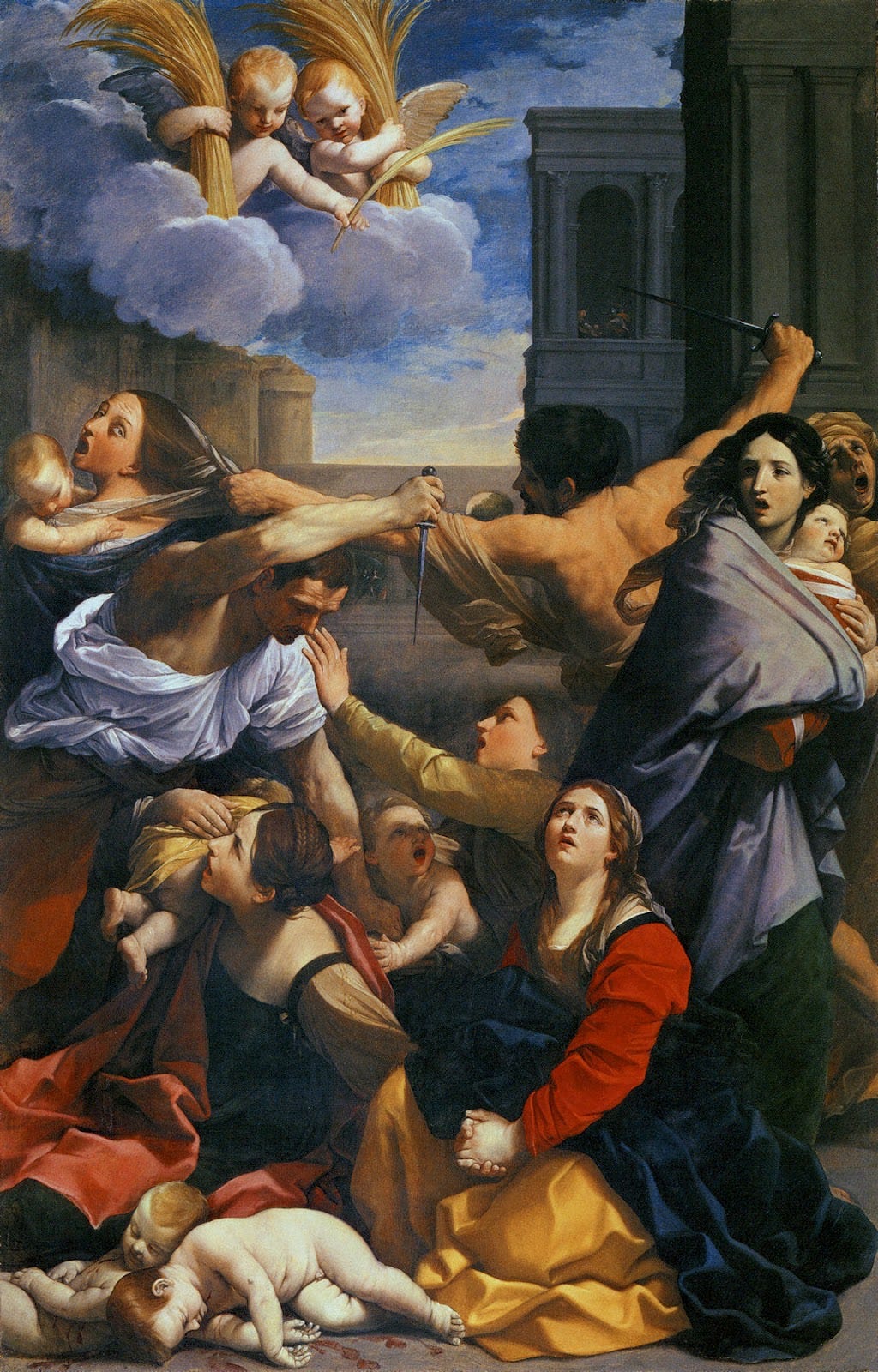
Reni built a whole visual language of piety, and one gesture became his signature: the head tilted back, eyes lifted to heaven.
You see it again and again. His many heads of Christ crowned with thorns, and his sorrowing Virgins, use the same upward gaze. These images were idealized rather than lifelike. Skin is smooth, features are regular, emotion is gentle and restrained.
Because they were so easy to feel, they were copied endlessly. Studios, printmakers and later followers turned the Reni saint into a template for Catholic devotion across Europe.
For generations, when ordinary worshippers pictured a holy face, they were often picturing Guido Reni's version of it.
Worshipped, then cast out
Few painters have ridden the reputation rollercoaster as hard as Reni.
For roughly two centuries after his death he sat near the summit of taste. His calm, idealized style matched exactly what collectors and academies said good painting should be.
Grand Tourists chased his pictures, and his tender saints were treated as models to copy.
Then the ground shifted. As nineteenth century critics turned against smooth idealism and toward realism and raw feeling, Reni came to stand for everything they disliked.
His sweetness was recast as empty and sentimental, and his standing collapsed in the modern era. Only in recent years has the tide turned again, helped by fresh scholarship and large museum shows.
His fall was not about the paintings. It was about changing fashion.
The devout and superstitious bachelor
The man behind the serene Madonnas was, by most accounts, deeply religious and unusually private.
According to his biographer Malvasia, Reni lived a chaste life and never married, keeping close to his mother and to his faith. These character details come mainly from that early source, so they are best read as contemporary reputation rather than hard record.
The same tradition paints him as anxious and superstitious. He is said to have feared witchcraft and poison, and to have guarded his habits with real dread.
That nervous devotion sits oddly beside the confidence of his art. His paintings look effortless and untroubled. His inner life, if the old accounts are right, was anything but.
The loose late hand and the end in Bologna, 1642
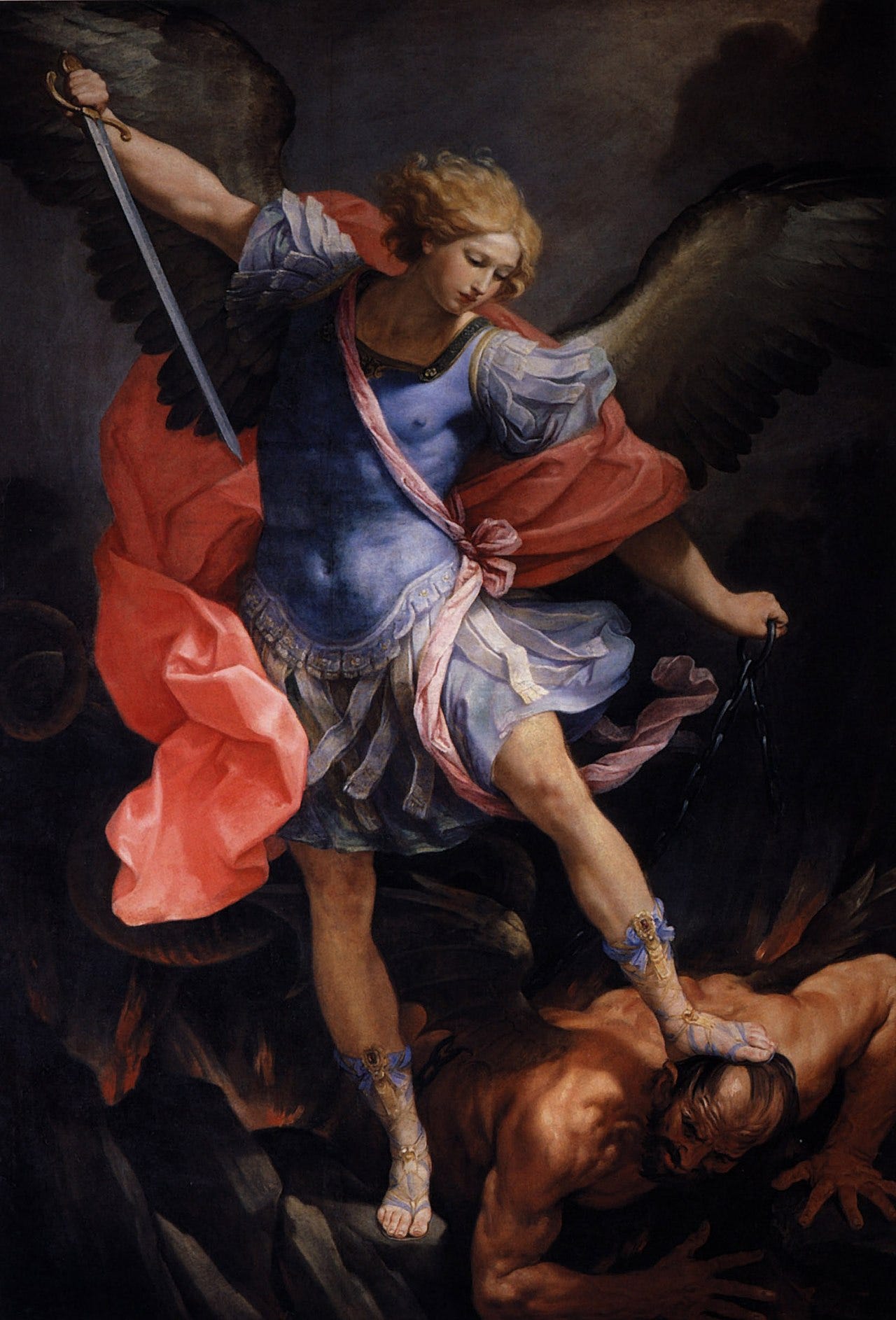
Reni's painting changed near the end, and the change is easy to miss if you only know his polished early work.
In the later part of his career he turned to lighter tones, softer colours and extremely free brushwork. Forms grew hazy, and some pictures were left thin or unfinished, with the canvas showing through.
Modern eyes often prize these late, sketchy works most of all, because they feel loose and alive in a way his glossy earlier paintings do not.
Reni died in Bologna on 18 August 1642, aged sixty six. He was buried in the city he had never really left, still its leading painter to the end.
The Guido Reni questions that keep coming up
What is he known for? Idealised Baroque saints and mythologies, above all the Aurora ceiling.
Was he really a gambler? Yes, heavy gambling debts pushed him to churn out late works for cash.
Why did Guido Reni’s reputation collapse and recover? Adored as the divine Guido in his lifetime, he was later dismissed as sentimental by Victorian critics. The twentieth century brought his elegance back into favor.
Did Guido Reni train with the Carracci? Yes. After an early apprenticeship to the Flemish painter Denis Calvaert in Bologna, Reni moved in the 1590s to the Carracci family's teaching academy, the Accademia degli Incamminati. Their reforming, life drawing based approach shaped his style far more than his first master did.
How and when did Guido Reni die? Guido Reni died in his home city of Bologna on 18 August 1642, at the age of sixty six. He had returned to Bologna around 1613 after years in Rome and remained its leading painter until the end.
More secrets to unlock


Why the divine Guido is back
Reni shows how fragile a reputation can be: once ranked near Raphael, then dismissed for centuries as merely pretty, now taken seriously again with major exhibitions restoring him.
His calm, glowing beauty turned out to be harder to dismiss than his critics hoped.
A major exhibition at the Prado in 2023 set out to rescue him, and the crowds proved the divine Guido can still hold a room.