
Annibale Carracci, who lived from 1560 to 1609, was a Bolognese painter who, with his brother Agostino and cousin Ludovico, pulled Italian art back to painting from life and set the pattern for the whole Baroque that followed.
On a Roman ceiling around 1600 he answered Michelangelo with the Farnese Gallery, and in his spare hours he and his family invented the caricature, sketching friends with an exaggerated nose or chin.
On a ceiling in Rome, around 1600, a young painter from Bologna covered the vault of the Farnese Gallery with gods and lovers in glowing colour, and visitors compared it, out loud, to the Sistine Chapel.
The painter was Annibale Carracci, and he had just helped drag Italian art out of a dead end.
More incredible painter stories
If Annibale Carracci pulled you in, you will love these too:


With his brother and cousin he led a reform that sent painting back to study from life, away from late Mannerist artifice, and shaped the whole Baroque that followed.
Annibale Carracci at a glance
1560. Born in Bologna, a tailor’s son.
1582. Founded a teaching academy in Bologna with his brother and cousin, drawing from life.
1595. Called to Rome by Cardinal Odoardo Farnese.
1601. Finished the Farnese Gallery ceiling, compared at once to the Sistine.
1609. Died in Rome and was buried, at his wish, near Raphael in the Pantheon.
The ceiling that rivalled the Sistine
His finest work is the ceiling of the Farnese Gallery in Rome, a riot of mythological lovers framed in painted architecture, so accomplished that contemporaries set it beside Michelangelo Sistine vault.
It is one of the great achievements of fresco painting, and it set the template for grand ceilings for a century.
The everyday and the earthy
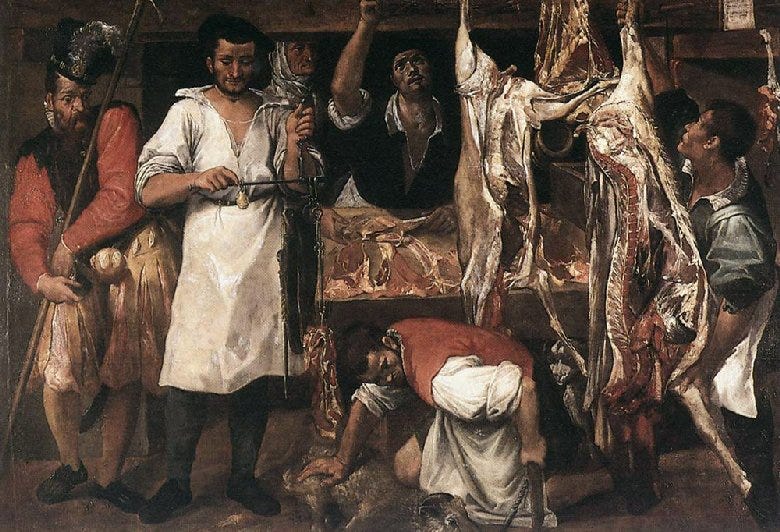
Carracci could also be plain and direct. He painted a butcher shop and a peasant tucking into beans, ordinary life rendered with sympathy and weight, long before such subjects were respectable.
That honest eye balanced his grand mythologies, and fed the realism that ran through the Baroque.
The birth of caricature
Annibale and the Carracci are credited with inventing something we still use every day: the caricatura. After serious work they would dash off quick comic portraits, exaggerating a nose or a chin to amuse friends in the studio.
The idea, and the word, spread from there. The notion that you can capture a person more sharply by distorting them than by copying them runs straight from the Bologna academy to every newspaper cartoon since.
The ceiling in Rome, and a canvas or two elsewhere
The Met in New York holds his Two Children Teasing a Cat.
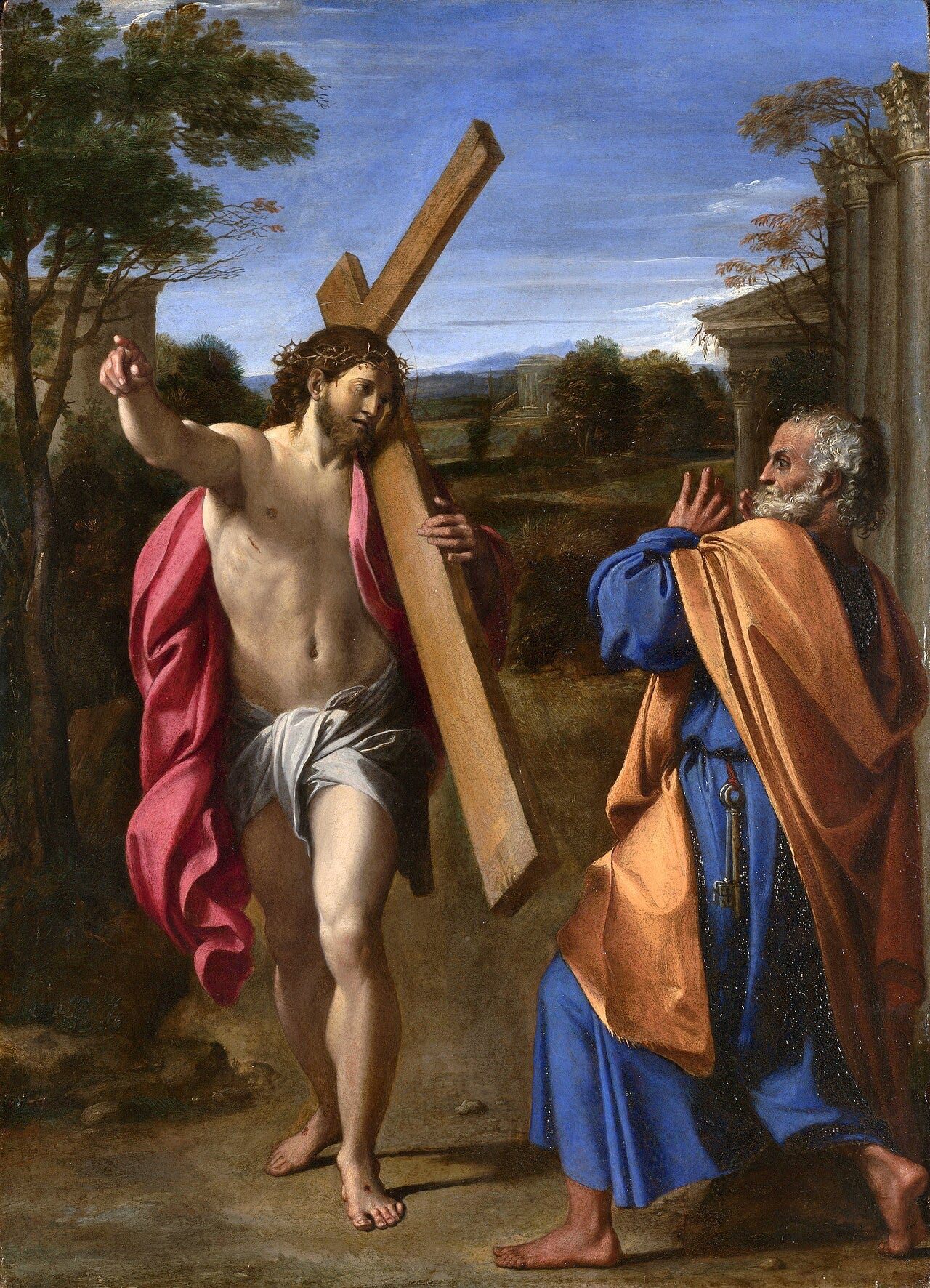
The National Gallery in London holds his work, including Domine, Quo Vadis. His greatest achievement, the Farnese Gallery ceiling, is still in place in the Palazzo Farnese in Rome.
A tailor's son in Bologna
Annibale Carracci was born in Bologna in 1560. His father worked as a tailor, so the family had no wealth and no studio name to hand down. Bologna was a busy university city in northern Italy, known for law and learning more than for painting.
Annibale trained young beside his older brother Agostino, born in 1557, and their older cousin Ludovico, born in 1555. None of them came from the grand workshops of Florence or Rome.
That outsider start matters. The three Carracci built their name from the ground up, in a city that was not yet a painting capital.
By the time Annibale left for Rome in his mid thirties, he had turned that modest Bolognese beginning into one of the most watched studios in Italy.
The school that drew from life
The Carracci did not only paint. They taught. In Bologna they founded an academy, usually known as the Accademia degli Incamminati, a name that means roughly the academy of those who have set out on the road.
Some scholars note it may first have been called the Desiderosi, the eager ones, so the exact early name is debated.
The method is clearer than the name. Students drew constantly from live models, from anatomy, and from the world in front of them, rather than copying the tired formulas of the day.
This habit of drawing from life became the engine of their whole reform. It also trained the next generation, since Guido Reni and Domenichino both passed through the Carracci circle before becoming stars in their own right.
The road to Parma and Venice
During the 1580s Annibale travelled through northern Italy to study the painters he admired most.
In Parma he looked hard at Correggio, whose soft modelling and tender faces left a deep mark on him. In Venice and the wider Veneto he studied the color of Titian and the grand staged scenes of Veronese, and he took in Tintoretto too.
These were study trips, not tourism. He copied, absorbed, and carried the lessons home.
The National Gallery in London credits this northern schooling for the warmth and naturalism that set his work apart. The color of Venice and the grace of Correggio met in Bologna, and the mix became the base of everything he did next.
The altarpieces that built his name
Before Rome, Annibale made his name in the churches of Bologna and the towns around it.
Through the 1580s and 1590s he painted altarpieces that felt direct and human after decades of stiff, crowded pictures. Figures stood in believable space. Faces carried real feeling.
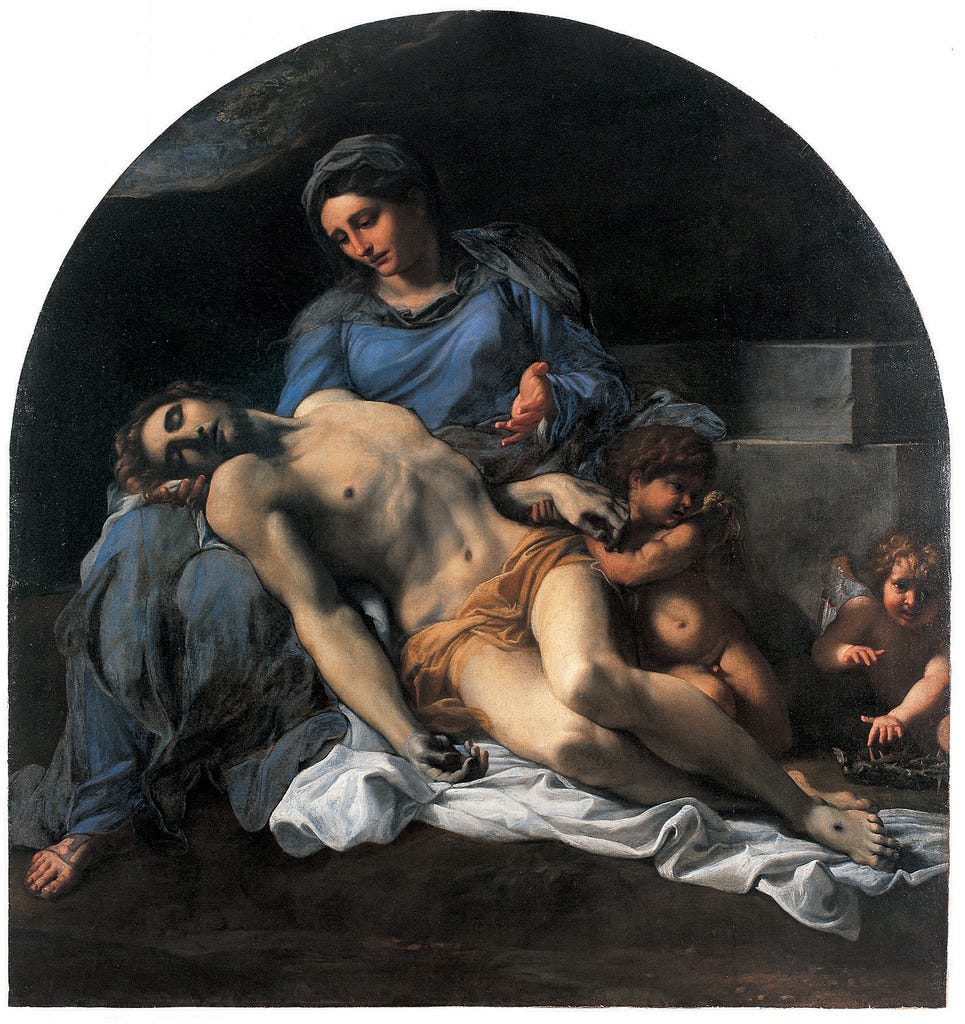
The subjects were the standard ones of the age, the Virgin, the saints, the dead Christ mourned, but the handling was fresh and built on close observation.
He returned to the lamentation over Christ again and again, a theme that stayed with him to the very end of his life. These Bolognese commissions proved his reform was not just talk.
The cardinal who called him to Rome
Annibale's Bolognese success reached Rome. Around 1595 Cardinal Odoardo Farnese, a member of one of the most powerful families in Italy, invited him south to decorate the family palace, the Palazzo Farnese.
It was a career defining call. Ludovico stayed in Bologna to run the academy, while Annibale took the commission that would consume his best years. Agostino joined him in Rome for part of the work before the brothers fell out.
In Rome, Annibale finally stood in front of ancient sculpture and the paintings of Michelangelo and Raphael. That first hand contact with the classical past reshaped his art. The Bologna reformer became a Roman painter.
The landscapes that pointed to Poussin and Claude
Annibale did more than paint gods and saints. He helped invent a whole way of picturing nature.
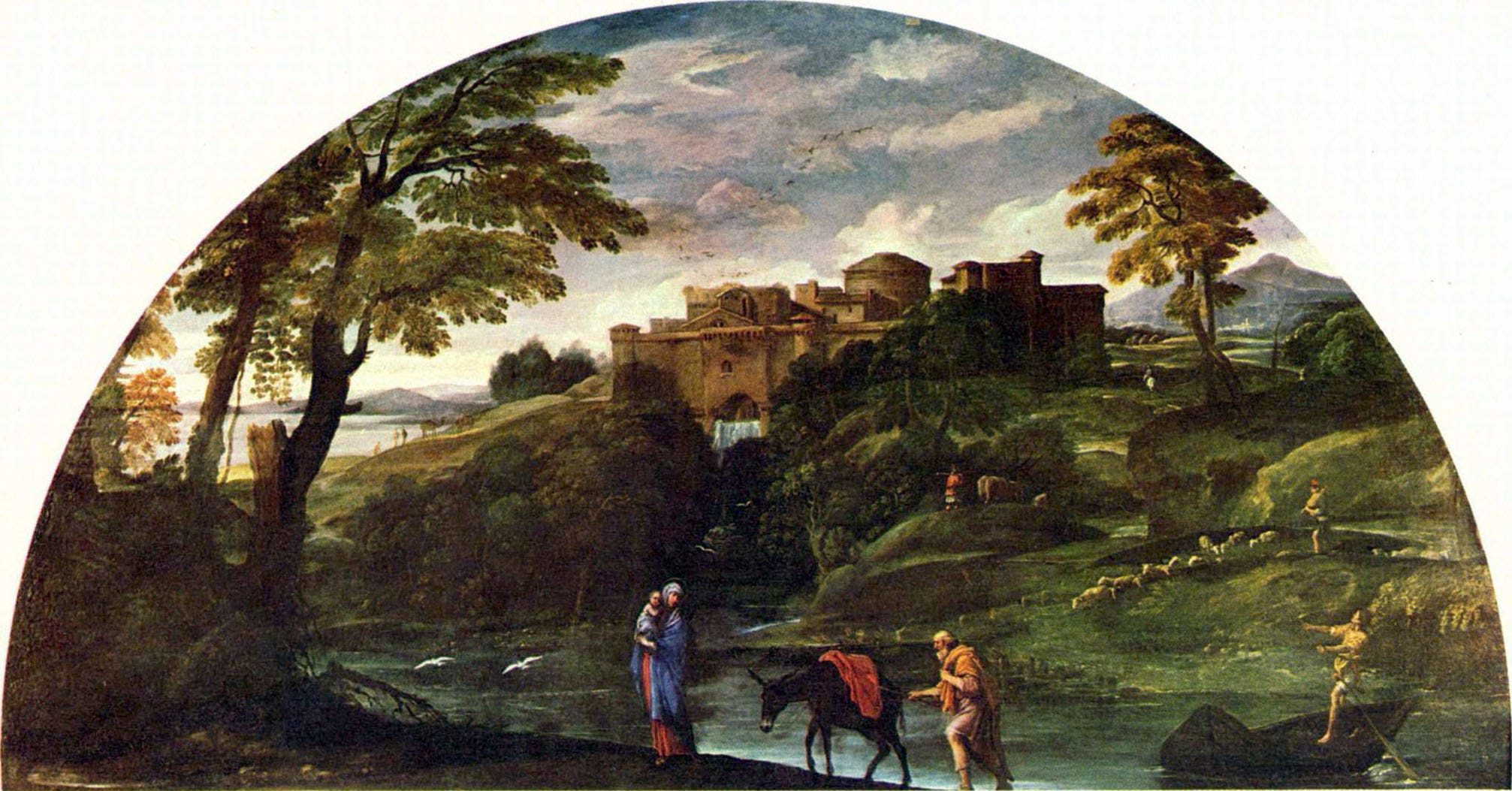
In his landscapes the countryside is never a random backdrop. It is arranged, calm, and balanced, with trees, water, and small figures placed to lead the eye. This ordered, ideal landscape became a model for others.
The National Gallery names his work as an important precursor to the classical landscapes of Domenichino, Claude and Poussin later in the seventeenth century.
When people picture the golden, serene landscapes of French and Italian art after him, they are looking at a tradition Annibale helped set in motion.
The payment that arrived in a bowl
Annibale gave years to the Farnese, and the reward stung.
According to early biographers, above all Giovan Pietro Bellori, the cardinal paid him a small, almost insulting sum for the enormous gallery, and the coins were reportedly handed over in a bowl.
The exact figure and the theatrics come from that early tradition rather than hard account books, so the detail should be read with some caution.
Better documented is the aftermath. A letter of 1606 has Cardinal Odoardo himself complaining that a heavy melancholic mood was keeping Annibale from working.
Whether the low pay caused the collapse or simply deepened it, the greatest work of his life left him poorer in spirit than when he had started it.
The silence of his last years
After the Farnese Gallery, Annibale slowed and then nearly stopped.
Sources from his own time describe a deep melancholy, low spirits, and heavy drinking in his final years. He painted less and less, leaning on pupils and assistants to finish commissions.
For a man who had drawn without pause since boyhood, the quiet was its own kind of tragedy.
Modern readers might recognize the pattern as depression, though we should be careful about fixing a diagnosis on a man four centuries gone.
What the record shows is a clear decline, not a sudden fall. The painter who had transformed Italian art spent his last stretch struggling to lift a brush at all.
Buried beside Raphael
Annibale Carracci died in Rome in 1609, aged about forty eight.
His death closed a career that had bridged Bologna and Rome, reform and the new Baroque style. He was buried, by his own wish, in the Pantheon, close to the tomb of Raphael, the artist he revered above all others.
Early tributes framed the two as near equals in genius, if not in fortune. The gesture said everything about how he saw himself, as an heir to the High Renaissance rather than a rebel against it.
His pupils carried the flame. Domenichino, Guido Reni and Giovanni Lanfranco spread the Bolognese manner across Italy.
The Annibale Carracci questions that keep coming up
What is he known for? Reforming Italian painting and the great Farnese Gallery ceiling in Rome.
Why does the Farnese ceiling matter? It was compared to the Sistine and set the model for Baroque ceilings.
Did he invent caricature? The Carracci are credited with inventing the comic exaggerated portrait.
When did he die? In 1609, in Rome, and he was buried near Raphael in the Pantheon.
Why was he buried near Raphael? He asked for it. He revered Raphael’s clarity, and after his lonely death in Rome in 1609 he was laid to rest beside him in the Pantheon.
Where and when was Annibale Carracci born? He was born in Bologna, in northern Italy, in 1560. His father was a tailor, and Annibale trained alongside his older brother Agostino and his cousin Ludovico, with whom he later founded a painting academy in the city.
More secrets to unlock


Why his road still runs
Carracci pulled painting back toward life just as it risked drowning in artifice, and built the bridge that the whole Baroque walked across.
He ended unhappily, underpaid for the Farnese work and sunk in melancholy, but the road he opened runs straight through Rubens, Bernini and beyond.
To me he is the most underrated giant of Italian art. Everyone knows the Sistine, and almost no one can name the ceiling that set out to answer it.