
To understand a modern work of art, ask three questions: what was the artist reacting against, what did they say they wanted, and what does the work do when you stand in front of it at full size. It also helps to follow the story in order, from Monet's haystacks to Kandinsky's colors, Mondrian's grids, Malevich's black square and Duchamp's urinal. Each step answers the one before.
I am Julien Charles-Césari. I write Cool Stories About Art, a newsletter read by more than 200,000 people who love art but never studied it. I still struggle with Picasso. Rothko and Joan Mitchell leave me cold, and they feel like a joke I am not in on.
So this page does not pretend that everything becomes beautiful once explained. It shows how this art came about, step by step, so that a black square or a canvas of colored rectangles stops looking random. Liking it is another matter, and it stays your call.
Cool Stories About Art is a newsletter to learn art the fun way.
Join 200,000+ readers and get:
10 new art stories / month
The entire archive of content (140+ articles)
Comment, ask questions, and chat with other readers
Which modern art are we talking about?
Manet painted Olympia in 1863. Monet painted Impression, Sunrise in 1872. Both are modern art, and almost nobody needs help to enjoy them. A haystack at sunset is still a haystack. A woman on a bed is still a woman on a bed.
The trouble starts later, the day a painting stops showing anything you can name. A square, a grid, a splash, an object bought in a shop and put on a pedestal. That is what most people mean when they say they don't understand modern art, and that is what this page is about.
Three questions for any modern work
What was the artist reacting against? Almost every modern work says no to something: to painting that copies the world, to the taste of the academies, to the idea that art must be beautiful. Find what it refuses, and you understand half of what it does.
What did the artist say they wanted? Modern artists wrote manifestos, letters, interviews and whole books. Their words are often clearer than their paintings, and one sentence can change how you look.
What happens in front of the real thing? Many modern works were made for a wall and a body standing in front of it. On a phone, they shrink to almost nothing.
These three questions are easier to ask when you know the story. Here it is, in six steps.
The story in six steps
Start with Monet's haystacks.
Read how Kandinsky failed to recognize one.
Watch Mondrian's tree disappear.
Find out who was meant to be shocked.
Stand in front of a Rothko, not a photo of one.
Decide what you think.
1. Start with Monet's haystacks
In 1890 and 1891, Monet painted the same stacks of grain near his house in Giverny some twenty-five times. In the morning, at noon, under snow, at sunset. The subject never changes. The light does.
By then, Monet was no longer really painting haystacks. He was painting the light of one hour on one day, and the haystack was the excuse. That is the first crack. For centuries, the subject was the point of a painting. With Monet, the way it is painted becomes the point.
He pushed it further at the end of his life. His eyesight was failing, and his water lilies turned into storms of color in which you can barely find the water. I tell that story in How Monet's cataracts changed modern art.
Once the subject matters less than the way it is painted, the next question comes on its own. What if there were no subject at all?
2. Read how Kandinsky failed to recognize a haystack
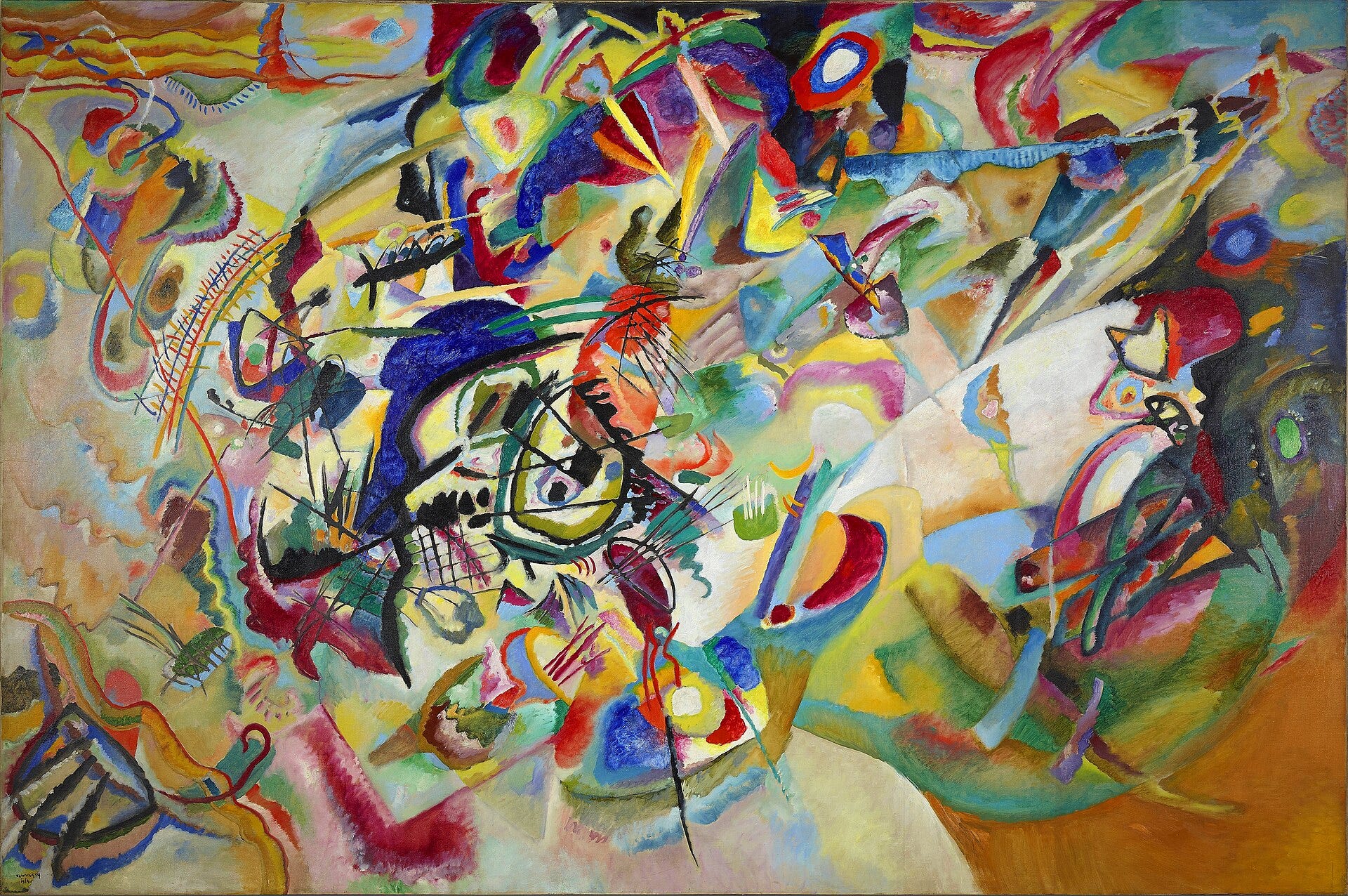
In 1896, in Moscow, a law lecturer about to turn thirty, Wassily Kandinsky, visited an exhibition of French painting. He stopped in front of a Monet and could not tell what it showed. The catalogue told him: a haystack.
He was annoyed. He was also gripped. In his memoirs, he wrote that the painting stayed with him for good, and that it showed him what color alone could do. That same year, he turned down a law professorship and left for Munich to paint.
It took him fifteen more years to get where that Monet had pointed. In 1911 he published a short book, Concerning the Spiritual in Art, built on one idea: color works on us like music, directly, without needing to show anything. "Color is the keyboard, the eyes are the hammers, the soul is the piano with many strings," he wrote.
Two years later he painted Composition VII, at the top of this page. Read that sentence, then look again. You stop searching for a house or a horse. You take in the clashes, the pace, the bright patches and the dark ones, the way you listen to a piece of music without asking what it represents.
3. Watch Mondrian's tree disappear
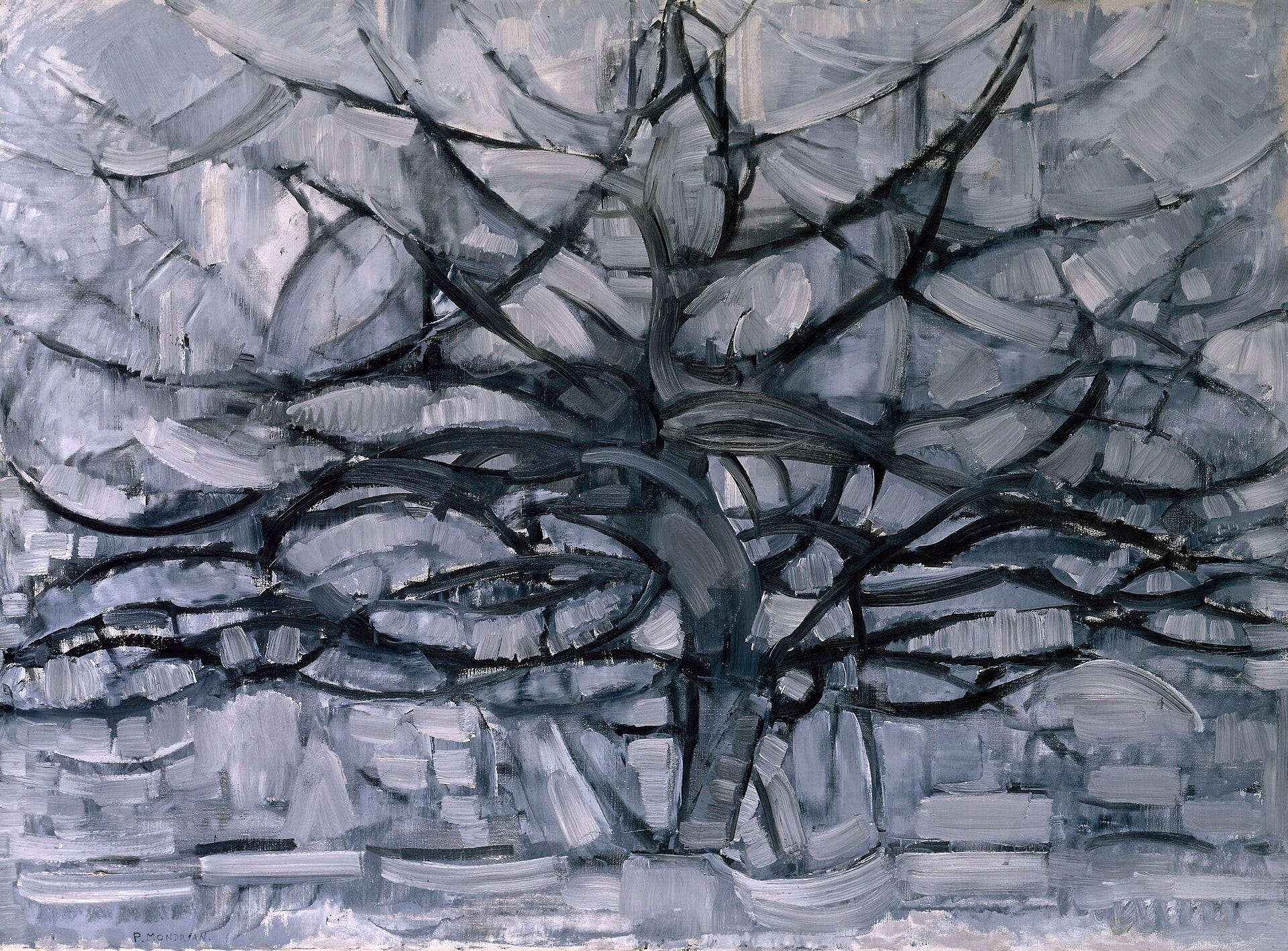
Piet Mondrian's grids of black lines and red, yellow and blue squares look as if they came from nowhere. They came from a tree.
Around 1908, Mondrian painted a red tree against a blue sky, trunk, branches and all. In The Gray Tree of 1911, above, the branches have become lines, and the sky has turned grey. In Flowering Apple Tree of 1912, below, only a rhythm of curves remains. You can still guess the tree if you know it is there.
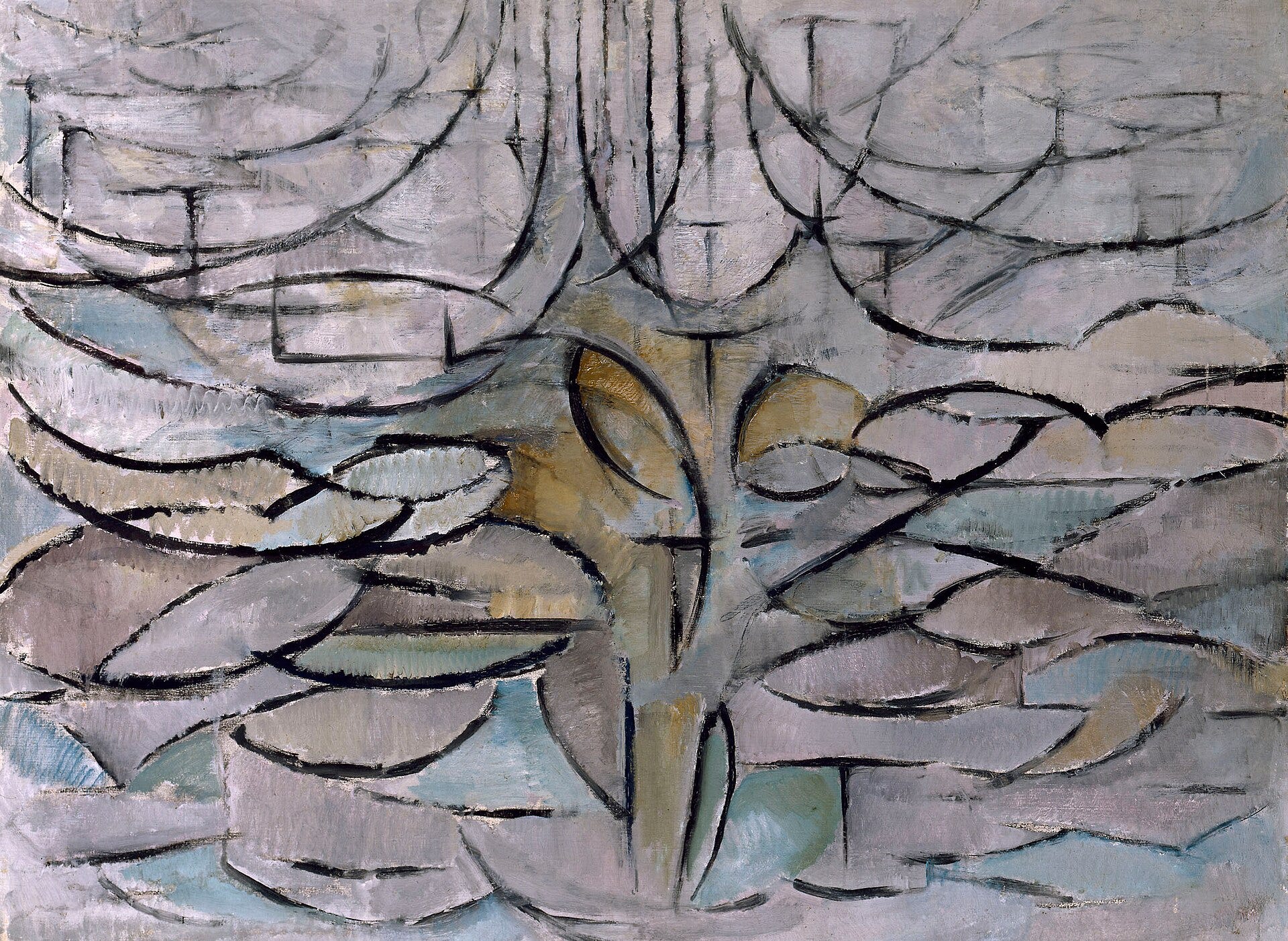
A few years later, even the curves are gone. Only horizontal and vertical lines are left, and a few blocks of pure color. Seen alone, a Mondrian grid looks like a design for a tablecloth. Seen at the end of that road, it is a tree stripped to its bones, and years of work to get there.
The same is true of Picasso. At fifteen, in Barcelona, he painted like a perfect academy student, with faces any teacher would approve. The broken faces of 1907 were a choice, made by someone who could do the rest.
This is the second key. In front of an abstract painting, look at what the artist painted ten years before. The strangeness was rarely an accident.
4. Find out who was meant to be shocked
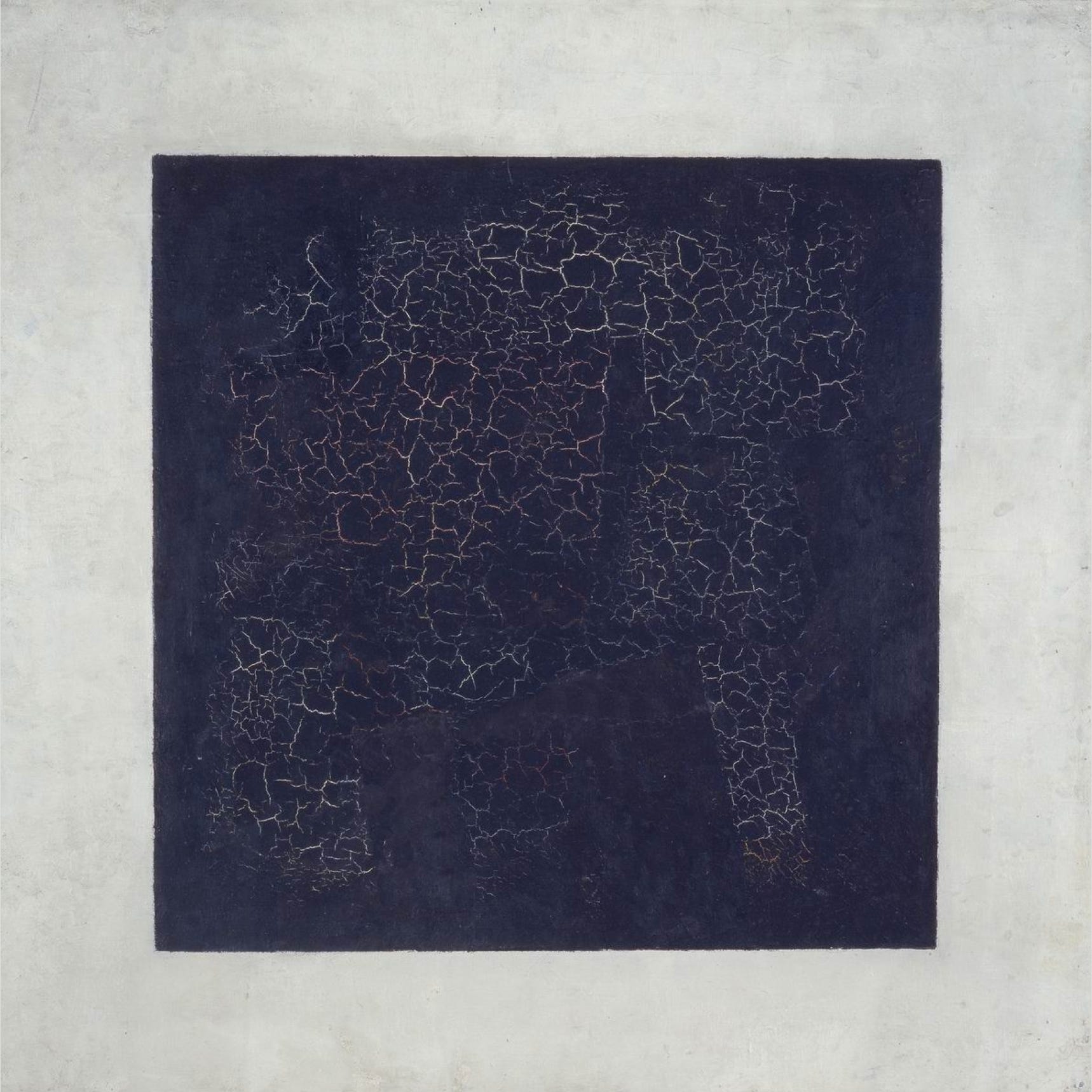
Many of these works were made to provoke, and they only make sense once you know who was meant to be shocked.
In December 1915, in Petrograd, Kazimir Malevich showed his Black Square for the first time. He hung it high across the corner of the room. In Russian homes, that corner belongs to the family icon, the holy image people pray to. Every visitor understood where the square had been placed, and what it was replacing.
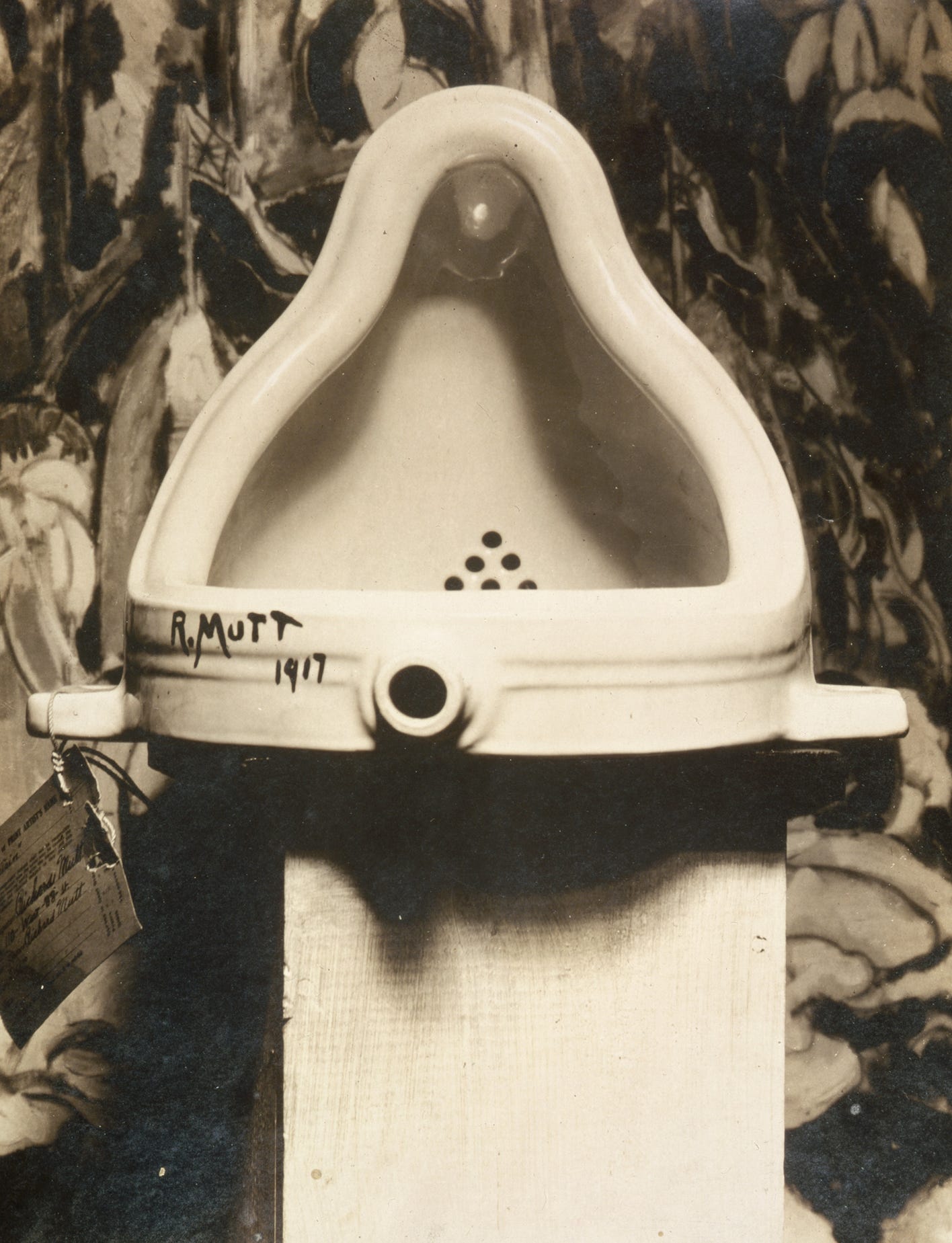
Two years later, in New York, Marcel Duchamp bought a urinal, signed it "R. Mutt" and sent it to an exhibition that promised to show any work submitted with the fee. The organizers refused to show it. The urinal disappeared, and only a photograph survives.
With that object, the question changed. It was no longer "is this well painted?" but "who decides what art is?" You may find the answer absurd. The question was serious, and the art world has been arguing about it ever since.
5. Stand in front of a Rothko, not a photo of one
A Rothko on a phone screen is a few blurred rectangles. On a wall, it can be taller than you.
Mark Rothko said he painted large pictures to be intimate, not grand: to put you inside the painting rather than in front of it. At Tate Modern in London, a dimly lit room holds the dark red canvases he painted for a New York restaurant, the Four Seasons, and then refused to deliver. There, they surround you, and the edges of the rectangles seem to move.
Joan Mitchell spent her last decades in Vétheuil, a village on the Seine, in a house above the one where Monet once lived. Since I learned that, I look for the light of that river in her canvases. It still does not quite work for me. But now I know what I am looking for, and that already changes the visit.
6. Decide what you think
Understanding a work does not oblige you to like it. I know why the Black Square mattered, and most of Rothko still leaves me cold. Both can be true at the same time.
What changes is the quality of the dislike. "My kid could do that" ends the conversation. "I see what he was refusing, and it does nothing for me" is an opinion you can defend.
Start, as with older art, from what you already like. Plenty of people who dislike abstraction love Klimt's gold, Hopper's silent diners or Frida Kahlo's self-portraits. All three belong to modern art too. Their lives, told in the Artists' Lives section of Cool Stories About Art, lead straight into the rest of the century.
And contemporary art?
Contemporary art, the art of the last few decades, follows directly from Duchamp's urinal. Many works rest on an idea, a gesture or a situation more than on a skilled hand. That is why they can look absurd at first sight.
The three questions still work. What is the work reacting against? What did the artist say about it? What does it do to the people around it? This is also the one case where reading the label first is a good idea, because the idea is often the work.
The best resources to understand modern art
My own list. The first one is mine, so read it with that in mind.
Cool Stories About Art, a newsletter on Substack, free to join, with a paid plan for the full stories. Twice a week, one painting or one artist's life, from the old masters to Monet, Picasso and Frida Kahlo. Start with Masterpieces Explained or Artists' Lives.
What Are You Looking At?, by Will Gompertz. 150 years of modern art told as one story, with humor, by a former director at the Tate. The best first book on the subject.
The Shock of the New, by Robert Hughes. A BBC series from 1980 and a book. Sharp, opinionated, and still the clearest account of how modern art happened.
Destins d'artistes, my book with Larousse. 57 artists' lives told like stories, from Giotto to Hilma af Klint, the Swedish painter who made abstract pictures before Kandinsky. In French, out October 21, 2026.
Modern Art & Ideas, a free online course from the Museum of Modern Art in New York, made for beginners.
Questions about modern art
How do I understand modern art as a beginner?
Ask three questions in front of any work: what was the artist reacting against, what did they say they wanted, and what does the work do at full size. Then follow the story in order, starting with Monet, where the subject is still there, before watching it disappear with Kandinsky and Mondrian. Each step answers the one before, and the strangest works become readable.
Why does modern art look so simple?
Because simplifying was the project. Mondrian spent years reducing a tree to a few lines, and Malevich wanted painting free of any subject. A grid or a black square is the end of a long road, not a quick sketch. Looking at what the artist painted ten years earlier usually proves it.
How do I understand abstract art when it looks like random shapes?
Look at what the artist painted before, and read what they wrote. Kandinsky compared color to music: his paintings make sense once you take them in the way you listen, for the rhythm and the clashes rather than for a subject. The shapes were chosen, and the artist's own words usually explain why.
How can I learn about contemporary art without feeling lost?
Start with Duchamp's urinal of 1917, because much of contemporary art follows from the question it raised: who decides what art is? Then read the label or the artist's statement before looking, since in contemporary art the idea is often the work.
Is modern art the same as contemporary art?
No. Modern art usually covers the period from the 1860s to the 1960s, from Manet and Monet to Rothko. Contemporary art is the art of the last few decades, made by artists working today or recently.
Is it okay not to like modern art?
Yes. Understanding a work does not oblige you to like it. Many people who dislike abstraction love Klimt, Hopper or Frida Kahlo, who also belong to modern art, and that is a good place to start.
What should I read to understand modern art?
Will Gompertz's What Are You Looking At? for a first overview, Robert Hughes's The Shock of the New for depth, and the free course Modern Art & Ideas from the Museum of Modern Art. To keep learning week after week, follow a newsletter that tells the story behind one work at a time, such as Cool Stories About Art.
About the Author
Julien Charles-Césari is a French art writer who tells the stories behind famous paintings and the lives of the artists who made them.
He created Cool Stories About Art on Instagram, followed by more than 320,000 people, and this Substack, where more than 200,000 subscribers learn art the fun way.
He also created Cool Stories About History, a Substack about the stories behind history. His book Destins d'artistes is published by Larousse.


