
Jan van Eyck was the Flemish master who made oil paint do things no one thought possible, the painter of the mirror, the little dog and the mysterious double portrait we call the Arnolfini Portrait.
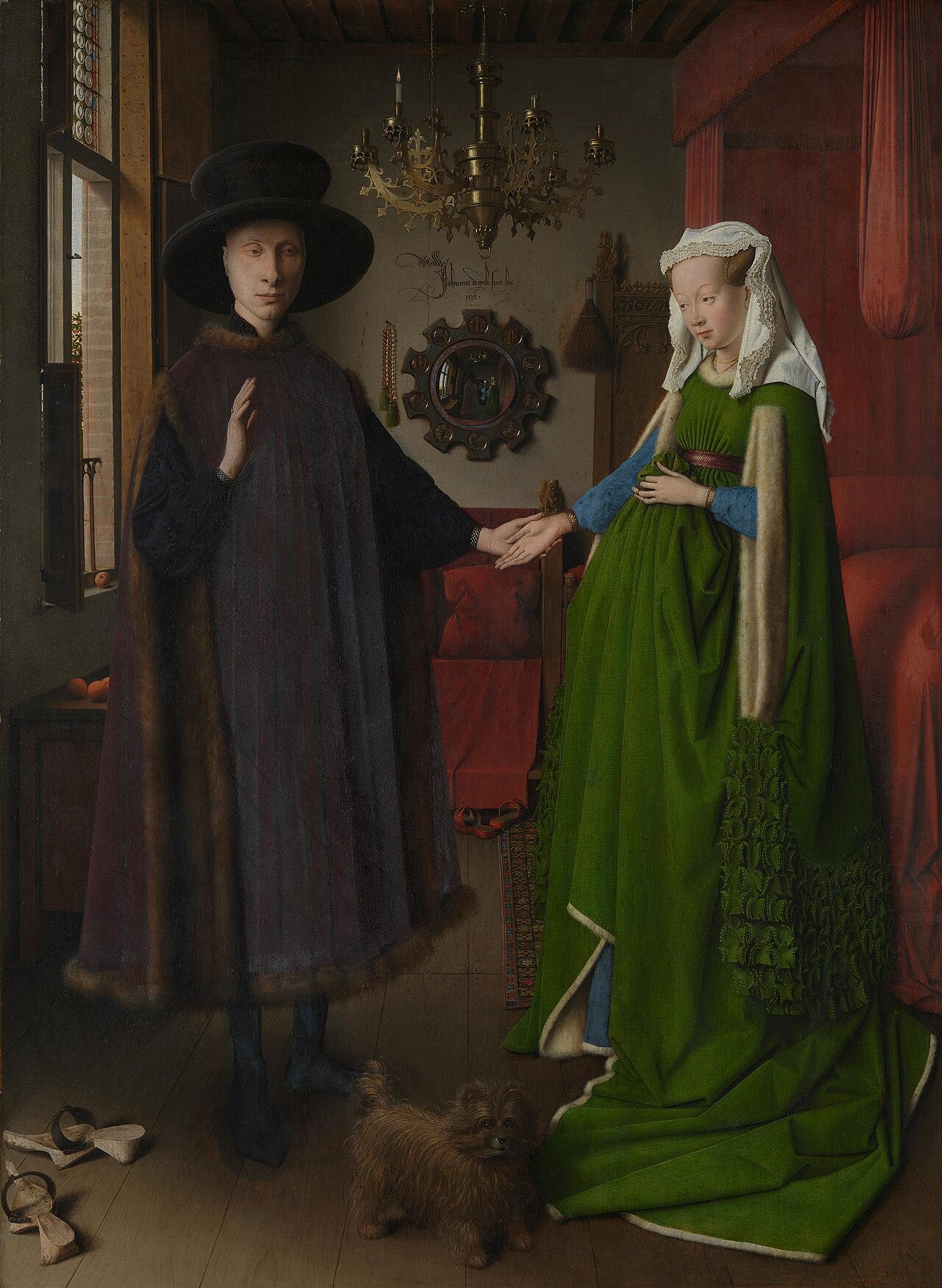
The credit was misplaced yet earned. He pushed oil paint so far that for centuries the invention was laid at his door. Lean close to a van Eyck and the realism still feels impossible.
More incredible painter stories
If Jan van Eyck pulled you in, you will love these too:


Jan van Eyck at a glance
1390. Born around this year, probably at Maaseik, near Liège.
1425. Named court painter and valet de chambre to Philip the Good, Duke of Burgundy.
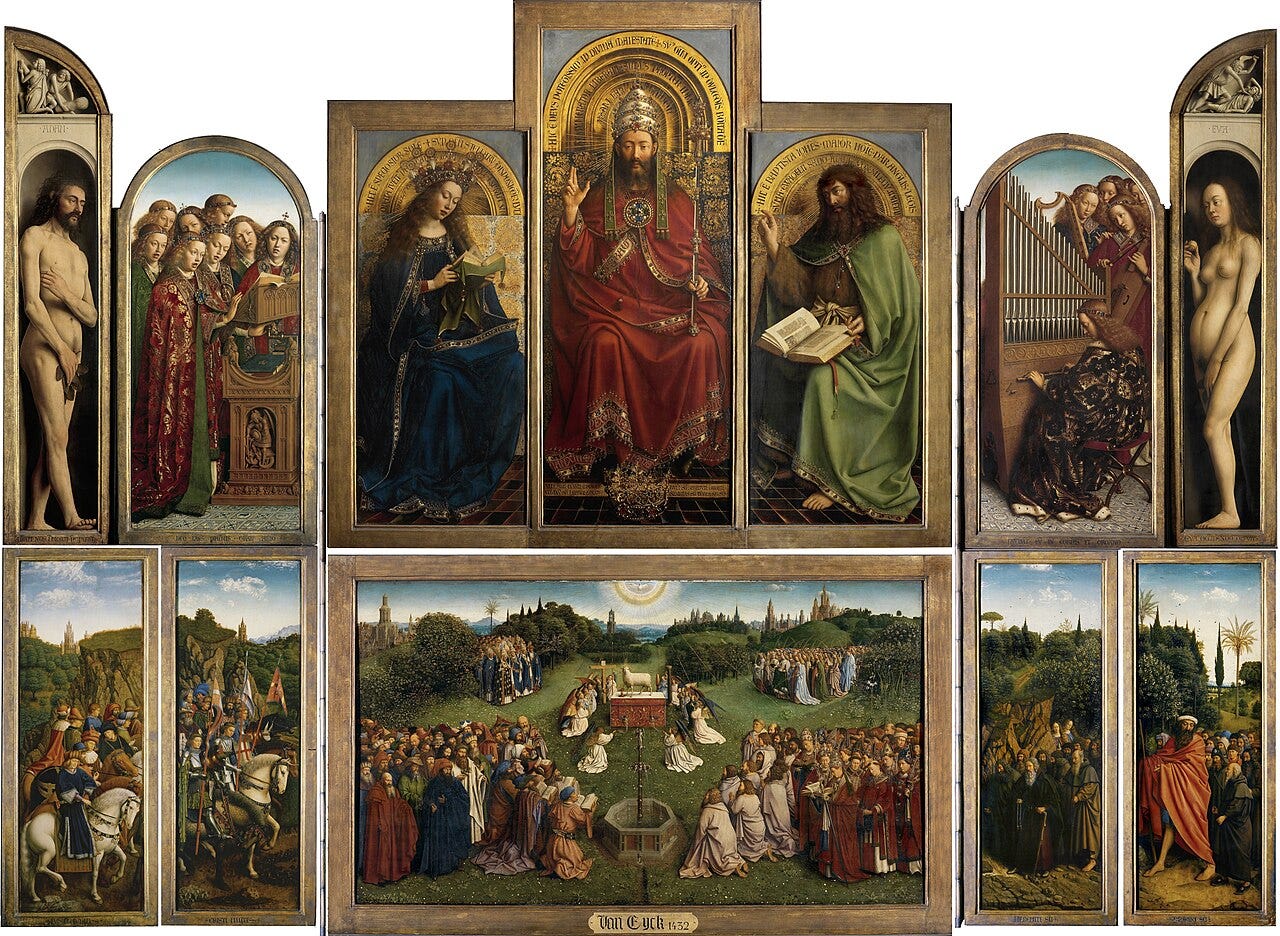
1432. Completed the Ghent Altarpiece, begun by his brother Hubert.
1434. The Arnolfini Portrait, signed on the wall: Johannes de eyck fuit hic.
1441. Died in Bruges. His workshop and widow carried on with ducal support.
The man who perfected oil
Before van Eyck, painters mostly worked in egg tempera, which dries fast and flat. He built his pictures in thin, glowing layers of oil paint, so that fur, brass, glass and skin each catch the light differently.
The result was a new kind of realism that swept across Europe and helped launch what we now call the Early Netherlandish school. Within that school, Rogier van der Weyden ended up copied even more than van Eyck across fifteenth century Europe, despite leaving no signed painting behind. That realism became one of the defining threads running through famous Northern Renaissance paintings for the century that followed.
The Arnolfini Portrait
A man and a woman stand in a sunlit room. Behind them a convex mirror reflects two more figures, and above it he wrote, in flourishing script, that Jan van Eyck was here.
A little dog sits at their feet, a single candle burns in daylight. Scholars have argued for two centuries over what the scene means, a wedding, a memorial, a contract, which is exactly why we keep looking.
The most stolen painting in history
His other giant achievement is the Ghent Altarpiece, a vast many panelled polyptych of the Adoration of the Mystic Lamb. It is also the most frequently stolen artwork ever made, targeted again and again across six hundred years.
One lower panel, the Just Judges, was stolen in 1934 and has never been recovered. A copy fills the gap to this day.
Signatures and hidden tricks
Van Eyck signed and dated his work when almost no one did, often with his personal motto, Als Ich Can, meaning as best I can, a sly humble brag.
His portraits stare straight out at you, and the famous Man in a Red Turban may well be the artist himself, one of the earliest true self portraits in Western art.
The window and the puzzle
Van Eyck turned the painted surface into a window and a puzzle at once. Every object means something, every reflection hides a detail. For me no one since has matched that mix of hard truth and quiet mystery.
Painter to a duke
Van Eyck was no struggling craftsman. He was court painter to Philip the Good, Duke of Burgundy, one of the richest men in Europe, who paid him well and trusted him.
The duke even sent him abroad on secret diplomatic errands. For a painter of the early 1400s, that rank and that confidence were almost unheard of.
Where to stand in front of a van Eyck
The National Gallery in London holds the Arnolfini Portrait, mirror and all. His greatest work, the Ghent Altarpiece of 1432, is still in Saint Bavo's Cathedral in Ghent, where you can stand in front of it.
The town that barely remembers him
Van Eyck left almost no paper trail before his thirties. Scholars place his birth around 1390, probably at Maaseik, a small town in the old diocese of Liege, in what is now Belgium.
His family carried a coat of arms, so the van Eycks belonged to the gentry, not the laboring class. He could read and write too, which was rare for a painter then.
One name keeps surfacing beside his. City records in Ghent mention a Master Hubert the painter, said to have died in 1426. Whether Hubert was his brother, and how closely they worked, is still argued.
The early years stay mostly blank, and honest historians admit it.
No, he did not invent oil paint
For centuries people credited van Eyck with inventing oil painting. The Italian writer Giorgio Vasari helped spread that claim in the sixteenth century.
It is not true. Painters had mixed pigments with oil long before him. What van Eyck did was perfect it. He built color in thin see through layers called glazes.
That let him control light, depth and surface in a way tempera and fresco could not match. Skin looks like skin. Metal glints. Distant hills fade into haze.
So the honest version is simpler. He did not discover the medium. He showed everyone what it could really do, and the rest of Europe followed.
The lost pages in Turin
Almost nothing survives that we can firmly date to van Eyck's youth. Many scholars think he trained as a manuscript illuminator, painting tiny scenes inside prayer books.
The clearest trace is a set of miniatures known as the Turin Milan Hours, linked to an anonymous hand that some experts identify as Jan himself. The attribution is debated and may never be settled.
Part of that manuscript was destroyed when a fire tore through the Turin library in 1904. Those pages now survive mainly through old photographs. It is a strange thought. Some of his earliest possible work exists only as faded reproductions.
Painter and valet de chambre
Van Eyck's first steady job was at The Hague, working from 1422 for John of Bavaria, ruler of Holland. When that patron died in 1425, van Eyck moved to the grandest court in the region.
That summer he entered the service of Philip the Good, Duke of Burgundy, based at Lille and Bruges. His title was valet de chambre and painter, which meant far more than a hired craftsman.
He held a salaried post, a rare social standing and freedom from the local painters guild. The Duke was the most powerful ruler and the leading art patron in Flanders, and van Eyck stayed in his employ until the end of his life.
The painter who was also a spy
Philip the Good did not only want pictures. He used van Eyck for quiet diplomacy. The most famous errand was a marriage mission. Philip needed a wife, and he wanted to see her first.
In 1428 van Eyck sailed with a Burgundian embassy to Portugal to meet Isabella, daughter of the Portuguese king. His job was to paint her portrait so the Duke could judge the match from far away.
The likeness went back north. Philip approved, and the wedding took place in 1430. An earlier effort to arrange a Spanish bride, around 1427, had come to nothing. The painter doubled as the Duke's own eyes.
The Adoration of the Mystic Lamb
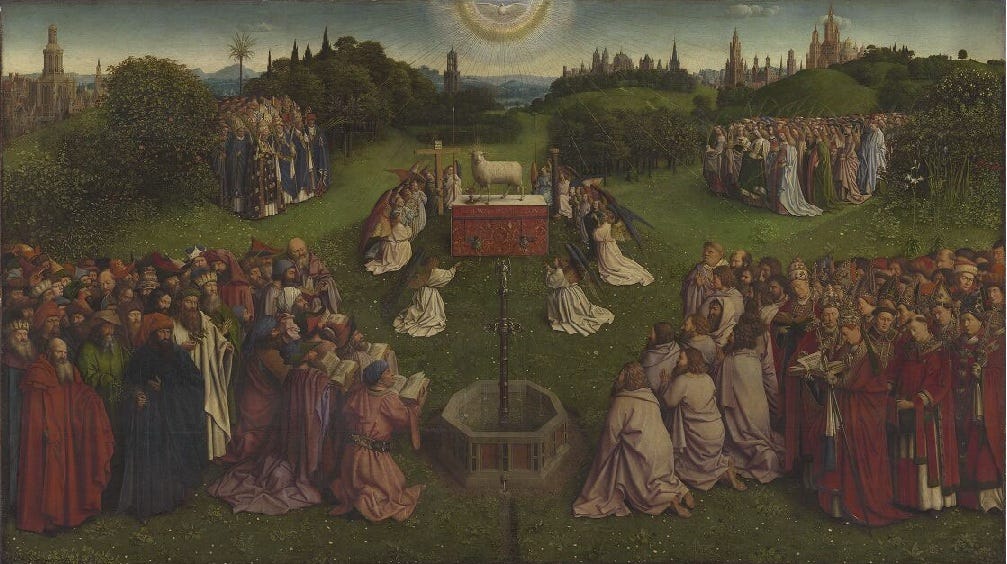
His largest surviving work stands in Ghent. It is the altarpiece called The Adoration of the Mystic Lamb, finished in 1432.
It is enormous. Opened out, the twelve panels stretch about 5.2 metres wide and 3.75 metres tall, painted on both sides. A local couple, Jodocus Vijd and Elizabeth Borluut, paid for it.
An inscription credits two hands. It says Hubert van Eyck began the work and Jan, his brother, carried it through. There is a catch.
That inscription is a later copy, and earlier writers named only Jan. So how much Hubert really did, if he painted at all, remains one of the oldest arguments in art history.
Two Madonnas, two cities
Beyond Ghent, two religious panels show van Eyck at full stretch. The Madonna of Chancellor Rolin, painted around 1435 and now in the Louvre, sets a powerful Burgundian official face to face with the Virgin and Child.
Behind them a river winds past tiny towers toward far blue hills, every pane of the window sharp.
The Virgin with Canon van der Paele, finished about 1436 and kept in Bruges, is denser still. Look at the gold thread on the cope, the round pearls, the reflections curving across Saint George's armor.
Van Eyck even tucked a small self portrait into the polished shield. These are pictures that reward standing very close.
The man in the red turban

Van Eyck changed portraiture. His sitters look straight out at you, lit and detailed like no one before them.
The best known is the Man in a Red Turban, dated 21 October 1433, now in London. Many believe it is van Eyck himself. It keeps its original gilded frame, the only one of his frames that survives.
Along the top, in Greek letters, runs his motto Als Ich Can, meaning as best I can, a quiet pun on his own name. An earlier portrait, the Leal Souvenir of 1432, sets a plain man behind a cracked stone ledge.
No flattery, no fuss. Just a face studied with total patience.
How far his fame traveled
Van Eyck died in Bruges in the summer of 1441 and was buried in the church of Saint Donatian. His brother Lambert, also a painter, helped settle the estate and probably closed the workshop.
His reputation did not fade with him. It spread south. In 1449 the Italian scholar Cyriacus of Ancona wrote that van Eyck's work seemed made not by human hands but by nature herself.
Kings and princes collected him. Alfonso of Aragon in Naples, the d'Este family in Ferrara and the Medici in Florence all wanted his panels.
Italian painters studied his oils, and within fifty years most of Europe had traded tempera for the medium he had shown how to use.
More secrets to unlock


The Jan van Eyck questions that keep coming up
Who was Jan van Eyck? An early Netherlandish master, one of the founders of oil painting realism.
When was he born? Around 1390, in the Low Countries.
When did he die? In 1441, in Bruges.
What is he famous for? The Arnolfini Portrait and the Ghent Altarpiece.
Did Jan van Eyck invent oil painting? No. Oil paint existed before him. Van Eyck perfected it in the 1420s and 1430s, layering thin glazes to catch light and texture, then made it famous across Europe. Vasari later spread the myth that he invented it.
Where can you see Jan van Eyck's work today? His largest work, the Ghent Altarpiece, is in Saint Bavo Cathedral in Ghent. The National Gallery in London holds the Arnolfini Portrait and the Man in a Red Turban. The Louvre in Paris and the Groeningemuseum in Bruges hold his great Madonnas.
For me the missing panel is the detail that haunts the whole altarpiece. In 1934 a Belgian named Arsene Goedertier confessed on his deathbed that he alone knew where the Just Judges lay, then took the secret with him. The case is still open.