
Alphonse Mucha was a Czech artist whose flowing posters of elegant women, framed by flowers, stars and swirling hair, came to define Art Nouveau, the decorative style that swept Europe around 1900.
To many people, Art Nouveau simply looks like Mucha. He became famous overnight in 1895, made a fortune from posters, jewelry and adverts, and was copied across the world, yet he spent the rest of his life longing to be remembered instead for the Slav Epic, his monumental painted history of the Slavic peoples.
This is the story of the man who gave an entire era its look, then tried to walk away from it.
More incredible painter stories
If Alphonse Mucha pulled you in, you will love these too:


Alphonse Mucha at a glance
1860. Born in Ivančice, Moravia.
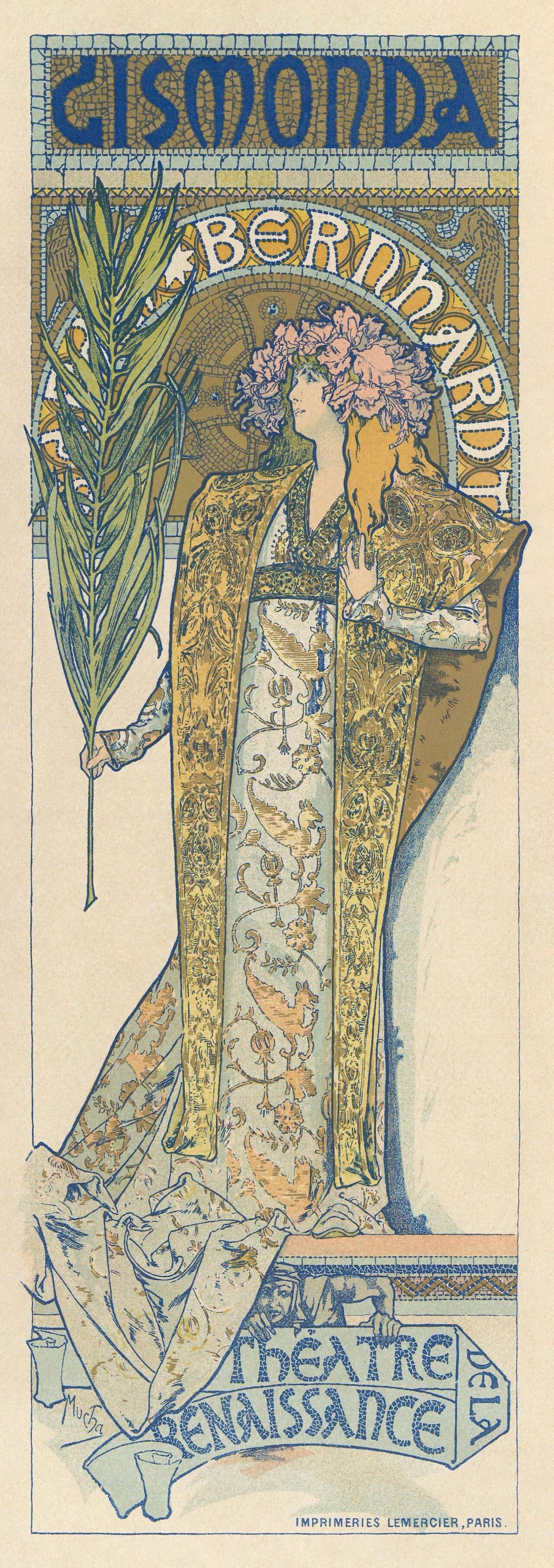
1895. The Gismonda poster appeared on Paris walls on New Year’s Day. Sarah Bernhardt signed him for six years.
1910. Returned home to begin the Slav Epic, twenty monumental canvases.
1918. Designed the new Czechoslovak state’s stamps and banknotes, for free.
1939. Interrogated by the Gestapo days after the occupation. He died months later in Prague.
Art Nouveau basically means Mucha
Art Nouveau, French for new art, was a style built on natural, curving lines: vines, flowers, flowing hair, the whiplash curve, the same sinuous line that runs through Aubrey Beardsley's black and white illustrations. It ran from about 1890 to 1910 and touched everything, posters, buildings, jewelry, furniture, even Metro entrances in Paris. A dozen paintings across that same range are gathered in a look at famous Art Nouveau art.
The idea was to erase the line between fine art and everyday design. A door handle or a soap advert could be as beautiful as a painting.
Mucha did not invent the movement, but he gave it its most recognizable human face. His posters became its unofficial logo.
How to spot a Mucha
His style is so consistent it became a template that thousands of imitators copied. A few signs give it away.
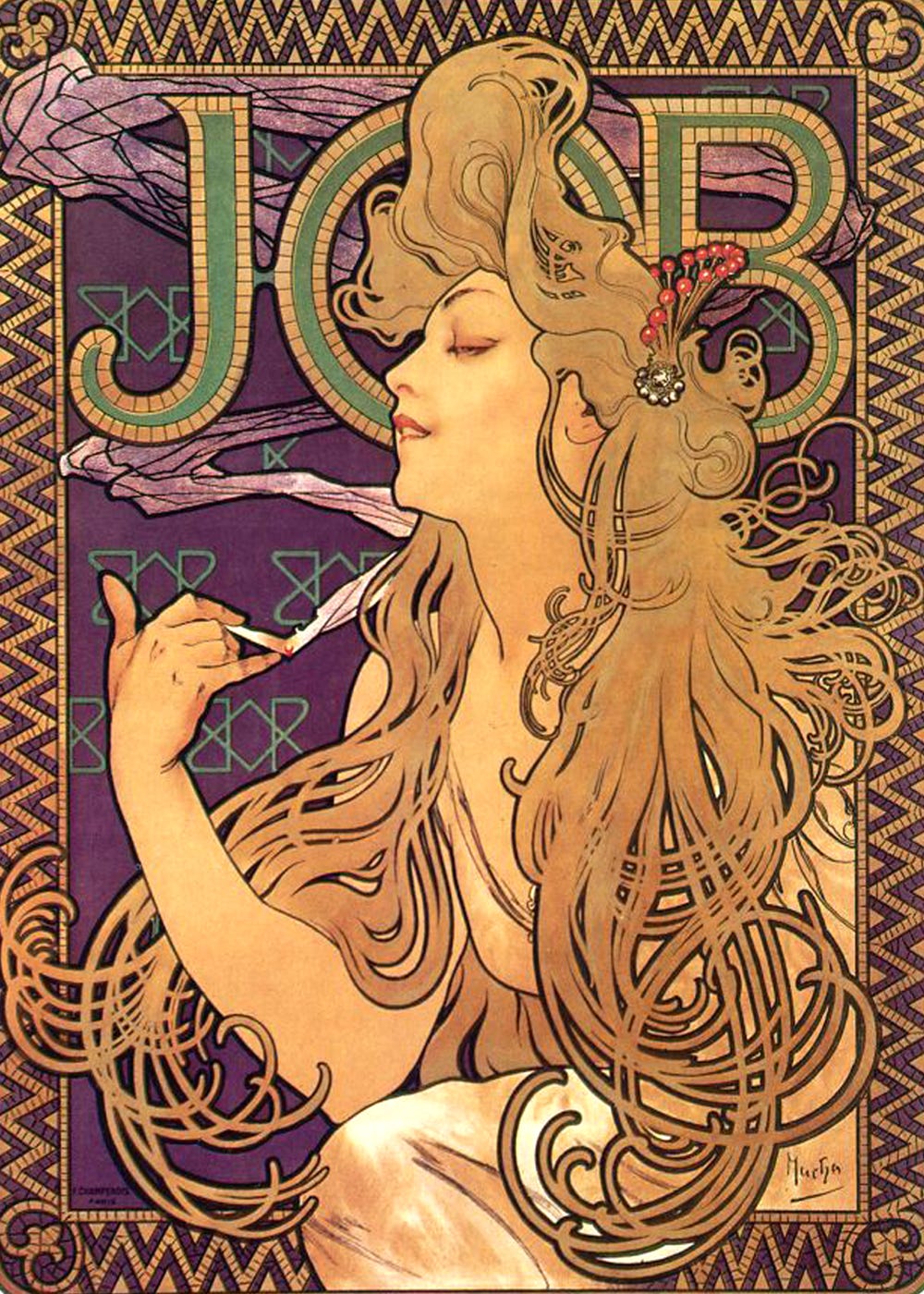
The halo. A circle or arch set behind the figure's head, like a stained glass window or a saint's halo.
The woman. A calm, graceful young woman, usually surrounded by flowers, stars or the seasons.
The hair. Long strands that curl and loop across the design like ribbons. People at the time called them macaroni.
The palette. Soft pastels, gold and muted tones, with a clear dark outline holding everything together.
He worked mostly in lithography, the printing method that let a single design reach huge numbers of people. His art was built to be everywhere, not locked in a gallery.
Byzantine gold, Japanese prints and Pre Raphaelite women
That famous look did not appear from nowhere. Three sources feed it.
The first is his Slavic childhood. The gold grounds and the halo arcs behind his women come straight from the Byzantine and Orthodox church art he grew up around. His decoration is, at heart, religious art turned worldly.
The second is Japan. Like much of Europe, Mucha absorbed Japanese prints, with their flat color, strong outline and confident framing. The third is the dreamy women of the English Pre Raphaelites. He fused all three into something instantly his own.
The first great commercial artist
Here is what makes Mucha genuinely modern. He treated advertising as art, and art as something for everyone.
He designed posters for champagne, cigarettes and biscuits, decorative panels sold as cheap prints, jewelry for the famous Paris jeweler Georges Fouquet, even whole shop interiors.
He published pattern books so other designers could work in his style.
In an age that still treated commercial work as beneath a real artist, Mucha built a career on the opposite belief. A railway poster, done well, could lift ordinary life. It made him rich and globally copied, and it quietly nagged at him for decades.
The work he actually cared about
Mucha grew tired of being known only for pretty posters. He was a proud Czech patriot, and he wanted to paint the history of his people.
What matters here is the irony: the world remembers him for the posters he half dismissed, not the epic he believed was his life's work.
To me that is the cruel joke of his life. He is loved for the posters he shrugged at, while the epic he poured eighteen years into hangs half forgotten.
The Czech patriot
Mucha's love of his homeland ran through everything he did once he left Paris.
The boy from a small Moravian town had become, in effect, the visual designer of a country.
The wife and daughter who saved the Slav Epic
Mucha married Maruska Chytilova, a Czech woman much younger than him, in 1906, and they settled in Prague.
They had two children. His daughter Jaroslava often modeled for him and later helped restore The Slav Epic, and his son Jiri grew up to be a well known writer who kept his father's memory alive. The family became the keepers of his legacy.
Forgotten, then everywhere again
After his death, Art Nouveau was dismissed as old fashioned, and Mucha nearly vanished from serious art history.
Then came the 1960s. The psychedelic poster artists of that era, designing for rock concerts and counterculture, fell in love with his curling lines and dreamy women and revived his look wholesale.
A surprising amount of 1960s poster art is Mucha in disguise.
Today his style is once again one of the most reproduced on earth, on posters, phone cases and tattoos, and Prague has a museum devoted entirely to him.
A choirboy from Ivancice who was told to give up
Alphonse Mucha was born on 24 July 1860 in Ivancice, a small town in Moravia, then part of the Austrian empire. He drew constantly as a boy, and he had a fine singing voice.
That voice earned him a place as a choir chorister in Brno, where the church music also paid for part of his schooling.
He wanted to be a painter. In 1878 he applied to the Academy of Fine Arts in Prague and was turned down. By his own account the school advised him to find another line of work.
He had no formal training, and for several years he learned mostly on his own.
Painting backdrops until a count opened a door
Mucha went to Vienna and found work with a firm that painted stage scenery for the theatres. He was in his early twenties, learning the craft by doing it.
When a fire destroyed one of the main theatres in 1881 and orders dried up, he lost the position and drifted back toward Moravia, settling for a while in Mikulov.
There a local landowner, Count Karl Khuen Belasi, hired him to decorate a family castle with murals. The count liked the results enough to become his patron.
He paid for Mucha to study at the Academy in Munich, and then, from 1887, to continue in Paris at the Academie Julian and the Academie Colarossi.
The poster that went up on New Year's Day
By late 1894 Mucha was a jobbing illustrator in Paris, short of money. The story, retold by the Mucha Foundation, is that he happened to be at a printer over the Christmas holiday when the actress Sarah Bernhardt demanded a new poster for her play Gismonda at short notice.
Mucha took the job and designed it in a rush.
The tall, narrow poster appeared on Paris walls on 1 January 1895. It showed Bernhardt full length, calm and almost sacred, in soft golds.
Passersby stopped to look, and some reportedly tried to peel copies off the walls. Almost overnight, an unknown Moravian illustrator became a name in Paris.
Six years tied to Sarah Bernhardt
Bernhardt was one of the most famous performers in Europe, and she moved quickly to keep Mucha for herself. She signed him to a contract that ran for about six years, from 1895.
Under that deal he designed her theatre posters, but also stage sets, costumes and jewellery. The partnership gave him steady work, a public platform, and a direct line to the taste of fashionable Paris.
When his name became a style
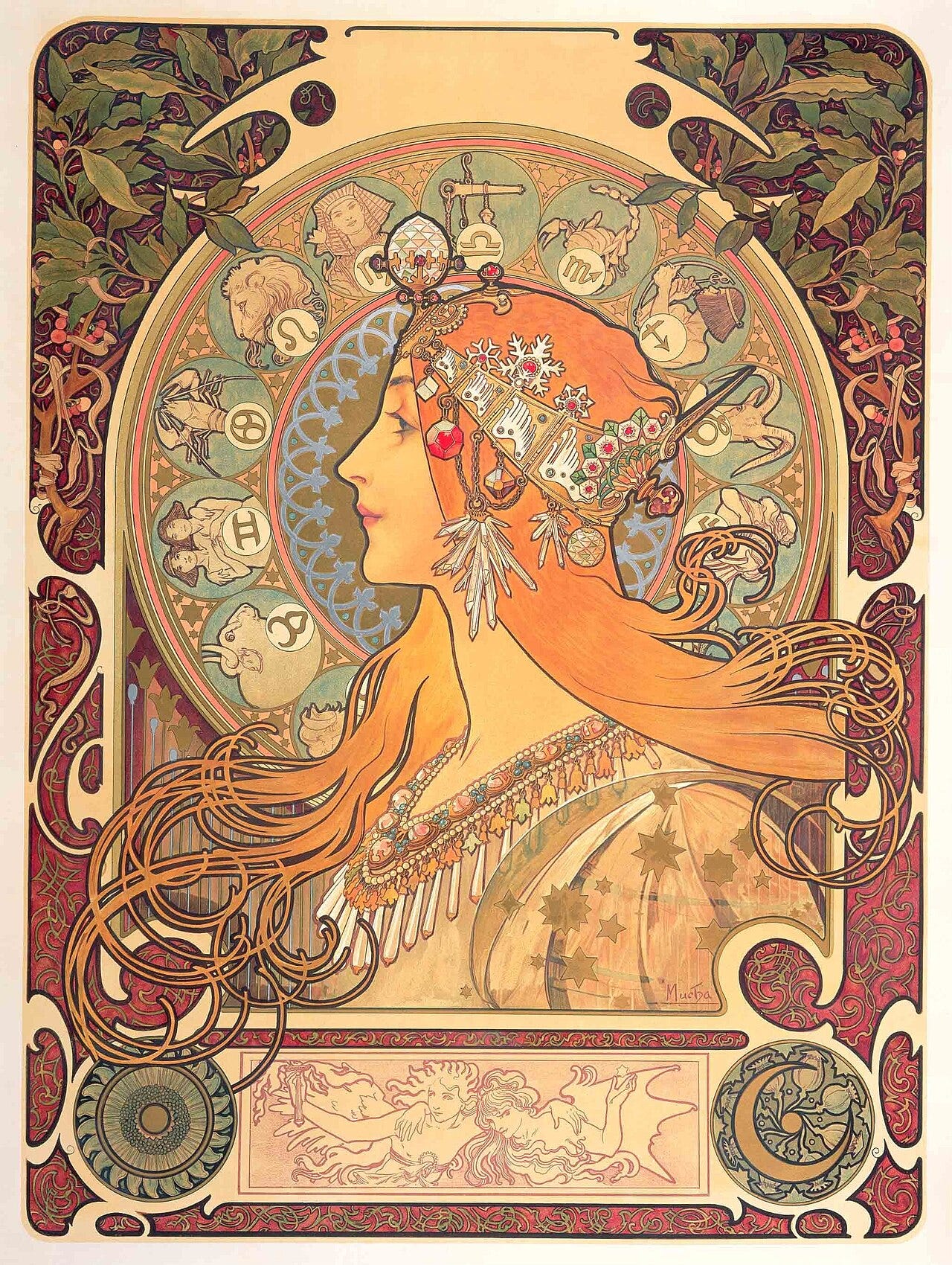
Mucha's look spread fast, and people began to call it le style Mucha. Its signatures were flowing hair, flowers, circular halos and idealised women set inside decorative borders.
He sold these images cheaply as decorative panels meant to be pinned up at home, in sets such as The Seasons in 1896 and The Flowers in 1898.
The same manner sold products. He drew advertisements for JOB cigarette papers, for Ruinart champagne, for Nestle and for biscuit makers, among many others.
It was commercial art, printed by the thousand, and it made his style familiar across France and beyond.
The teacher, the manual, and two difficult friends
Success turned Mucha into a kind of one man design school. In 1902 he published Documents Decoratifs, a manual of patterns, figures and ornament that art students and craftsmen could copy and adapt. He also taught and lectured.
His Paris circle included the painter Paul Gauguin, with whom he is said to have shared a studio for a time, and the Swedish writer August Strindberg, who drew him toward mysticism and the occult.
Photographs survive of Gauguin in Mucha's studio, a reminder that these were real working friendships and not just names.
America, and the man who funded a dream
Around 1904 Mucha began traveling to the United States, and he spent much of the period up to about 1910 there. He taught, took portrait and decorative commissions, and hoped to earn enough freedom to paint the serious historical work he cared about.
The turning point was meeting Charles Richard Crane, a wealthy American businessman with a deep interest in Slavic peoples and politics.
Crane agreed to fund Mucha's long held dream, a vast cycle of paintings on Slavic history. That money let Mucha finally go home.
Twenty canvases for the Slavs
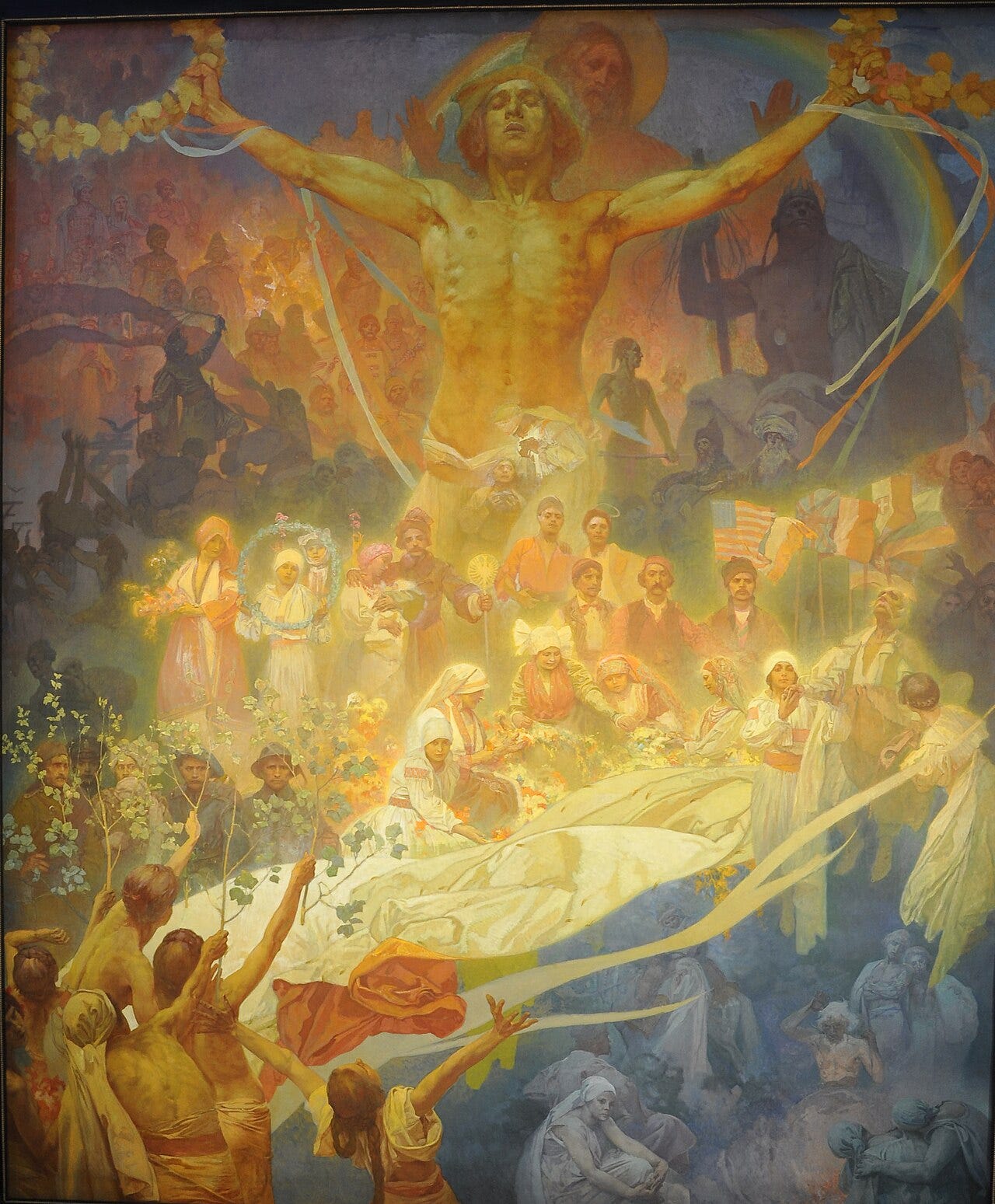
Back in Bohemia, Mucha poured himself into the Slav Epic, a series of twenty enormous canvases telling the story of the Slavic peoples.
He worked on it for roughly eighteen years, into the late 1920s, and he gave the whole cycle to the city of Prague.
This was the work he most wanted to be judged by. Mucha thought of himself as a serious painter of Slavic history and Czech identity, and he somewhat resented being remembered mainly for his decorative Paris posters.
The Epic was his answer to that, a national project rather than a commercial one.
The banknotes, the Gestapo, and a quiet end
When Czechoslovakia became independent in 1918, Mucha offered his skills to the new state, reportedly without charge. He designed its first banknotes and postage stamps and helped design the national coat of arms, so that a Czech visual identity carried his hand.
In March 1939 Nazi Germany occupied the Czech lands. Mucha, by then in his late seventies and a well known patriot, was among those detained and questioned by the Gestapo.
He fell ill soon after, with a lung infection often described as pneumonia, and died in Prague on 14 July 1939.
Where to stand in front of a real Mucha
If you want the real thing, the Czech Republic is the place.
The Mucha Museum, Prague. The essential stop, devoted entirely to his posters, panels and drawings.
The Slav Epic. His 20 monumental canvases, shown in Prague, the work he cared about most.
Major touring shows. His posters travel constantly in Art Nouveau exhibitions worldwide.
A good starting point online is the Mucha Foundation and the National Gallery Prague.
Alphonse Mucha defined the flowing, floral line of Art Nouveau in 1890s Paris posters; three decades later Tamara de Lempicka took that same decorative instinct and hardened it into the sharp angles and metallic sheen of Art Deco portraiture.
The Alphonse Mucha questions that keep coming up
What made Alphonse Mucha famous overnight? The Gismonda poster for Sarah Bernhardt, printed for January 1, 1895: Paris collectors bribed billstickers and cut posters off the walls within days, and Bernhardt signed him for six years.
What is le style Mucha? The swirling hair, halos, and pastel ornament that Paris briefly called by his name before Art Nouveau stuck. He insisted it came from Czech folk sources, not fashion.
What is the Slav Epic? Twenty monumental canvases on Slavic history, painted between 1912 and 1926 and given to the city of Prague, the project he considered his real life's work.
Why was Mucha arrested at the end of his life? The Gestapo interrogated the 78-year-old painter as a patriot freemason after the Nazis took Prague in 1939. Weakened, he died of pneumonia that July.
How much does a Mucha cost? Original lithographs run from a few thousand to six figures for rare states, and his oils have passed the million mark.
Where can I see Mucha? The Mucha Museum in Prague, the Slav Epic on display in Moravský Krumlov and Prague, and poster collections in Paris and Vienna.
More secrets to unlock


Mucha and the poster age, answered
Was Mucha arrested by the Nazis? Yes. When Germany occupied Czechoslovakia in 1939, the Gestapo arrested him among the first, for his patriotic art and his Freemasonry. The interrogations broke his health and he died months later.
What made him famous? His 1895 Gismonda poster for Sarah Bernhardt.
What is The Slav Epic? Twenty huge canvases on Slavic history he gave to Prague.
Did he design anything official? Yes, the first banknotes and stamps of Czechoslovakia, for free.
How do you say his name? Roughly MOO kha, with a soft throaty kh.
When did he live? Born in 1860, died in 1939.