
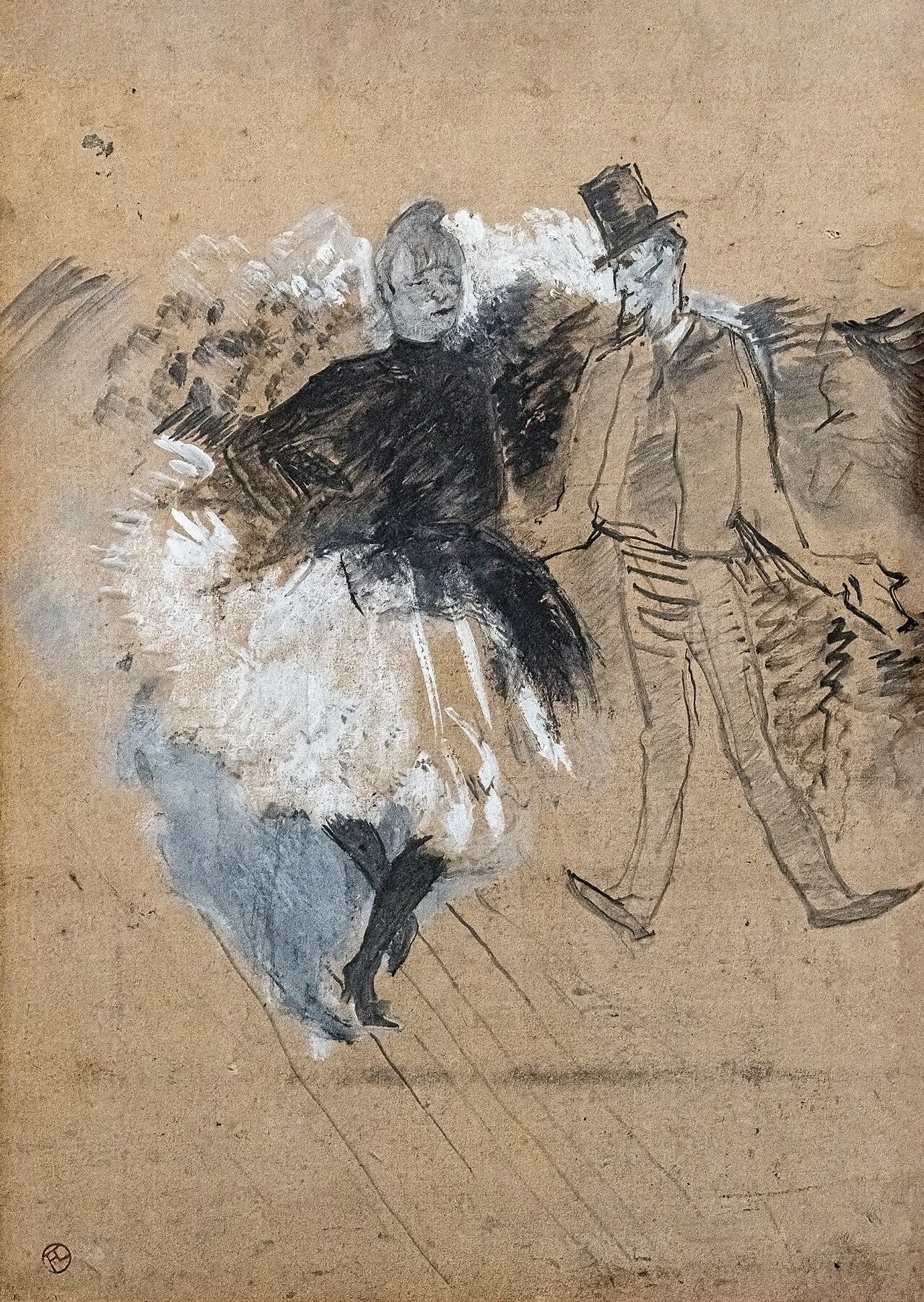
Lithography is a way of printing from a flat surface, usually a smooth slab of limestone, using a simple chemical fact: grease and water do not mix.
The artist draws with a greasy crayon, the stone is wetted and inked, and ink sticks only to the drawing. Nothing is carved, nothing is bitten.
Woodcut prints from a raised surface. Etching prints from a sunken one.
Lithography prints from a flat one, and that makes it the odd one out.
Lithography, the basics
What it is: printing from a flat stone, with no carving at all.
The trick: grease attracts ink, water repels it, so only the drawing prints.
The feel: it can look exactly like a chalk or crayon drawing.
The golden age: the poster boom of 1890s Paris.
The masters: Daumier, Goya at the very end, and Toulouse Lautrec.
Keep learning art the fun way


Printing with no cut at all
Every older print needs a physical groove. A relief block stands up, an intaglio line sinks down. Lithography needs neither.
The artist draws straight onto a polished stone with a greasy crayon or ink. The stone is treated, then kept damp.
When an inked roller passes over it, the ink clings to the greasy marks and slides off the wet blank areas. Press paper to the stone and the drawing transfers.
The surface stays flat the whole time. The image lives in chemistry, not in depth.
A printmaker who just wanted to print plays
Lithography was not invented by an artist. It was invented by someone trying to save money.
In 1796 a struggling Bavarian playwright named Alois Senefelder was looking for a cheap way to print his own scripts.
Experimenting with greasy ink on Bavarian limestone, he stumbled on the grease and water principle and realized he had a brand new way to print. He called it stone writing, which is what lithography means.
To my mind it is the only major printmaking process that was stumbled upon rather than carved into being.
The crayon that fooled everyone
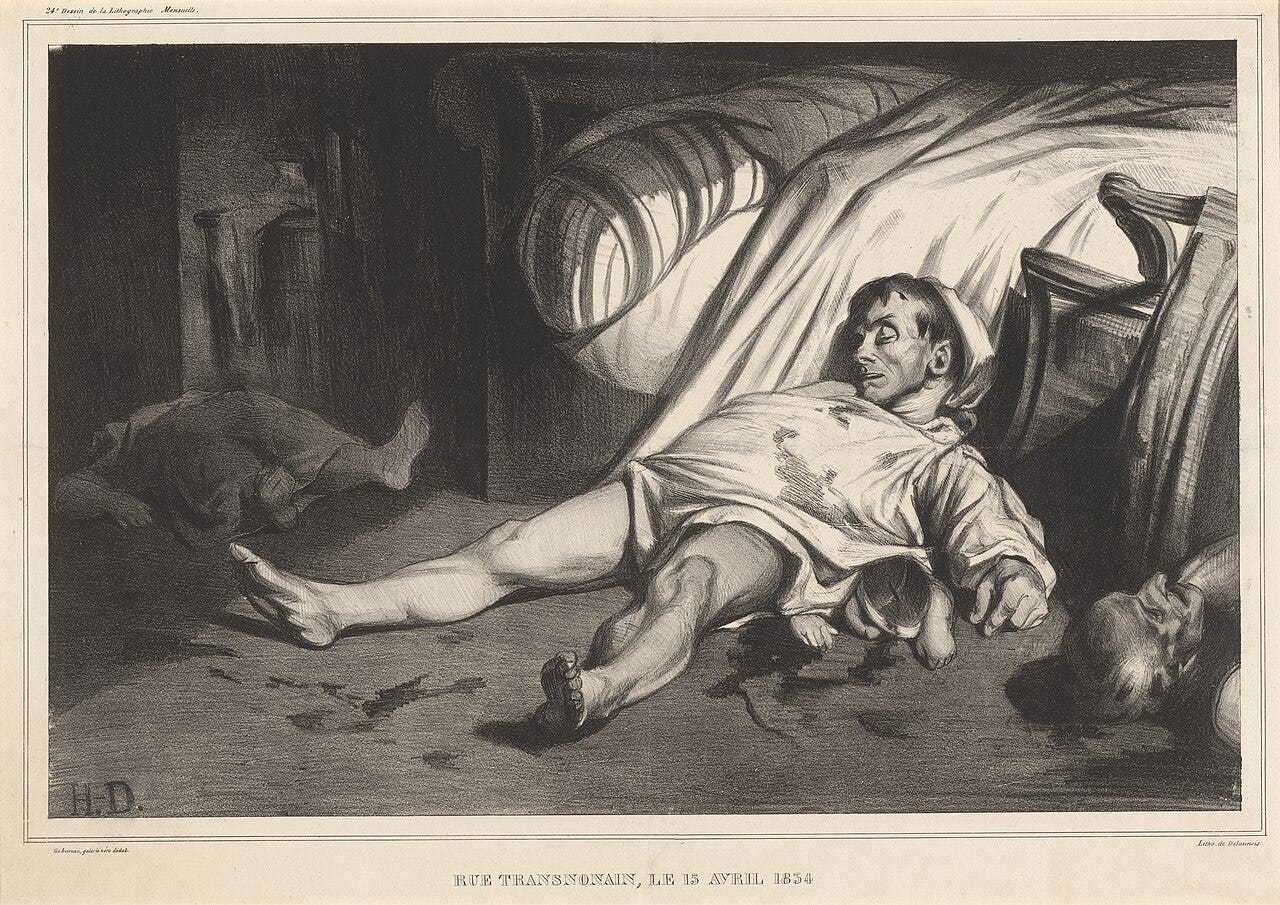
The wonder of lithography is how natural it looks.
Because the artist simply draws, a lithograph can reproduce the exact softness of a crayon, the smudge of a thumb, the speed of a sketch. Honore Daumier used it to fire off some 4,000 biting caricatures for the Paris press, many in Le Charivari.
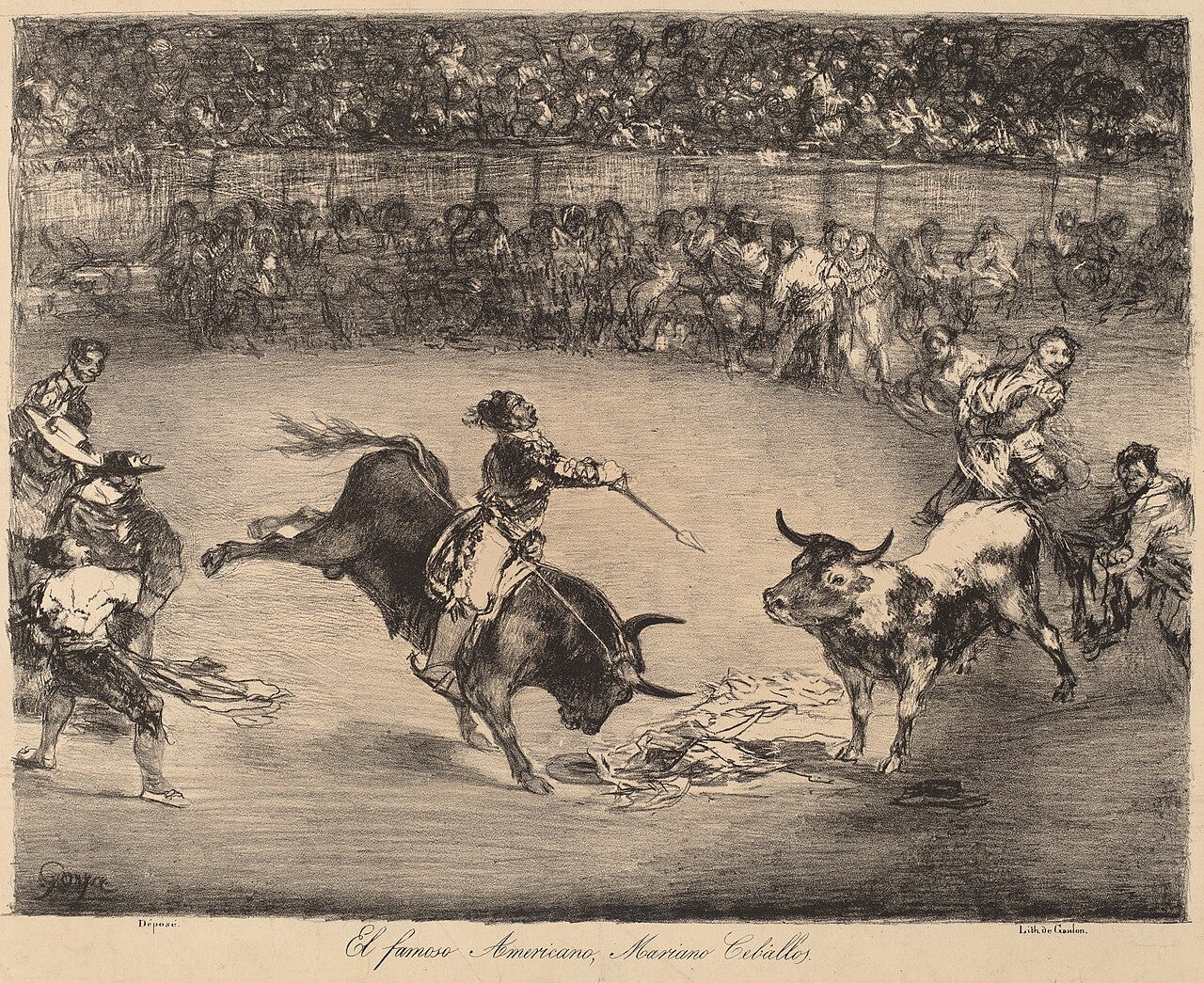
Goya, old and exiled in Bordeaux, used it for his last great works, a set of charging bulls drawn with a freedom his etchings never had.
No translation into line or dot. The drawing prints as a drawing.
The poster that conquered the street
Then color lithography turned the medium loose on the city.
In 1890s Paris, Henri de Toulouse Lautrec built giant color posters for the Moulin Rouge and its dancers, flat planes of color and crisp silhouettes pulled from several stones in register.
Pasted on walls all over the city, they turned advertising into art and made the lithographic poster the look of the age.
The same stone that printed quiet caricatures now shouted across boulevards.
The studio of the modern masters
Lithography never became a museum relic. In mid 1900s Paris, the Mourlot workshop drew in Picasso, Matisse, Chagall and Miro, who made hundreds of lithographs there.
Picasso alone pared a single bull down to a few lines across eleven printed states in 1945, a sequence I find mesmerising.
Original art or cheap copy
Here is where the word gets muddy.
Today people say lithograph and often mean a machine printed poster of a famous painting, the kind sold in museum shops. That is offset reproduction, not the same thing.
An original lithograph is one the artist actually drew on the stone, conceived as a print from the start. Daumier, Goya and Toulouse Lautrec made original lithographs, real works of art, not copies of anything.
The technique behind your cheap wall print and behind a Toulouse Lautrec is the same. The intent could not be more different.
How to spot a real lithograph
A few signs separate an original from a shop reproduction:
It was drawn by the artist on the stone, not photographed from a finished painting.
A pencil signature and an edition number like 12/50 sit in the margin.
Under a loupe the marks show grainy crayon texture, where an offset copy shows a tidy dot grid.
It stands as a work in its own right, not a copy of a famous canvas.
The Met in New York holds both an original Moulin Rouge poster by Toulouse Lautrec and a sheet from Goya’s Bulls of Bordeaux.
Lithography, the stone questions
What is lithography? A way of printing from a flat stone using the fact that grease and water repel each other.
How is it different from etching or woodcut? Nothing is carved or bitten. The surface stays flat and the image is chemical.
Who invented it? Alois Senefelder, around 1796, while trying to cheaply print his own plays.
Why does a lithograph look like a drawing? Because the artist draws directly on the stone, so the marks print exactly as made.
Is a lithograph an original artwork? It can be. An original lithograph is drawn by the artist. A shop poster of a painting is a machine reproduction.
More secrets to unlock


A drawing that learned to multiply
Lithography changed almost nothing about the act of drawing. It simply let an artist draw once and print that drawing a thousand times, every smudge and hesitation intact.
There is one last irony, and you can measure it at auction. A Toulouse Lautrec poster, printed cheaply to be pasted on a wall and torn down, now changes hands for six figures.
