
Henri de Toulouse Lautrec was the French aristocrat who became the great painter of Paris nightlife. His Moulin Rouge posters made him famous and changed advertising art forever.
Born a count in 1864 and dead at 36, he spent his short life among the dancers, singers and sex workers of Montmartre, turning the cabaret into the first great subject of modern advertising art.
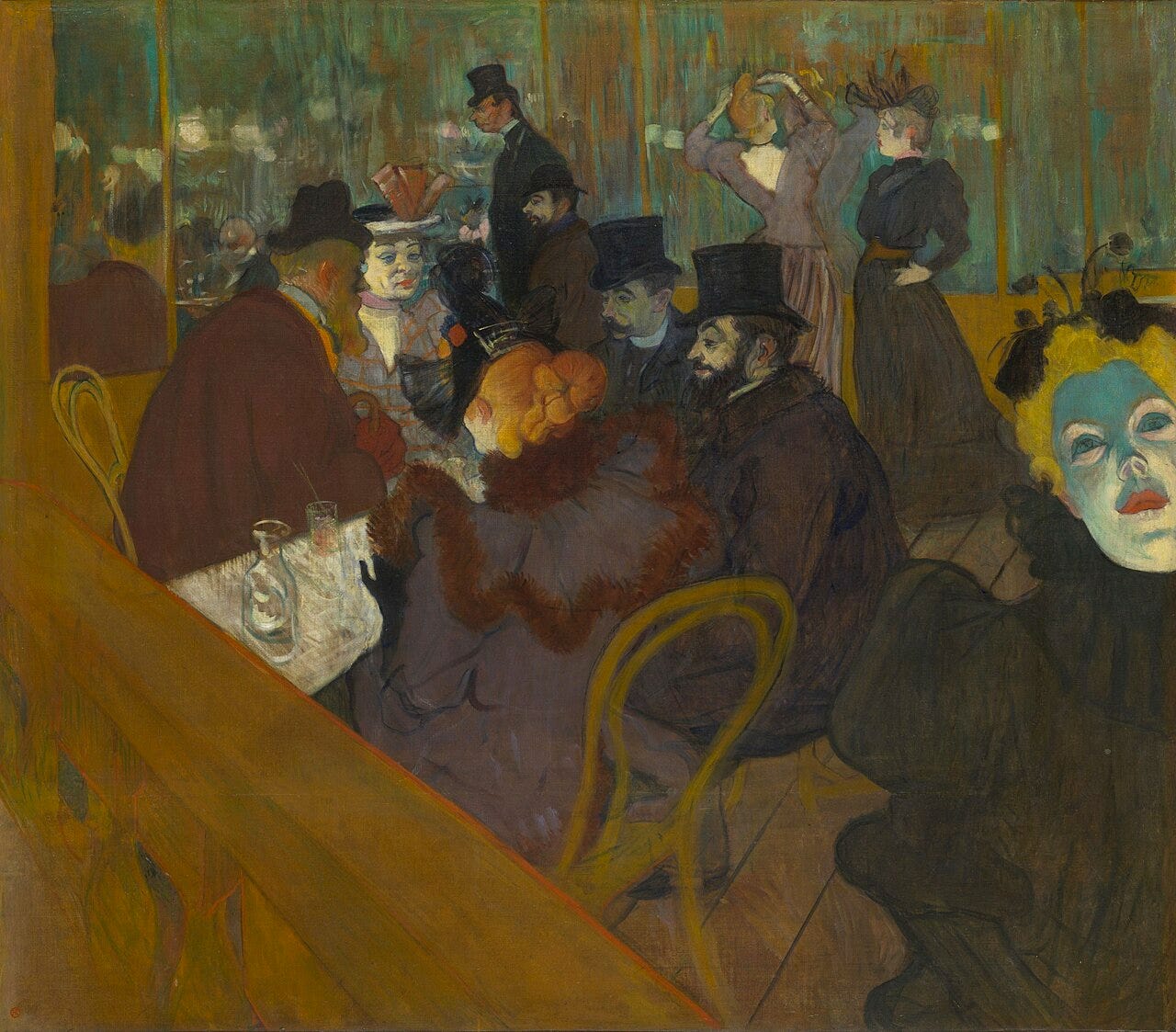
He was also a man the world stared at. A bone condition left his legs stunted, so that a count born into one of France's oldest families stood barely over a meter and a half tall, and chose to live among the outcasts of the cabarets.
He burned through life and was dead at 36. Here is the whole story.
Henri de Toulouse-Lautrec at a glance
1864. Born in Albi to one of the oldest noble families in France.
1878. The first of two falls that broke his femurs. His legs stopped growing.
1891. The Moulin Rouge poster made him famous overnight.
1899. Committed to a clinic, he drew the circus from memory to prove his mind was intact.
1901. Died at 36 at his mother's château. She later built the Albi museum that carries his name.
The count who painted the cabarets
Lautrec is famous for two things at once. He invented the modern poster, and he immortalized a whole world of Paris nightlife.
His posters for cabarets like the Moulin Rouge turned advertising into art, and his paintings captured dancers, drinkers and sex workers as real people, not jokes or symbols. He gave dignity to a world polite society pretended not to see.
His body, and the syndrome named after him
Lautrec's parents were first cousins, and he was born with a fragile bone condition. As a teenager he broke both legs, and they stopped growing while his torso developed normally, the pattern doctors now group under Toulouse Lautrec syndrome.
As an adult he stood around one and a half meters tall, walking with a cane. He turned the isolation it caused into sharp, clear eyed observation of others.
The genetic disorder behind it is now sometimes called Toulouse Lautrec syndrome, named after its most famous sufferer. That diagnosis was made long after his death, though, and has never been proven.
Posters built to read across a crowded street
His look is unmistakable, and built for the printed page.
Flat, strong color. Large areas of solid color with little shading, made to read across a crowded street.
The cut off edge. Figures sliced by the frame, as if you just glimpsed them in a busy room.
The confident line. A quick, sure outline that captures a dancer or drinker in a few strokes.
Empty space. Big blank areas that make the figures pop, a trick learned from Japanese prints.
He was a master of lithography, the printing method that let his posters cover Paris, and his painting belongs to Post Impressionism.
Montmartre and the Moulin Rouge
Lautrec made his home in Montmartre, the hilltop district of cabarets, dance halls and bohemian life.
His 1891 poster for the Moulin Rouge, starring the dancer La Goulue, made him an overnight sensation. He became the chronicler of the cabaret stars, the dancer Jane Avril, the singer Aristide Bruant in his red scarf, the performer Yvette Guilbert with her long black gloves.
Three decades later, another painter turned the same city into her subject. The Danish artist Gerda Wegener painted the cabarets and the lesbian salons of 1920s Paris with an equally direct eye.
More incredible painter stories
If Henri de Toulouse Lautrec pulled you in, you will love these too:


The world of the brothels
Lautrec went where few respectable painters dared. For long stretches he lived inside Paris brothels, and painted the women there in a series sometimes called Elles.
He showed them resting, bored, dressing, simply existing between clients, with sympathy rather than judgment. For me it is some of the most honest and human work of its time.
What he took from Degas and Japan
Lautrec built his style from a few key sources.
From Edgar Degas he took unexpected angles and scenes of performers caught off guard. From Japanese woodblock prints he took flat color, strong outline and abrupt cropping.
He fused them into something built for the modern city and the printing press.
The drinking and the decline
Lautrec lived as hard as the world he painted. He was a heavy drinker, famous for a hollow cane he secretly filled with alcohol and for inventing potent cocktails.
Years of drinking, along with syphilis, wrecked his health. He suffered a breakdown and a spell in a clinic, where he astonished doctors by drawing a whole circus from memory to prove he was well enough to leave.
How Toulouse Lautrec died
His body gave out young. Worn down by alcohol and illness, he returned to his mother's care and died at the family estate of Malrome in 1901, at just 36.
In barely two decades of work he had produced hundreds of paintings and thousands of drawings and prints, and reinvented the poster.
Legacy and the museum his mother built
After his death, Lautrec's devoted mother gathered his work and helped found a museum for it in his hometown.
The Musee Toulouse Lautrec in Albi opened in 1922 and holds over a thousand of his works, the largest collection of his art anywhere.
Two French museums, above all
Two French museums lead the way.
The Musee Toulouse Lautrec, Albi. The essential stop, with the world's largest collection, in his birthplace.
The Musee d'Orsay, Paris. Holds major paintings and posters among its Post Impressionist treasures.
Outside France, the Metropolitan Museum of Art in New York holds his Moulin Rouge posters.
The studios of Bonnat and Cormon
In 1882 the young Toulouse Lautrec came to Paris to train. He entered the studio of Leon Bonnat, a strict academic painter, and then moved to the atelier of Fernand Cormon.
Cormon's studio was livelier and more open, and it turned out to be the making of him. There he learned the discipline of drawing while mixing with a circle of restless young artists.
Among the students he met were Vincent van Gogh, Emile Bernard and Louis Anquetin. In that room the future of modern painting was quietly gathering, and Lautrec was in the middle of it.
The pastel portrait of Van Gogh
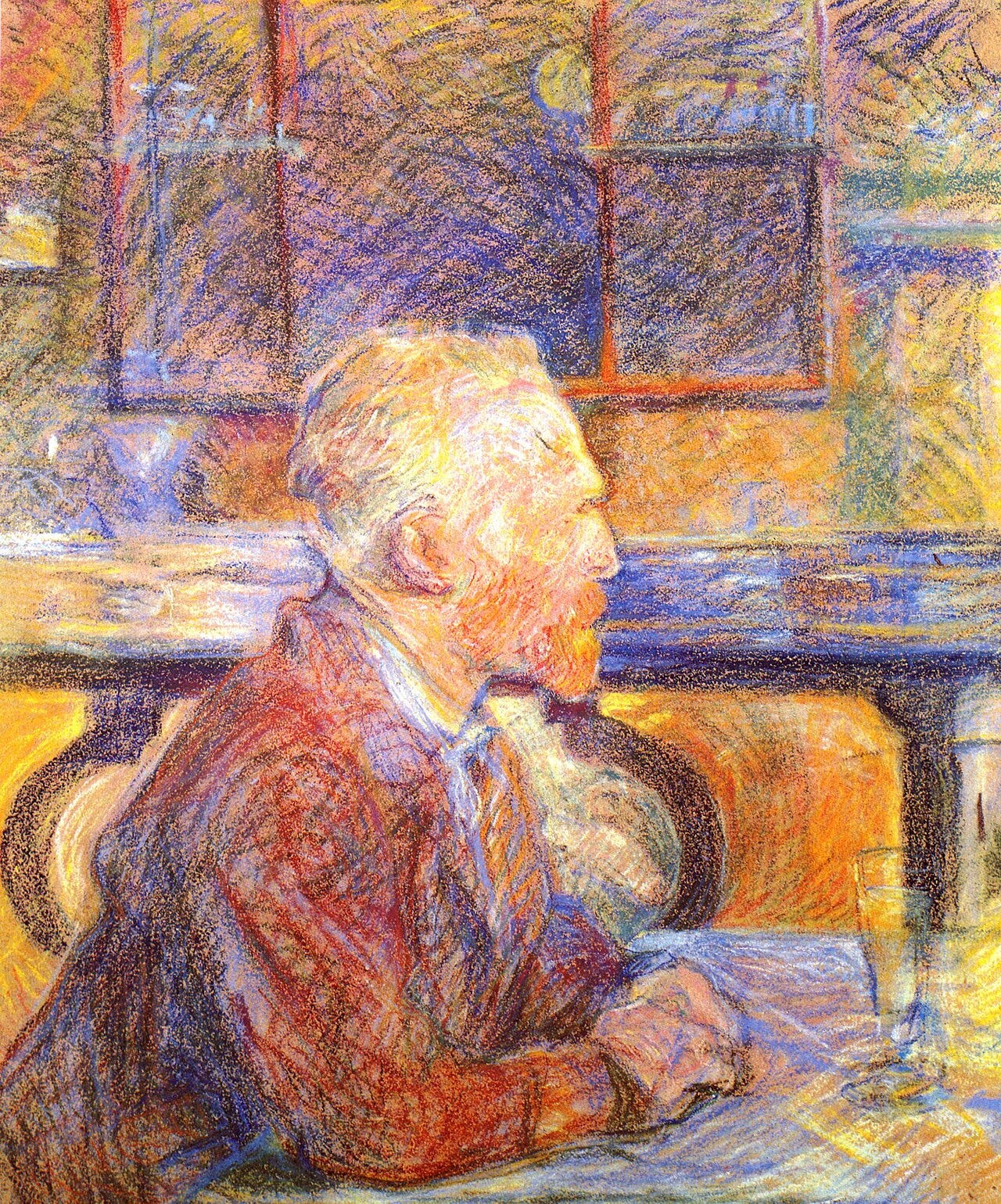
The friendship between Lautrec and Van Gogh left one memorable object. In 1887 Lautrec drew a portrait of Vincent in pastel, seated in profile at a cafe table with a glass of absinthe before him.
It catches Van Gogh leaning forward, tense and alert, a year before he left Paris for the south. The two men admired each other and shared an outsider's view of the art world.
The pastel now hangs in the Van Gogh Museum in Amsterdam. It is one of the few portraits of Vincent made by a friend who was himself becoming a major artist.
The performers he turned into legends
Lautrec did not invent the stars of Montmartre, but his posters and paintings fixed them forever. The dancer La Goulue kicks her leg at the Moulin Rouge, the singer Aristide Bruant scowls in his red scarf and black cape, and Jane Avril spins in a private world of her own.
Suzanne Valadon belonged to that same world too, a former circus acrobat who modeled for him before he encouraged her to paint.
He watched these performers night after night and caught the exact tilt of a head or flick of a hand that made each one recognizable. His images became their public faces.
The English dancer May Milton and the diseuse Yvette Guilbert, with her long black gloves, joined the cast. Through Lautrec, a handful of cabaret entertainers became some of the most reproduced figures of their age.
The circus drawn from memory
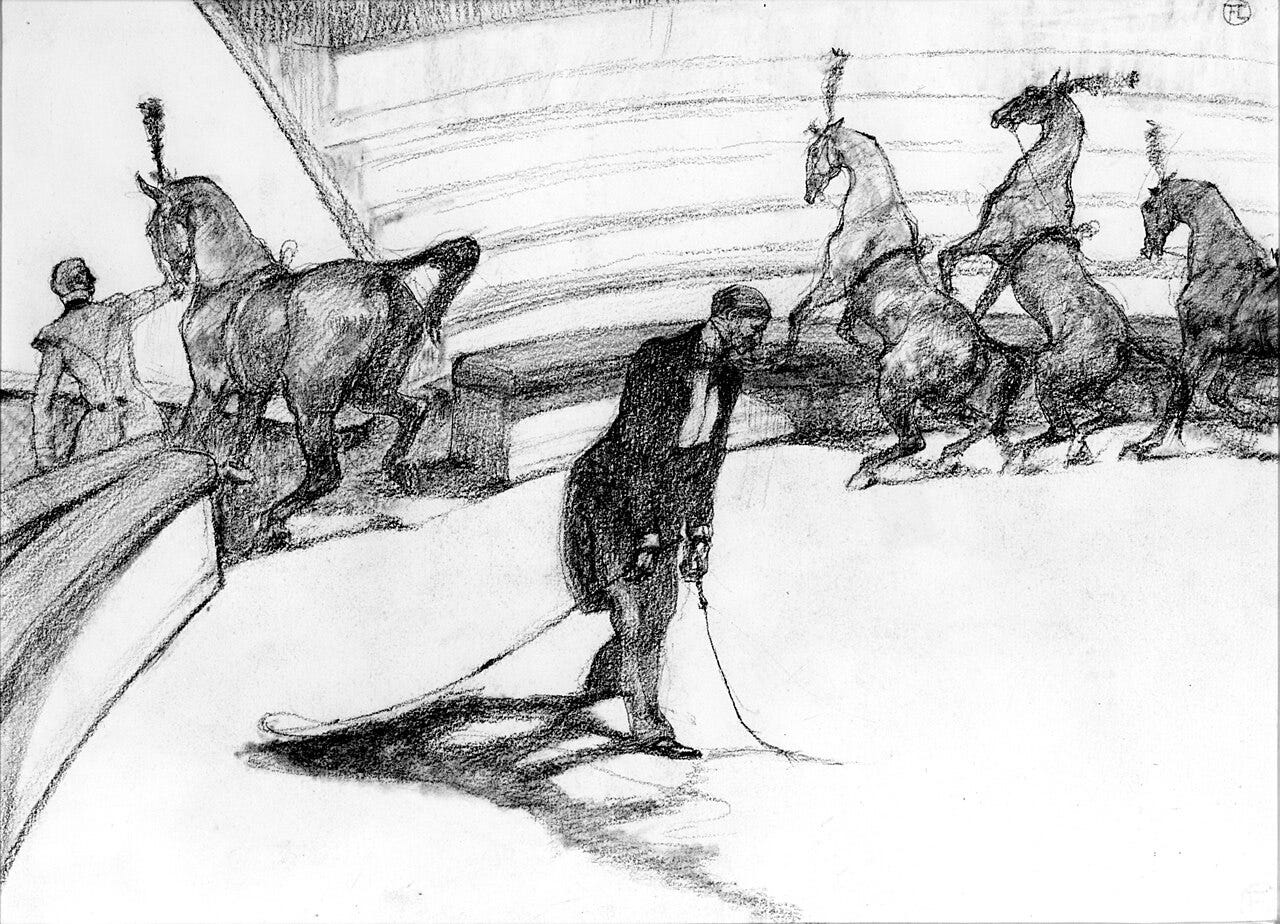
By 1899 Lautrec's drinking had wrecked his health, and his family had him placed in a clinic at Neuilly, outside Paris. He was determined to prove he was sane and could leave.
With no models and no cabaret in front of him, he drew a whole series of circus scenes entirely from memory, horses, riders, clowns and acrobats set down in colored crayon. The doctors were impressed, and he was released.
The relief did not last. He soon returned to drink, and his body gave out. Lautrec died in 1901 at the family estate of Malrome, at just 36. The circus drawings survive as proof of how much he could summon from memory alone.
The album called Elles
Beyond the famous posters, Lautrec made albums of fine prints. In 1896 he published Elles, a set of lithographs about the women of the Paris brothels.
The prints show these women not at work but at rest, washing, dressing, lying down, treated with a plain, unjudging attention rare for the subject.
The album sold poorly at the time and is prized now. It shows the quieter, more tender side of an artist better known for the noise of the dance hall.
Toulouse Lautrec at the Moulin Rouge, answered
How tall was Toulouse Lautrec? Around one and a half meters, due to a bone condition that stunted his legs.
What is Toulouse Lautrec syndrome? A genetic bone disorder named after him, which can cause short stature and fragile bones.
How did he die? From the effects of alcoholism and syphilis, in 1901, aged 36.
Where was he from? Albi, in the south of France, born into an aristocratic family.
What is he known for? His Moulin Rouge posters and his paintings of Paris nightlife.
Did Toulouse Lautrec know Van Gogh? Yes. They met around 1886 in the Paris studio of Fernand Cormon, where both were students. In 1887 Lautrec drew a pastel portrait of Van Gogh at a cafe table, now in the Van Gogh Museum in Amsterdam.
How tall was Toulouse Lautrec? He is usually said to have stood about 1.52 meters, roughly five feet. Two childhood leg fractures that failed to heal properly, linked to a bone condition, left his legs short while his torso grew to adult size.
What is Toulouse Lautrec actually famous for? Montmartre nightlife and the modern art poster itself, the form he more or less invented for the Moulin Rouge. The short answer, spelled out, covers Jane Avril and La Goulue too.


