
Correggio, who lived from about 1489 to 1534, was an Italian painter who worked far from Rome in the northern city of Parma, yet his soft, sensual figures and dizzying dome ceilings quietly invented the future of Baroque painting.
He spent his life in a provincial town yet taught ceilings to dissolve into open sky and figures to melt into light, decades before anyone else dared.
Tip your head back under the dome of Parma Cathedral and the ceiling seems to dissolve into open sky, a spiral of figures rushing up toward the light.
More incredible painter stories
If Correggio pulled you in, you will love these too:


When Correggio painted it, some contemporaries were baffled. One reportedly sneered that it looked like a hash of frogs legs. They were wrong: he had just invented the future of ceiling painting.
Correggio worked far from Rome and Florence, in the northern city of Parma, yet his soft, sensual, dizzying art quietly prophesied the whole Baroque to come.
Correggio at a glance
1489. Born Antonio Allegri around this year in Correggio, the small town that gave him his name.
1519. Painted the private room of the abbess Giovanna in Parma, the Camera di San Paolo.
1520. Began the dome of San Giovanni Evangelista, his first opened sky.
1530. Finished the Assumption dome of Parma Cathedral, a whirlpool of ascending figures.
1534. Died back in his home town, barely 44.
The dome that became the sky
Correggio painted the inside of the Parma Cathedral dome as a swirling vortex of figures spiralling up into light, seen sharply from below. Nothing like it had been attempted.
That dizzying upward illusion, a remarkable feat of fresco painting, prophesied the great Baroque ceilings of the following century.
Softness and sensuality
His figures are famously tender and soft, modelled in gentle gradations of light and shade that seem to melt rather than carve. He used chiaroscuro not for drama but for caress.
That sweetness made him one of the most admired painters of tenderness and the female form in all of Italian art.
The Loves of Jupiter
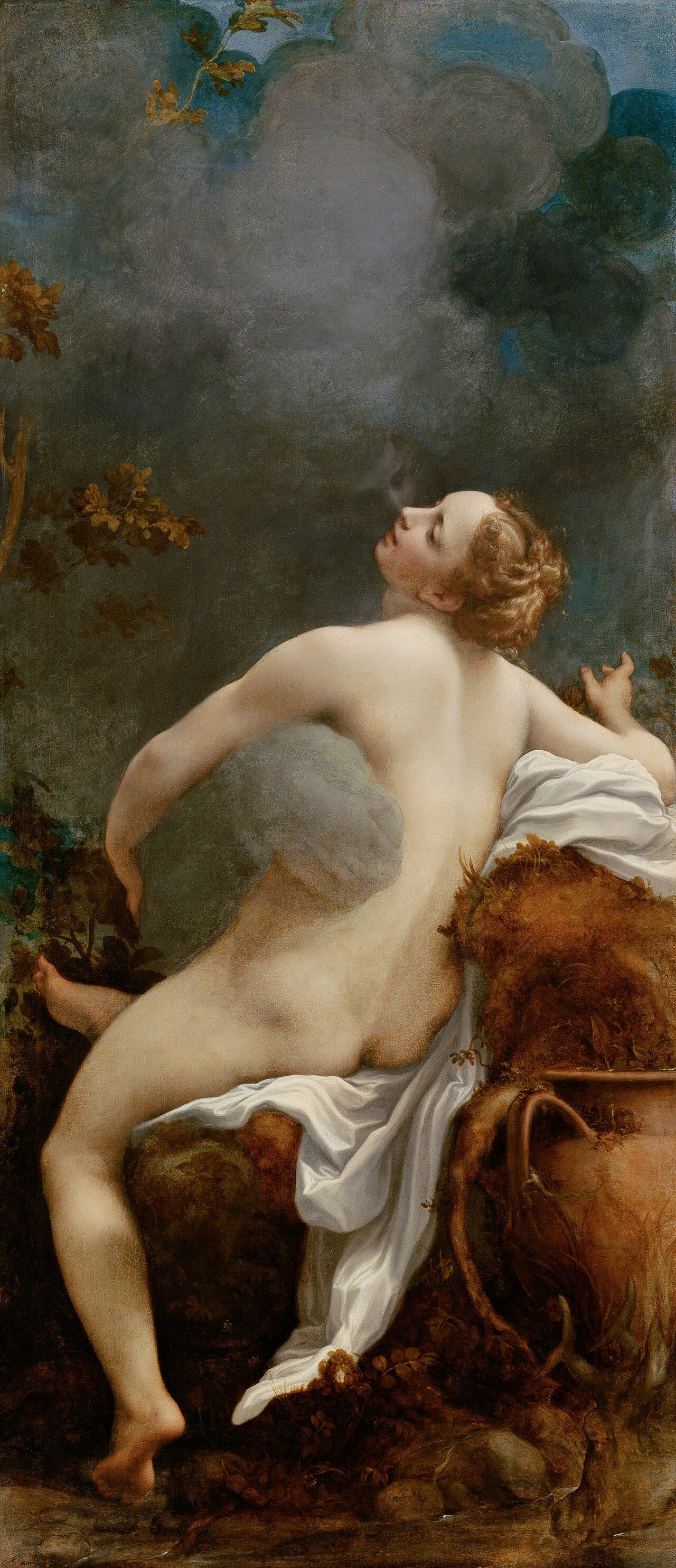
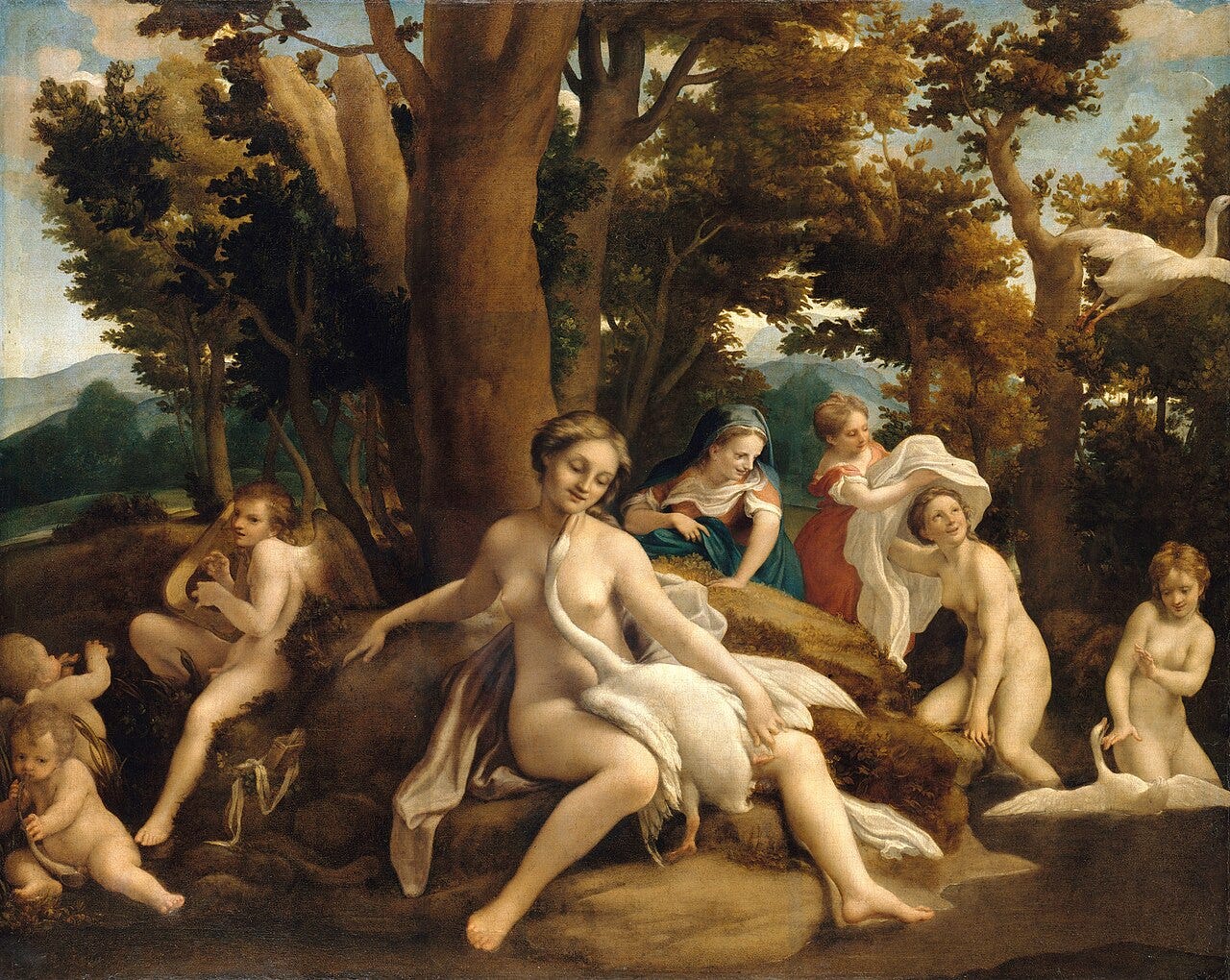
Late in life Correggio painted a set of erotic mythologies for Federico Gonzaga of Mantua, the Loves of Jupiter, showing the god seducing mortals as a cloud, a swan, a shower of gold and an eagle, probably meant as a princely gift for the emperor Charles the Fifth.
Their later history was rough. One pious owner was so disturbed by the Leda that he had her head cut out of the canvas, before it was later restored.
Famous late, then loved
Correggio was little known beyond Parma in his lifetime, but later painters fell hard for him. From Lanfranco to the high Baroque, artists studied him to learn how to open a roof into the heavens.
His reputation grew steadily after his death until he was ranked among the great masters of soft, sensual painting.
The painter from a small town
He is named after Correggio, the small town where he was born around 1489. He worked mostly in Parma, far from Rome and Florence.
Yet from that quiet corner he leapt a century ahead. His painted domes seem to dissolve the ceiling into open sky, an illusion later Baroque artists would chase for two hundred years.
Parma, and two small panels in London
The National Gallery in London holds the Madonna of the Basket and the sensual School of Love. His ceiling frescoes are still in place in Parma.
Who taught him to paint
Correggio grew up far from Florence and Rome, so his schooling as a painter is patchy in the records.
The National Gallery says he was probably trained by a minor artist, Francesco Bianchi Ferrari, in nearby Modena. After that he seems to have taught himself by looking hard at other people's work.
He studied Andrea Mantegna in Mantua, borrowed from Lorenzo Costa, and copied ideas from Northern European prints. Two forces mattered most.
One was Leonardo da Vinci, whose soft sfumato had been on show in Milan. The other was the warm color of the Venetians. There is no signed contract for an apprenticeship, so much of this is reconstructed from his paintings rather than documents.
The early altarpieces
Before the famous ceilings, Correggio built his name the ordinary way, painting altarpieces for churches around his home region.
These date mostly from the 1510s. One documented example is the so called Madonna of Saint Francis, delivered around 1514 or 1515 and now in Dresden.
In pictures like this you can already see him softening every edge, letting light fall like it does in Leonardo.
They are calm, tender scenes rather than grand statements. Saints lean in. Babies squirm. Faces glow from within. This is the quiet apprentice stage that made the later leap possible. By the time Parma called, he had years of altarpieces behind him.
A private room for an abbess
Correggio's first big Parma job was not a church at all. Around 1518 to 1519 he was hired to decorate the ceiling of a private dining room, the Camera di San Paolo, inside a convent.
The commission came from the convent's abbess, usually named as Giovanna da Piacenza, who wanted something worldly, not pious.
He painted the vault as a leafy pergola. Through gaps in the greenery, plump little putti lean out holding hunting trophies. Below them run scenes of the goddess Diana and figures from myth.
For a nun's quarters it is a surprising choice of subject. It also told Parma exactly what this newcomer could do. The room reads as an open garden overhead, years before he opened up a whole cathedral.
Saint John's vision, his first real dome
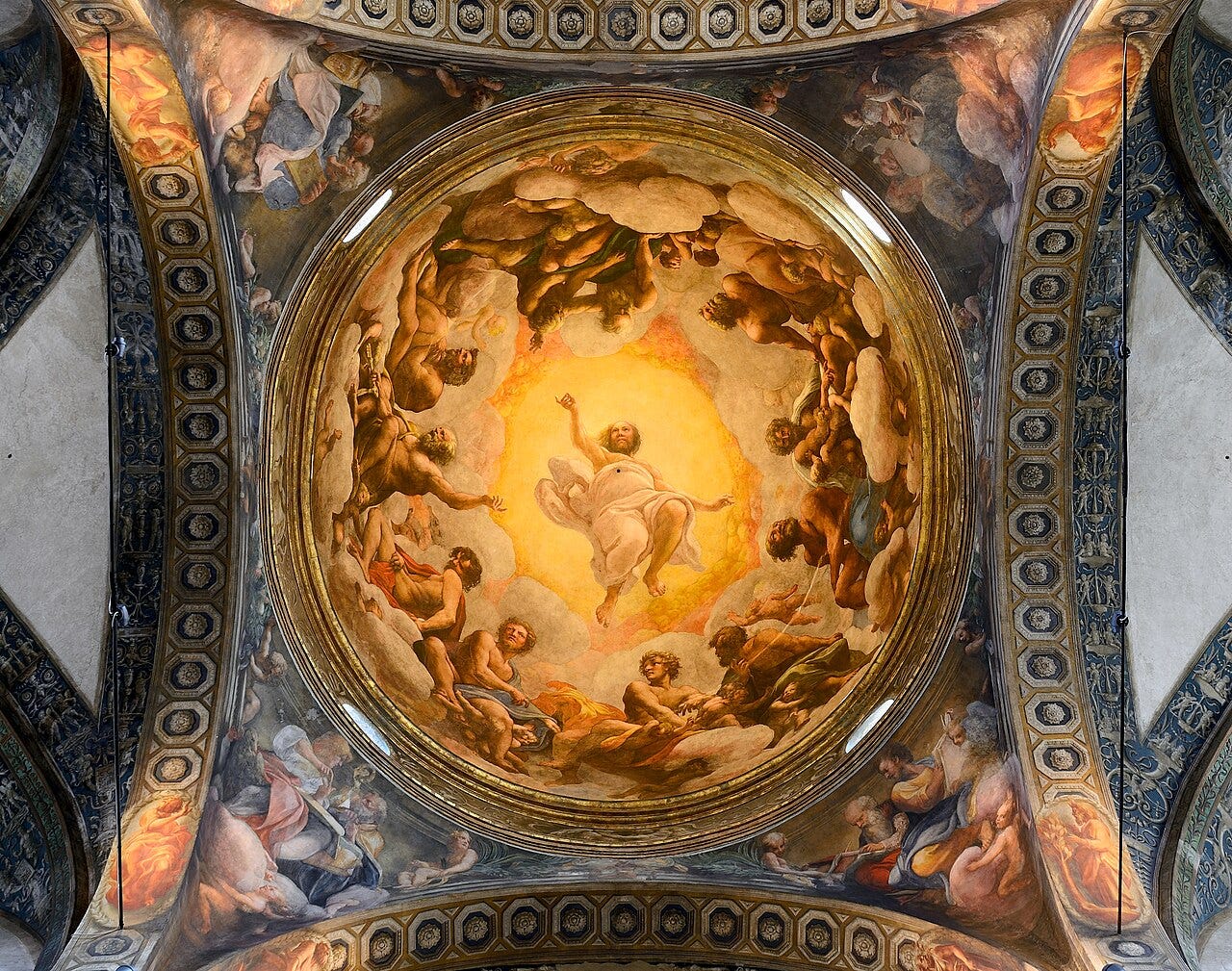
In the early 1520s Correggio took on the dome of the church of San Giovanni Evangelista in Parma. It was his first true test of painting a sky onto a curved ceiling.
The subject is the vision of Saint John the Evangelist on the island of Patmos. Christ floats down through golden cloud, ringed by the seated apostles, while John gazes up from the edge.
Look up and the stone dome seems to dissolve into open air. There is no solid ceiling anymore, only figures riding light. It was a rehearsal.
The idea of turning a hard architectural shell into a hole in the heavens was still fairly new, and here Correggio proved it could carry a whole building.
The paintings people called Day and Night
Away from the ceilings, Correggio painted two altarpieces so admired that Parma gave them nicknames.
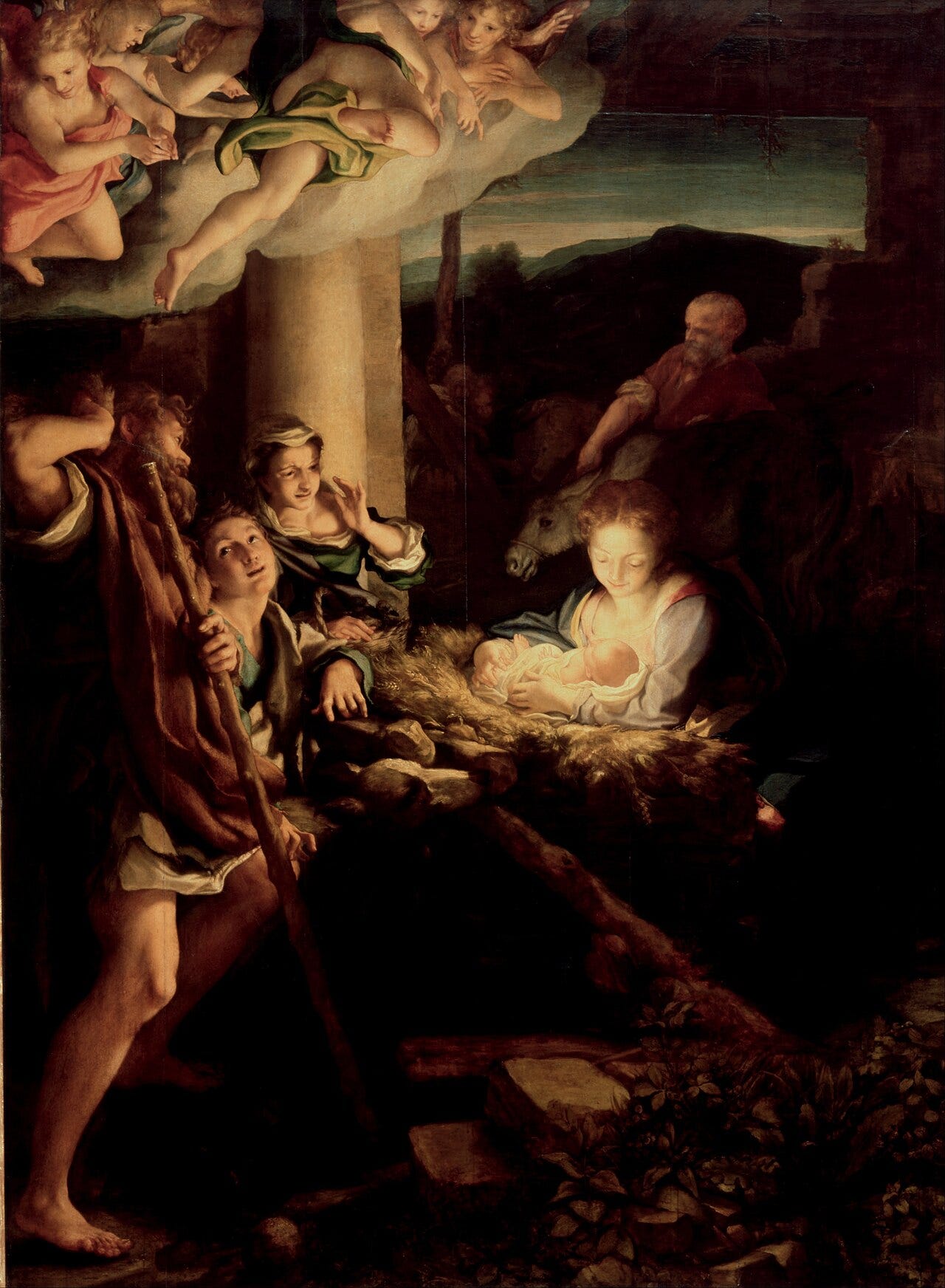
One is the Adoration of the Shepherds, better known as The Holy Night, or simply La Notte, the Night. It was commissioned in 1522 and finished around 1530.
The whole scene is lit by the newborn Christ himself, whose body seems to give off the only light. Painting a light source inside the picture like this was rare and much copied.
Its partner is the Madonna of Saint Jerome, from about 1527 to 1528, nicknamed The Day, or Il Giorno. Here everything is warm daylight and soft skin. Day and Night, one bright and one dark, became a pair in people's minds.
The duke of Mantua comes calling
Late in his life Correggio picked up a very different kind of patron. Federico the Second Gonzaga, the ruler of nearby Mantua, wanted mythological pictures for private eyes only.
Around 1530 Correggio produced a set often called the Loves of Jupiter. Scholars think the canvases may have been meant as a gift, possibly for the Holy Roman Emperor Charles the Fifth, though the exact plan is uncertain.
Today the group is scattered across Europe. Jupiter and Io is in Vienna, Danae is in the Galleria Borghese in Rome, and related panels hang in Berlin.
It is a small body of secular work from a man known for churches. That a powerful duke sought him out shows how far his name had traveled by the end.
A quiet life and a thin paper trail
For an artist this influential, Correggio left oddly little trace of himself.
He spent almost his whole career in the small Emilian towns near his birthplace, chiefly in Parma. Unlike Michelangelo or Raphael, he did not settle into the glare of Rome or the courts of Florence.
He may have visited Rome around 1518, but even that is unproven.
Very few documents about his daily life survive. No diary, no famous circle of letters, few reliable records of who he knew. Much of the story we tell comes from Giorgio Vasari, writing decades after Correggio died and never having met him.
That means dates are often about and anecdotes often reportedly. The paintings are loud. The man stayed quiet.
Back home, and gone too soon
Correggio ended where he began. He returned to his home town of Correggio and died there on the fifth of March 1534.
He was only about 45, having been born around August 1489. By the standards of the great Renaissance names, that is a short life.
The cause is not documented. A sudden fever is sometimes mentioned in later accounts, but it is not certain, so it is best treated as tradition rather than fact.
He did not live to see how large his shadow would grow. The soft light, the tender skin and the ceilings that open onto sky would feed Parmigianino, then generations of Baroque and Rococo painters.
The Correggio questions that keep coming up
What is Correggio famous for? The illusionistic domes of Parma, ceilings that dissolve into open sky a century before the baroque, and the tender eroticism of his mythologies.
What is special about the Parma Cathedral dome? His Assumption of the Virgin, painted 1526 to 1530, spirals hundreds of figures upward into light. One canon allegedly grumbled it looked like a hash of frogs' legs; Titian reportedly said the dome filled with gold would not equal its worth.
What are the Loves of Jupiter? His 1530s mythological series for Federico Gonzaga, including Jupiter and Io, where the god arrives as embracing cloud, now split between Vienna, Berlin, and Rome.
Who did Correggio influence? Every baroque ceiling descends from his domes, and the eighteenth century adored him: collectors ranked him beside Raphael, and Parmigianino grew up in his shadow.
Why is Correggio less famous today? His best work cannot travel: the domes are architecture, Parma is off the main tourist axis, and no scandal or biography feeds the legend machine.
Where can I see Correggio? Parma above all, the cathedral and San Giovanni Evangelista domes and the Camera di San Paolo, then the Louvre, Vienna, Dresden, and the National Gallery in London.
What is he known for? His illusionistic Parma dome and his soft, sensual figures.
Why was the dome important? Its dizzying upward illusion prophesied the great Baroque ceilings.
What are the Loves of Jupiter? Erotic mythologies painted for Federico Gonzaga of Mantua.
When did he die? In 1534, in the town of Correggio where he was born.
Was Correggio famous in his own lifetime? No. He was little known beyond Parma while he lived, and only later did painters from Lanfranco to the high Baroque study him closely.
Who was Correggio's teacher? He was probably trained by Francesco Bianchi Ferrari, a minor painter, though the records are thin. His real education came from studying Mantegna, Leonardo and Venetian color for himself.
When and where did Correggio die? He died on the fifth of March 1534 in his home town of Correggio, at about 45 years old. He had been born there around August 1489.
More secrets to unlock


Why his sky still opens
Correggio worked in a quiet provincial city and changed the course of painting anyway, teaching ceilings to dissolve and figures to melt into light. The frog legs joke aged badly: a century of Baroque masters spent their careers catching up to him.
To me he is the great secret of Italian art. Everyone learns Raphael and Michelangelo, and almost no one is told that the man who taught ceilings to open onto the sky worked quietly up in Parma.