
Famous Cat Paintings: 12 That Purr Off the Canvas
Painting a cat is almost a contradiction, since the whole charm of a cat is that it will not pose. The most famous cat paintings are five hundred years of artists chasing that impossible stillness, and mostly failing in the most delightful ways.
Here are twelve of the greatest, all now in the public domain.

From a Japanese master who lived knee deep in cats to a six foot canvas of forty two of them, the cat has driven painters a little mad. I have gathered the pictures that still make cat people gasp.
What prowls through them:
The obsession. Artists who kept dozens of cats and drew almost nothing else.
The money. The priciest cat painting on earth, and the story behind it.
The mischief. Rooftop trysts and grinning cats that scandalized their day.
The stare. That cool, unbothered look no painter could quite pin down.
Where to go deeper
Three worth opening next:
Ten women artists you need to know, the names the textbooks skipped
Was Monet really the first Impressionist, the painting that may have got there first
Lady with an Ermine, detail by detail, why she is holding that animal
1. Utagawa Kuniyoshi, Cats Suggested as the Fifty Three Stations of the Tokaido (1850)
The greatest cat lover in the history of art may be a Japanese printmaker who worked with cats draped over his shoulders. Kuniyoshi filled his studio with them and drew cats as everything, actors, monsters, even the towns along a famous road, each cat curled into the shape of a place name.
When his cats died he gave them Buddhist funerals.
This print turns the fifty three stations of the Tokaido highway into a crowd of cats, one for every stop, a visual pun only he would attempt.
His love of cats runs through hundreds of his woodblock prints, part of the wider Japanese wave that would soon sweep Europe.
Fish sellers, he joked, must have loved him and feared him at once.
2. Carl Kahler, My Wife's Lovers (1891)
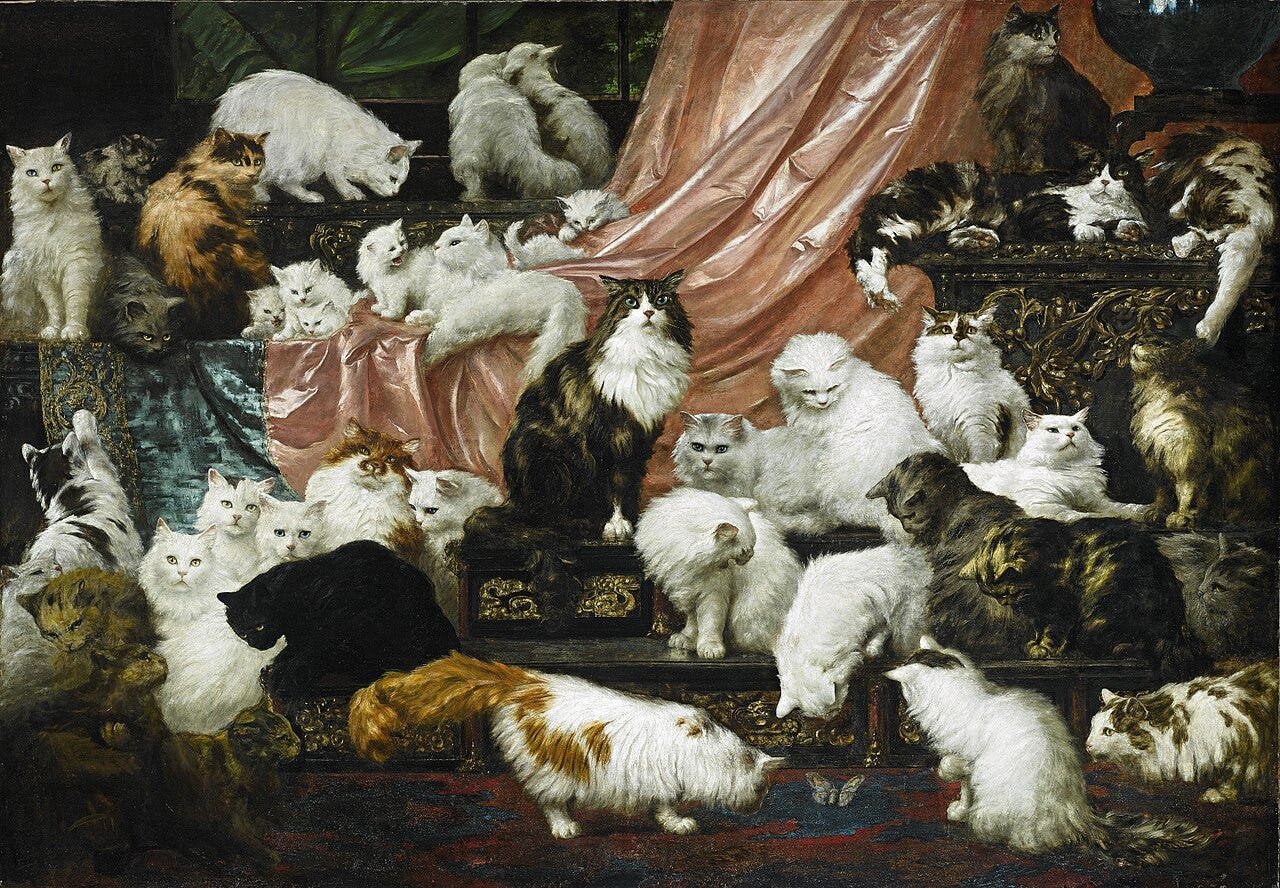
The most valuable cat painting in the world is six feet wide and packed with forty two cats, and it began as a rich woman's whim.
A California millionaire's wife kept a colony of about three hundred and fifty cats and hired an Austrian painter to portrait her favorites.
He had never painted a cat in his life.
Kahler spent three years studying the cats before he could catch their movement, then crammed the finest into one enormous canvas named, with a wink, My Wife's Lovers.
The star was a prize Angora called Sultan, bought in Paris for a small fortune. In 2015 the picture sold at auction for over eight hundred thousand dollars.
3. Theophile Steinlen, Tournee du Chat Noir (1896)
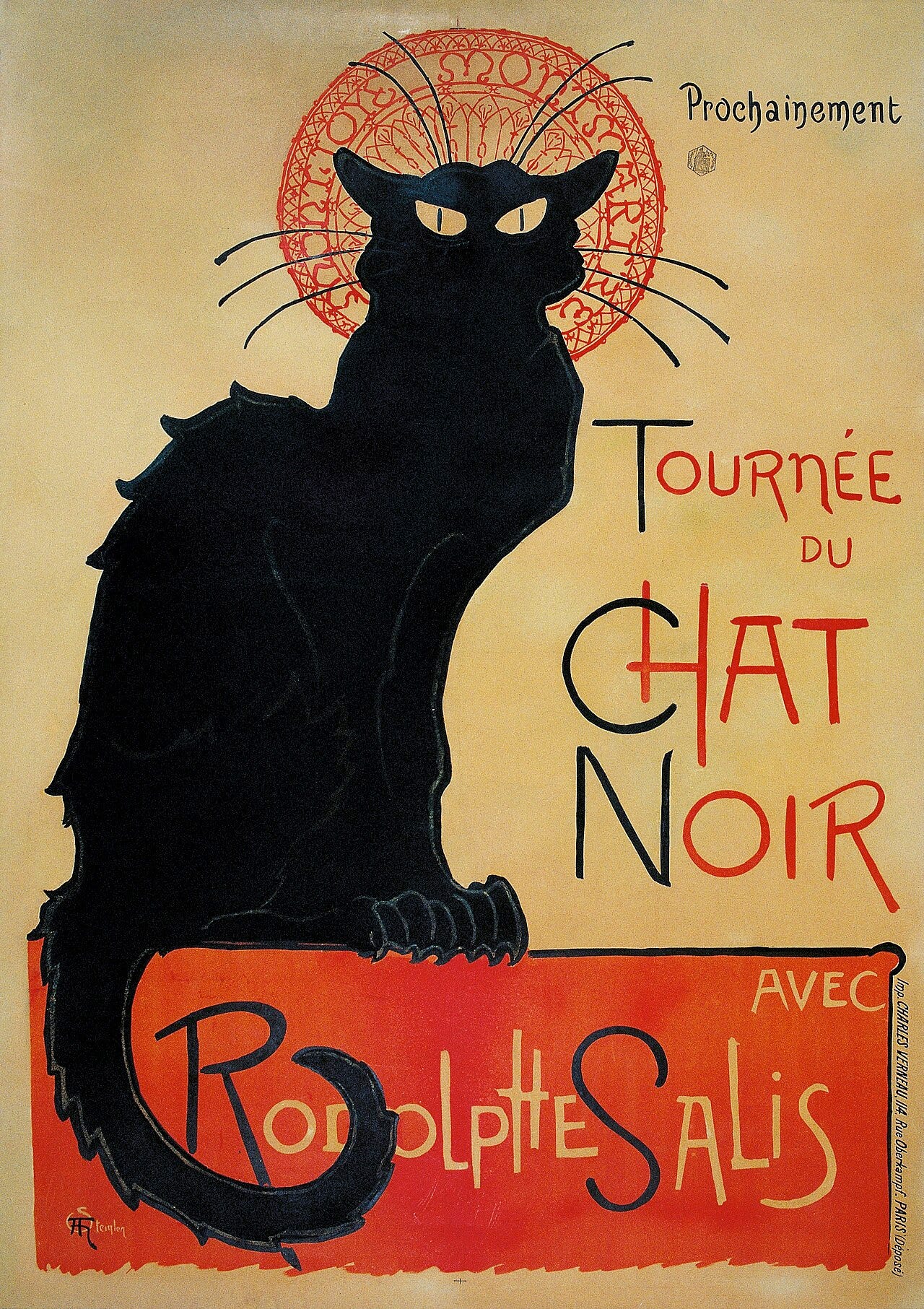
You have seen this black cat on a thousand posters and postcards without knowing it advertised a Paris nightclub. Steinlen designed it as a lithograph poster for the Chat Noir, the most famous cabaret in Montmartre, where poets and drunks gathered under a cat sign.
It became the most reproduced cat image ever made.
The cat sits proud and haloed against a golden ground, half stray and half god. Steinlen owned dozens of cats and let them roam his studio freely, calling the place Cats' Corner.
The Chat Noir cabaret itself closed in 1897, but its haloed cat has outlived it by more than a century, framed on walls all over the world.
4. Leonardo da Vinci, Studies of Cats (about 1517)
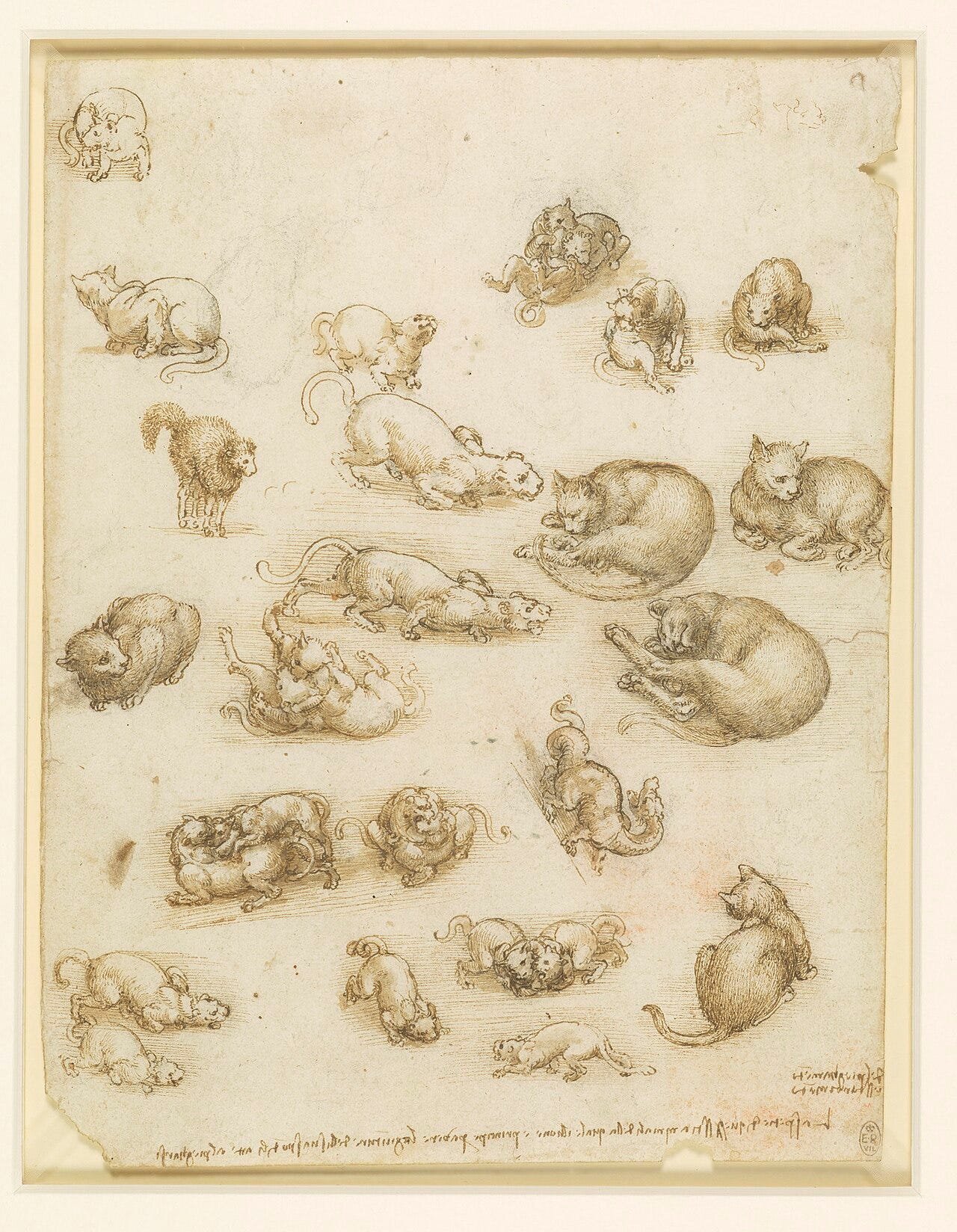
A single sheet swarms with cats, more than twenty of them, stretching, fighting, washing and sleeping, all drawn from close watching.
Leonardo studied cats the way he studied muscles and rivers, as machines of pure motion. One even turns, near the bottom, into a small curling dragon.
He wanted to understand how a cat gathers and springs, so he sketched the same body in a dozen poses at once. The saying that even the smallest cat is a perfect little creature is only rumored to be his, but the drawing proves the love was real.
It is kept in the Royal Collection at Windsor, among his private papers.
5. Utagawa Hiroshige, Cat at a Window (1857)
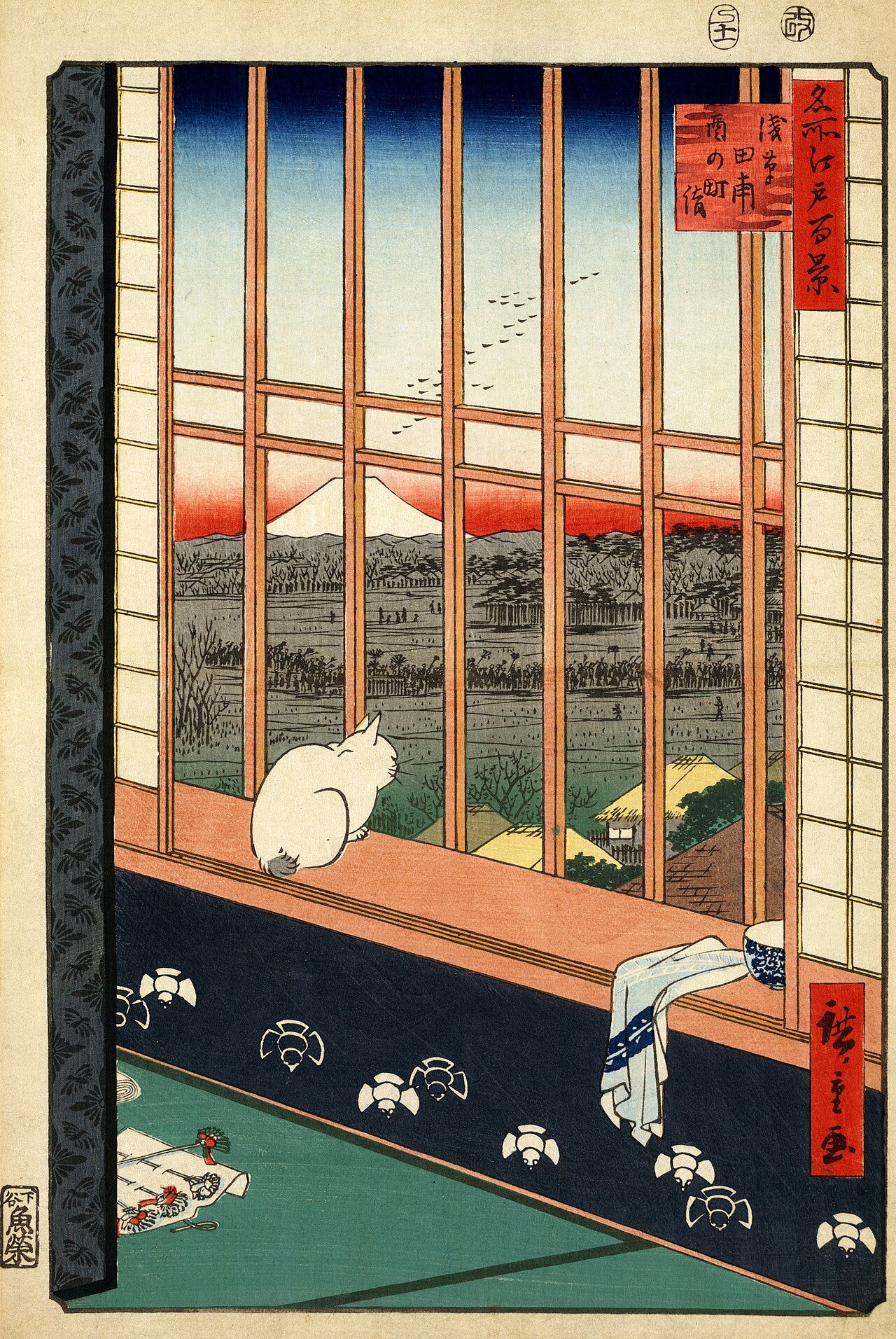
A plump white cat sits on a windowsill with its back to us, gazing out over a hazy view of fields and distant hills. It is one of the last prints in Hiroshige's great series of a hundred views of the city of Edo, now Tokyo.
The whole bustling world is out there, and the cat could not care less.
Below the window stretch the Asakusa rice fields at festival time, tiny and busy, while the cat simply watches. A hairpin left on the sill hints at the woman who has just stepped away.
Prints like this taught Western artists to crop a scene sharply and leave the rest to the mind.
6. Pierre Auguste Renoir, Woman with a Cat (about 1875)
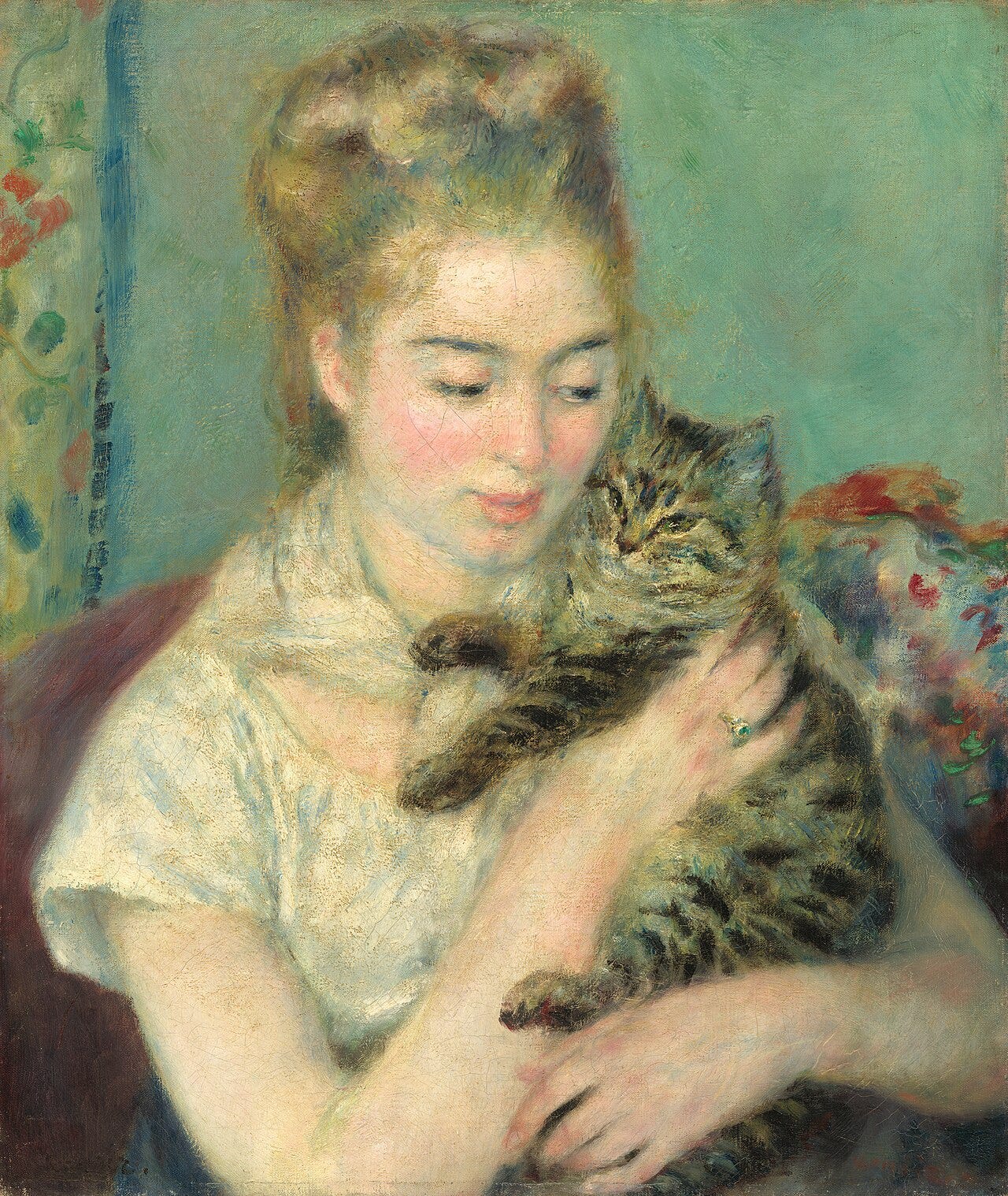
A young woman cradles a sleeping cat against her chest, both of them warm, soft and half dozing in the afternoon light. Renoir painted cats and women with the same tenderness, all rounded forms and glowing skin. It is comfort turned into paint.
He loved the way a cat's fur caught the light, much as he loved a woman's hair or a ripe peach. This one hangs in the National Gallery of Art in Washington, and Renoir went on painting women and cats even after arthritis had crippled his hands.
7. Edouard Manet, The Cats' Rendezvous (1868)
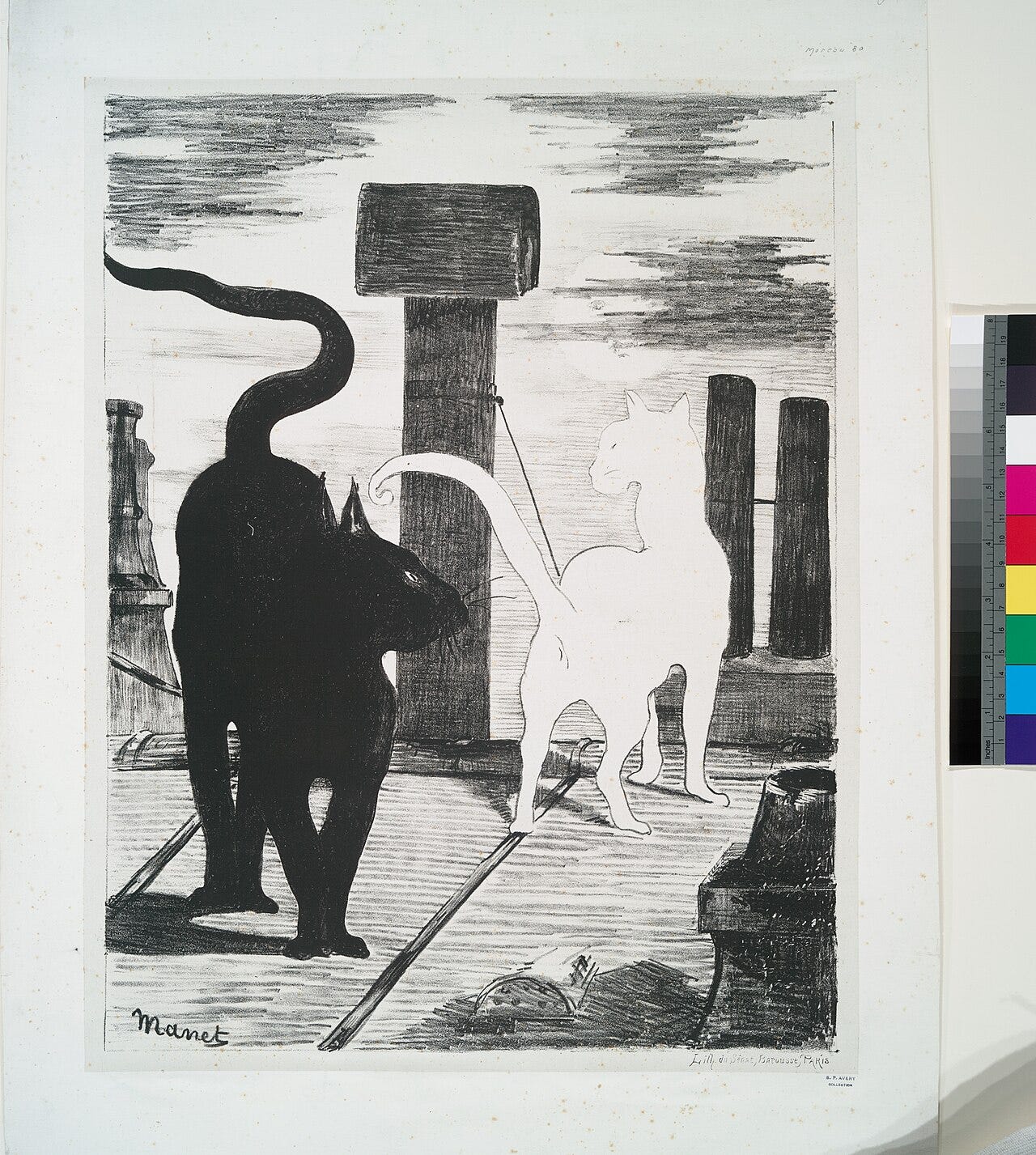
Two cats meet on a moonlit rooftop, one black and one white, tails high, in a small lithograph that scandalized polite Paris. Manet made it as a poster for a book about cats, and the pairing of black and white was read as anything but innocent.
Some shops thought it too suggestive to show.
The black cat arches toward the white one under a big pale moon, and everyone knew what the meeting was about. Manet had already shocked the public with a black cat lurking in his painting Olympia.
Cheap and cheeky, this little poster sold fast and spread his fame further.
8. Franz Marc, Two Cats, Blue and Yellow (1912)
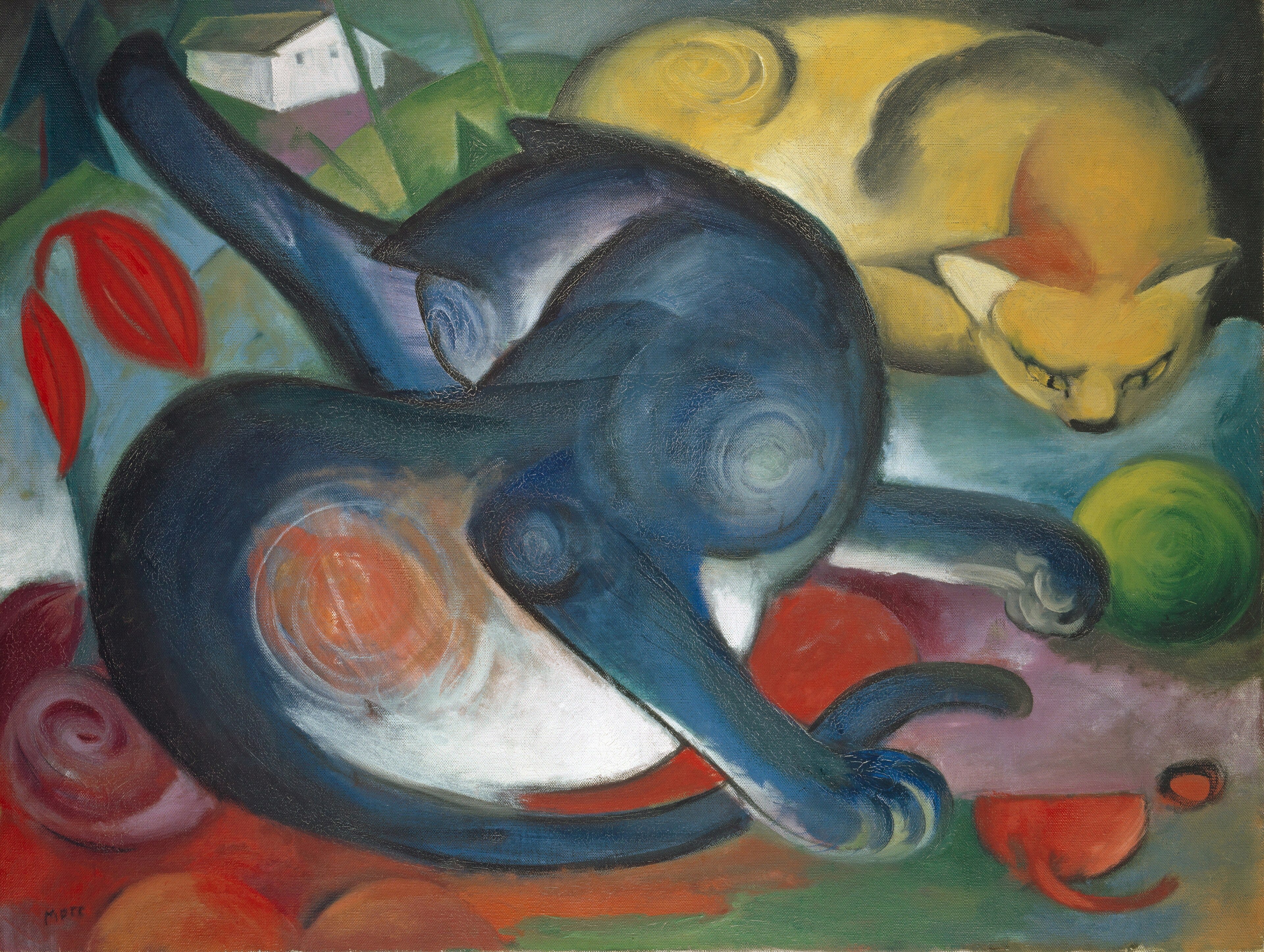
Two cats, one glowing blue and one yellow, tangle together in a knot of pure color, painted in the visionary style of the Blue Rider group.
Franz Marc believed animals were purer and more spiritual than people, and he painted them with reverence. To him even a pair of house cats was almost holy.
He gave his animals symbolic colors, yellow for gentle joy, blue for the spiritual, red for the earthly and heavy. Marc was killed at Verdun in 1916, only thirty six, his gentle animal world cut brutally short.
His cats and horses are now among the most loved images of German modern art.
9. Gottfried Mind, Cats and Kittens (about 1805)
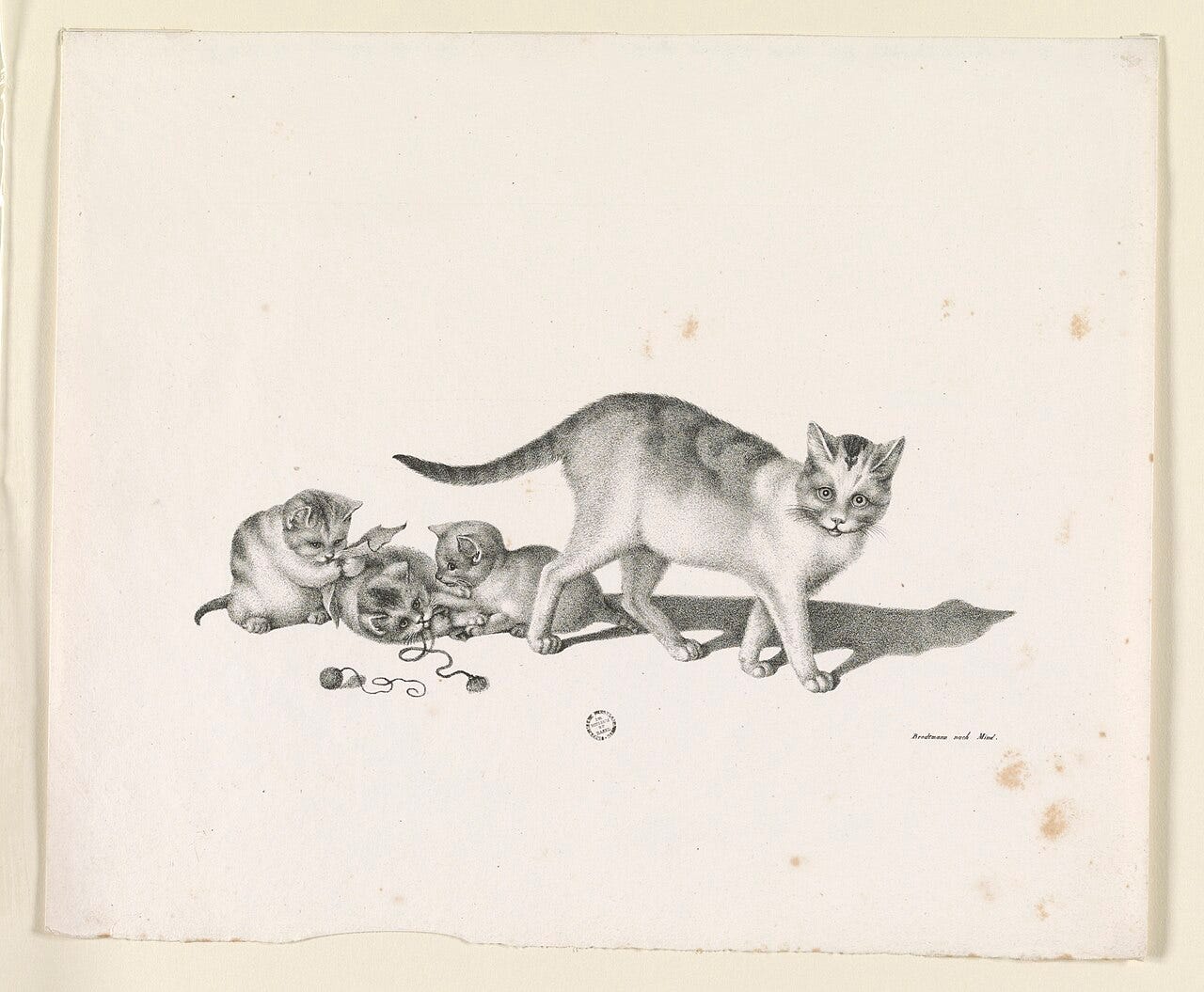
A Swiss artist who could draw almost nothing but cats became known across Europe as the Cats' Raphael. Gottfried Mind was what we would now call autistic, drawing the same beloved subjects, cats and bears, over and over with uncanny skill.
His cats look ready to purr off the page.
By a popular story, when Bern ordered its cats culled during a rabies scare, Mind hid his own and mourned the rest. Empresses and collectors paid high prices for his simple watercolors of kittens.
He lived quietly with his animals until his death in 1814.
10. Henriette Ronner Knip, A Cat and Her Kittens (about 1890)
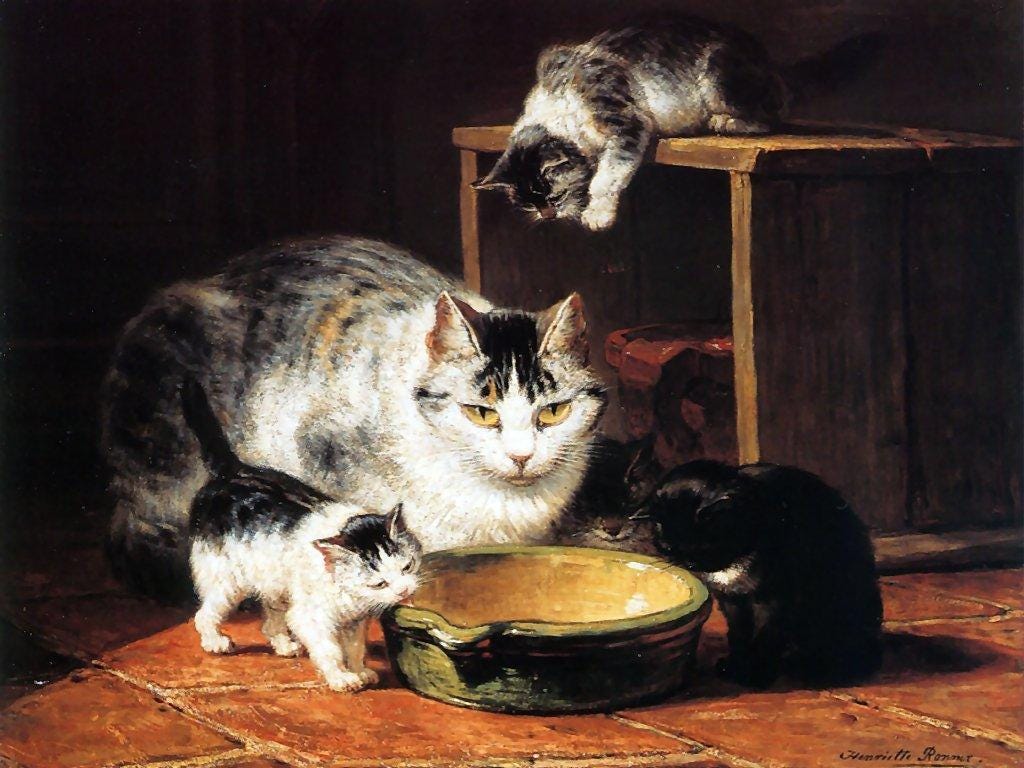
In the age of Queen Victoria, no one sold more pictures of kittens than a Dutch woman working in Belgium. Ronner Knip built a whole industry out of fluffy cats tumbling in baskets and playing with wool.
She was the queen of the sentimental cat picture.
She kept a glass fronted studio cage so she could watch her models play without them wandering off. Her soft, cozy scenes hung in parlors across Europe and made her rich and famous.
Prized in her day, then mocked as too sweet, her kittens are loved again now.
11. Louis Wain, Cats (about 1910)
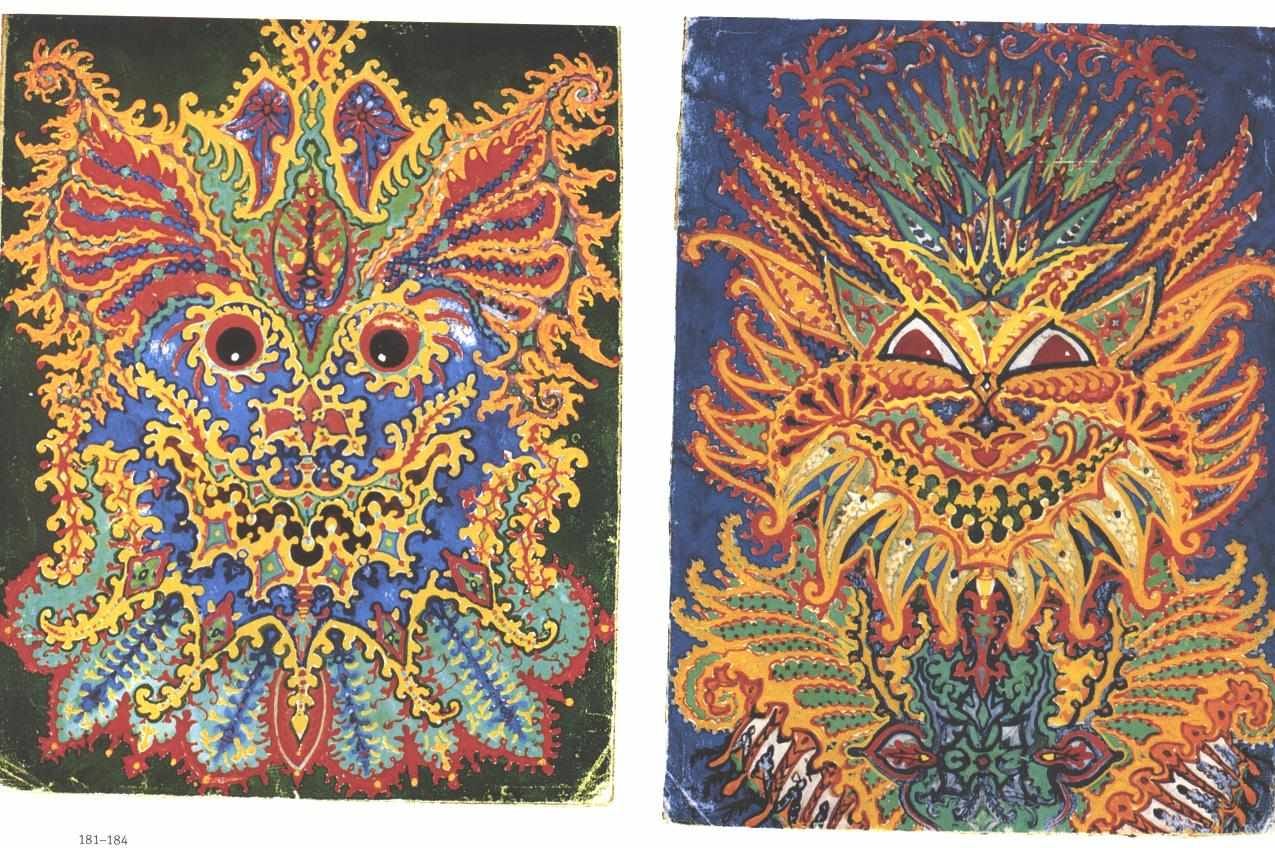
For decades the most popular cats in Britain were the wide eyed, grinning creatures drawn by Louis Wain, who put cats on countless cards and books.
Late in life, living in an asylum, he drew them stranger and stranger, dissolving into bursts of pattern and color.
Those electric cats have haunted people ever since.
For years his fractured, kaleidoscope cats were used to chart the descent of his mind into illness, a story now treated with far more doubt. Wain simply loved cats to the end, once saying they had done more for him than any human.
He even served as president of Britain's National Cat Club, and is often credited with helping make the pet cat respectable in the first place.
12. Marguerite Gerard, The Cat's Lunch (about 1800)
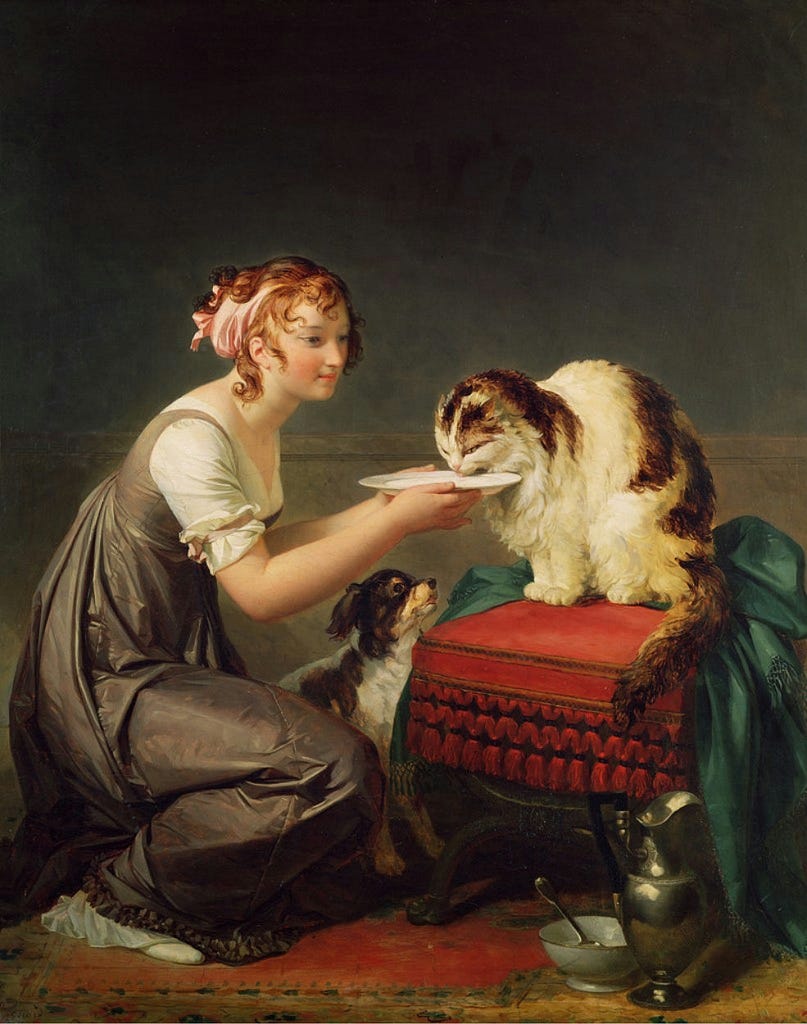
In an elegant drawing room, two well dressed women fuss over a small dog and a cat as if the animals were the guests of honor. Marguerite Gerard painted the pampered pets of the French upper classes with the polish of a jeweler.
The cat, of course, is entirely in charge.
Trained by her brother in law, the painter Fragonard, she became one of the most successful women artists of her day. Her tender, glossy scenes of family life almost always slip in a beloved animal.
She earned enough from pictures like this to buy property and live independently, a rare feat for a woman painter of her day.
Where to find the cats
Leonardo da Vinci, Studies of Cats: the Royal Collection, Windsor.
Pierre Auguste Renoir, Woman with a Cat: the National Gallery of Art, Washington.
Utagawa Kuniyoshi and Hiroshige, cat prints: the print rooms of the Met and the British Museum.
Franz Marc, Two Cats, Blue and Yellow: the Kunstmuseum Basel.
Carl Kahler, My Wife's Lovers: in a private collection since 2015.
Theophile Steinlen, Tournee du Chat Noir: reproduced worldwide, with original posters in design museums.
If these cats pulled you in, keep going:
The secret behind Hopper Soir Bleu, the clown picture that went wrong
Titian, Sacred and Profane Love, which of the two women is which
Twelve famous portraits and the real people, the faces behind the paintings
Cat paintings, a few quick questions
What is the most famous cat painting? Steinlen's black cat poster for the Chat Noir is the most reproduced, while Kahler's My Wife's Lovers is the most valuable.
Why did Japanese artists paint so many cats? Cats were beloved pets and lucky charms in Japan, and masters like Kuniyoshi drew them constantly, part of the Japanese art that later swept Europe.
Did Leonardo da Vinci like cats? Very much. He filled a whole sheet with more than twenty cats in motion and studied them as closely as he studied the human body.
Who was Louis Wain? A British artist famous for comic cats who ended his life in an asylum, drawing the swirling, patterned cats that still fascinate people today.
Where can I see famous cat paintings? Print rooms at the Met and the British Museum, plus the National Gallery in Washington and museums across Europe.
The animal that would not sit still
For centuries artists have chased a stillness the cat refuses to give, from Leonardo filling a page with springing bodies to Kuniyoshi living knee deep in them.
The cats never cooperated, and that is exactly the point. A dog looks straight at you, hoping to please, while a cat looks past you, sure it is the more important one in the room.
Painters have spent five hundred years trying to catch that cool, unbothered stare, and the cats have let them try.