
Giovanni Boldini, 1842 to 1931, was the most fashionable portrait painter of Belle Epoque Paris. Nicknamed the Master of Swish, he painted high society in long, swirling strokes that make silk and skin look like they are still moving.
Italian by birth but Parisian by ambition, he became the portraitist every duchess, dandy and star wanted to sit for, and his fast, glamorous likenesses still define the look of Belle Epoque Paris.
He flattered the rich and delighted everyone else. One of his portraits even waited 70 years, sealed in an abandoned Paris flat. Here is his story.
More incredible painter stories
If Giovanni Boldini pulled you in, you will love these too:


A Ferrara boyhood spent in a painter's studio
Giovanni Boldini was born in Ferrara in 1842. His father, Antonio Boldini, was a painter who copied and restored older Italian works, so the boy grew up surrounded by brushes, pigments and church commissions.
He was one of many children in a crowded household and learned the trade at home long before any academy. By his teens he was already painting portraits of family and local sitters.
That early apprenticeship at his father's side gave him a start most young painters never had. He arrived at his formal studies already able to draw a face.
Florence and the company of the Macchiaioli
Around 1862 Boldini moved to Florence to study. There he fell in with the Macchiaioli, a group of Tuscan painters who built their pictures from patches, or macchie, of light and shade.
Members such as Telemaco Signorini and Cristiano Banti worked outdoors and broke from academic polish. Boldini took on their loose handling but kept leaning toward portraits and small figure scenes.
These Florence years gave him a quick, observant eye. He learned to catch a likeness fast, in a few decided strokes, a habit that stayed with him for life.
From London drawing rooms to a Paris studio
In the early 1870s Boldini spent time in London, where he found buyers for small pictures and portrait work among wealthy patrons. English society liked his ease and speed.
By 1871 he had settled in Paris, which remained his home for the rest of his life. The city was then the heart of the art market and of fashionable society.
He opened a studio and began building a name with collectors and dealers. Within a decade he was one of the portrait painters that fashionable Paris most wanted to sit for.
Verdi in a top hat, painted in a single afternoon
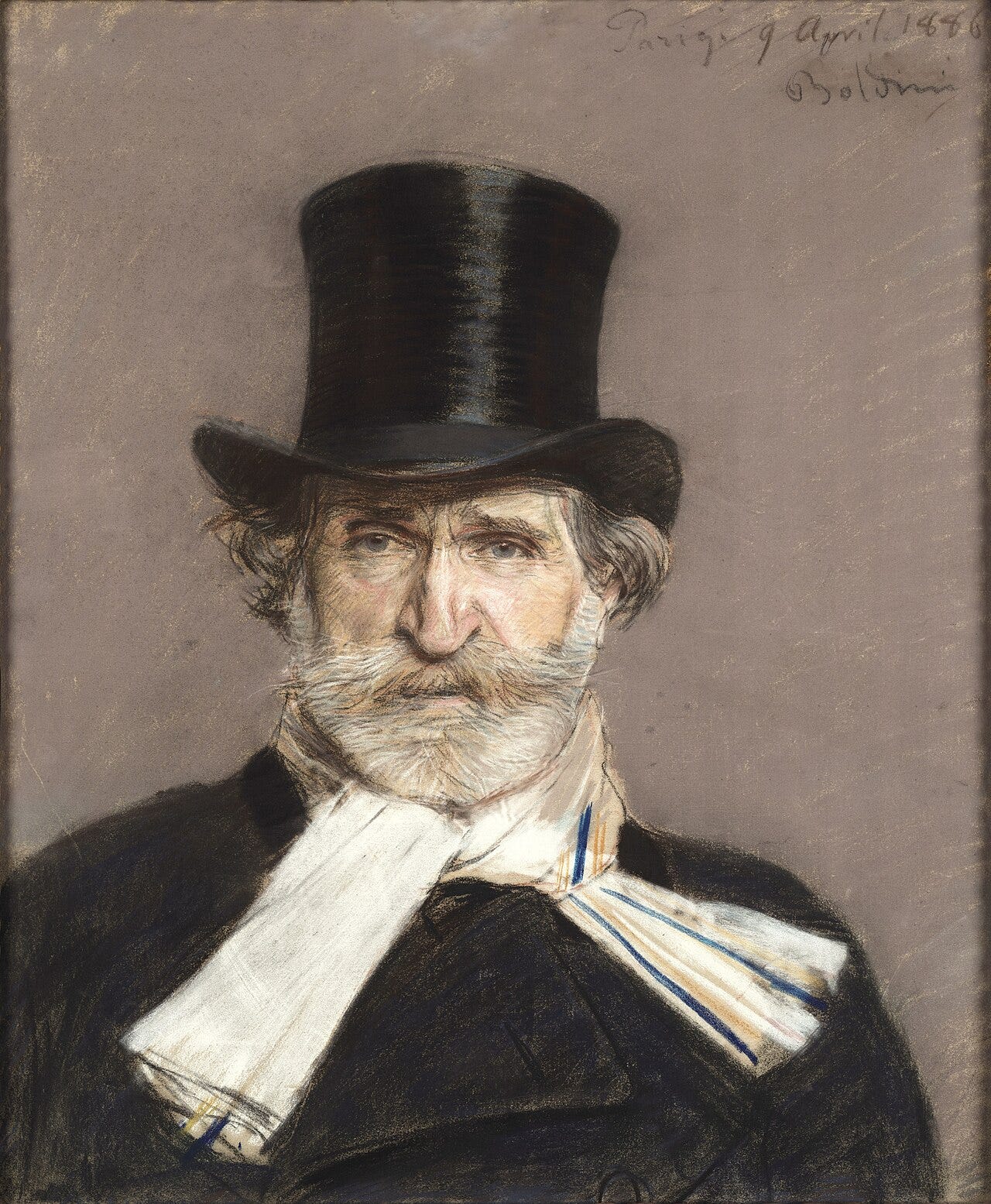
In 1886 Boldini portrayed the composer Giuseppe Verdi. His first attempt in oil did not satisfy him, so on 9 April 1886 he made a second version in pastel.
Accounts say he finished this pastel in only a few hours. It shows Verdi in a top hat and white scarf, alert and a little amused, and it became the image most people picture when they think of the composer.
The pastel is held today by the Galleria Nazionale d'Arte Moderna in Rome. It is proof of how much Boldini could catch when he worked at speed.
Sargent, a contemporary and a yardstick
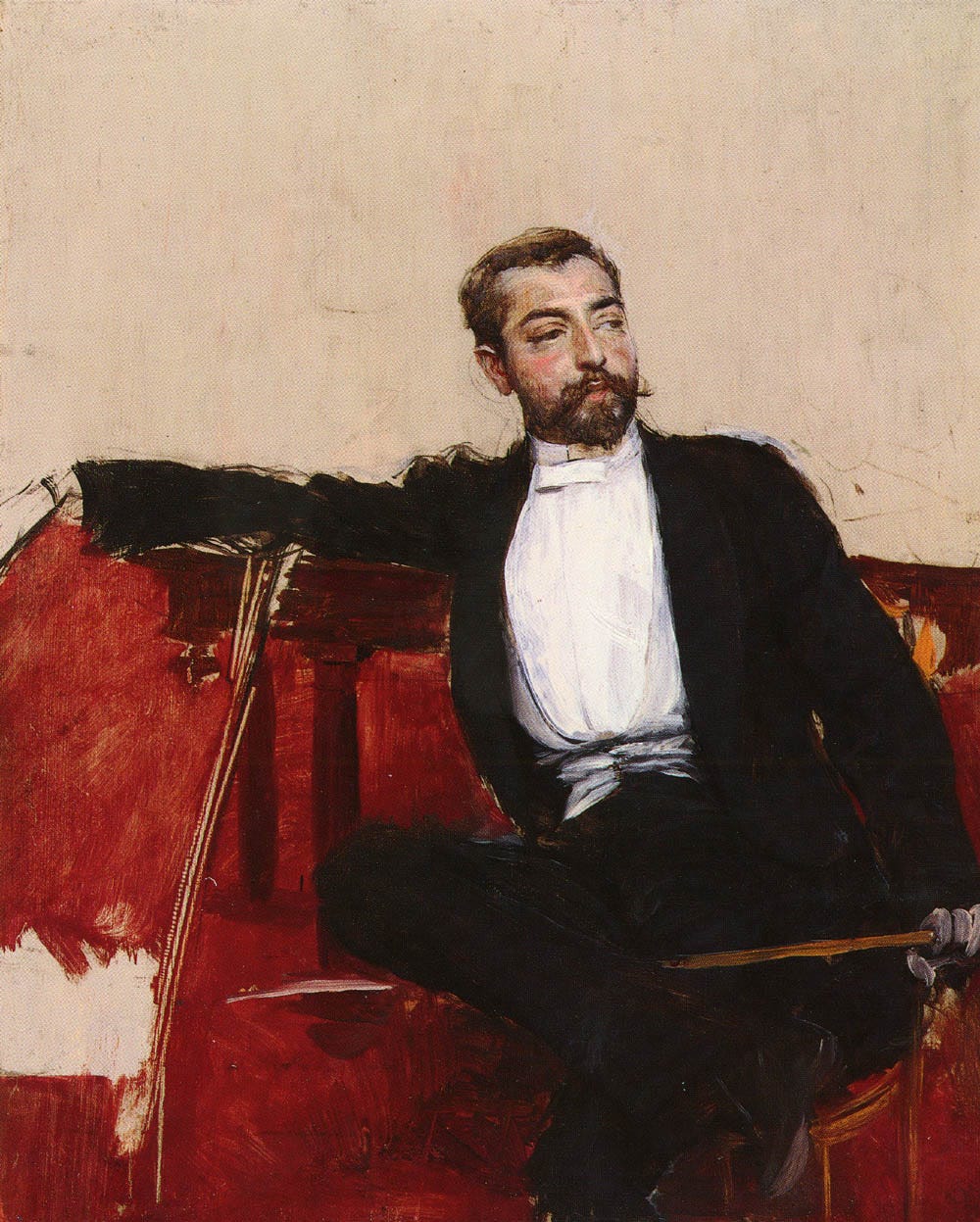
Boldini worked in the same world as the American portraitist John Singer Sargent. Both were foreign born painters who captured the society of the Belle Epoque, and the two are often set side by side.
Writers have described them as friendly rivals, though the true closeness of their friendship is not fully documented.
Where Sargent could feel composed and grave, Boldini leaned toward motion. Put a Sargent and a Boldini on the same wall and the difference between stillness and swirl is easy to see.
The years after the Belle Epoque ended
The world that made Boldini rich did not last. The First World War swept away the drawing rooms and the leisured hours his portraits had celebrated.
His output slowed in his final decades, and his eyesight began to fail. Yet he kept painting, and a younger generation of collectors started to look back on his work with fresh interest.
By the time he died, the Belle Epoque already felt like a lost age. Boldini's canvases became one of the clearest records of how that vanished society had wished to see itself.
A marriage at eighty seven and a quiet death

Boldini stayed a bachelor into extreme old age. On 19 October 1929, at close to eighty seven, he married Emilia Cardona, an Italian journalist several decades younger.
Cardona had come to interview him and stayed to share his last years. She later wrote about his life and helped shape his early reputation.
Boldini died in Paris on 11 January 1931, aged 88. He is commonly reported to have been buried in his native Ferrara, the town where the whole story had begun.
Giovanni Boldini at a glance
1842. Born in Ferrara, son of a painter of religious pictures.
1871. Settled in Paris after a London season of society portraits.
1886. Painted Verdi in a top hat, in pastel, in a single afternoon.
1929. Married the journalist Emilia Cardona at 86.
1931. Died in Paris. In 2010 a sealed Paris apartment yielded an unknown Boldini that sold for millions.
The Master of Swish
Boldini was born in Ferrara, Italy, the son of a painter, and settled in Paris in the early 1870s. The city was the capital of pleasure and money, and it wanted to see itself.
He gave it what it wanted: luminous likenesses of duchesses, dandies and stars, brushed with a speed that felt alive. The nickname Master of Swish stuck.
The painter Belle Epoque Paris wanted
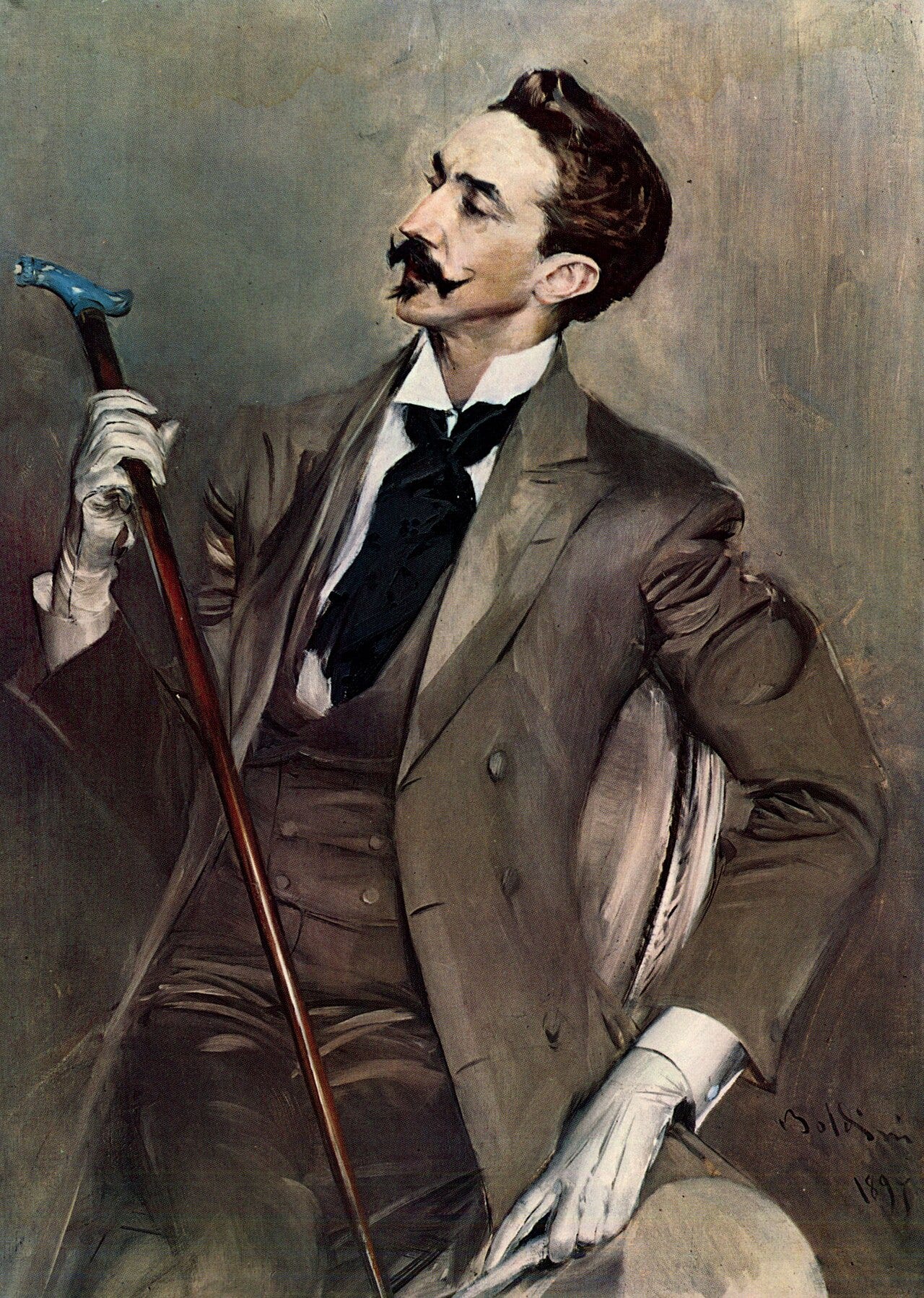
To sit for Boldini was a mark of arrival. He painted the composer Giuseppe Verdi, the dandy Robert de Montesquiou, and the eccentric Marchesa Luisa Casati.
He moved in the circle of Degas, Whistler and Sargent, sharing their world of cafes, studios and society salons.
The portrait found in a sealed apartment
In 2010, a Paris flat was opened for the first time in about 70 years. Its owner had left in 1942 and never returned, leaving everything frozen in time.
Inside hung a Boldini portrait of Marthe de Florian, a Belle Epoque beauty and the owner's grandmother. The rediscovered painting sold at auction for around 2.1 million euros.
The swirl that gave him his name
Look for the swirl. He stretched his sitters tall and let their clothes whip into ribbons of paint, so a still pose looks caught mid turn.
It is portrait painting as performance. The face is precise, but the body and the dress are pure motion.
The three faces that made his name
First, his Giuseppe Verdi of 1886, a pastel of the composer in a top hat and scarf, warm and instantly human.
Second, the Marchesa Luisa Casati, all nervous energy and dark eyes.
Third, the portrait of Marthe de Florian, famous now as much for its rediscovery as for its beauty.
The myth of mere flattery
Boldini is often dismissed as a society flatterer who made the rich look good. That undersells the hand.
Few painters could suggest movement and light the way he did. The flattery was real, but so was the virtuosity.
Where his Paris hangs
The Museo Giovanni Boldini in his native Ferrara holds many works. The Petit Palais in Paris shows him among the Belle Epoque greats.
Speed as a method
Boldini began in Florence among the Macchiaioli, painters of quick light and small canvases, before he ever reached Paris. That training in speed never left him.
He often worked fast and from life, whipping the brush so a dress seemed to move before it dried. In his day his portraits sold for some of the highest prices any living painter could command.
The most famous proof of that speed is his pastel of Giuseppe Verdi in top hat and white scarf, made in a single sitting in 1886. Boldini kept it for more than thirty years before giving it to Italy in 1918; it hangs in Rome's national gallery of modern art.
The etchings behind the portraits
Boldini is remembered for oil and pastel, but he was also a fine printmaker. He made etchings and drypoints, many of them quick studies of Paris streets, cafes and figures caught in a few bitten lines.
The needle suited his hand. It let him work at the same speed he loved on canvas, scratching a scene straight into the plate without slow preparation.
These prints are less known than the society portraits, yet they show the same restless line. They are a reminder that his gift was drawing first, before it was ever about silk and jewels.
The Marchesa Casati, painted more than once
Among his most memorable sitters was Luisa Casati, an Italian heiress famous for her theatrical dress, her live cheetahs and her painted eyes. Boldini returned to her more than once in the years before the First World War.
In one portrait he set her against a leaping greyhound, all diagonal energy and black feathers. Casati wanted to be, in her own words, a living work of art, and Boldini gave her exactly the image she craved.
The pictures capture a woman who spent a fortune on spectacle and died poor. Through Boldini, the most extravagant hostess of the age still looks out at us, exactly as she wished to be seen.
More secrets to unlock


The Giovanni Boldini questions that keep coming up
When was Giovanni Boldini born? In 1842 in Ferrara, Italy. He died in Paris in 1931.
What is he famous for? Swirling society portraits of Belle Epoque Paris.
Why is he called the Master of Swish? For the long, whipping brushstrokes that make his sitters look in motion.
What is the sealed apartment story? A Boldini portrait was found in a Paris flat untouched for about 70 years, then sold for some 2.1 million euros.
Where can I see his work? The Boldini museum in Ferrara and the Petit Palais in Paris.
Did Boldini really marry very late in life? Yes. On 19 October 1929, at close to 88, Boldini married Emilia Cardona, an Italian journalist several decades younger. She had come to interview him, stayed to share his final years, and later wrote about his work.
When and where did Boldini die? Boldini died in Paris on 11 January 1931, aged 88. He is commonly reported to have been buried in his native Ferrara.